半导体

Search documents
中晶科技(003026) - 中晶科技: 投资者关系活动记录表
2026-03-25 11:41
Group 1: Company Overview - The company specializes in the research, production, and sales of semiconductor silicon materials and products, holding a leading market position in three segments: single crystal silicon rods, polished silicon wafers, and high-voltage rectifier devices [2][3] - The main production bases include Ningxia Zhongjing for silicon rod processing and Zhejiang Zhongjing and Xi'an Zhongjing for silicon wafer processing, with a focus on becoming a world-class semiconductor silicon material manufacturer [3] Group 2: Business Operations and Growth - The company is currently enhancing its product matrix through capacity expansion and new customer certifications, particularly in the polished silicon wafer segment, which is expected to become a key product in the future [4][5] - The company anticipates that the main factors influencing its 2025 performance will include increased production capacity from fundraising projects, improved cost management, and the acquisition of minority stakes in subsidiaries [4] Group 3: Project Developments - The Jiangsu Gaoxin project is progressing with new product launches and facility upgrades, with equipment installation currently underway [6][7] - The company is committed to increasing R&D investment and product introduction to establish Jiangsu Gaoxin as a leading semiconductor chip R&D and production base [7] Group 4: Product Applications and Market Position - Jiangsu Gaoxin produces semiconductor power chips and devices that are critical components in various electronic devices, including microwaves, laser printers, and medical equipment [8] - The company has improved silicon wafer yield and equipment utilization through independent R&D and process innovation, ensuring that production capacity meets diverse customer needs [9] Group 5: Future Plans and Market Strategy - The management is actively monitoring industry trends and potential opportunities for expansion, considering investments and acquisitions to enhance product structure and downstream applications [10] - Product pricing is influenced by market supply and demand, production costs, and varies across different products and market segments [11][12]
CPU,全面涨价
半导体芯闻· 2026-03-25 10:49
Core Viewpoint - The supply shortage of CPUs from Intel and AMD is worsening, significantly impacting PC and server manufacturers already affected by memory chip shortages [1][2]. Group 1: CPU Supply Shortage - Major PC manufacturers like HP and Dell have reported a noticeable gap between the required and available CPU quantities since late February, with the situation deteriorating compared to previous months [1]. - The average delivery time for CPUs has increased from one to two weeks to eight to twelve weeks, with some cases extending to six months [1]. - CPU prices have risen multiple times this year, with an average increase of 10% to 15%, and some products experiencing even higher price hikes [1][2]. Group 2: Market Dynamics - Intel and AMD are prioritizing server CPUs, leading to a reduced supply for the PC segment, which is expected to worsen in the second quarter of the year [2]. - The demand for AI computing capabilities is driving the shortage of memory chips and other materials, prompting PC and smartphone brands to announce price increases for the year [2]. - The competition in the CPU market is intensifying, with companies like Arm entering the server CPU space, potentially increasing pressure on the x86 architecture [6][3]. Group 3: Industry Response - Companies are investing more resources into designing CPUs based on Arm architecture due to the tight supply of Intel CPUs [3]. - The demand for general-purpose and storage servers is expected to grow significantly, with estimates suggesting a growth rate close to 15% this year, while Intel's capacity expansion is lagging [6][7]. - Both Intel and AMD are working to increase production capacity to meet market demand, but face challenges such as supply constraints for chip substrates and competition for manufacturing capacity with AI chip giants [7][8].


美国,新增一座晶圆厂?
半导体芯闻· 2026-03-25 10:49
Core Insights - Samsung is rapidly expanding its semiconductor manufacturing capabilities in Taylor, Texas, with plans for a second factory (Fab 2) due to increased demand for foundry services amid TSMC's capacity constraints [1][2] - The initial investment for the first factory (Fab 1) has increased from $17 billion to $37 billion, with $4.75 billion coming from federal subsidies under the CHIPS and Science Act [1][2] - Samsung aims to solidify its position as the world's second-largest foundry by leveraging advanced process technologies and expanding its production capacity [2] Group 1 - Samsung's second semiconductor manufacturing plant (Fab 2) is in the early stages of regulatory review and planning, with the Taylor City Council approving an extension of the contract with HDR Engineering for oversight [1] - Fab 2 is expected to cover approximately 2.7 million square feet, similar in size to the ongoing Fab 1 construction, and is part of a larger plan to create a semiconductor industry cluster capable of housing up to 10 advanced fabs [1] - The company has acquired 1,268 acres of land in Taylor, Texas, marking its long-term expansion ambitions in the semiconductor sector [1] Group 2 - Samsung has secured orders from 121 customers, with expectations of large contracts from major companies like Google, AMD, and ByteDance [2] - Fab 1 is scheduled to begin mass production in 2027, aligning with Tesla's $16.5 billion next-generation AI chip production agreements [2] - The foundry business revenue is projected to grow by 6.7% to $3.4 billion by Q4 2025, with a global market share increase to 7.1% [2]
存储巨头,在中国斥巨资扩产
半导体芯闻· 2026-03-25 10:49
Core Viewpoint - Samsung Electronics and SK Hynix are making significant investments in their Chinese factories to enhance both process technology and production capacity in response to the global AI investment boom and the resulting shortage of memory semiconductors [1][2][3]. Group 1: Samsung Electronics - Samsung invested 465.4 billion KRW (approximately 344 million USD) in its Xi'an factory in China last year, a 67.5% increase from 277.8 billion KRW the previous year [1]. - The Xi'an factory is Samsung's only overseas NAND flash production base, accounting for about 40% of its total production [1]. - After a hiatus in major investments from 2020 to 2023, Samsung resumed investments in 2024, increasing its funding for local production line upgrades [1]. Group 2: SK Hynix - SK Hynix invested over 1 trillion KRW in its Chinese factories last year, with 581 billion KRW in the Wuxi DRAM factory (a 102% increase from 287.3 billion KRW in 2024) and 440.6 billion KRW in the Dalian NAND factory (a 52% increase) [2]. - This marks the first time SK Hynix has made trillion KRW scale investments in its Chinese factories since acquiring Intel's Dalian NAND factory in 2022 [2]. - The demand for high-performance DRAM is surging due to the evolution of AI services, leading to a complete sell-out of this year's DRAM and NAND flash production capacity [2]. Group 3: Industry Trends - The global semiconductor market is expected to grow by over 40% year-on-year, reaching 1 trillion USD (approximately 149.6 trillion KRW) [2]. - The domestic demand for memory semiconductors in China was approximately 458 billion RMB (around 99 trillion KRW) last year and is projected to expand further this year [2]. - Samsung plans to upgrade its Xi'an NAND factory from the sixth generation (128 layers) to the eighth generation (236 layers), while SK Hynix is upgrading its Wuxi DRAM production process from the third generation (10nm) to the fourth generation [3].
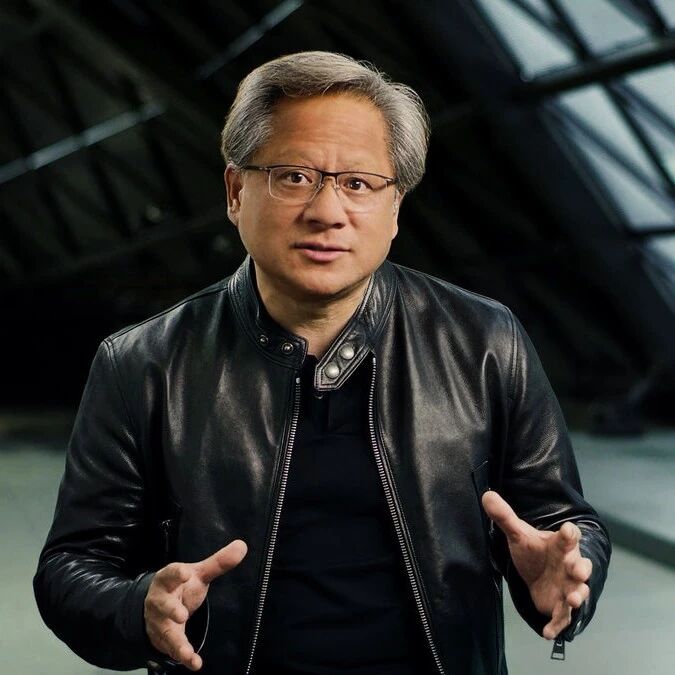
黄仁勋谈生死:希望在工作中突然离世
半导体芯闻· 2026-03-25 10:49
Core Viewpoint - Jensen Huang, CEO of NVIDIA, expressed a desire to pass away suddenly while at work, emphasizing his passion for life and work, and the importance of NVIDIA in the tech industry [1] Group 1 - Huang stated he does not fear death but wishes for a quick passing without prolonged suffering, highlighting his love for his family and work [1] - He regards NVIDIA as one of the most important tech companies in human history, indicating the significance of the work being done [1] - Huang expressed distrust in traditional succession plans, advocating for the continuous transfer of knowledge and skills to empower others within and outside the company [1]

未来10年,这18个赛道将带来48万亿美元收入
创业家· 2026-03-25 10:17
Core Insights - McKinsey's report identifies 18 industry sectors likely to reshape the global business landscape, predicting revenues of $29 trillion to $48 trillion by 2040, contributing 18-34% to global GDP growth [2] E-commerce - By 2040, e-commerce's share of global retail revenue could reach 27%-38%, up from approximately 20% currently [3] - Growth drivers include market expansion in developing countries and new product categories in developed nations, such as healthcare and emotionally valuable products [4] - Significant investments are expected in customer acquisition and last-mile delivery across e-commerce platforms [5] Electric Vehicles - Electric vehicles (EVs) are projected to exceed 50% of global passenger car sales by 2040 [6] - Breakthroughs in battery technology and smart algorithms will significantly influence this sector, prompting increased R&D investments from both EV manufacturers and traditional automakers [7] Cloud Services - The demand for storage and computing power is rising as the world becomes more interconnected, with new AI products requiring substantial computational resources [9] - The cloud services industry experienced a 17% compound annual growth rate from 2005 to 2020, with similar growth expected in the coming decades [10] Semiconductors - Semiconductors are foundational to the digital world, with demand from various sectors driving rapid growth [11] - The semiconductor industry is expected to maintain a 6%-8% compound annual growth rate over the next decade [11] AI Software Services - The rapid development of AI has led to its classification as a distinct sector, with increasing usage of AI assistants [12] - Companies in the AI space are engaged in a competitive race to develop advanced foundational models and applications [13] Digital Advertising - Digital advertising, through search, social media, and media platforms, is expanding in value as internet usage among the middle class increases [14] - Continuous algorithm improvements enhance platforms' abilities to target customers and track advertising costs, although competition for user attention drives platforms to invest heavily in engaging content [15] Streaming Video - Increased investment in customer acquisition and content production may lead streaming platforms to seek new revenue models [17] - Developing countries are expected to contribute to growth in subscription and advertising revenue for streaming services, with projections of over 1 billion households subscribing to long-form video services by 2040 [18] Shared Autonomous Vehicles - The advent of autonomous driving technology may reduce the necessity for personal vehicle ownership [19] - By 2040, shared autonomous vehicles could account for 25%-51% of shared mobility revenue [20] Space Economy - The world is on the brink of entering a space economy era, with advancements in reusable rocket technology changing the aerospace industry [21][22] Cybersecurity - Cybercrime caused approximately $950 billion in direct economic losses in 2020, with indirect losses potentially reaching $4-6 trillion [24] - Increasing awareness of cybersecurity has led businesses to invest more in enhancing their security measures [25] Batteries - Significant advancements in battery technology have tripled energy density over the past few decades [26] - The global energy transition is driving demand for batteries, particularly in electric vehicles, energy storage, and consumer electronics, with EVs expected to represent over 80% of the battery market by 2040 [28] Video Games - By 2030, an estimated 40% of the global population may become video game players [30] - New gaming models, such as mobile and cloud gaming, are accelerating market growth, with free-to-play games generating substantial revenue [32] Robotics - The integration of AI with robotics is creating significant expectations for humanoid robots as potential "ultimate intelligent agents" [33] Industrial and Consumer Biotechnology - Advances in gene editing and other technologies are accelerating the application of biotechnology in agriculture, alternative proteins, consumer products, and bio-materials [37] Modular Construction - Modular construction methods, which involve prefabricating building components, can significantly enhance construction efficiency [38] Nuclear Fission Power - The development of safer, smaller modular reactors may supplement renewable energy sources [39] Air Traffic - Electric vertical takeoff and landing vehicles and delivery drones represent major technological shifts in air traffic [41] Obesity Treatment Drugs - The prevalence of obesity is projected to rise from 15% in 2020 to 24% by 2035, indicating a potential market for effective weight loss products [43]

GTC 2026|黄仁勋五层蛋糕重构AI价值体系,投资逻辑全解析 | 市场观察
私募排排网· 2026-03-25 09:49
Core Viewpoint - The article discusses Jensen Huang's "AI Five-Layer Cake" framework presented at NVIDIA GTC 2026, which outlines how value in the AI era is created and distributed across various industries, emphasizing the interconnectedness of the AI ecosystem and its implications for investment logic and asset allocation [3][5]. Group 1: AI Five-Layer Cake Theory - The "AI Five-Layer Cake" consists of five interconnected layers that collectively drive the AI industry's growth, where progress in each layer directly impacts the value realization of the upper layers [6]. - The five layers are: 1. **Energy Layer**: The foundation of AI, emphasizing the need for efficient energy supply and the projected doubling of global data center electricity consumption to 945 TWh by 2030 [7]. 2. **Chip Layer**: The core of computational power, with advancements in chip technology critical for AI expansion, including NVIDIA's new GPU architecture expected to achieve 50 PFLOPS [8]. 3. **Infrastructure Layer**: The physical embodiment of AI capabilities, with significant investments in AI factories and supercomputers, highlighting the importance of cooling technologies and innovative data center designs [9]. 4. **Model Layer**: The brain of AI, focusing on the transition from language models to physical AI, with open-source models driving demand across the architecture stack [10]. 5. **Application Layer**: The final interface where AI creates measurable economic value, with a shift towards AI agents capable of executing complex tasks across various sectors [11]. Group 2: Investment Logic from the Five-Layer Cake - Huang's framework provides a comprehensive investment strategy that emphasizes prioritizing foundational layers, driven by the exponential growth of token consumption and the need for heavy asset infrastructure [12][13]. - Key investment logic includes: 1. **Bottom-Up Approach**: Prioritizing investments in energy, chips, and infrastructure, which are expected to see more stable performance compared to upper layers [14]. 2. **Token Economy**: The increasing demand for tokens in AI applications, making "cost per token" a critical competitive metric [14]. 3. **Heavy Asset Infrastructure**: The construction of AI factories and data centers represents a new wave of capital expenditure, akin to a modern infrastructure boom [14]. 4. **Positive Feedback Loop**: The interdependence of applications, models, infrastructure, chips, and energy creates a strong positive cycle that enhances value across the entire AI ecosystem [14]. Group 3: Layer-Specific Investment Strategies - **Energy Layer**: Focus on green energy, grid equipment, and storage technologies as core beneficiaries of AI's energy demands [16]. - **Chip Layer**: Investment in GPUs, LPU, and advanced packaging technologies, driven by domestic alternatives and technological advancements [18]. - **Infrastructure Layer**: Capitalizing on the construction of AI factories and data centers, with a focus on liquid cooling and optical interconnects [20]. - **Model Layer**: Targeting investments in general models and open-source ecosystems, while being mindful of competitive pressures [22]. - **Application Layer**: Emphasizing sectors with high barriers to entry and strong profitability potential, such as embodied intelligence and industry-specific AI applications [24]. Group 4: Overall Industry Outlook - The AI industry is in its early stages of industrialization, with significant long-term growth potential as it transitions from training to inference, driving value across the entire supply chain [26].

通信有色行业领涨,A股震荡上行
Zhongyuan Securities· 2026-03-25 09:26
Market Overview - On March 25, the A-share market opened high and experienced slight fluctuations, with the Shanghai Composite Index facing resistance around 3932 points[2] - The Shanghai Composite Index closed at 3931.84 points, up 1.30%, while the Shenzhen Component Index rose 1.95% to 13801.00 points[7] - Total trading volume for both markets reached 21,931 billion yuan, above the median of the past three years[3] Sector Performance - Strong performers included non-ferrous metals, communication equipment, semiconductors, and consumer electronics, while photovoltaic equipment, coal, power equipment, and oil and petrochemicals lagged[3] - Over 90% of stocks in both markets rose, with notable gains in sectors like ground weaponry, electricity, and communication equipment[7] Valuation Metrics - The average price-to-earnings (P/E) ratios for the Shanghai Composite and ChiNext indices are 15.79 times and 45.41 times, respectively, above the median levels of the past three years, indicating a favorable environment for medium to long-term investments[3][16] Economic Outlook - Key risks include potential escalation of Middle Eastern conflicts affecting oil prices and global inflation pressures, which could impact liquidity and risk appetite[4] - The central bank has committed to maintaining a moderately loose monetary policy, providing a solid support base for the market[3] Investment Recommendations - Investors are advised to focus on sectors such as non-ferrous metals, consumer electronics, communication equipment, and semiconductors for short-term opportunities[3][16]
港股科网股、半导体股集体拉升,京东、阿里、理想汽车大涨4%,泡泡玛特重挫22%
2 1 Shi Ji Jing Ji Bao Dao· 2026-03-25 08:53
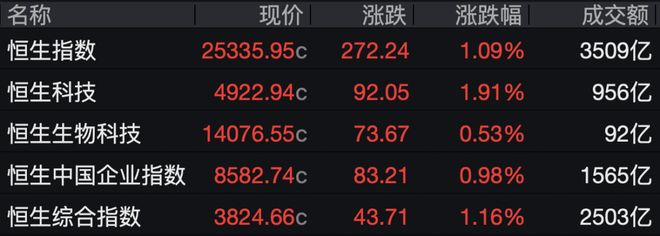
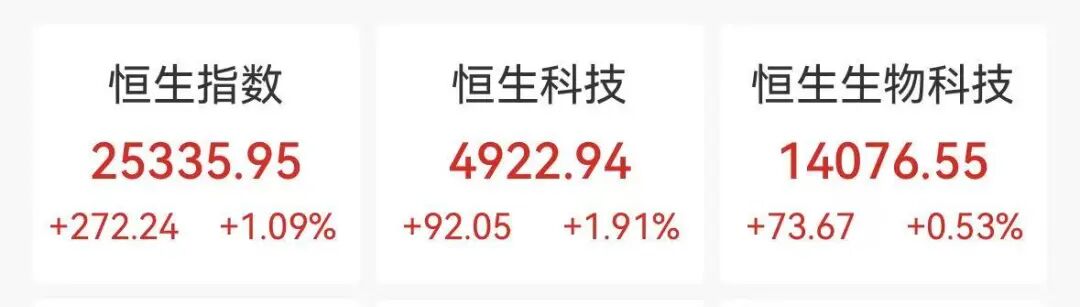
Market Overview - The Hong Kong stock market experienced an overall increase, with the Hang Seng Index rising by 1.09% to close at 25,335.95 and the Hang Seng Tech Index increasing by nearly 2% to 4,922.94 [1][5]. Key Stock Performances - Meituan saw a significant rise of nearly 14%, while JD.com, Alibaba, and Li Auto each increased by over 4%. BYD Electronics rose by over 3%, and NIO increased by nearly 2% [2][7]. - In the semiconductor sector, notable gains were observed with Wallen Technology rising over 5%, and Lattice Semiconductor increasing by over 4%. SMIC and Hua Hong Semiconductor both rose by over 2% [11]. Sector Performance - AI application stocks showed strong performance, with Zhizhu rising over 16% and MINIMAX-W increasing by over 4% [11]. - The non-consumer sector faced declines, particularly with Pop Mart falling over 22% due to unmet sales expectations for non-Labubu IP products, and Mixue Group dropping over 5% [11].

美团、京东、阿里巴巴,大涨
Di Yi Cai Jing Zi Xun· 2026-03-25 08:49
Group 1 - Tech stocks surged, with Meituan leading the rise at nearly 14%, while JD Group and Alibaba both increased by over 4% [1][2] - The Hang Seng Index rose by 1.09%, and the Hang Seng Tech Index increased by 1.91% on March 25 [3] - The semiconductor sector saw a collective increase, with Guomin Technology rising over 21%, and other companies like Lanke Technology and SMIC also showing gains [4][5] Group 2 - Pop Mart's stock fell over 22% despite reporting a revenue of 37.12 billion yuan for 2025, a year-on-year increase of 184.7%, and an adjusted net profit of 13.08 billion yuan, up 284.5% [5][6] - Analysts noted that while Pop Mart's overall revenue is strong, the LABUBU series contributes excessively to the company's performance [6] - Haidilao's stock dropped over 11% [7]