
基础化工

Search documents
招商策略2月行业配置关注:景气修复的线索和春季行情的演绎
Xin Lang Cai Jing· 2026-01-28 14:43
格隆汇1月28日|招商策略研报指出,过去一个月市场总体小幅震荡上行,部分涨价资源品、AI景气催 化的TMT板块表现较好。展望2月份,行业配置重点关注景气修复的线索和春季行情的演绎,聚焦顺周 期+科技领域,同时随着春节临近,增加对部分可选消费的关注。结合中观景气、盈利能力、筹码分 布、估值、交易、周期阶段和赛道价值等多个维度,本期推荐关注电子(半导体)、传媒(广告营销、 游戏、影视)、机械(自动化设备、工程机械)、电力设备(电池、电网设备、光伏设备)、基础化 工、社会服务等。 ...
资源股强势大涨
Tebon Securities· 2026-01-28 12:23
Market Overview - The A-share market experienced a volatile upward trend, with the Shanghai Composite Index closing at 4151.24 points, up 0.27%, while the Shenzhen Component Index rose slightly by 0.09% to 14342.89 points, and the ChiNext Index fell by 0.57% to 3323.56 points, indicating a cooling risk appetite for growth stocks [6][9] - Resource stocks led the market rally, with significant gains in sectors such as non-ferrous metals (up 6.02%), coal (up 3.29%), and oil & petrochemicals (up 3.26%), contributing to a 2.54% increase in the resource stock index, reaching a new high for the year [6][9] Sector Analysis - The report highlights a strong performance in resource stocks, particularly precious metals like gold and silver, which saw substantial price increases due to international market dynamics, including gold surpassing 5200 USD/ounce [6][9] - The report suggests a shift in investment focus from technology growth stocks to cyclical stocks, with an emphasis on sectors such as non-ferrous metals, oil & petrochemicals, and basic chemicals, which are expected to show high earnings growth [7][14] Commodity Market - The commodity index continued its strong upward trend, with the South China commodity index closing at 2866.28 points, up 1.49%, marking a new high for the year, driven by significant gains in aluminum and other commodities [9][11] - The report notes that aluminum prices surged by 5.75%, driven by economic recovery expectations and increased demand from downstream processing enterprises [15] Investment Themes - The report identifies key investment themes, including a focus on photovoltaic technology, commercial aerospace, and precious metals, as sectors likely to benefit from macroeconomic recovery and policy support [7][14] - The report emphasizes the importance of monitoring the performance of growth stocks and thematic stocks, which may face valuation pressures if annual report earnings do not meet expectations [7][14] Bond Market - The bond market showed slight increases, with the 2-year, 5-year, and 10-year treasury futures contracts experiencing minor gains, reflecting a stable liquidity environment supported by central bank operations [11][14] - The report indicates that the central bank's net injection of 140 billion yuan and the decline in short-term interest rates suggest a continued easing of monetary conditions [11][14]





A股的情绪与位置(1月W3):降温不改暖意,慢牛行远未已
Changjiang Securities· 2026-01-28 07:01
报告要点 [Table_Summary] 上证指数在 2026 年开年连续上涨后进入阶段性的震荡整固期,技术上 RSI 指标从超买区回落, 正寻求 10EMA 与 21EMA 均线支撑,换手率高位回落但全 A 成交额倍数指标尚未触及历史高 点,结构上看,商业航天及 AI 应用等热点板块仍待企稳。从中长期股债性价比看,市场估值仍 有较大上行空间,资金面上,杠杆资金高度聚焦科技方向,电子、通信、军工等方向融资余额 占比已创 2015 年以来新高,风格极值接近滚动 3 个月均值,短期市场轮动或将加速,金融、 消费风格或有望迎来反弹,中长期看好"科技+资源"双主线不变。 丨证券研究报告丨 市场策略丨专题报告 [Table_Title] 降温不改暖意,慢牛行远未已——A 股的情绪与 位置(1 月 W3) 分析师及联系人 [Table_Author] 戴清 李巍东 SAC:S0490524010002 SFC:BTR264 请阅读最后评级说明和重要声明 %% %% %% %% research.95579.com 1 [Table_Title 降温不改暖意,慢牛行远未已—— 2] A 股的情绪与 位置(1 月 W3) [ ...
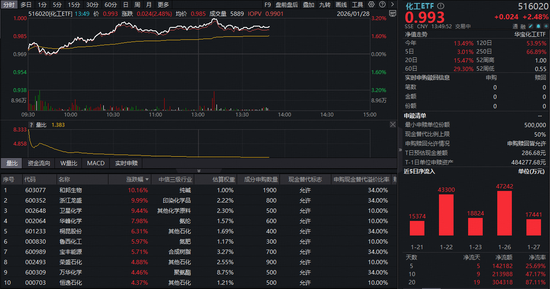
化工板块午后井喷,两股涨停!化工ETF(516020)盘中涨超3%,机构:化工景气周期或超预期
Xin Lang Cai Jing· 2026-01-28 06:06
Group 1 - The chemical sector is experiencing a strong upward trend, with the chemical ETF (516020) rising over 2.48% and reaching a peak increase of over 3% during trading [1][7] - Key stocks in the sector include Hebang Biotechnology and Zhejiang Longsheng, both hitting the daily limit, while Satellite Chemical surged over 9% [1][7] - The overall market sentiment indicates that the current chemical sector boom may have more sustainability compared to previous cycles, with expectations for a prolonged upward trend [8][10] Group 2 - Guojin Securities suggests that the chemical sector may undergo a revaluation driven by supply-side policies and the current mismatch between China's chemical industry status and operational conditions, indicating a high probability of recovery [9] - The market may be underestimating the impact of liquidity on the sector, which is characterized by being at the bottom of the cycle, with an upward trend in fundamentals and attractive valuations [9] - Guohai Securities highlights that leading companies in the global chemical sector have established solid cost and efficiency advantages, entering a long-term upward performance phase [10] Group 3 - There are four key opportunities in the chemical sector: low-cost expansion, improving market conditions, new materials, and high dividends [10] - The chemical ETF (516020) tracks the CSI sub-sector chemical industry index, covering popular themes such as AI computing power, anti-involution, robotics, and new energy [10] - Investors can also consider the chemical ETF linked funds (Class A 012537/Class C 012538) for more efficient exposure to the chemical sector [10]


石油石化持续走强,化工行业ETF易方达(516570)一度涨超4%,机构判断油价短期维持震荡偏强运行
Sou Hu Cai Jing· 2026-01-28 05:57
截至2026年1月28日 13:29,中证石化产业指数(H11057)强势上涨3.13%,化工行业ETF易方达(516570)一 度涨超4%,现涨3.23%,盘中换手8.22%,成交4633.00万元。 化工行业ETF易方达(516570,场外联接A/C: 020104/020105)一键打包三桶油、万华化学等石油石 化、基础化工产业龙头,跟踪的中证石化产业指数指数构成接近于石化化工板块中哑铃策略标的,同时 涵盖高股息+高成长成份券,2023年以来收益表现在可比化工行业指数中保持领先。 化工行业ETF易方达(516570)管理+托管费率0.15%+0.05%/年,显著低于石化化工板块的同类ETF产品, 较低的费率能够有效为投资者降低成本支出,以更高性价比布局石化化工产业供需两端共振向好发展机 遇! 以上内容与数据,与有连云立场无关,不构成投资建议。据此操作,风险自担。 从资金净流入方面来看,化工行业ETF易方达(516570)近8天获得连续资金净流入,最高单日获得 7496.68万元净流入,合计"吸金"2.80亿元。 消息面上,美国北达科他州因严寒天气而减产石油8万-11万桶/日。国信期货指出,上周五一场伴有 ...
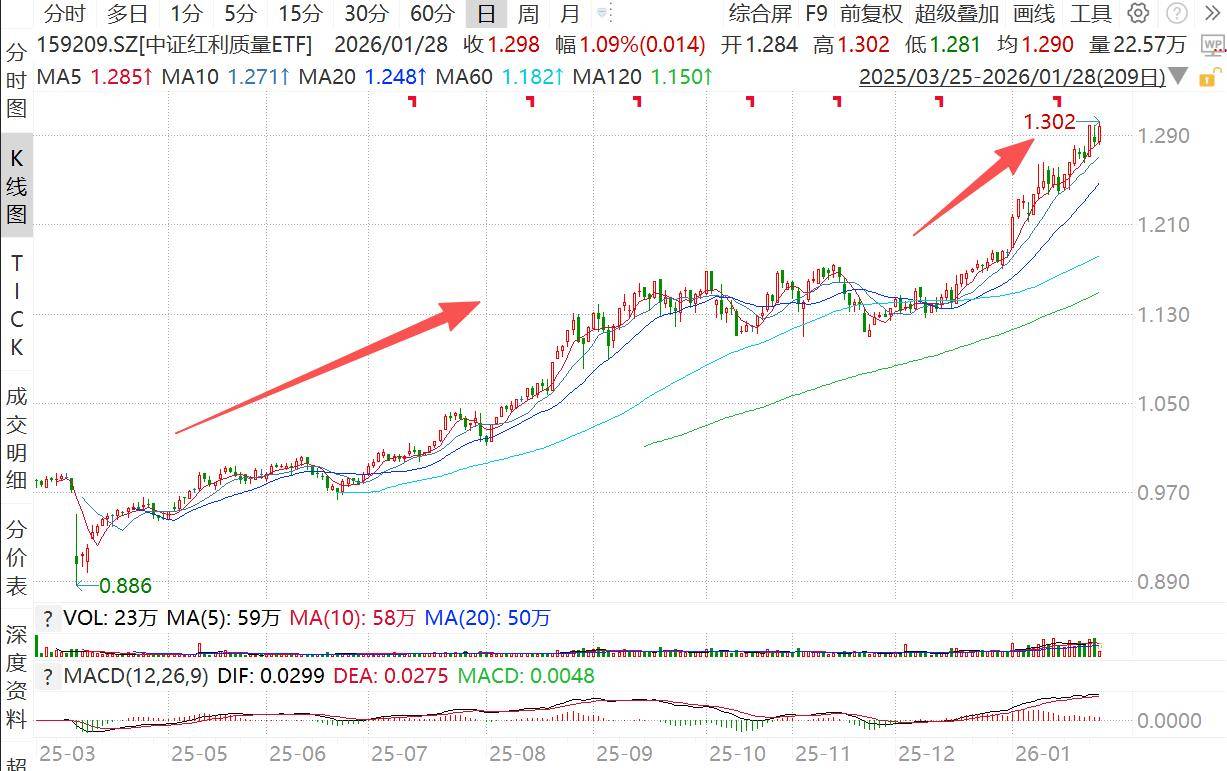
牛市中的“红利骑兵”,这只红利ETF进攻性拉满
Sou Hu Cai Jing· 2026-01-28 03:45
Core Viewpoint - The article highlights the emergence of the China Securities Dividend Quality ETF (159209) as a "third path" in investment strategy, combining dividend safety with strong offensive elasticity, distinguishing it from traditional defensive dividend stocks and growth stocks [1]. Group 1: Investment Strategy - Traditional dividend strategies are often linked to defensive sectors like banking, coal, and utilities, which tend to underperform in a bull market [3]. - The China Securities Dividend Quality Index incorporates quality factors (high ROE, stable growth, excellent cash flow) to transform traditional dividend stocks, resulting in a selection of companies that not only pay dividends but also have the capacity for endogenous growth through high-quality operations [3]. Group 2: Sector Performance - The leading sectors in the China Securities Dividend Quality Index include non-ferrous metals, media, and basic chemicals, which align perfectly with the current market trends of economic recovery and industrial prosperity [3][4]. - Non-ferrous metals serve as a core vehicle for inflation trades and global manufacturing recovery, with price elasticity directly translating into profit surges for leading companies [4]. - The media sector, particularly gaming and film, benefits from AI-driven cost reductions and consumer recovery, presenting significant profit recovery and valuation enhancement opportunities [4]. Group 3: Market Dynamics - The interconnected rise of these three sectors is not merely a beta market trend but a result of the "high quality" selection criteria, ensuring the index captures high-dividend, cyclical growth stocks during economic upturns [6]. - The China Securities Dividend Quality ETF (159209) evolves from being a defensive tool to an offensive strategy, allowing investors to embrace bull markets without sacrificing dividend income for volatility control [6].
工业转型规模化:2025年高排放行业与净零转型进展
Zhong Guo Yin He Zheng Quan· 2026-01-28 03:24
Group 1: Industrial Transition Overview - The report highlights that global industrial transition is entering a decisive phase by 2025, with a clear decarbonization path established[3] - The focus has shifted from "can emissions be reduced" to "how to achieve large-scale reductions at acceptable costs"[6] - In 2024, global CO2 emissions are projected to reach 3.82 billion tons, marking a historical high with a year-on-year increase of 0.9%[8] Group 2: Key Challenges - Five core constraints identified include technology deployment pace differences, insufficient low-carbon demand, fragmented policies, infrastructure gaps, and uneven capital allocation[4] - Approximately 50% of industrial emissions can be reduced using existing mature technologies, while the remaining emissions rely on advanced technologies like hydrogen and CCUS[6] - The rising interest rates are expected to increase the costs of wind and solar energy by approximately 30%[6] Group 3: Sector-Specific Insights - In 2024, the aviation sector is expected to see a 10.4% increase in operational activity, contributing 1.108 billion tons of CO2 emissions, a 6.4% rise from the previous year[8] - The cement and steel industries are projected to experience slight decreases in emissions, while sectors like aviation and aluminum will see significant increases[8] Group 4: Policy and Economic Environment - The global industrial transition exhibits significant regional differentiation, with the EU leading compliance, the US balancing incentives and compliance, and emerging markets developing frameworks[14] - The economic environment is characterized by rising interest rates and cost inflation, which elevate the economic feasibility threshold for low-carbon projects[15] Group 5: Recommendations for Scaling Transition - The report suggests five strategic actions to promote large-scale transition: standardizing demand mechanisms, accelerating shared infrastructure construction, optimizing financing costs, prioritizing mature technology deployment, and enhancing policy and innovation collaboration[23]
中银国际化工行业2026年度策略:行业周期拐点已近 新材料蓄势腾飞
智通财经网· 2026-01-28 03:15
智通财经APP获悉,中银国际发布研报称,2025年化工行业景气度处于低位。展望2026年,本轮行业扩 产已近尾声,"反内卷"等措施有望催化行业盈利底部修复,同时新材料受益于下游需求的快速发展,有 望开启新一轮高成长。当前行业估值处于低位。维持行业强于大市评级,推荐三条投资主线。1、传统 化工龙头;2、"反内卷"等持续催化,关注供需格局持续向好子行业;3、下游行业快速发展,新材料领 域公司发展空间广阔。 中银国际主要观点如下: 化工品价格处于历史低位,基础化工盈利周期性触底 截至2025年11月,全国工业品PPI、生产资料PPI及化工工业PPI均连续38个月呈现同比负增长,形成仅 次于2012-2016年周期(当时为连续54个月)的历史第二长负增长持续期间。产品价格方面,以2015年以来 的价格数据为基础,截至25年12月底,在该行跟踪的111个化工品种中,价格分位数在10%以下的品种 有30种,价格分位数在30%以下(含10%以下)的品种有70种,价格分位数在50%以上的品种有25种。截 至2025年前三季度,SW基础化工行业销售毛利率和销售净利率分别为16.82%和6.41%。SW石油石化行 业得益于油气上 ...
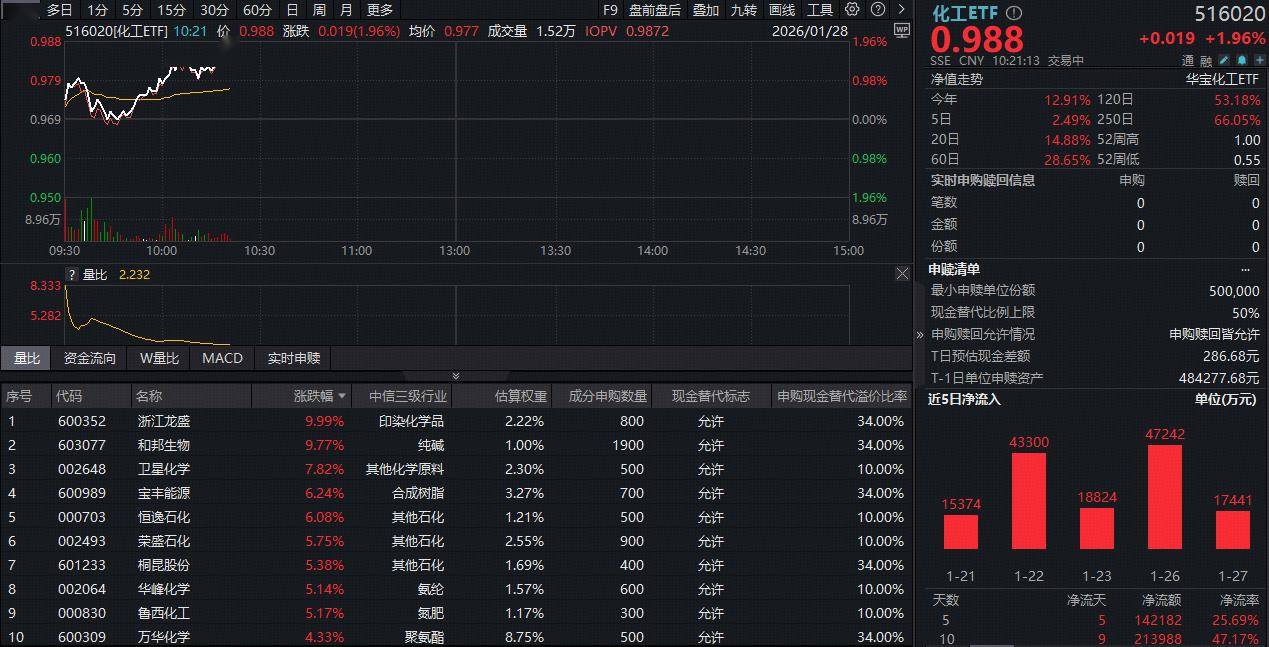
ETF盘中资讯|暴力拉升!化工ETF(516020)盘中涨超2%,资金持续加码!机构:化工有望开启新一轮高成长
Sou Hu Cai Jing· 2026-01-28 02:58
Group 1 - The chemical sector has regained momentum, with the chemical ETF (516020) experiencing a rise of 1.96% after a brief fluctuation at the opening [1][2] - Key stocks in the sector include Zhejiang Longsheng, which hit the daily limit, and other notable gainers such as Hebang Biotechnology, Satellite Chemical, Baofeng Energy, and Hengyi Petrochemical, all showing significant increases [1][2] - The chemical ETF (516020) has attracted substantial investment, with net subscriptions of 1.422 billion yuan over the past five days and 2.14 billion yuan over the past ten days [1][2] Group 2 - Recent advancements in the basic chemical industry include breakthroughs in green refrigeration technology and key technologies for the industrialization of high-performance liquid crystal polyarylate fibers [3] - Looking ahead, the chemical industry is expected to experience low prosperity in 2025, with potential recovery in profitability driven by measures against "involution" and rapid growth in new materials due to downstream demand [3] - Investment opportunities in the large chemical sector are viewed positively, particularly in leading companies and sub-industries facing supply changes or significant pressure [3]


报告点评:工业转型规模化:2025年高排放行业与净零转型进展
Yin He Zheng Quan· 2026-01-28 02:55
Group 1: Industrial Transition Overview - The report highlights that global industrial transition is entering a decisive phase by 2025, with a clear decarbonization path established[3] - Approximately 50% of industrial emissions can be reduced using existing mature technologies, while the remaining emissions rely on deep innovation and large-scale application of frontier technologies like hydrogen and CCUS[6] - In 2024, global CO2 emissions are projected to reach 38.2 billion tons, marking a historical high with a year-on-year increase of 0.9%, where high-emission industries contribute nearly 40% of the emission growth[8] Group 2: Key Challenges - The core challenges for high-emission industries have shifted from technical feasibility to economic feasibility and system coordination for large-scale deployment[4] - Five main constraints identified include: technology deployment pace differences, insufficient low-carbon demand, fragmented policies, infrastructure gaps, and uneven capital allocation[4] - The rise in interest rates and cost inflation has increased the economic viability threshold for low-carbon projects, making financing and policy coordination critical for project implementation[15] Group 3: Sector-Specific Insights - In the aviation sector, operational activity is expected to grow by 10.4% in 2024, with emissions increasing to 1.108 billion tons, a rise of 6.4%[8] - The shipping industry will see a 5.5% increase in operational activity, with emissions reaching 0.847 billion tons, up by 2.7%[8] - The cement and steel industries are projected to experience slight decreases in emissions, while sectors like aluminum and basic chemicals will see significant increases in emissions[8] Group 4: Policy and Economic Environment - The global industrial transition exhibits significant regional differentiation, with the EU leading compliance, the US balancing incentives and compliance, and emerging markets developing frameworks[14] - The EU's carbon market is expected to cover over 45% of industrial emissions by 2030, while the US faces policy volatility affecting corporate decision-making[14] - Emerging markets like China and India are accelerating carbon accounting systems, but face challenges in policy maturity and infrastructure development[14] Group 5: Recommendations for Scaling Transition - Establish standardized low-carbon demand mechanisms to enhance the credibility of demand signals and promote public procurement of low-carbon products[23] - Accelerate the construction of shared infrastructure, including integrated energy networks and CO2 transport pipelines, to support large-scale reductions[23] - Innovate financial tools to lower financing costs and support the scaling of frontier technologies like hydrogen and CCUS[24]