
服务业

Search documents
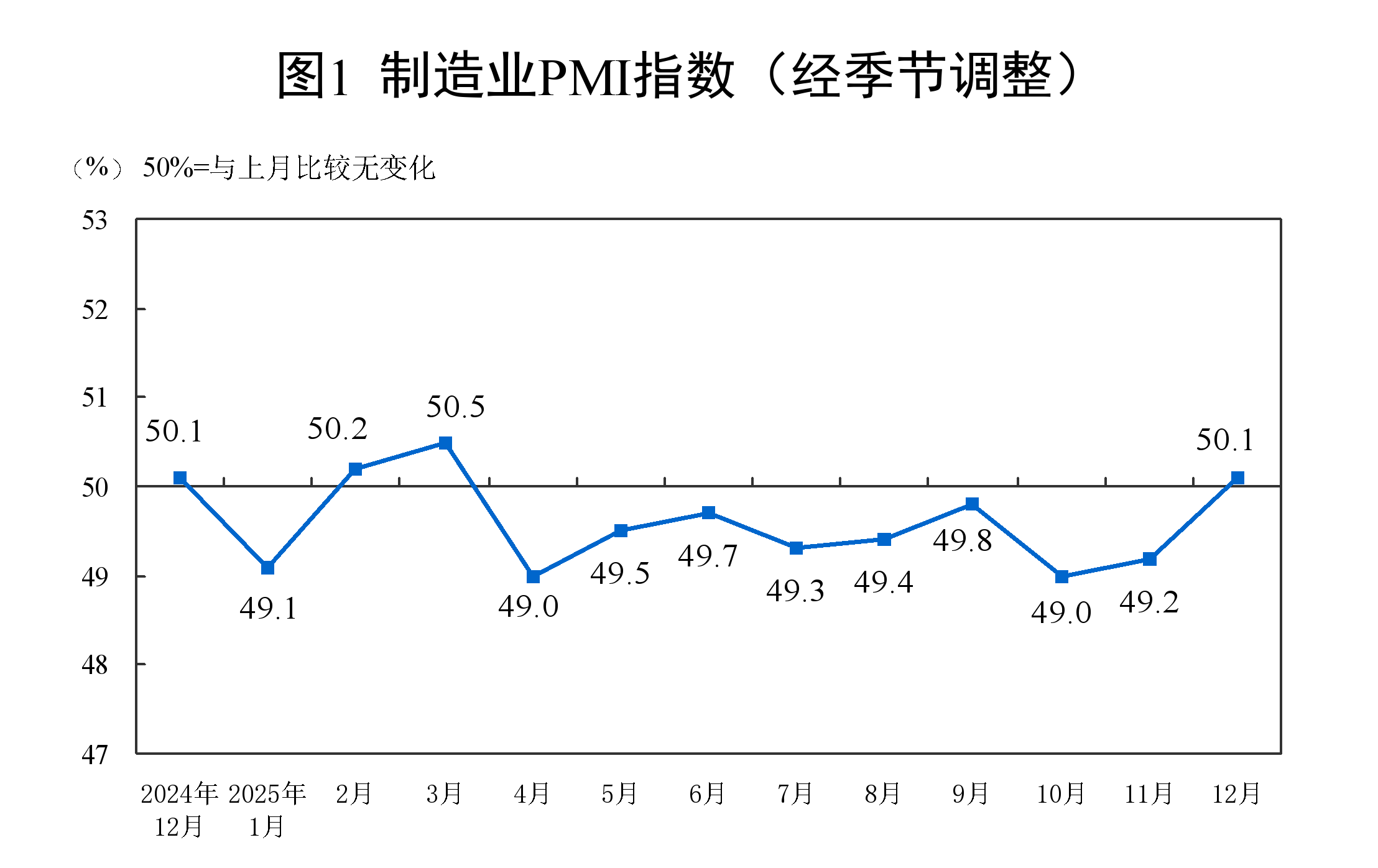
12月中国制造业PMI为50.1%,较上月上升0.9个百分点
Guo Jia Tong Ji Ju· 2025-12-31 01:37
一、中国制造业采购经理指数运行情况 12月份,制造业采购经理指数(PMI)为50.1%,比上月上升0.9个百分点,升至扩张区间。 新订单指数为50.8%,比上月上升1.6个百分点,表明制造业市场需求有所改善。 原材料库存指数为47.8%,比上月上升0.5个百分点,表明制造业主要原材料库存量降幅收窄。 从业人员指数为48.2%,比上月下降0.2个百分点,表明制造业企业用工景气度小幅回落。 供应商配送时间指数为50.2%,比上月上升0.1个百分点,表明制造业原材料供应商交货时间继续加快。 从企业规模看,大型企业PMI为50.8%,比上月上升1.5个百分点,高于临界点;中型企业PMI为49.8%,比上月上升0.9个百分点,仍低于临界点;小型企业 PMI为48.6%,比上月下降0.5个百分点,低于临界点。 二、中国非制造业采购经理指数运行情况 从分类指数看,在构成制造业PMI的5个分类指数中,生产指数、新订单指数和供应商配送时间指数均高于临界点,原材料库存指数和从业人员指数均低于 临界点。 12月份,非制造业商务活动指数为50.2%,比上月上升0.7个百分点,重返扩张区间。 生产指数为51.7%,比上月上升1.7个百 ...

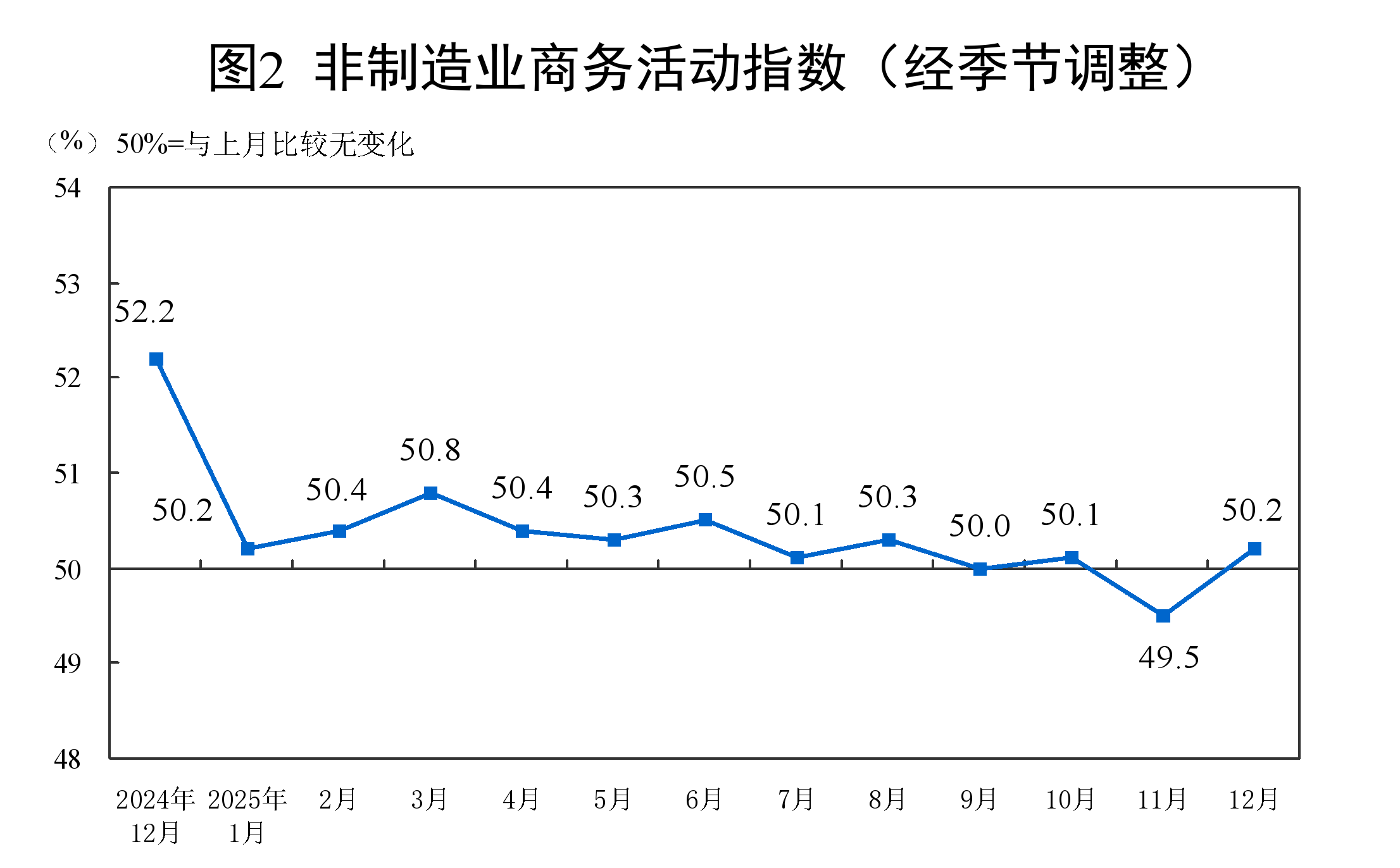
国家统计局:12月份非制造业商务活动指数为50.2% 重返扩张区间
Guo Jia Tong Ji Ju· 2025-12-31 01:36
Core Viewpoint - The non-manufacturing business activity index in December rose to 50.2%, indicating a return to the expansion zone with a month-on-month increase of 0.7 percentage points [1] Industry Summary - The construction industry business activity index reached 52.8%, up by 3.2 percentage points from the previous month, signaling strong growth [1] - The service industry business activity index was at 49.7%, showing a slight increase of 0.2 percentage points compared to last month, but still below the expansion threshold [1] Sector Performance - Within the service sector, industries such as telecommunications, broadcasting, television, and satellite transmission services, monetary financial services, and capital market services reported business activity indices above 60.0%, indicating a high level of economic activity [1] - Conversely, retail and catering industries had business activity indices below the critical point, suggesting weaker performance in these areas [1]
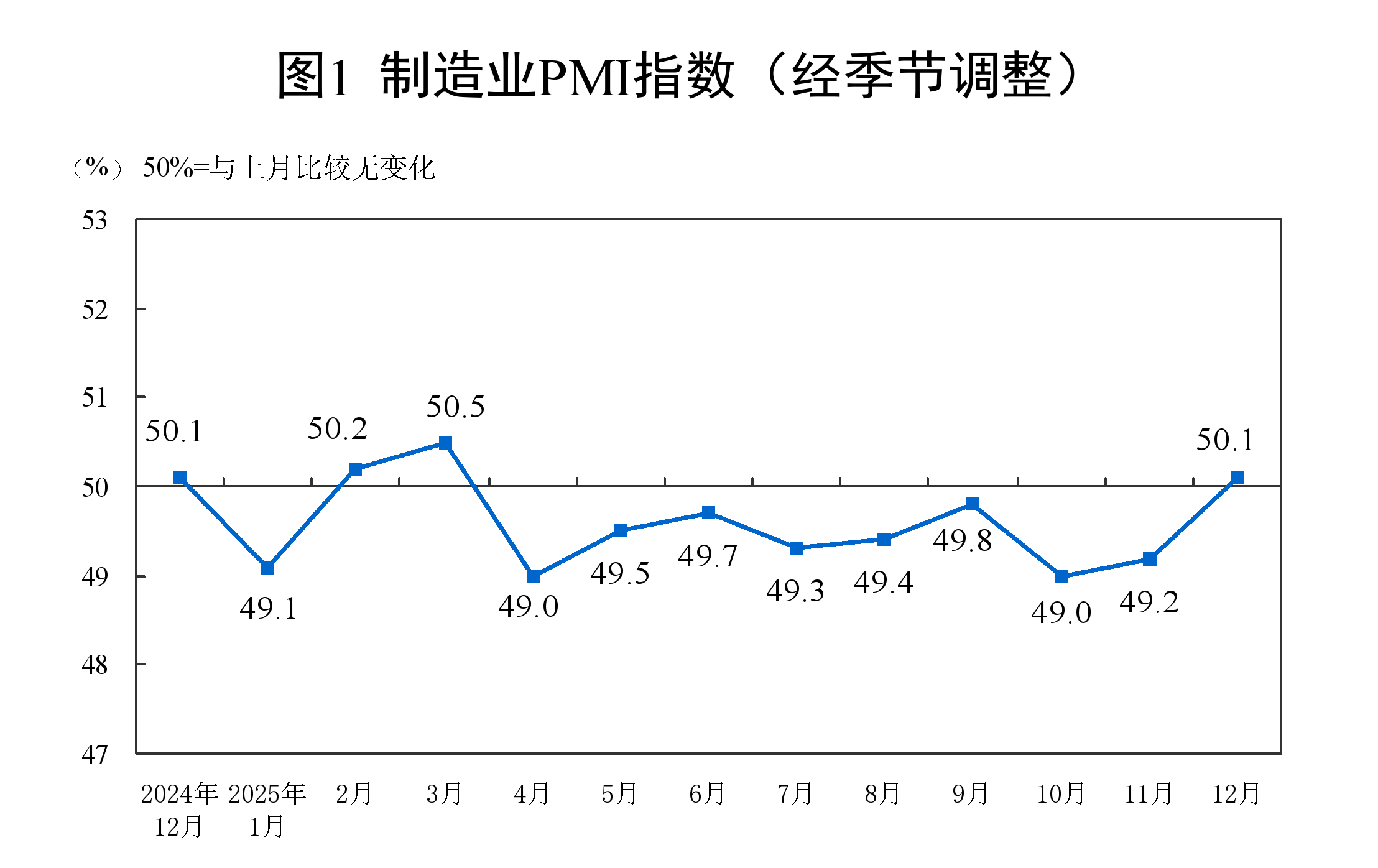
中国12月制造业PMI为50.1%,比上月上升0.9个百分点
Guo Jia Tong Ji Ju· 2025-12-31 01:35
一、中国制造业采购经理指数运行情况 12月份,制造业采购经理指数(PMI)为50.1%,比上月上升0.9个百分点,升至扩张区间。 从企业规模看,大型企业PMI为50.8%,比上月上升1.5个百分点,高于临界点;中型企业PMI为49.8%,比上月上升0.9个百分点,仍低于临界点;小型企业 PMI为48.6%,比上月下降0.5个百分点,低于临界点。 从分类指数看,在构成制造业PMI的5个分类指数中,生产指数、新订单指数和供应商配送时间指数均高于临界点,原材料库存指数和从业人员指数均低于 临界点。 生产指数为51.7%,比上月上升1.7个百分点,表明制造业企业生产活动加快。 新订单指数为50.8%,比上月上升1.6个百分点,表明制造业市场需求有所改善。 原材料库存指数为47.8%,比上月上升0.5个百分点,表明制造业主要原材料库存量降幅收窄。 从业人员指数为48.2%,比上月下降0.2个百分点,表明制造业企业用工景气度小幅回落。 | | | | | | | | | == 17: 70 | | --- | --- | --- | --- | --- | --- | --- | --- | --- | | | 新出口 ...
俄罗斯12月服务业PMI为52.3
Di Yi Cai Jing· 2025-12-30 06:07
Group 1 - The core point of the article indicates that Russia's service sector PMI for December is reported at 52.3, while the composite PMI stands at 50 [1] Group 2 - The service sector PMI of 52.3 suggests that the sector is experiencing growth, as a PMI above 50 indicates expansion [1] - The composite PMI of 50 indicates stagnation in overall economic activity, as it reflects a balance between growth and contraction [1]
枣庄推出“十大行动”,打造新能源产业制造基地和大运河文化旅游名城
Sou Hu Cai Jing· 2025-12-29 15:20
Core Insights - The economic performance of Zaozhuang in 2025 is projected to be strong, with significant growth in key economic indicators during the "14th Five-Year Plan" period [1] - The city aims to transition into a resource-based, green, and low-carbon development model, focusing on industrial enhancement and transformation strategies [1] Group 1: Economic Performance - From January to November, 14 out of 16 major economic indicators in Zaozhuang ranked in the top 10 of the province, with 9 indicators in the top 5 and 7 in the top 3 [1] - The GDP growth rate reached 5.7%, consistently exceeding the provincial average for 15 consecutive quarters [1] - General public budget revenue increased by 4.5%, surpassing the provincial average by 3.2 percentage points, ranking first in the province [1] Group 2: Strategic Focus for 2026 - In 2026, Zaozhuang will prioritize industrial economy, urban construction, public welfare, and workforce development [2] - The city will enhance four pillar industries: new energy, chemical new materials, high-end equipment, and modern light industry, while also fostering three emerging industries: artificial intelligence, low-altitude economy, and biomanufacturing [2] - 2026 has been designated as the "Year of Serving Enterprises," aiming to create a favorable business environment for investment and operations [2]
国泰海通|宏观:消费温和改善
国泰海通证券研究· 2025-12-29 14:58
Group 1 - The core viewpoint of the article indicates a moderate improvement in consumption, with service consumption recovering ahead of the holiday, as evidenced by increased subway passenger flow in 18 cities and a positive shift in the Hainan tourism price index year-on-year [1] - In terms of investment, the issuance of special bonds has concluded, leading to an increase in physical workload, with asphalt operating rates rebounding and continuous improvement in building materials data [1] - The real estate sector shows a seasonal recovery in sales, with an increase in the proportion of second-hand housing, although overall prices and premiums remain low [1] Group 2 - In foreign trade, there is a divergence between rising domestic export freight rates and a decline in the Baltic Dry Index (BDI) [1] - Production continues to show differentiation, with emerging industries such as polyester, lithium batteries, and photovoltaic chains demonstrating strong resilience, while traditional cyclical industries like steel and some chemicals are experiencing a downturn [1] - Inventory levels are decreasing for coal and building materials, while PTA continues to deplete inventory and polyester shows a slight accumulation [1] Group 3 - Industrial product prices are generally rebounding, with oil and non-ferrous metals experiencing a rebound, and the South China index rising [1] - The Consumer Price Index (CPI) shows structural differentiation, with food prices fluctuating [1] - In terms of liquidity, funding rates have shown slight fluctuations, and the renminbi continues to strengthen due to a weaker dollar and increased demand for foreign exchange settlements [1]

《“AI闪耀中国”2025,在算法时代重塑人的光芒》
Xin Lang Cai Jing· 2025-12-29 13:44
Group 1 - The core competition in AI is between the US and China, with the US focusing on foundational infrastructure and closed-source models, while China leverages its manufacturing capabilities and application market for open-source models and industrial applications [2][14] - By January 15, 2025, China is expected to reach a pivotal moment in AI development, with the gap in large model capabilities between China and the US narrowing from 20% to just 0.3% [2][14] - AI's multi-modal technology is revolutionizing content production, significantly reducing production cycles and costs, with capabilities surpassing human production [3][15] Group 2 - AI is being integrated into various industries, with specific applications like AI-native mobile banking and smart decision-making in sectors such as mining and home decoration [3][15] - The rise of intelligent agents is making personal AI assistants commonplace, enhancing knowledge management and office efficiency [4][16] - The robotics market is projected to explode into a trillion-dollar industry within five years, with China holding a 65% share of the global embodied intelligence supply chain [5][17] Group 3 - China is defining Industry 5.0, focusing on machine vision, deep learning, and comprehensive AI management, with 79 out of 189 global "lighthouse factories" located in China [6][19] - The e-commerce landscape is shifting, with AI transforming trade models and reducing barriers for small businesses, leading to a more equitable market by 2026 [7][19] - AI is enhancing consumer experiences in the service industry, with applications in healthcare and personal services demonstrating significant improvements [8][20] Group 4 - AI is deeply integrating into daily consumer products, providing competitive advantages over Western products due to China's manufacturing capabilities [9][21] - The upcoming sixth wave of entrepreneurship in 2026 is expected to be driven by AI tools, enabling small teams to achieve productivity levels comparable to larger organizations [10][22] - A new investment fund has been established to support this wave of AI-driven entrepreneurship, highlighting China's ongoing commitment to innovation [12][22]
厦门信达:12月29日召开董事会会议
Mei Ri Jing Ji Xin Wen· 2025-12-29 11:50
Group 1 - Xiamen Xinda (SZ 000701) announced the 16th meeting of the 12th Board of Directors for the year 2025, held on December 29, 2025, combining in-person and remote participation [1] - The meeting reviewed the proposal to revise the company's Strategic Management System [1] - For the first half of 2025, Xiamen Xinda's revenue composition was as follows: 97.7% from commercial activities, 1.73% from industrial activities, and 0.57% from the service sector [1] - As of the report date, Xiamen Xinda's market capitalization was 4.6 billion yuan [1] Group 2 - A new type of chip has been developed in China, which bypasses the limitations of lithography machines, supporting AI training and embodied intelligence, and can be mass-produced using mature processes of 28 nanometers and above [1]

美GDP数据现背离沪金抗跌凸显
Jin Tou Wang· 2025-12-29 04:05
Group 1 - The core point of the news highlights the current state of the gold futures market, with the latest price of Shanghai gold futures at 1017.26 CNY per gram, showing a slight increase of 0.08% [1] - The price range for the day fluctuated between a high of 1024.00 CNY and a low of 1009.00 CNY, indicating a narrow trading range [1] - The market is currently in a consolidation phase with a significant decrease in volatility, as indicated by the narrowing Bollinger Bands and stable RSI around 52, suggesting no clear overbought or oversold signals [4] Group 2 - The U.S. economy showed a 4.3% annualized growth in Q3, but this growth is misleading as real disposable income only increased by 0.6%, indicating a divergence between output and income [3] - Consumer spending contributed 2.3 percentage points to GDP growth, with over 70% of this coming from essential services, reflecting cost pressures rather than consumer confidence [3] - The labor market is showing signs of weakness, with declines in hours worked, hiring, and job quality, suggesting a potential economic downturn [3]
固就业之基 稳民生之本
Xin Lang Cai Jing· 2025-12-26 13:53
Group 1 - The core viewpoint emphasizes the importance of high-quality and sufficient employment as a priority for economic and social development, with various measures implemented to stabilize and expand employment opportunities [1] - The current employment landscape is undergoing structural changes due to industrial transformation, with traditional industries upgrading and new strategic emerging industries creating demand for skilled and versatile talent [1] - The need to align employment expansion with high-quality development is highlighted, aiming to create more job opportunities while enhancing the stability and sustainability of employment [1] Group 2 - Policies are being reinforced to ensure employment stability, with a focus on integrating employment stabilization requirements into policy formulation and implementation across various sectors [2] - The industrial support system is being strengthened to drive employment growth, emphasizing the development of modern agriculture, advanced manufacturing, and modern services to create job opportunities locally [2] - Support for small and micro enterprises is crucial, with targeted assistance to help them thrive and contribute significantly to employment stability and livelihood protection [2] Group 3 - The focus on enhancing employment quality is underscored, with a call for a robust lifelong vocational training system to meet market demands and improve job stability [3] - A comprehensive employment service system is being developed to improve labor resource allocation efficiency, utilizing digital technology for better job matching [3] - Continuous support for individuals facing employment difficulties is essential, ensuring that employment policies are effectively implemented and provide meaningful assistance [3]