
焦炭

Search documents
焦炭板块9月24日跌1.47%,美锦能源领跌,主力资金净流出1477.67万元
Zheng Xing Xing Ye Ri Bao· 2025-09-24 08:46
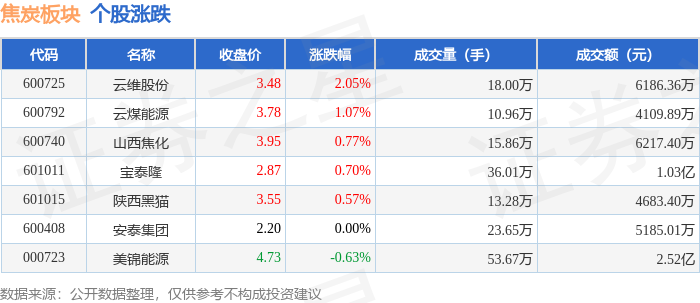
Core Insights - The coke sector experienced a decline of 1.47% on September 24, with Meijin Energy leading the drop [1] - The Shanghai Composite Index closed at 3853.64, up 0.83%, while the Shenzhen Component Index closed at 13356.14, up 1.8% [1] Sector Performance - Key stocks in the coke sector showed mixed performance, with Yunwei Co. rising by 2.05% to a closing price of 3.48, while Meijin Energy fell by 0.63% to 4.73 [1] - The trading volume for Meijin Energy was 536,700 shares, with a transaction value of 252 million yuan [1] Capital Flow - The coke sector saw a net outflow of 14.77 million yuan from main funds, while retail investors contributed a net inflow of 10.34 million yuan [1] - Specific stock capital flows indicated that Yunmei Energy had a main fund net inflow of 7.74 million yuan, while Meijin Energy experienced a significant outflow of 30.21 million yuan [2]


广发早知道:汇总版-20250924
Guang Fa Qi Huo· 2025-09-24 06:24
Report Industry Investment Rating No relevant content provided. Core Viewpoints of the Report The report comprehensively analyzes various sectors in the financial and commodity markets, including financial derivatives, precious metals, shipping, and multiple commodity futures. It points out that market trends are influenced by a combination of factors, such as macro - economic policies, supply - demand balances, and geopolitical situations. Different sectors present different trends, with some in a state of shock, others showing signs of weakness or strength, and the overall market is complex and changeable. Summary by Directory Financial Derivatives Financial Futures - **Stock Index Futures**: The A - share market showed an overall correction on Tuesday, with the main stock indexes fluctuating downwards during the session and rebounding slightly at the end. The main contracts of the four major stock index futures had mixed performances. The banking and precious metals sectors among the cyclical sectors were strong, while technology stocks corrected. It is recommended to lightly sell put options on MO2511 near the strike price of 6600 when the index corrects to collect premiums [2][3][4]. - **Treasury Bond Futures**: Treasury bond futures closed down across the board, and the yields of major inter - bank interest - rate bonds generally rose. The central bank's open - market operations led to a net withdrawal of funds, and the bond market sentiment was weak. It is recommended to operate within a range, lightly test long positions when the market sentiment stabilizes at low levels, and appropriately participate in the basis narrowing strategy for the TL contract [5][8]. Precious Metals - The US dollar index remained weak, and safe - haven sentiment drove funds to flow into gold, pushing up its price. The price of international gold reached a high and then narrowed its gains, while silver showed a slight decline. It is recommended to buy gold on dips or buy out - of - the - money call options, and sell out - of - the - money put options on silver when the price is above $41 [9][12][13]. Container Shipping Index (European Route) - The EC futures market oscillated. The spot freight rates showed a certain range of fluctuations, and the market had digested the impact of the previous spot decline. It is recommended to wait and see in a volatile market [14][15]. Commodity Futures Non - Ferrous Metals - **Copper**: The copper market oscillated. The spot price declined, and the downstream was less willing to buy at high prices. The supply side was affected by factors such as smelter maintenance, and the demand side improved after the price decline. It is expected to oscillate in the short term, with the main contract referring to the range of 79,000 - 81,000 yuan [15][17][20]. - **Alumina**: The alumina market was in a pattern of high supply, high inventory, and weak demand. The futures price was in a bottom - wide oscillation. It is expected to oscillate in the range of 2850 - 3150 yuan/ton, and it is necessary to pay attention to policy changes in Guinea and cost - profit changes [20][22][23]. - **Aluminum**: The aluminum price declined, and the market trading activity increased slightly. The supply was at a high level, the demand entered the peak season, and the inventory was still in a state of accumulation. It is expected to oscillate in the range of 20,600 - 21,000 yuan/ton, and it is necessary to pay attention to the double - festival stocking and inventory inflection points [23][25]. - **Aluminum Alloy**: The pre - holiday stocking demand provided phased support for the spot price. The supply was tight, the demand was gradually recovering, and the inventory was accumulating. It is expected to oscillate in the range of 20,200 - 20,600 yuan/ton, and attention should be paid to the supply of scrap aluminum and import policies [25][27][28]. - **Zinc**: The zinc market was in a state of supply - demand differentiation at home and abroad. The domestic supply was loose, and the demand was in the peak season. The short - term price was expected to oscillate, with the main contract referring to the range of 21,500 - 22,500 yuan [28][30][31]. - **Tin**: The import of tin ore in August remained at a low level, and the supply was tight. The demand was in a state of "weak supply and demand". It is expected to oscillate at a high level, with the price range of 265,000 - 285,000 yuan, and attention should be paid to the import situation of tin ore from Myanmar [31][33][34]. - **Nickel**: The nickel market oscillated weakly. The supply was at a high level, the demand was relatively stable in some areas and general in others. It is expected to oscillate in the range of 119,000 - 124,000 yuan, and attention should be paid to macro - expectations and ore - related news [34][35][36]. - **Stainless Steel**: The stainless - steel market oscillated narrowly. The raw material prices were firm, the supply was under pressure, and the demand had not significantly increased. It is expected to oscillate in the range of 12,800 - 13,200 yuan, and attention should be paid to steel - mill dynamics and pre - holiday stocking [37][40]. - **Lithium Carbonate**: The lithium - carbonate market oscillated. The supply and demand were in a tight balance during the peak season. It is expected to oscillate in the range of 70,000 - 75,000 yuan, and attention should be paid to the marginal changes in orders [41][44]. Black Metals - **Steel**: The steel market was affected by factors such as export support and seasonal demand changes. The price was expected to oscillate at a high level, with the thread referring to the range of 3100 - 3350 yuan and the hot - rolled coil referring to the range of 3300 - 3500 yuan. It is recommended to lightly try long positions and pay attention to the seasonal recovery of apparent demand [44][46]. - **Iron Ore**: The iron - ore market was supported by factors such as reduced shipments and increased iron - water production. The price was expected to oscillate upwards, with the range of 780 - 850 yuan. It is recommended to buy on dips and consider the arbitrage strategy of long iron ore and short hot - rolled coil [47][48]. - **Coking Coal**: The coking - coal market was in a state of supply - demand balance and tightening. The price was expected to oscillate upwards, with the range of 1150 - 1300 yuan. It is recommended to buy on dips and consider the arbitrage strategy of long coking coal and short coke [49][51]. - **Coke**: The coke market was in a process of price adjustment. The price was expected to rebound gradually, with the range of 1650 - 1800 yuan. It is recommended to buy on dips and consider the arbitrage strategy of long coking coal and short coke [52][55]. Agricultural Products - **Meal**: Argentina's cancellation of the export tax on soybeans and their derivatives put pressure on the two - meal market. The domestic meal supply was abundant, and the market was expected to oscillate weakly [56][59]. - **Pigs**: The pig market had a large slaughter pressure, and the spot price was difficult to improve before the National Day. The market was expected to adjust weakly, and the previous reverse - spread strategy was recommended to be withdrawn and observed [60][61].
政策扰动市场情绪,板块品种价格仍有?撑
Zhong Xin Qi Huo· 2025-09-23 06:14
1. Report Industry Investment Rating - Mid - term outlook for the black building materials industry: Oscillating with a slight upward trend [7] - Short - term outlook for each variety: - Steel: Oscillating [9] - Iron ore: Oscillating [10] - Scrap steel: Oscillating [11] - Coke: Oscillating [13] - Coking coal: Oscillating with a slight upward trend [14] - Glass: Oscillating [15] - Soda ash: Oscillating [18] - Manganese silicon: Oscillating [19] - Ferrosilicon: Oscillating [20] 2. Core Views of the Report - The release of the "Steel Industry Steady Growth Work Plan (2025 - 2026)" has a minor impact on the futures prices of the sector, but the prices of sector varieties still have support due to the marginal improvement in the industrial chain during the peak season and the market's expectations for the fourth - quarter important meetings [2] - Overall, in the short term, the "anti - involution" factor causes market fluctuations, but based on the improvement of the industrial chain fundamentals, the callback space is limited. With the positive expectations of domestic important meetings in the fourth quarter and overseas interest rate cuts, prices are expected to rise steadily [7] 3. Summary by Relevant Catalogs 3.1 Iron Element - Iron ore: Shipments have declined but remain at a high level. The arrival volume has been affected by typhoons. Demand remains high, and the pre - National Day restocking expectation still exists. The fundamentals are healthy, and prices are supported [3] - Scrap steel: The fundamentals have marginally weakened, and prices mainly follow the fluctuations of finished products [3] 3.2 Carbon Element - Coke: The work plan has a certain negative impact on the furnace charge end, but before the National Day, the demand is well - supported, and with the cost support from the stable and rising coal prices, the price is expected to remain oscillating in the short term [3] - Coking coal: The "anti - involution" policy remains the main line. The fundamentals are healthy, and with the pre - National Day restocking by the mid - and downstream, the price is expected to oscillate with a slight upward trend in the short term [3] 3.3 Alloys - Manganese silicon: The short - term peak - season expectation supports the price to some extent, but the future supply - demand outlook is pessimistic, and the price may decline after the peak season [3] - Ferrosilicon: The peak - season expectation supports the price, but the future supply - demand relationship will tend to be loose, and the price may face downward pressure after the peak season [3] 3.4 Glass - The current demand is weak, but there are peak - season and policy expectations. After the mid - stream destocking, there may be another round of oscillations. In the long term, market - oriented capacity reduction is needed, and if prices return to fundamental trading, they are expected to decline oscillatingly [4] 3.5 Soda Ash - The supply - surplus pattern remains unchanged. After the decline in the futures price, the spot - futures trading volume has slightly increased, and the price is expected to oscillate widely in the future. In the long term, the price center will decline to promote capacity reduction [7] 3.6 Specific Analysis of Each Variety - Steel: Spot market transactions are generally weak. The peak - season demand recovery is less than expected, and inventories are at a moderately high level. The short - term futures price is expected to oscillate widely [9] - Iron ore: Overseas shipments have slightly declined, and the arrival volume has increased. Demand is supported in the short term, and inventories are at a moderate level. The price is expected to oscillate in the short term [9] - Scrap steel: Supply has increased slightly, demand has decreased, and inventories have increased slightly. The fundamentals have marginally weakened, and prices follow finished products [11] - Coke: Supply remains stable at a high level, and demand is strongly supported. The price is expected to remain oscillating in the short term [13] - Coking coal: Supply recovery is slow, and demand is strong. The price is expected to oscillate with a slight upward trend in the short term [14] - Glass: Demand is in the off - season, and supply has uncertainties. The price is expected to oscillate in the short term and decline in the long term [15] - Soda ash: Supply capacity has not been cleared, and demand is stable with a slight increase. The price is expected to oscillate [18] - Manganese silicon: Market supply pressure is increasing, and the future price may decline [19] - Ferrosilicon: Supply is increasing, and demand growth is limited. The price may face downward pressure after the peak season [20]
美锦能源跌2.07%,成交额1.32亿元,主力资金净流出1015.01万元
Xin Lang Cai Jing· 2025-09-23 02:35
Core Viewpoint - Meijin Energy's stock price has shown fluctuations, with a recent decline of 2.07% and a year-to-date increase of 4.88%, indicating mixed market sentiment towards the company [1]. Company Overview - Meijin Energy, established on January 8, 1997, and listed on May 15, 1997, is based in Taiyuan, Shanxi Province. The company primarily engages in the production and sales of coal, coke, natural gas, and hydrogen fuel cell vehicles, with 97.45% of its revenue coming from coal and coke products [1][2]. - As of June 30, 2025, Meijin Energy reported a revenue of 8.245 billion yuan, a year-on-year decrease of 6.46%, while the net profit attributable to shareholders was -674 million yuan, reflecting a growth of 1.29% [2]. Stock Performance - The stock price of Meijin Energy is currently at 4.73 yuan per share, with a market capitalization of 20.828 billion yuan. The trading volume was 132 million yuan, with a turnover rate of 0.63% [1]. - Year-to-date, the stock has experienced a 4.88% increase, with a slight decline of 1.87% over the last five trading days and a 10% increase over the last 60 days [1]. Shareholder Information - As of June 30, 2025, Meijin Energy had 248,700 shareholders, a decrease of 5.77% from the previous period. The average number of circulating shares per shareholder increased by 6.12% to 17,679 shares [2]. - The company has cumulatively distributed 1.976 billion yuan in dividends since its A-share listing, with no dividends paid in the last three years [3]. Institutional Holdings - Among the top ten circulating shareholders, Guotai Zhongxin Coal ETF ranks as the fourth largest with 47.8686 million shares, an increase of 10.9022 million shares from the previous period. Other notable shareholders include Southern CSI 500 ETF and Hong Kong Central Clearing Limited [3].
永安期货焦炭日报-20250923
Yong An Qi Huo· 2025-09-23 00:58
焦炭日报 研究中心黑色团队 2025/9/23 | | 最新 | 日变化 | 周变化 | 月变化 同比 | | 最新 | 日变化 | 周变化 | 月变化 同比 | | | --- | --- | --- | --- | --- | --- | --- | --- | --- | --- | --- | | 山西准一湿熄 | 1427.78 | 0.00 | -54.61 | -108.16 | -14.41% 高炉开工率 | 90.35 | | 0.17 | 0.10 | 7.70% | | 河北准一干熄 | 1680.00 | 0.00 | -55.00 | -110.00 | 7.69% 铁水日均产量 | 241.02 | | 0.47 | 0.27 | 7.68% | | 山东准一干熄 | 1605.00 | 0.00 | -55.00 | -110.00 | -10.34% 盘面05 | 1868.5 | 2.00 | 0.00 | 114.00 | -1.03% | | 江苏准一干熄 | 1645.00 | 0.00 | -55.00 | -110.00 | -10.11% 盘面09 | 1948 ...
南华煤焦产业风险管理日报-20250922
Nan Hua Qi Huo· 2025-09-22 11:06
Report Industry Investment Rating - Not provided in the document Core Viewpoints - The report maintains the previous judgment that coking coal and coke are not considered as short - allocation in the black series. However, the high supply pressure and high inventory of steel will suppress the rebound height of coking coal and coke prices. For coking coal, it is not recommended to use it as a short - allocation variety in the black series. For coke, the industrial sector can focus on hedging opportunities under low basis, and arbitrageurs can focus on the 1 - 5 reverse spread of coking coal and coke [4]. Summary by Relevant Catalogs 1. Price Forecast and Risk Management Strategy - **Price Forecast**: The monthly price range of coking coal is predicted to be 1200 - 1350, with a current 20 - day rolling volatility of 41.63% and a historical percentile of 81.94%. The monthly price range of coke is predicted to be 1650 - 1850, with a current 20 - day rolling volatility of 31.38% and a historical percentile of 67.08% [3]. - **Risk Management Strategy**: For inventory hedging of coke, when coke production recovers rapidly and the spot supply - demand becomes loose, coke enterprises worried about price drops can short - sell the J2601 contract. The recommended hedging ratio is 25% at the price range of (1780, 1830) and 50% at (1830 - 1880). For procurement management of coking coal, due to factors such as repeated macro - sentiment, low seasonal coking coal mine production, and inspections for over - production, coking plants worried about price increases can long - buy the JM2605 contract. The recommended hedging ratio is 25% at the price range of (1200, 1250) and 50% at (1150, 1200) [3]. 2. Black Warehouse Receipt Daily Report - **Warehouse Receipt Data**: The warehouse receipt data of various black products on 2025 - 09 - 22, 2025 - 09 - 19, and 2025 - 09 - 15 are provided, including the daily and weekly changes. For example, the warehouse receipt of rebar decreased by 21,922 tons compared to the previous day and 20,487 tons compared to the previous week [4]. - **Market Situation**: Downstream pre - festival replenishment improved the coking coal inventory structure, and there was a price - holding sentiment at the mine mouth, leading to a stop - fall and rebound of coking coal spot prices. The second - round price cut of coke was fully implemented, the cost of coking coal for furnaces increased, and coking profits shrank rapidly. It is difficult to implement the third - round price cut before the festival [4]. 3.利多 and 利空 Interpretations - **利多 Factors**: Downstream pre - festival seasonal replenishment eased the inventory pressure of coking coal mines, and the mine mouth actively held prices. The difficulty of the third - round price cut of coke increased, and some coke enterprises tried to raise prices. After the second - round price cut, the profit of steel spot improved, and the high pig iron output provided rigid support for the short - term demand of coking coal and coke. "Anti - involution" is the trading focus in the second half of the year, and the macro - sentiment will repeatedly dominate the coking coal and coke futures market. The Fed cut interest rates by 25BP as expected, and the market expects two more interest rate cuts this year, which supports the overall valuation of commodities [6]. - **利空 Factors**: The social inventory pressure of finished steel products is still large, and the demand in the peak season is lower than expected, limiting the rebound space of coking coal and coke. The average daily customs clearance at the port this week exceeded 1250 vehicles, and the coal shipment volume remained at a high level, resulting in a strong supply of imported coal [7]. 4. Coking Coal and Coke Futures and Spot Prices - **Futures Prices**: The report provides the coking coal and coke futures prices on 2025 - 09 - 22, 2025 - 09 - 19, and 2025 - 09 - 15, including the basis, price differences between different contracts, and some ratios [8]. - **Spot Prices**: The spot prices of coking coal and coke on 2025 - 09 - 22, 2025 - 09 - 19, and 2025 - 09 - 15 are provided, including domestic and imported coking coal, and different types of coke. It also includes the profit data of coking, coal import, and coke export [9][10].
焦炭板块9月22日跌1.08%,云维股份领跌,主力资金净流出5310.27万元
Zheng Xing Xing Ye Ri Bao· 2025-09-22 08:53
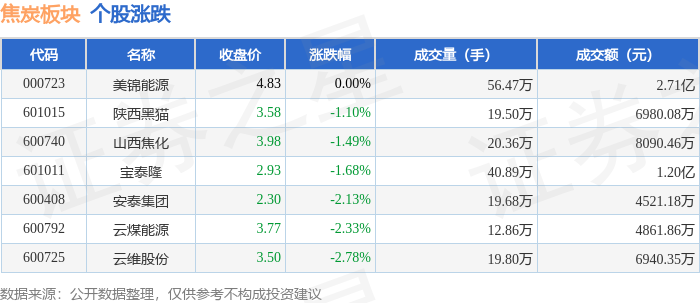
Group 1 - The coke sector experienced a decline of 1.08% on September 22, with Yunwei Co. leading the drop [1] - The Shanghai Composite Index closed at 3828.58, up 0.22%, while the Shenzhen Component Index closed at 13157.97, up 0.67% [1] - Major stocks in the coke sector showed varied performance, with Meijin Energy remaining flat at 4.83, while Yunwei Co. fell by 2.78% to 3.50 [1] Group 2 - The net outflow of main funds in the coke sector was 53.1 million yuan, while retail investors saw a net inflow of 34.8 million yuan [1] - Detailed fund flow data indicated that major stocks like Shanxi Coking Coal and Meijin Energy faced significant net outflows of 9.93% and 9.92% respectively [2] - Retail investors showed a positive net inflow in several stocks, with Shanxi Coking Coal attracting 849.21 million yuan, indicating strong retail interest despite overall sector decline [2]


中经评论:治理“内卷”并非不要竞争
Jing Ji Ri Bao· 2025-09-20 07:21
Group 1 - The recent news about the Beijing Civil Affairs Bureau's decision to legally dissolve the "China Low Altitude Economy Alliance" highlights the growing concern over "involution" competition within the low-altitude economy sector, which is seen as a strategic emerging industry with significant potential [1] - The dissolution is viewed as a critical first step in addressing the chaotic competition in the low-altitude industry, signaling the authorities' commitment to optimizing the industry ecosystem and curbing unhealthy competition practices [1] - Various industries, including both emerging sectors like photovoltaics and traditional sectors like coking and landscaping, have faced similar issues of "involution," characterized by excessive price competition and low-level repetitive construction, leading to overcapacity and thin profit margins [1] Group 2 - The persistent issue of "involution" competition is closely linked to resource misallocation and distorted market mechanisms, where companies focusing on short-term gains through price wars neglect quality and service improvements, resulting in inefficiency [2] - Governments that create "policy depressions" without considering local industry foundations and resource endowments contribute to homogenized industry layouts and resource waste, further exacerbating the problem [2] - Effective governance of "involution" competition requires a multi-faceted approach, emphasizing the need for a collaborative market environment that combines effective markets with proactive government intervention [2] Group 3 - To combat "involution" competition, it is essential to optimize the business environment, which involves reducing costs while increasing value, encouraging businesses to move away from zero-sum price wars and reliance on subsidies [3] - The focus should shift from resource-driven competition to innovation-driven growth, allowing businesses to unlock innovation, quality, and brand advantages [3] - The governance approach has evolved from merely preventing "involution" competition to actively regulating low-price disorderly competition, reflecting a systematic and legal framework for long-term management of the issue [3]
治理“内卷”并非不要竞争
Jing Ji Ri Bao· 2025-09-19 22:15
Core Viewpoint - The article emphasizes the need for a multi-faceted approach to address "involutionary" competition, advocating for a collaborative market environment that combines an effective market with proactive government intervention [1][2][3]. Group 1: Issues in the Low Altitude Economy - The recent action by the Beijing Civil Affairs Bureau to dismantle the "China Low Altitude Economy Alliance" is seen as a significant step towards regulating the low altitude industry and addressing "involutionary" competition [1]. - The low altitude economy is identified as a strategic emerging industry that has attracted considerable capital interest, but has also been subject to exploitation by organizations misrepresenting themselves as industry associations [1]. - The article highlights that many industries, including both emerging sectors like photovoltaics and traditional sectors like coking and landscaping, have faced similar issues of excessive competition and resource waste [1]. Group 2: Root Causes of Involutionary Competition - The persistence of "involutionary" competition is linked to resource misallocation and distorted market mechanisms, where companies focus on short-term gains through price wars rather than improving product quality [2]. - Local governments that create "policy depressions" without considering local industry foundations contribute to homogenized industry layouts and resource wastage [2]. - The inadequacy of market mechanisms fosters an environment conducive to "involutionary" competition, which can stifle innovation and sustainable development in industries [2]. Group 3: Strategies for Governance - To effectively govern "involutionary" competition, a combination of strategies is necessary, focusing on creating a synergistic market environment through unified national market construction and regulatory recognition [2][3]. - Improving the business environment requires reducing costs while increasing value, encouraging businesses to shift from price wars to innovation-driven growth [3]. - The governance approach has evolved from merely preventing "involutionary" competition to implementing systematic and legal measures to regulate low-price disorderly competition [3].
黑色金属日报-20250919
Guo Tou Qi Huo· 2025-09-19 11:55
Report Industry Investment Ratings - Thread: ★☆☆ [1] - Hot Rolled: ☆☆☆ [1] - Iron Ore: ☆☆☆ [1] - Coke: ★☆☆ [1] - Coking Coal: ★☆☆ [1] - Ferrosilicon Manganese: ★☆☆ [1] - Ferrosilicon: ★☆☆ [1] Core Views - Steel is expected to oscillate strongly, constrained by weak demand expectations and supported by "anti - involution" and Fed rate cuts [2] - Iron ore is likely to oscillate at a high level in the short term, influenced by high supply, short - term demand support, and expectations of macro - policies [3] - Coke and coking coal are likely to oscillate strongly, with sufficient carbon supply, high - level downstream iron - water providing support, and pre - National Day restocking sentiment [4][6] - Ferrosilicon manganese and ferrosilicon are likely to be prone to rising and difficult to fall, with improved price valuations and the impact of "anti - involution" [7][8] Summary by Relevant Catalogs Steel - Thread demand improved this week with reduced production and inventory, while hot - rolled demand declined with increased production and re - accumulated inventory [2] - High - speed blast furnace复产, but limited by poor profit per ton, and attention should be paid to environmental protection restrictions in Tangshan [2] - Downstream industries have weak domestic demand, but steel exports remain high, and the market is expected to oscillate strongly [2] Iron Ore - Global shipments are high, domestic arrivals decreased slightly, and port inventory decreased this week [3] - Terminal demand is weak, but high - level iron - water and pre - holiday restocking by steel mills support short - term demand [3] - The market expects macro - policies, and external factors like Fed rate cuts influence the market, with short - term high - level oscillation expected [3] Coke - There is still an expectation of the third round of price cuts, and some coking plants started the first round of price increases, with intensified competition [4] - Coking profit is average, daily production slightly decreased, and overall inventory increased [4] - Ample carbon supply, high - level downstream iron - water, and pre - National Day restocking make the price relatively firm and likely to oscillate strongly [4] Coking Coal - Coking coal mine production increased slightly, and pre - National Day restocking sentiment is strong [6] - Total coking coal inventory increased, production - end inventory decreased slightly, and the possibility of further large - scale capacity release is low [6] - Ample carbon supply, high - level downstream iron - water, and pre - National Day restocking make the price relatively firm and likely to oscillate strongly [6] Ferrosilicon Manganese - Iron - water production continued to rise, and ferrosilicon manganese production increased to a high level [7] - Ferrosilicon manganese inventory did not increase, and demand for futures and spot is good [7] - Manganese ore prices increased, and with "anti - involution", the price is likely to rise [7] Ferrosilicon - Iron - water production continued to rise, export demand remained at about 30,000 tons, and secondary demand declined slightly [8] - Ferrosilicon supply returned to a high level, market demand for futures and spot is good, and on - balance inventory decreased slightly [8] - With improved price valuation and "anti - involution", the price is likely to rise [8]