电信

Search documents
沙特电信与Humain公司成立合资企业 推进数据中心建设
Xin Lang Cai Jing· 2025-12-18 08:33
Core Insights - Saudi Telecom Company (STC) has announced a joint venture with the AI firm Humain to develop and operate data centers [1][2] - Humain will hold a 51% stake in the joint venture, while STC will own 49% [1][2] - This initiative aligns with Saudi Arabia's strategy to accelerate AI development and diversify its economy away from oil dependency [1][2] Company Overview - Humain is supported by the Saudi Public Investment Fund (PIF) and has established multiple partnerships, including collaborations with Elon Musk's xAI and Blackstone-backed AirTrunk [1][2] - The company aims to achieve approximately 6 gigawatts of data center capacity by 2034 [1][2] Project Details - The joint venture will focus on building infrastructure capable of supporting up to 1 gigawatt of load [1][2] - The initial deployment scale of the project is expected to reach up to 250 megawatts [1][2]
美银:印度已成全球最活跃AI大模型市场,庞大年轻人口沦为硅谷“试验田”
Hua Er Jie Jian Wen· 2025-12-18 06:22
Core Insights - India has surpassed other countries to become the market with the highest penetration of large language models (LLMs), driven by low data costs and a large young population [1] - According to Bank of America, India is not only the most active AI consumer market but also a key frontier for global tech giants to test next-generation AI technologies [1] Market Dynamics - India leads globally in user numbers for popular AI applications like ChatGPT, Gemini, and Perplexity, reflected in both monthly active users (MAUs) and daily active users (DAUs) [1] - Local telecom giants such as Bharti Airtel and Jio are accelerating this trend by offering free premium AI application subscriptions, further solidifying market penetration [1] Competitive Landscape - Bank of America identifies Bharti Airtel and Jio as potential market winners in this trend, as such collaborations can enhance user stickiness and benefit them in the mid-term AI scale-up [1] - However, the report warns that local startups may face increased pressure as global AI companies enter the market, potentially squeezing their survival space [1] User Base and Accessibility - India's vast and diverse user base makes it an ideal testing ground for "Agentic AI," which can independently reason, plan, and execute tasks [2] - The country has the second-largest online population globally, with over 700 to 750 million mobile internet users, and low data costs (approximately $2 for 20 to 30GB of monthly data) lower the entry barrier for AI [3] Role of Telecom Operators - Telecom operators like Jio and Bharti Airtel play a crucial role in the AI adoption wave in India by offering free subscriptions to paid versions of AI applications, creating a win-win situation for users, AI companies, and telecom operators [3] - This strategy not only reduces the cost of advanced AI tools but also fosters a fair competitive environment, enhancing learning outcomes and productivity [3] Future Testing Grounds - India is positioned to be a testing ground for the next phase of AI technology, particularly "Agentic AI," due to its large and diverse user base [4] - Bank of America suggests that global AI companies could partner with local firms in India to provide service fulfillment, indicating that India is not just a consumer market but also a critical experimental base for Silicon Valley tech giants [4]
专访原海南省大数据管理局局长董学耕:以数据跨境为桥连接全球数字经济 海南探路数据跨境“自贸港模式”
Zheng Quan Shi Bao· 2025-12-18 04:53
Core Insights - Hainan Free Trade Port officially launched its full island closure on December 18, focusing on cross-border data flow management through a negative list-based "non-prohibition unless permitted" model, which is seen as a significant practice for exploring safe and orderly cross-border data flow [1] Group 1: Hainan's Unique Approach - Hainan's differentiated exploration in cross-border data flow management is characterized by two main aspects: industry focus and optimized regulatory processes [2] - The emphasis on specific industries such as deep-sea technology, commercial aerospace, low-altitude economy, modern agriculture, tourism, and modern services aligns with regional resource endowments and strategic positioning [2] - Hainan allows data to exit under specified conditions without prior approval, enhancing operational efficiency for enterprises [2] Group 2: Negative List Management - A clear and actionable negative list for regulated "important data" and "personal information" is an efficient management approach that helps enterprises understand and comply with rules [3] - The negative list management mechanism aims for precise scene identification, ensuring clarity and operational feasibility for businesses [3] - Continuous optimization of the negative list is necessary, including timely revisions and expansions to enhance policy transparency and predictability [3] Group 3: Regulatory Framework for Data Flow - The "Regulations on the Development of International Data Centers in Hainan Free Trade Port" was approved on November 29, 2024, supporting domestic and foreign enterprises in establishing international data centers [4] - The business forms include "foreign data for foreign use," "domestic data for foreign use," and "foreign data for domestic use," each with specific compliance requirements [4] Group 4: Infrastructure and Soft Environment - Key infrastructure such as the Haikou International Communication Business Entry Bureau and cross-border submarine cables are being developed to support safe and orderly cross-border data flow [5] - The establishment of a supportive "soft environment" through rules, regulations, and standards is crucial for maximizing the effectiveness of hard infrastructure [5] Group 5: Opening Up to Foreign Investment - Hainan has lifted several foreign equity restrictions in value-added telecommunications services, allowing foreign investment in cloud services and computing markets [6] - The pilot program aims to attract international enterprises and enhance China's digital industry development [6] Group 6: Future Directions and Innovations - Hainan aims to promote data security and orderly flow as outlined in its overall construction plan, focusing on replicable and scalable practices in cross-border data flow [9] - Future exploration will focus on four areas: promoting "foreign data for foreign use," regulating "domestic data for foreign use," exploring "foreign data for domestic use," and integrating these data flow models [9]


向全球数字贸易规则 “试验田”迈进
Zheng Quan Shi Bao· 2025-12-17 19:16
Core Insights - Hainan Free Trade Port aims to enhance data flow security while expanding data openness and innovating safety regulations, which is crucial for establishing a high-level open economy [1] - The port has unique advantages in telecommunications and international data center legislation, positioning it as a pioneer in digital trade rule innovation [1] - Hainan's differentiated approach to cross-border data management focuses on specific industries, enhancing operational efficiency and risk control [1][2] Data Management Framework - The "negative list" management model emphasizes a "non-prohibited, but permitted" approach, providing businesses with stable expectations and clear operational guidelines [2] - Hainan Free Trade Port has categorized international data center operations into three types: "external data for external use," "internal data for external use," and "external data for internal use," with a focus on the first category [2] - The development of physical infrastructure, such as international communication hubs and cross-border cables, is essential for facilitating rapid data flow to Southeast Asia [2] Regulatory Environment - Hainan has removed foreign ownership restrictions on several value-added telecommunications services, allowing foreign investment in cloud services and computing markets [3] - The pilot program is expected to attract international companies to the Chinese market and assist local firms in expanding globally [3] - Hainan aims to serve as a testing ground for institutional openness and a platform for exploring mutual recognition of digital trade rules [3]
解码GCC 5G-A商业成功:从技术部署到价值变现的“破壁”
Sou Hu Cai Jing· 2025-12-17 11:44
Core Insights - The GCC region has emerged as a pioneer in the 5G-Advanced (5G-A) connectivity field due to early strategic investments, establishing a solid foundation for smart networks, AI-driven operations, and new monetization experiences [1] - The UAE operators, du and e&, are key drivers in the commercialization of 5G-A, showcasing a dual approach in technology implementation and scenario innovation [2] Group 1: 5G-A Network Development - The GCC region has deployed over 10,000 5G-A sites and has a commercial user base in the millions, providing a first-mover advantage [1] - du's transformation focuses on a "vertical-centric" approach, targeting vertical industry ecosystem partners rather than just end-users, and has completed the first 3CC indoor network deployment in the Middle East [3] - e& is building a "cloud-native + all-scenario" foundation, achieving 100Gbps aggregation rates and seamless coverage in high-density areas [4] Group 2: Policy and Strategic Framework - Multiple Middle Eastern countries view 5G-A as a key strategy for economic diversification, with initiatives like Saudi Arabia's "Vision 2030" and the UAE's "Digital Economy Strategy" emphasizing 5G-A as a core component of new infrastructure [4] - Regulatory bodies are shifting from rule-makers to ecosystem catalysts, with the UAE's TDRA working on cross-industry data interaction standards for 5G-A [4] Group 3: Business Model Innovation - The business model is evolving from a "traffic pipeline" to "experience management," with operators like du and e& offering customized experience packages for vertical industries [4] - Saudi Arabia's Zain has introduced a "5G-A ultra-fast package" that focuses on service offerings rather than just speed [4] Group 4: Ecosystem Collaboration - The commercial boundaries of 5G-A extend beyond telecommunications, integrating deeply into sectors like transportation, healthcare, and manufacturing [4] - Operators are leveraging industry knowledge and telecom technology to break down barriers, as seen with du's involvement in smart energy projects [4] Group 5: Global Context and Future Outlook - China has achieved full 5G-A network coverage across 31 provinces within a year, with over 60 million users, creating a complete ecosystem [5] - Huawei emphasizes the importance of commercial network interaction and has set a target for GCC to enter the 10Gbps era by 2026, promoting the first commercial 5G-A network [7] - The "3A infrastructure" proposed by Huawei aligns with the GCC's practices, focusing on rate breakthroughs and scenario adaptation [8] Group 6: Value Creation and Sustainability - Experience management is identified as a core strategy, with the GCC's practices demonstrating that transforming intangible experiences into tangible services is essential for monetization [9] - Ecosystem symbiosis is crucial, as evidenced by the integration of 5G-A into various industries, highlighting the need for operators to facilitate value chain participation [9] - Cost-sharing mechanisms, such as national subsidies and industry co-construction, are vital for the sustainable deployment of 5G-A [10]

除了12315,还有哪些正规高效的投诉维权途径?
Xin Lang Cai Jing· 2025-12-17 11:13
Core Viewpoint - The article discusses various effective and accessible complaint channels for consumers beyond the official 12315 hotline, highlighting the importance of these alternatives in protecting consumer rights [1][7]. Group 1: Industry Regulatory Complaint Channels - Complaints related to specific industries can be addressed directly to the relevant regulatory bodies for more professional and quicker responses [2][8]. - The Ministry of Industry and Information Technology (MIIT) provides a complaint platform for telecommunications issues, where complaints can be submitted via their official website or by calling 12300, ensuring high response rates from telecom operators [2][11]. - The State Post Bureau's complaint website is the most efficient channel for issues related to express delivery, with results directly impacting the assessment of delivery companies [9][12]. - Financial disputes involving banks, insurance, and securities can be addressed to financial regulatory bodies, such as the National Financial Supervision Administration, through their official websites or local offices [9][12]. Group 2: Internet Platform Complaint Channels - Internet platforms, particularly those operated by large companies, have emerged as convenient and rapid avenues for consumer complaints, especially among younger demographics [3][13]. - The Black Cat Complaint platform exemplifies a comprehensive online consumer dispute resolution platform, allowing users to submit complaints easily through various digital channels, including its website and mobile applications [3][13]. - The platform features a transparent and visual complaint tracking system, enabling users to monitor the progress of their complaints and receive notifications at each stage [4][14]. - Black Cat Complaint also aggregates collective complaints against the same business, increasing visibility and pressure on companies to respond [4][14]. Group 3: Consumer Association Organizations - Consumer associations, such as the China Consumers Association, play a unique role in resolving disputes due to their public trust and non-binding mediation results [6][15]. - Consumers can file complaints through phone, mail, or official websites, and associations may organize mediation between consumers and businesses [6][15]. - For significant or widespread issues, consumer associations can issue warnings, support litigation, or even initiate public interest lawsuits against unscrupulous businesses [6][15]. Group 4: Choosing and Combining Channels - For clear, small, and evidence-supported disputes, internet platforms like Black Cat Complaint should be prioritized for their quick response mechanisms [10][16]. - For issues requiring specialized industry adjudication, regulatory complaint channels are often the most effective [10][16]. - In cases involving significant rights or illegal activities, consumers should report through the 12315 platform to initiate administrative enforcement [10][16]. - Seeking social support and public opinion through consumer associations can be effective for typical issues or unreasonable industry practices [10][16]. Group 5: Conclusion - The modern consumer rights protection landscape has developed into a multi-layered and comprehensive network of channels, providing consumers with more options and empowerment in defending their rights [17].
北水动向|北水成交净买入79.09亿 内资全天抢筹科网股 加仓南方恒生科技(03033)超7亿港元
智通财经网· 2025-12-17 10:04
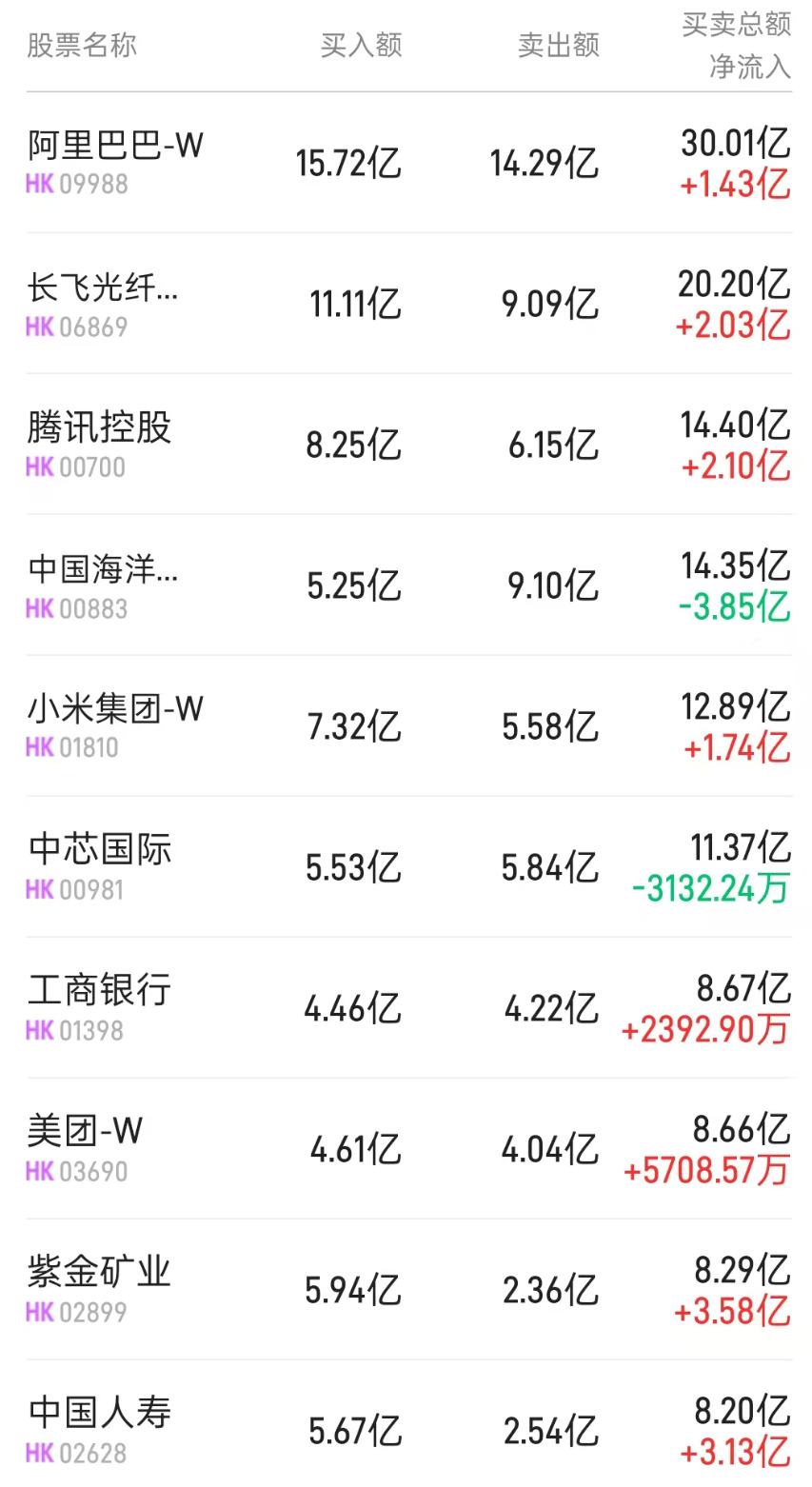
Summary of Key Points Core Viewpoint - The Hong Kong stock market saw significant net buying from northbound capital, totaling HKD 79.09 billion, with notable interest in technology stocks and a cautious approach from investors as they await policy changes in the new year [1]. Group 1: Northbound Capital Inflows - Northbound capital recorded a net buying of HKD 79.09 billion, with HKD 22.18 billion from the Shanghai Stock Connect and HKD 56.91 billion from the Shenzhen Stock Connect [1]. - The most purchased stocks included Xiaomi Group-W (01810), Meituan-W (03690), and Southern Hang Seng Technology (03033) [1]. - The largest net sell-offs were seen in China Mobile (00941) and CNOOC (00883) [1]. Group 2: Individual Stock Performance - Alibaba-W (09988) had a net inflow of HKD 15.72 billion, with total transactions of HKD 30.01 billion [2]. - Meituan-W (03690) recorded a net inflow of HKD 4.61 billion, with total transactions of HKD 8.66 billion [3]. - Xiaomi Group-W (01810) saw a net inflow of HKD 10.62 billion, with a future focus on R&D investment of HKD 200 billion over five years [4]. Group 3: Sector Insights - The technology sector, particularly AI-related stocks, is expected to rebound significantly with potential policy catalysts in the new year [5]. - Longi Green Energy (06869) received a net inflow of HKD 4.13 billion, with plans to use proceeds from a new share placement to expand overseas [5]. - China Life (02628) had a net inflow of HKD 3.13 billion, with expectations of valuation recovery due to stabilizing long-term interest rates [6]. Group 4: Market Trends - Semiconductor company SMIC (00981) received a net inflow of HKD 2.17 billion, with its market share closely approaching that of Samsung [7]. - Overall, the top ten foundries saw a revenue increase of 8.1% quarter-over-quarter, indicating a positive trend in the semiconductor industry [7].






【环球财经】意大利企业AI技术使用率翻倍
Xin Hua She· 2025-12-16 06:51
Core Insights - The usage of artificial intelligence (AI) technology in Italian enterprises has doubled compared to last year, although it remains at a low level, particularly in small and medium-sized enterprises (SMEs) [1] Group 1: AI Usage Statistics - In 2023, 16.4% of Italian enterprises with 10 or more employees utilized some form of AI technology, up from 8.2% in 2024 and 5.0% in 2023 [1] - For large enterprises with 250 or more employees, the AI usage rate increased from 32.5% in 2024 to 53.1% [1] - Small enterprises saw an increase in AI usage from 7.7% to 15.7% [1] Group 2: Leading Sectors and Applications - The top three sectors with the highest AI usage are information technology services, video production, and telecommunications [1] - Common AI applications include text data extraction, language and image generation, and speech-to-text conversion [1] Group 3: Barriers to AI Adoption - The main reasons cited by Italian enterprises for not using AI include lack of relevant skills, unclear regulations, data protection concerns, and high costs [1] - Approximately 14.8% of enterprises believe that AI is of no use to them [1]
【微特稿】意大利企业AI技术使用率翻倍
Xin Hua She· 2025-12-16 04:22
Core Insights - The usage of artificial intelligence (AI) technology in Italian companies has doubled compared to last year, although it remains at a low level, particularly among small and medium-sized enterprises (SMEs) [1] Group 1: AI Adoption Rates - In 2023, 16.4% of Italian companies with 10 or more employees utilized some form of AI technology, up from 8.2% in 2024 and 5.0% in 2023 [1] - The adoption rate among large enterprises (250 or more employees) increased significantly from 32.5% in 2024 to 53.1% [1] - Small enterprises saw an increase in AI usage from 7.7% to 15.7% [1] Group 2: Key Sectors and Applications - The top three sectors with the highest AI usage are information technology services, video production, and telecommunications [1] - Common AI applications include text data extraction, language and image generation, and speech-to-text conversion [1] Group 3: Barriers to AI Adoption - Companies that have not adopted AI cite reasons such as lack of relevant skills, unclear regulations, data protection concerns, and high costs [1] - Approximately 14.8% of companies believe that AI is of no use to them [1]
SpaceX凭什么值1.5万亿美元?
创业邦· 2025-12-15 10:10
Core Viewpoint - SpaceX is planning to go public with a valuation of $1.5 trillion, aiming to raise over $30 billion, primarily driven by the need for capital to fund its ambitious projects and employee compensation [6][12][19]. Group 1: Financial Needs and Valuation - SpaceX's revenue is projected to be $15.5 billion in 2025, but the company faces significant expenses, including a $17 billion acquisition of EchoStar's spectrum licenses and ongoing development costs for its Starship program [13][14]. - The company has a growing workforce, with 13,000 employees as of September 2023, and average salaries ranging from $185,000 to $230,000, leading to an estimated annual payroll of $2.6 billion [16][19]. - The valuation of $1.5 trillion would place SpaceX among the top five companies in the U.S. stock market, surpassing Meta [9][20]. Group 2: Business Segments and Growth Potential - A significant portion of SpaceX's valuation is based on its Starlink service, which has 7.65 million active subscribers and is expected to generate over $9.18 billion in revenue annually [23][24]. - Starlink's business model allows for high profit margins, with net profit margins projected to be between 30% and 40%, compared to traditional telecom companies [24]. - The company is also focusing on its launch services, with plans to conduct 150 launches in 2024 and potentially over 200 in 2025, capturing 90% of the global launch market [35][36]. Group 3: Future Prospects and Risks - SpaceX's future growth is tied to ambitious projects like the Starship, which aims to revolutionize transportation costs and enable new markets, including space tourism and manufacturing in microgravity [41]. - The company is also developing Starshield, a defense-related service for the U.S. military, which could significantly increase its market share in the defense sector [42]. - However, the company's valuation may be heavily influenced by Elon Musk's leadership, and any regulatory challenges or operational setbacks could impact its growth trajectory [50][52].