
数码产品

Search documents
去年以旧换新商品销售额超2.6万亿元
Xin Lang Cai Jing· 2026-01-02 22:39
Group 1 - The core viewpoint of the articles highlights the significant impact of the "trade-in for new" policy on consumer spending and economic growth, projecting a sales volume exceeding 2.6 trillion yuan by 2025, benefiting over 360 million people [1][2] Group 2 - In the automotive sector, over 11.5 million vehicles are expected to be traded in, with nearly 60% being new energy vehicles, contributing to a retail market share of over 50% for new energy passenger cars for nine consecutive months [1] - The home appliance sector anticipates over 129 million units to be traded in, with over 90% of new products being first-class energy efficiency [1] - The retail sales of consumer goods increased by 4.0% year-on-year in the first eleven months of the previous year, with the trade-in policy contributing over 1 percentage point to this growth [1] Group 3 - The policy is expected to promote a green economic transformation, with a projected 24.5% increase in scrapped vehicle recovery by 2025, leading to the recycling of approximately 9.6 million tons of steel and 1.3 million tons of non-ferrous metals, while reducing carbon emissions by about 24.5 million tons [1] - Since the full implementation of the policy in September 2024, over 480 million direct subsidies have been issued to consumers, facilitating the entry of numerous green, low-carbon, and smart products into daily life [2] Group 4 - The trade-in policy has stimulated offline retail, with consumers increasingly opting for in-store experiences, leading to a 30% increase in consumer spending in areas with concentrated home appliance trade-in stores [2]
大行评级|中银国际:预计中国汽车行业今年开门红 首季或进入去库存阶段
Ge Long Hui· 2026-01-02 07:15
Core Viewpoint - The report from Zhongyin International indicates that the recent policy notification from the State Council regarding the 2026 large-scale equipment update and consumer goods trade-in subsidy will continue to incentivize the automotive, home appliance, and digital product sectors, with targeted optimizations to enhance policy effectiveness [1] Group 1: Subsidy Policy Details - The fiscal budget for subsidies is expected to decrease, but the new policy is clearly tilted towards the mid-to-high-end market, with the corresponding subsidy reduction for eligible models being much lower than market concerns [1] - Digital product subsidies will remain at 15% of the selling price, with a cap of 500 yuan, which is better than market expectations [1] - Home appliance subsidies will be tightened, focusing on six core categories and only subsidizing products that meet the first-level energy efficiency standard, with the subsidy rate reduced from 20% to 15% of the selling price [1] Group 2: Industry Outlook - With the early implementation of subsidy details and timely allocation of subsidy funds, the automotive industry is expected to achieve a strong start in 2026 [1] - However, due to consumer hesitation in the fourth quarter leading to high channel inventory at year-end, the first quarter of 2026 may enter a destocking phase [1] Group 3: Company Impact - Companies such as Li Auto, Xiaomi, NIO, Wenjie, and Zeekr are expected to be minimally affected by the adjustments to the trade-in subsidy [1]
“两新”政策优化升级促内需
Xin Lang Cai Jing· 2026-01-01 22:54
Core Viewpoint - The National Development and Reform Commission (NDRC) and the Ministry of Finance have issued a notice to implement large-scale equipment updates and a trade-in policy for consumer goods in 2026, aiming to optimize support scope, subsidy standards, and implementation mechanisms for the "Two New" policies [1] Group 1: Policy Implementation - The first batch of 625 billion yuan in special long-term bonds to support the trade-in policy for consumer goods has been allocated in advance to meet the consumption demand during peak seasons like New Year and Spring Festival [1] - The 2026 "Two New" policy focuses on social concerns and real needs, with a systematic deployment characterized by precise targeting and quality improvement [1] Group 2: Equipment Updates - The 2026 policy will expand the support scope for equipment updates to include the installation of elevators in old residential communities, equipment updates in elderly care institutions, and facilities for fire rescue and inspection [1] - The subsidy for updating old residential elevators will shift from a fixed amount to a tiered subsidy based on the number of elevator floors [2] Group 3: Consumer Goods Trade-in - The policy continues to support trade-ins for automobiles and focuses on six categories of home appliances: refrigerators, washing machines, televisions, air conditioners, computers, and water heaters [1] - The subsidy for household appliances will be adjusted to support products with a 1st-level energy efficiency or water efficiency rating, with a maximum subsidy of 1,500 yuan per item [2] Group 4: Funding and Oversight - The notice outlines requirements for optimizing funding channels, regulating fund usage, and enhancing supervision to maximize the effectiveness of the funds [2] - Measures will be taken to optimize the project application mechanism and review process, lowering the investment threshold for applications and increasing support for small and medium-sized enterprises [2] Group 5: Future Actions - The NDRC will work with relevant departments to strengthen coordination and monitoring, ensuring a balanced and orderly use of subsidy funds while implementing the trade-in policy for consumer goods [3]
2026“国补”继续!几类补贴有变化,一文看懂→
Xin Lang Cai Jing· 2026-01-01 22:54
Core Viewpoint - The new round of "National Subsidy" for 2026 has officially started, with a total of 62.5 billion yuan allocated to support the replacement of old products and enhance consumer spending [3]. Group 1: Digital and Smart Products - Digital and smart products will continue to receive a 15% subsidy, with a maximum of 500 yuan per item. The subsidy categories have expanded to include smart glasses alongside existing products like smartphones and smart home devices [3]. - The subsidy applies to products priced up to 6,000 yuan, with each consumer limited to one subsidy per product category [3]. Group 2: Home Appliances - The subsidy for home appliances in 2026 will focus solely on products that meet the highest energy efficiency standards (1st level) or water efficiency standards, excluding lower-rated products [4]. - Eligible appliances include refrigerators, washing machines, televisions, air conditioners, computers, and water heaters, with a maximum subsidy of 1,500 yuan per item [4]. Group 3: Automotive Subsidies - The automotive subsidy will be adjusted to a fixed percentage of the new car sales price, with a maximum subsidy of 20,000 yuan for eligible vehicles [5]. - For gasoline vehicles, the registration date must be before June 30, 2013, while for diesel and other fuel vehicles, it must be before June 30, 2015. For new energy vehicles, the registration date must be before December 31, 2019 [7]. - The subsidy for purchasing new energy vehicles after scrapping an old vehicle is set at 12% of the new car price, with a cap of 20,000 yuan [7]. Group 4: Addressing Public Concerns - The new round of subsidies aims to address public concerns regarding issues such as the installation of elevators in old residential areas and the updating of equipment in elderly care facilities [6][8]. - Additional support will be provided for updating equipment in commercial facilities, including shopping centers and supermarkets [8]. Group 5: Application Process - Consumers can apply for subsidies through designated platforms or mini-programs related to specific product categories, ensuring a streamlined process for accessing the benefits [10][12]. - There will be strict measures to combat fraudulent claims and ensure that the subsidy benefits reach the intended consumers effectively [12].

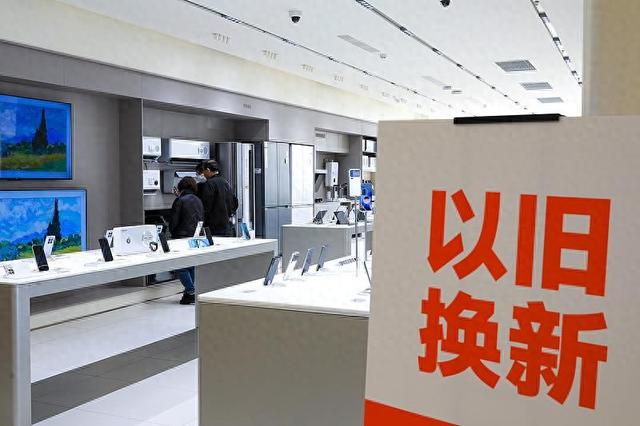
2026“国补”继续!几类补贴有变化 一文看懂→
Yang Shi Xin Wen· 2026-01-01 22:29
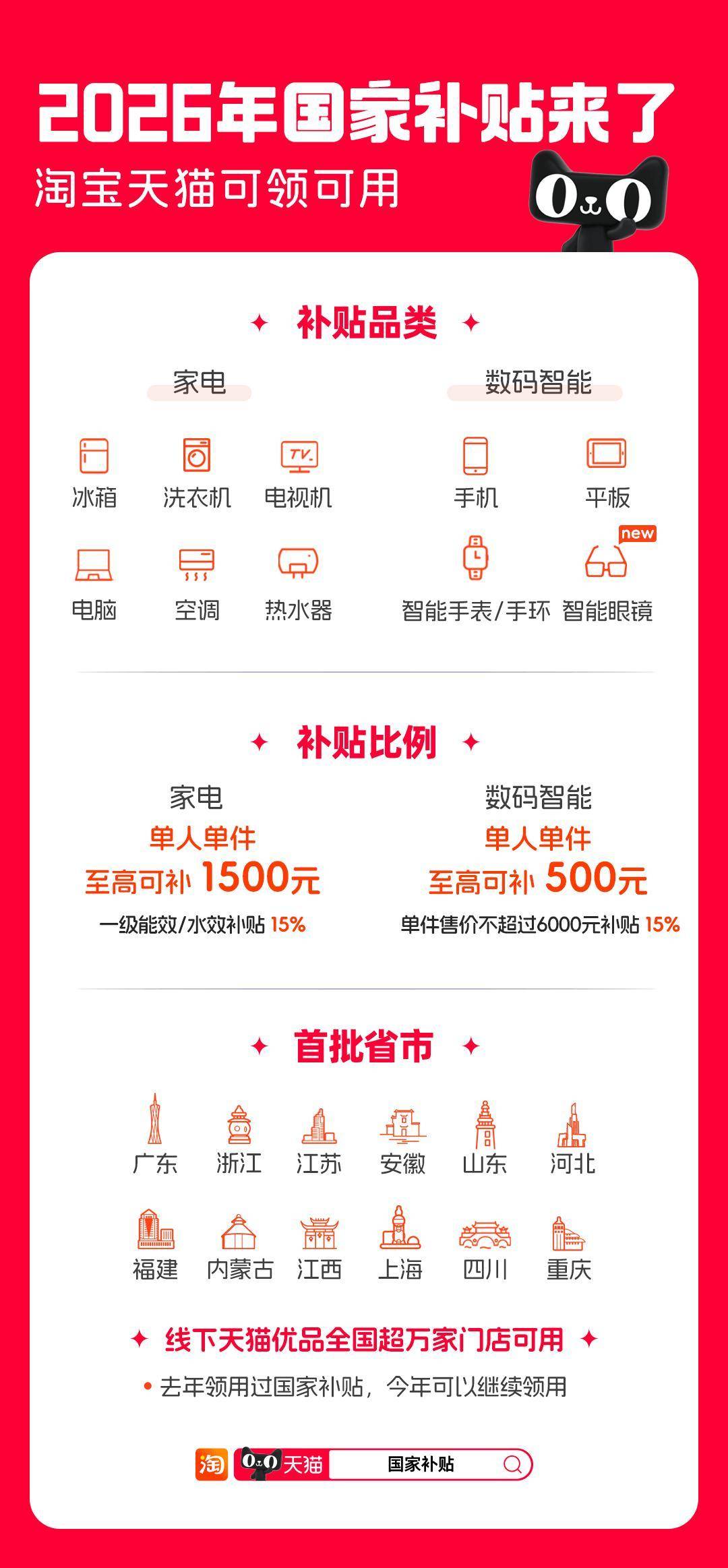
最近,不少人在关心 "2026年以旧换新补贴,还有没有?" 答案是:有! 1月1日,新一轮"国补"正式开始! 2026年首批625亿元国补资金已下达 延续消费品以旧换新 并加大对设备更新的支持力度 新一轮"国补"有哪些看点和变化? 一次梳理清楚 01 数码和智能产品继续享受 15%国补 单件最高500元 数码和智能产品的补贴标准基本与2025年保持一致。但补贴品类进一步扩大:在延续手机、平板、智能手表(手环)和智能家居产品(含适老家居)的基础 上,新增了智能眼镜这一品类。 02 家电产品只补贴1级能效 或水效标准产品 补贴品类:包括冰箱、洗衣机、电视、空调、电脑、热水器等6类产品。 补贴规则:单件产品销售价格不超过6000元,按销售价格的15%给予补贴。单件补贴最高不超过500元(每位消费者每一类产品限补1件)。 补贴规则:补贴条件是达到1级能效或水效标准。每位消费者每类产品可补贴1件,每件补贴不超过1500元。 03汽车调整为按价格比例补贴 最高补贴2万元 《2026年汽车以旧换新补贴实施细则》明确,参与申领2026年汽车报废更新补贴旧车的注册登记时间,相比2025年进一步扩大支持范围。 若参与申领补贴的报 ...
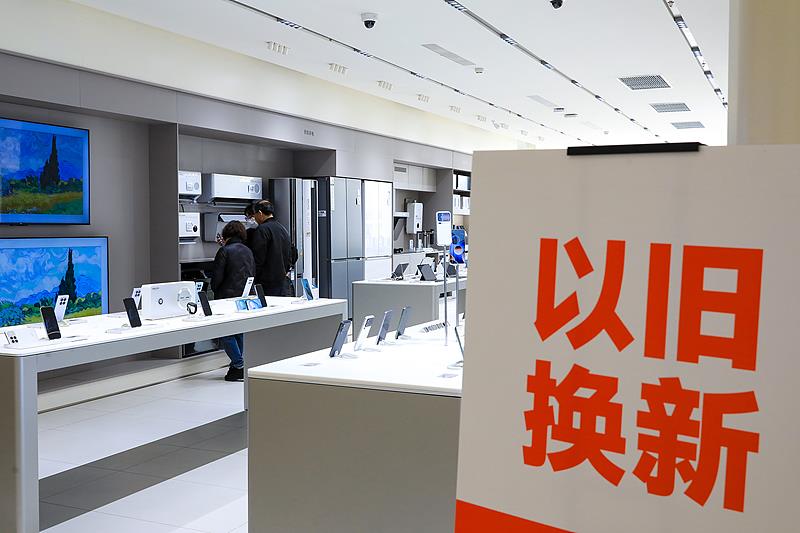
2026年“国补”新鲜出炉:家电数码补贴15%,智能眼镜首次入围!
Xin Lang Cai Jing· 2026-01-01 17:42
Core Insights - The 2026 "National Subsidy" policy has been officially implemented, focusing on optimizing and adjusting the categories and requirements for subsidies on home appliances and digital products [1][3]. Group 1: Home Appliance Subsidies - The new policy supports the replacement of home appliances, specifically targeting products with 1st-level energy efficiency or water efficiency standards, including refrigerators, washing machines, televisions, air conditioners, computers, and water heaters [1][4]. - The subsidy rate has been reduced from 20% to 15%, with a cap of 1,500 yuan per item, down from the previous 2,000 yuan limit. The number of supported categories has decreased from 12 to 6, excluding items like gas stoves and water purifiers from the subsidy [3][4]. Group 2: Digital and Smart Product Subsidies - The policy introduces subsidies for digital and smart products, including smartphones, tablets, smartwatches, and for the first time, smart glasses, with a subsidy of 15% on products priced up to 6,000 yuan, capped at 500 yuan per item [6][8]. - The inclusion of smart glasses signals a strong governmental support for the integration of artificial intelligence and consumer technology, aiming to stimulate consumption and promote industry growth [8][10]. Group 3: Market Implications - The adjustments in the subsidy policy are seen as a strategic move to enhance the quality of products rather than merely increasing sales volume, promoting green consumption and energy efficiency [4][10]. - The market for smart glasses is projected to grow significantly, with sales in China increasing from 452,000 units in 2025 to an estimated 1.37 million units in 2026, reflecting a growth rate of 215.7% [8].
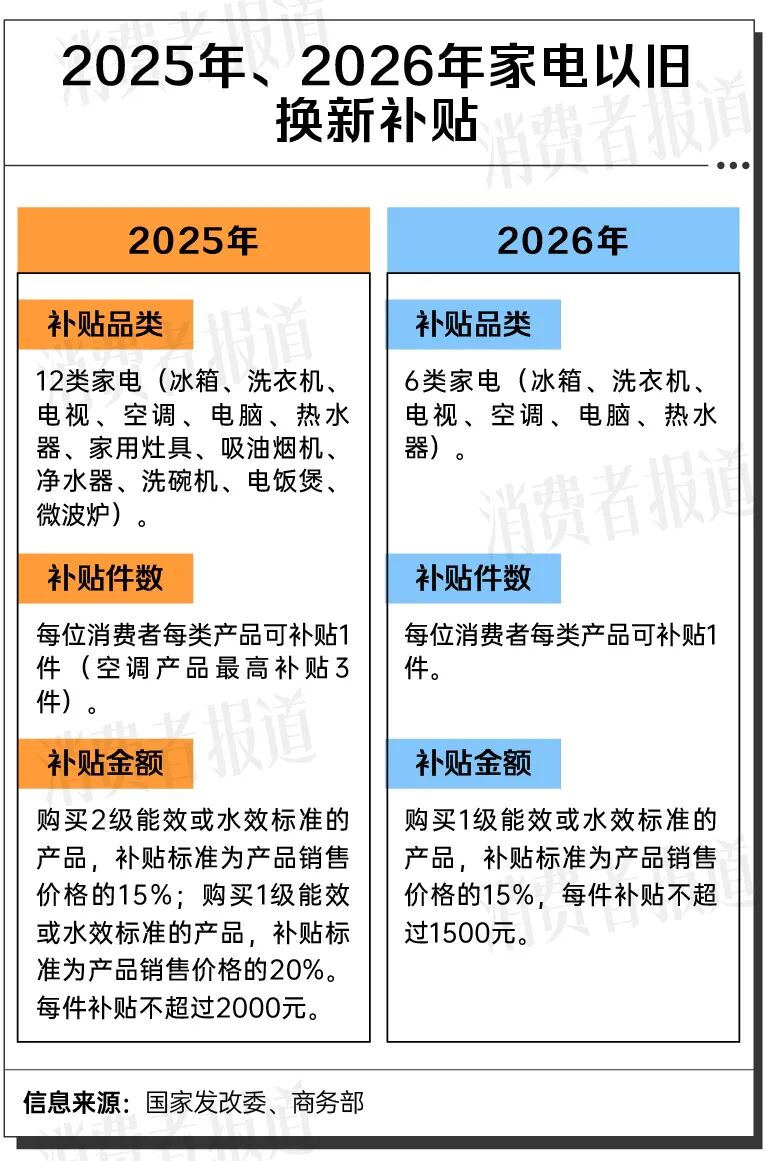
2026年国补来了!淘宝天猫加码补贴“焕新”
Yang Zi Wan Bao Wang· 2025-12-31 04:30
Group 1 - The new round of national subsidies will officially start on January 1, 2026, with consumers able to claim them on Taobao and Tmall [1] - The 2026 national subsidy covers ten categories, including refrigerators, washing machines, televisions, air conditioners, computers, water heaters, mobile phones, tablets, smartwatches, and smart glasses, with smart glasses being a new addition [1] - The subsidy rate is set at 15%, with a maximum subsidy of 1500 yuan for energy/water-efficient appliances and 500 yuan for digital and smart products priced under 6000 yuan [1] Group 2 - Provinces such as Guangdong, Zhejiang, Jiangsu, and others have already launched the national subsidy on Taobao and Tmall, allowing consumers to access it through the app [4] - Tmall is fully supporting the 2026 national subsidy both online and offline, with over 10,000 physical stores participating [4] - From January 1 to 3, Tmall will collaborate with brands like Haier, Midea, Huawei, and Siemens to offer additional discounts, with consumers able to receive up to 950 yuan in consumption vouchers on top of the national subsidy [4]
“退货羽绒服口袋现机票”引争议;2026年“国补”政策来了| 消费早参
Mei Ri Jing Ji Xin Wen· 2025-12-30 23:04
点评:2026 年"两新"政策的延续与扩围,是积极聚焦扩内需、促转型的精准发力,契合消费升级与新 质生产力培育需求,以财政资金撬动居民换新意愿、缓解企业转型压力。是"十五五"开局之年稳增长、 优结构的重要抓手,彰显了以消费牵引供给、以产业升级支撑高质量发展的政策逻辑。 NO.2 东莞首富母子完成交接班 62岁的东阳光联合创始人郭梅兰因"年事已高",将其持有的核心资产全部转让给38岁的儿子张寓帅。至 此,这位38岁的"创二代"成为东阳光唯一实际控制人,独自掌控着价值近700亿的上市公司平台,母子 二人合计400亿元的财富版图实现平稳交接。 点评:这是民营上市公司代际传承浪潮中的典型案例。此次交接以全额资产转让的方式完成控制权过 渡,既符合家族企业传承的常见路径,也让市场将目光聚焦于新任实控人后续在企业研发投入、业务布 局等方面的决策走向,以及这种传承模式对公司长期经营稳定性的影响。 丨 2025年12月31日星期三丨 NO.1 2026年"国补"政策来了 国家发展改革委、财政部印发的《关于2026年实施大规模设备更新和消费品以旧换新政策的通知》30日 对外发布,明确2026年"两新"政策的支持范围、补贴标准和工 ...
将扩大有效需求 作为高质量发展的关键抓手
Xin Lang Cai Jing· 2025-12-30 20:11
Core Viewpoint - The Sichuan Provincial Economic Work Conference emphasizes the importance of expanding effective demand as a key strategy for promoting high-quality economic development, particularly in Chengdu as the core engine of the Chengdu-Chongqing economic circle [1] Consumption Expansion and Quality Improvement - Chengdu aims to enhance consumer spending through policies and innovative consumption scenarios, targeting a retail sales total of 8,291.7 billion yuan by the third quarter of 2025, reflecting a 6.5% year-on-year growth, surpassing the national average of 4.5% [1] - The "trade-in" policy has been pivotal in stimulating large-scale consumption, with over 58,000 applications for vehicle subsidies in the first half of 2025, leading to new car sales of 40 billion yuan [2] - Innovative consumption scenarios are reshaping the urban consumption ecosystem, with a 197.2% increase in retail sales of communication equipment and a 22.2% growth in sports and entertainment products by 2025 [3] Investment Precision and Infrastructure Development - Chengdu focuses on major projects in infrastructure, industry upgrades, and public welfare to enhance investment scale and efficiency, with significant infrastructure projects like the completion of the Jinsha River Silver River Hydropower Station by December 2025 [5] - The city is advancing new productive forces through investments in artificial intelligence and other emerging industries, with the first commercial supercritical carbon dioxide generator set to operate in 2025 [6] Social Investment and Quality of Life - Investment in public services such as education, healthcare, and elderly care is increasing, with plans to build or expand 20 schools and add 30 community elderly care complexes by 2025 [7] - This investment strategy aims to alleviate residents' financial burdens in education, healthcare, and elderly care, thereby enhancing consumer confidence and spending capacity [7] Regional Collaborative Development - Chengdu is breaking the urban-rural dual structure and promoting regional collaboration to extend the internal demand market from cities to rural areas, with rural residents' disposable income projected to grow by 5.8% by 2025 [8] - The Chengdu-Chongqing economic circle is expected to see a retail sales total exceeding 3 trillion yuan by 2025, becoming one of the fastest-growing regional consumer markets in the country [9] Reform and Innovation - Continuous optimization of consumption policies is essential to enhance consumer confidence and capability, with plans to expand the scope of trade-in subsidies and improve the quality of consumption scenarios [11] - The focus on breaking down barriers to resource allocation and promoting regional integration is crucial for expanding internal demand and enhancing market efficiency [12]
“微醺悦己”“送礼犒劳自己”带热跨年消费,美团闪购:精酿啤酒销量翻倍,智能手表销量涨6倍
Feng Huang Wang Cai Jing· 2025-12-30 14:54
Group 1 - The core trend for New Year's Eve consumption among young people is the pursuit of "self-indulgence," with many becoming "New Year's hosts" and focusing on gifts for themselves [1][2] - Popular products for New Year's Eve include various alcoholic beverages, with sales of craft beer and white wine increasing over 100% year-on-year, and brand new low-alcohol products gaining traction [1] - Digital products are also in high demand as gifts, with smart watch sales increasing by 610% and tablet sales rising over 210% in the week leading up to New Year's [1] Group 2 - Innovative fruit and flower arrangements have become popular for enhancing the New Year's celebration, with some products seeing a 13-fold increase in search volume [2] - Young consumers are opting for new styles of flowers, including collaborations with brands like Disney, which have seen rapid sales growth [2] - Platforms are offering promotional discounts for New Year's shopping, with Meituan Flash Sale planning to distribute up to 2026 yuan in coupons for various products [2]

