自动驾驶

Search documents
小马智行预计2025年亏损大幅收窄至6900-8600万美元
Xin Lang Cai Jing· 2026-02-04 00:26
亏损收窄主要源于报告期内对上市公司的投资的公允价值变动收益增长。 免责声明:本文内容与数据由观点根据公开信息整理,不构成投资建议,使用前请核实。 根据公告内容,截至2025年12月31日止年度,集团层面预期亏损净额约6900-8600万美元,2024年同期 为亏损2.75亿美元;小马智行层面应占亏损净额约1.26-1.43亿美元,2024年同期亏损为2.741亿美元。 来源:观点地产网 观点网讯:2月4日,小马智行-W发布正面盈利预告,预计2025年度亏损净额将较上年大幅收窄。 ...
小马智行-W(02026)发盈喜 预期2025年净亏损约6900万美元至8600万美元 同比收窄
智通财经网· 2026-02-03 23:10
智通财经APP讯,小马智行-W(02026)发布公告,截至2025年12月31日止年度(报告期)集团预期于报告期 内取得亏损净额介乎约6900万美元至8600万美元,而截至2024年12月31日止年度亏损净额为2.75亿美 元,及Pony AI Inc.应占亏损净额介乎约1.26亿美元至1.43亿美元,而截至2024年12月31日止年度Pony AI Inc.应占亏损净额为2.74亿美元。亏损净额及 Pony AI Inc.应占亏损净额收窄的主要原因是由于报告期内 对上市公司的投资的公允价值变动收益增长所致。集团未来的财务表现可能因为(其中包括)本集团所持 有公开交易股票价格的波动而发生变动。 ...
Wedbush: UBER Earnings Need to Show TSLA, Waymo Robotaxi Resilience
Youtube· 2026-02-03 17:30
Core Viewpoint - Uber is expected to report strong earnings with an adjusted EPS of 79 cents and revenue exceeding $14 billion, reflecting a 20% growth in topline and 17% EBITDA margins [1][2][3] Financial Performance - Analysts anticipate Uber's revenue growth to be around 20% with EBITDA margins at 17% [2][3] - The stock has seen a 16% increase over the past 12 months, although it is currently trading lower by about 3% ahead of earnings [1][2] Competitive Landscape - The emergence of autonomous vehicles, particularly from competitors like Waymo and Tesla, poses significant challenges to Uber's business model [3][4][5] - The industry is expected to shift from a fragmented supply base to a more concentrated one, which could negatively impact Uber's take rate [5][6] Market Position - Uber is better positioned than Lyft due to its global presence and diversified revenue streams, with 50% of gross bookings coming from its delivery business [10][11] - Lyft is primarily a US-based business and is more exposed to the risks associated with the ride-sharing market [10][11] Investment Outlook - The current neutral rating on Uber reflects concerns about long-term impacts from competition and market concentration, with a price target set at $78 [6][7] - Short-term dynamics remain positive as long as economic conditions are favorable, but there are concerns about terminal value risks [8][9]



行业深度 | RoboX:产业奇点已至 规模化应用加速【国联民生汽车 崔琰团队】
汽车琰究· 2026-02-03 16:03
Core Insights - The RoboX industry is approaching a commercialization inflection point, driven by strong policy support, increasing demand for cost-effective and safe autonomous driving solutions, and significant reductions in core component costs [2][6][11]. Group 1: RoboX Overview - RoboX encompasses various forms of autonomous driving applications, including Robotaxi, Robovan, and Robotruck, designed to adapt to different transportation scenarios through modular design [8]. - The industry is experiencing rapid advancements in technology, with the penetration rate of L2 and above autonomous features in passenger vehicles expected to exceed 90% by 2030, significantly driving down costs for key components like LiDAR and computing chips [9][11]. Group 2: Robotaxi Insights - Robotaxi is projected to achieve an operational cost of $0.2 per kilometer by 2027, a 50% reduction compared to traditional ride-sharing platforms, primarily due to the remote safety operator model and economies of scale [3][17]. - The global Robotaxi market is expected to reach a valuation of $352.6 billion by 2035, with the Chinese market anticipated to grow from $200 million in 2025 to $179.4 billion by 2035, indicating strong growth potential [23][28]. Group 3: Robovan Insights - The demand for Robovan is driven by labor shortages and high costs in last-mile delivery, with its capabilities making it a key solution across e-commerce, retail, and food delivery sectors [4]. - The cost of Robovan is expected to drop significantly, from 500,000-600,000 yuan to around 20,000 yuan, due to economies of scale and increased penetration of L2 and above features in passenger vehicles [4][11]. Group 4: Robotruck Insights - Robotruck applications are expanding from closed environments to long-haul logistics, with a market potential reaching hundreds of billions, focusing on stable freight demand and high operational value [5]. - The adoption of "virtual drivers" in Robotrucks is expected to significantly reduce the operating costs of electric trucks, enhancing their commercial viability [5]. Group 5: Policy Support - Since 2020, the Chinese government has implemented numerous policies to support the development of intelligent connected vehicles, establishing a robust regulatory framework for the industry [11][13]. - By 2025, 17 national-level testing demonstration zones have been established, with over 32,000 kilometers of testing roads opened, facilitating the transition from technology validation to commercial operation [11][13]. Group 6: Investment Recommendations - Companies involved in autonomous driving solutions and operations are expected to benefit directly from the commercialization of RoboX, with a projected rapid increase in penetration rates between 2026 and 2027, unlocking a market potential of hundreds of billions [6][28]. - Recommended companies include WeRide, Cao Cao Mobility, and XPeng Motors, with a focus on intelligent component manufacturers like Horizon Robotics and Bertelson [6].


美股盘前丨股指期货涨跌不一 太空概念股反弹
Xin Lang Cai Jing· 2026-02-03 13:37
Company News - SpaceX announced the acquisition of artificial intelligence company xAI, leading to a pre-market increase of over 1% in Tesla's stock [1] - Pfizer's stock fell over 5% in pre-market trading, currently at $25.31 [1] - PayPal's pre-market decline expanded to 16% after reporting fourth-quarter profits below market expectations and appointing a new CEO [1] - Hesai's stock rose approximately 4% in pre-market trading, with plans to double production capacity by 2026 [1] - Pony.ai's stock increased over 3% in pre-market trading as the "AI + mobility" service expands into the high-end market [1] - Intel's stock rose over 2% in pre-market trading amid reports that Apple may restart its contract manufacturing with Intel [1]
美股异动丨小马智行盘前涨5.2%,“AI+出行”服务赛道拓展至高端市场
Ge Long Hui· 2026-02-03 09:47
Core Viewpoint - Pony.ai (PONY.US) shares rose by 5.2% to $14.05 following a business collaboration with Aitboda to establish a fully autonomous ride-hailing fleet, enhancing the application of autonomous driving technology in urban and travel scenarios [1] Group 1 - The partnership signifies an expansion of the "AI + Mobility" service sector into the high-end market [1] - This collaboration introduces a new demonstration of "smart technology + luxury service" [1] - The initiative injects new momentum into the commercialization path of Level 4 (L4) autonomous driving [1]
Waymo寻求按近1100亿美元估值融资约160亿美元,红杉资本入局
Cai Jing Wang· 2026-02-03 09:18
Core Viewpoint - Waymo, a subsidiary of Alphabet Inc., is seeking to raise approximately $16 billion in a funding round that values the company at nearly $110 billion [1] Funding Details - Alphabet will contribute about $13 billion to this funding round, with the remaining amount coming from other investors, including new entrants Sequoia Capital, DST Global, and Dragoneer Investment Group [1] - The funding round is expected to be completed by February [1] Previous Valuation - In October 2024, Waymo completed a previous funding round at a valuation exceeding $45 billion [1]
1110亿元!自动驾驶开年最大融资来了
Shang Hai Zheng Quan Bao· 2026-02-03 06:37
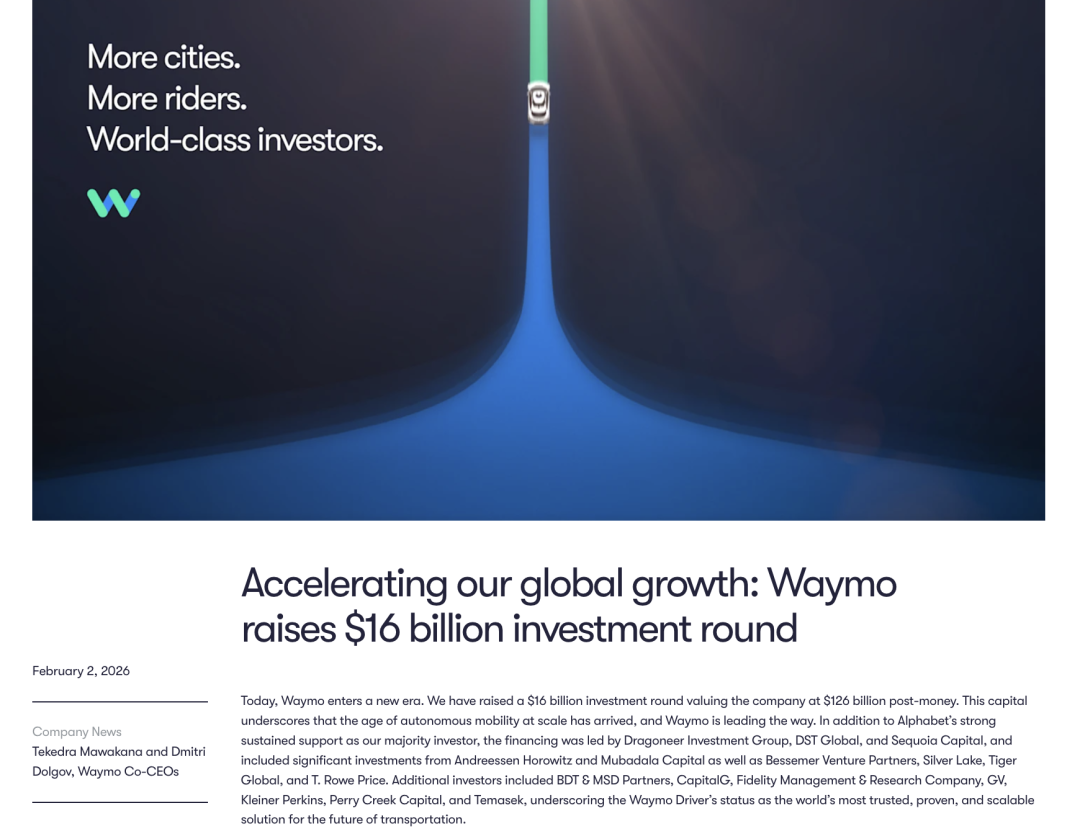
Group 1 - Waymo has completed a $16 billion financing round, achieving a post-money valuation of $126 billion, marking one of the largest single financings in the autonomous driving sector in recent years [1][4] - The financing round was led by Dragoneer Investment Group, DST Global, and Sequoia Capital, with participation from several notable investors including a16z, Mubadala Capital, and T. Rowe Price [1] - Waymo's annual order volume is projected to more than double by 2025, reaching 15 million, with a cumulative order volume exceeding 20 million to date [1] Group 2 - Waymo's valuation has doubled since its last financing round in October 2024, when it raised $5.6 billion at a valuation of over $45 billion [4] - The company operates fully autonomous ride-hailing services in several U.S. cities, including San Francisco and Los Angeles, and plans to expand to over 20 cities globally, including London and Tokyo [4] - The funding will help Waymo scale its fleet and enhance its team to meet the growing demand for autonomous transportation while maintaining industry-leading safety standards [4] Group 3 - The autonomous driving industry is transitioning from small-scale commercial applications to large-scale expansion, with competitors like Tesla also ramping up their Robotaxi services [5] - Tesla's Robotaxi fleet has surpassed 500 vehicles, with plans to launch autonomous services in multiple major U.S. cities by the end of 2026 [5] - In China, companies like WeRide and Pony.ai are entering the "thousand-vehicle" era, with WeRide deploying 1,023 Robotaxis globally and Pony.ai targeting over 1,159 vehicles by 2025 [6] Group 4 - The market potential for Robotaxis in China's first and second-tier cities is projected to reach 1.01 million vehicles by 2030, with a market size estimated at 242.4 billion RMB [7] - The global Robotaxi market is expected to reach approximately $63 billion, equivalent to nearly 500 billion RMB by 2030 [7]

All in AI!别再把特斯拉看成汽车公司
Hua Er Jie Jian Wen· 2026-02-03 05:34
Group 1 - Deutsche Bank's latest report redefines Tesla as a technology company focused on artificial intelligence, robotics, and autonomous driving, rather than just an automotive company [1] - Tesla plans to increase capital expenditures to over $20 billion, primarily for AI training systems, data centers, custom chips, robotic factories, and new platforms [1][2] - The bank maintains a buy rating on Tesla but lowers the target price from $500 to $480, reflecting more conservative expectations for vehicle sales and new model launches [1] Group 2 - Tesla is undergoing a capital-intensive transformation, with billions allocated for computing infrastructure to support large-scale training for autonomous driving and robotics [2] - The autonomous driving and robotics segments are central to Deutsche Bank's long-term outlook, with expectations of up to $10 billion in annual revenue from the FSD subscription service and over $15 billion from the robotaxi network by the end of the decade [2] - Analysts express cautious optimism regarding Tesla's humanoid robot, Optimus, while acknowledging challenges such as engineering complexity and supply chain issues that may limit short-term production [2] Group 3 - The report highlights several risk factors, including weak demand for electric vehicles, intense competition, high execution barriers in AI and robotics, regulatory scrutiny, and reliance on Elon Musk [3] - Despite these risks, Deutsche Bank believes Tesla's scale, data accumulation, and vertical integration provide a strong competitive advantage if the strategy succeeds [3] - The report positions Tesla as a company undergoing significant transformation, aiming to become a leader in AI-driven mobility and automation, with the potential to reshape multiple industries over the next decade [3]
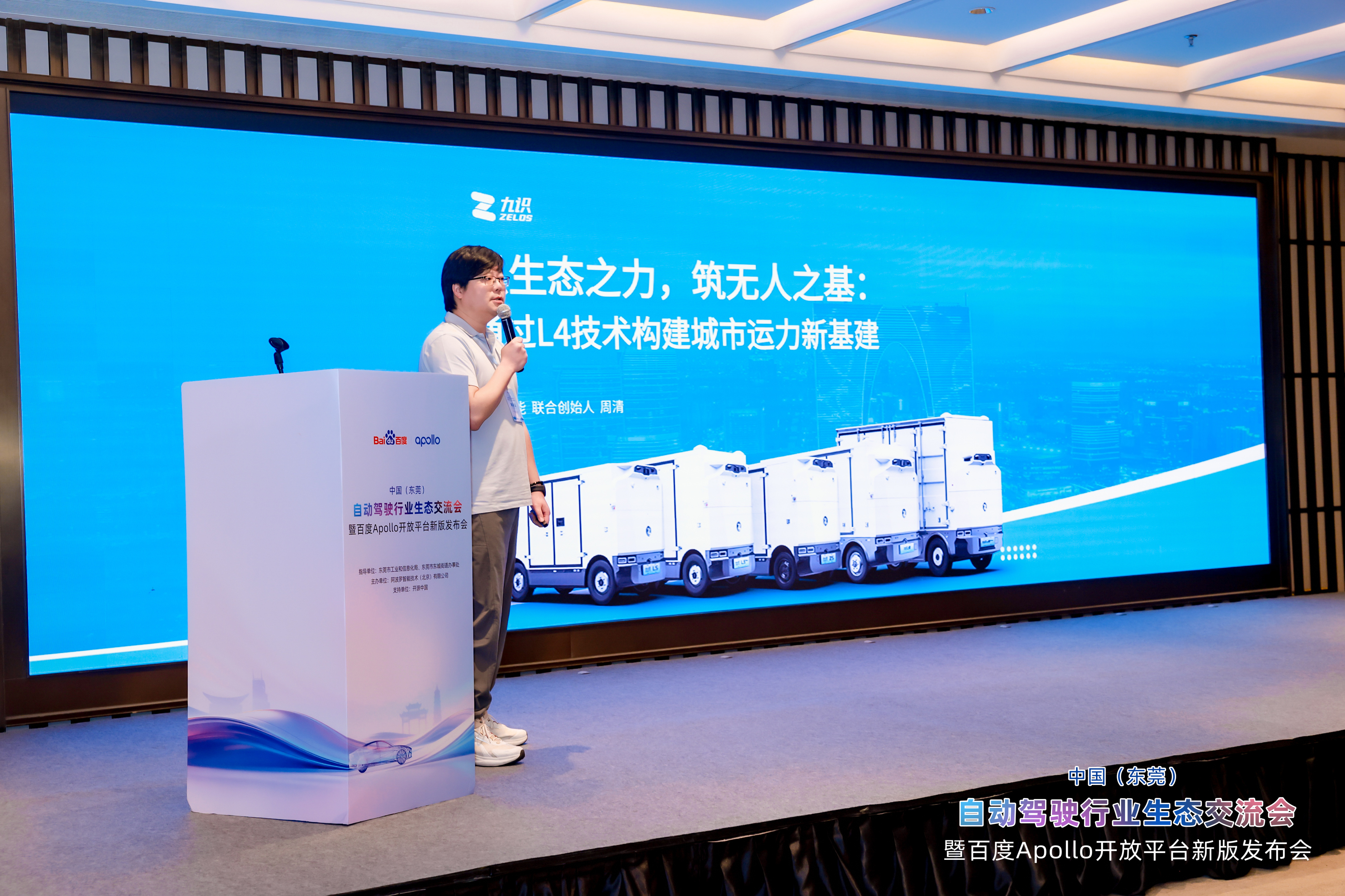
九识智能:致敬百度Apollo开源战略 通过L4技术构建城市运力新基建
Jin Rong Jie· 2026-02-03 04:34
Core Insights - The article discusses the launch of the upgraded Baidu Apollo platform, marking a shift from "technology open-source" to "scenario-driven + ecosystem co-construction" in the autonomous driving sector [1] - Jiushi Intelligent, a leading L4 autonomous delivery vehicle company, emphasizes the rapid commercialization and deployment of unmanned logistics vehicles, which have outpaced smart electric vehicles in achieving L4-level autonomous driving [4][6] Group 1: Industry Development - The global autonomous driving landscape was significantly influenced by Baidu's Apollo project, which initiated a wave of entrepreneurship in the field [5] - The traditional logistics system, based on "manpower + fuel vehicles," is increasingly unable to meet the demands of the booming e-commerce sector, leading to structural inefficiencies [7] - National policies have created a favorable environment for the development of unmanned logistics vehicles, with over 103 cities in China granting road rights for such vehicles [9][10] Group 2: Jiushi Intelligent's Strategy and Achievements - Jiushi Intelligent has developed a comprehensive L4 autonomous driving technology and has deployed over 17,000 vehicles across more than 300 cities globally, achieving over 80 million kilometers of operational mileage [12][20] - The company offers a subscription service for its fully autonomous driving technology, significantly lowering the entry barrier for logistics companies [13] - Jiushi Intelligent has captured a 76% market share among major logistics clients in China and has been selected as a primary supplier for a large-scale procurement project by China Post [20][22] Group 3: Impact on Logistics Efficiency - The introduction of Jiushi Intelligent's unmanned delivery vehicles has led to significant improvements in delivery efficiency, with some clients reporting a 27% increase in delivery performance [16] - The use of these vehicles has also enhanced the logistics experience for rural residents, increasing their online shopping frequency by approximately 30% [18] - Jiushi Intelligent's vehicles have reduced delivery costs by around 60% in certain regions while also contributing to lower carbon emissions through the use of new energy sources [18]