
造船

Search documents
晶采观察丨四中全会将这项任务摆在首位 传递哪些信号?
Yang Guang Wang· 2025-10-28 14:27
10月20日至23日,中国共产党第二十届中央委员会第四次全体会议在京召开。全会审议通过《中共中央 关于制定国民经济和社会发展第十五个五年规划的建议》(以下简称《建议》),圆满完成各项议程。 相信很多人都关注到了这一点,党的二十届四中全会部署12项战略任务,明确把"建设现代化产业体 系,巩固壮大实体经济根基"摆在第一条。这足以说明实体经济的分量,以及对我国"立身之本"的重 视。 市场方面,大国经济都是内需为主导,市场是当今世界最稀缺的资源。因此,构建强大国内市场不仅是 发展的必然选择,更是推进中国式现代化的关键战略依托,这也体现了我们发展的战略定力。在具体路 径上,《建议》提出坚持扩大内需这个战略基点。一是拓展增量,二是提升效益,三是畅通循环。 在提升效益方面,国家发展改革委方面表示,我国固定资产投资年度规模已达到50万亿元,但惠民生、 补短板、育动能等任务还很重,必须把"钱"特别是政府资金更好地用在发展紧要处,花在群众生活上。 对此,《建议》提出优化政府投资结构,提高民生类政府投资比重,统筹用好各类政府投资,加强政府 投资全过程管理等举措,将更好地发挥政府投资的撬动作用,不断增进投资的综合效益。 推动经济行稳 ...
四中全会将这项任务摆在首位 传递哪些信号?
Yang Guang Wang· 2025-10-28 13:12
Core Viewpoint - The Fourth Plenary Session of the 20th Central Committee of the Communist Party of China emphasized the importance of building a modern industrial system and strengthening the foundation of the real economy as a priority for national development [1][2]. Group 1: Industrial Development - The proposal aims to optimize and upgrade traditional industries, focusing on enhancing the global competitiveness of sectors such as chemicals, machinery, and shipbuilding, which account for approximately 80% of the manufacturing value added in China [2]. - An estimated market space of around 10 trillion yuan will be created over the next five years through these initiatives [2]. - The development of emerging pillar industries, including new energy, new materials, aerospace, and low-altitude economy, is expected to generate several trillion-level market opportunities [2]. Group 2: Economic Strategy - The strategy emphasizes the importance of domestic demand as the main driver of the economy, highlighting the need to build a strong domestic market as a key strategic support for modernization [2]. - The proposal outlines three specific pathways to expand domestic demand: increasing volume, enhancing efficiency, and ensuring smooth circulation [2]. Group 3: Investment and Efficiency - The annual scale of fixed asset investment in China has reached 50 trillion yuan, with a focus on improving the effectiveness of government investments in areas that benefit people's livelihoods and address critical gaps [3]. - The proposal suggests optimizing the structure of government investment to increase the proportion allocated to public welfare, thereby enhancing the overall effectiveness of investments [3]. - The synergy between upgrading traditional industries and the growth of emerging industries is crucial for achieving stable and dynamic economic growth [3].
中国的预判没错:坏消息一个接一个,特朗普终于对中国说了大实话
Sou Hu Cai Jing· 2025-10-28 13:11
Group 1: US-China Trade Relations - The US-China trade tensions have escalated since Trump's presidency, with high tariffs causing disruptions in global supply chains [1] - Recent comments from Trump indicate that the high tariffs are unsustainable, leading to a rebound in the US stock market [1][16] - The Australian government has resisted US pressure to decouple from China, emphasizing the economic importance of China as its largest trading partner [3] Group 2: Rare Earth Elements - The US Treasury Secretary criticized China's export controls on rare earth elements, labeling it as "against the world," while G7 discussions on a united response have stalled [4][9] - China controls over 80% of the global rare earth processing chain, making it a critical player in high-tech and military applications [7] - The US's attempts to rally allies against China have been met with hesitance, as countries weigh their own economic dependencies [5][9] Group 3: Shipping and Logistics - The US has imposed additional port fees on Chinese shipping, which China has retaliated against with similar fees on US vessels [10][12] - This tit-for-tat in shipping fees is disrupting logistics and increasing costs for US importers [10][12] Group 4: Technology Sector - Nvidia's market share in China has plummeted from 95% to 0% due to US export controls, highlighting the unintended consequences of such policies [14] - The US's restrictions on technology exports are pushing Chinese companies to innovate and fill the gap left by American firms [14][17] Group 5: Domestic US Issues - The US government shutdown has further complicated trade negotiations, as it hampers the government's operational capacity [16][17] - Trump's acknowledgment that high tariffs are not sustainable reflects the growing pressure from both domestic and international fronts [16][17]


日本5500亿美元投资美国基建,首个项目将于年底前敲定
Jing Ji Guan Cha Wang· 2025-10-28 06:37
Core Insights - The U.S. Secretary of Commerce, Gina Raimondo, stated that the $550 billion investment framework between Japan and the U.S. will focus on low-risk infrastructure sectors such as power generation and energy pipelines [1] - Approximately 10 to 12 Japanese companies, including those in the electricity and shipbuilding sectors, are exploring specific investment plans in the U.S., with the first project expected to be finalized by the end of the year [1] - The investment aims to enhance economic security for both nations, with the initial project likely to come from the power industry, driven by the growing electricity demand in the U.S. due to data center expansion [1] - Japanese companies are expected to supply gas turbines and other equipment to boost U.S. power generation capacity [1] - The Alaskan liquefied natural gas (LNG) project is also under consideration, with Japanese involvement potentially aiding in achieving energy independence [1] - More than half of the $550 billion is anticipated to be allocated to the power and energy sectors [1]
美国商务部长:日本5500亿美元投资用于基础设施
日经中文网· 2025-10-28 03:10
Group 1 - The core viewpoint of the article is that the U.S. and Japan have reached an agreement on a $550 billion investment framework aimed at enhancing economic security through joint investments, particularly in low-risk infrastructure projects such as power generation and pipelines [2][6]. - U.S. Secretary of Commerce Gina Raimondo indicated that the first projects under this framework are expected to be finalized by 2025, with 10 to 12 Japanese companies exploring investment opportunities in the U.S. [2][4]. - The investment framework is seen as a means to bolster both U.S. and Japanese economic security, with a significant portion of the funds likely directed towards energy projects, including the development of liquefied natural gas (LNG) in Alaska [6][7]. Group 2 - The U.S. Commerce Department plans to facilitate the issuance of work visas for Japanese companies investing in the U.S., addressing concerns about the difficulty of obtaining such visas under the current administration [7]. - There is an ongoing discussion about the introduction of sector-specific tariffs, particularly on semiconductors, while maintaining a 15% tariff rate for Japanese-produced semiconductors and pharmaceuticals [7][8]. - The U.S. and Japan have reached a consensus to minimize tariffs on semiconductors and pharmaceuticals, although there are concerns regarding the U.S. commitment to uphold this agreement [8].

美财长:不再考虑对华加征100%关税
Sou Hu Cai Jing· 2025-10-27 12:04
Core Points - The recent two-day trade talks between China and the U.S. in Kuala Lumpur resulted in a basic consensus on key economic issues, including maritime logistics, shipbuilding, and agricultural trade [1][2][3] - Both sides emphasized the importance of mutual respect and cooperation to resolve trade disputes, highlighting the significance of the U.S.-China economic relationship on a global scale [2][5] - The discussions were described as constructive, with both parties expressing a commitment to further detail and internal approval processes for the agreements reached [1][4] Group 1 - The talks were led by China's Vice Premier He Lifeng and U.S. Treasury Secretary Steven Mnuchin, lasting over five hours on the first day [2][3] - The U.S. Treasury Secretary stated that a "very successful framework" was established during the negotiations, which could pave the way for a meeting between the two countries' leaders [3][4] - The outcome of the talks is seen as a sign of easing tensions between the two largest economies, with the current suspension of tariffs set to expire on November 10 [4][5] Group 2 - The discussions covered a wide range of topics, including export controls, the extension of tariff suspensions, and cooperation on fentanyl issues, indicating a comprehensive approach to trade relations [2][5] - Analysts noted that the timing of the talks before the APEC meeting could signal a positive development in U.S.-China relations, which is crucial for global economic stability [5][6] - The upcoming APEC meeting is expected to be influenced by the outcomes of the U.S.-China discussions, with South Korea playing a pivotal role as the host [6][7]
韩国股市:首破4000点,三星电子股价首破10万韩元
Sou Hu Cai Jing· 2025-10-27 11:26
Core Points - The South Korean stock market has closed above the 4000-point mark for the first time, reaching a historic high of 4042.83 points, with a significant increase in trading volume and value [1] - The Korean won has appreciated against the US dollar, with the exchange rate at 1431.70 won per dollar, up by 5.40 won from the previous day [1] - Institutional and foreign investors have shown strong buying interest, net purchasing 2340.7 billion won and 6455.4 billion won in stocks respectively, while retail investors net sold 7945.1 billion won [1] Market Performance - The KOSPI index rose by 101.24 points, with 561 stocks gaining and 319 stocks declining [1] - Notable stock performances include Samsung Electronics, which increased by 3.24% to 102,000 won, and SK Hynix, which rose by 4.9% to 535,000 won [1] - Hyundai Motor's stock price increased by 0.79% to 255,500 won, while Hyundai Heavy Industries surged by 17.02% to 212,500 won [1] - Declining stocks included Korea Electric Power, down by 0.69% to 43,000 won, and POSCO, which fell by 1.69% to 320,000 won [1] Market Sentiment - The market rebound is attributed to optimistic sentiment regarding trade agreements and increased appetite for risk assets amid expectations of further interest rate cuts in the US [1]
国家发展改革委:市场是最稀缺的资源 将建设强大国内市场
Zhong Guo Jing Ying Bao· 2025-10-27 06:19
Core Insights - The article discusses the key points from the press conference held by the Central Committee of the Communist Party of China, focusing on the "14th Five-Year Plan" and its implications for industry development and market construction [2][3]. Group 1: Industry Development - Traditional industries are emphasized as the "basic plate" of China's industrial system, contributing approximately 80% to the manufacturing value added [2]. - The plan aims to enhance key industries such as chemicals, machinery, and shipbuilding to strengthen international competitiveness, with an estimated market space of about 10 trillion yuan to be added over the next five years [2]. Group 2: Market Construction - The article outlines three key tasks for expanding domestic demand: "expanding increment," "improving efficiency," and "smoothening circulation" [3]. - The potential for expanding domestic demand is significant, with actions proposed to boost consumption, maintain reasonable investment growth, and enhance the participation of private enterprises in major projects [3]. - The government aims to optimize investment structures, increase the proportion of investments in people's livelihoods, and improve overall management to enhance the effectiveness of government investments [3]. - The negative list for market access has been reduced from 328 to 106 items, and over 4,200 policies hindering factor flow have been cleared, although challenges remain [3]. Group 3: Policy Changes - The recent plenary session highlighted a shift in focus towards building a strong domestic market, indicating a stronger commitment to domestic market development compared to previous plans [4]. - The new emphasis on combining investments in goods and people suggests that more policy resources will be allocated to consumer and livelihood enhancement, potentially including expanded subsidies for childbirth [4]. - The prioritization of "boosting consumption" over "expanding total investment" in the latest plan signals a clear focus on consumption expansion as a core direction for economic work in the coming five years [5].

亚太股市,全线大涨,A50高开
Zheng Quan Shi Bao· 2025-10-27 02:04
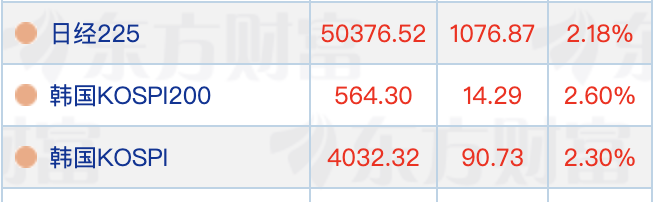
Market Performance - Global stock markets showed strong performance on October 27, with significant gains in Japan and South Korea, where the Nikkei 225 index surpassed 50,000 points [1] - The Nikkei 225 index rose by 2.18%, reaching 50,376.52 points, while the KOSPI200 and KOSPI indices increased by 2.60% and 2.30%, respectively [2] Individual Stock Movements - Notable individual stock performances included Kawasaki Heavy Industries, which surged over 6%, and several other Japanese companies like Hitachi and Komatsu, which rose more than 3% [2][3] - In South Korea, Hanwha's stock jumped over 20%, with Hyundai Heavy Industries and Samsung Heavy Industries also seeing gains exceeding 10% [4] US Market Futures - US stock index futures were also on the rise, with the Dow Jones futures up over 0.58%, S&P 500 futures up 0.69%, and Nasdaq 100 futures up 0.88% [4][5] Economic Indicators - Recent economic data showed that the US Consumer Price Index (CPI) for September rose by 0.3%, lower than the expected 0.4%, indicating a potential for interest rate cuts by the Federal Reserve [7] - The market anticipates a 98.3% probability of a 25 basis point rate cut during the upcoming Federal Reserve meeting [8] Central Bank Actions - The Federal Reserve is expected to announce a halt to its balance sheet reduction, which has been aimed at withdrawing liquidity from the financial markets [9] - Other central banks, including the European Central Bank and the Bank of Japan, are also expected to maintain current interest rates in their upcoming meetings [9] A-Share Market Outlook - Analysts suggest that the A-share market may stabilize after recent volatility, with a focus on the technology sector as a long-term investment theme [10] - The upcoming earnings reports from technology giants are anticipated to be a focal point, particularly in the context of the accelerating global AI arms race [10]
中信证券:预计将强化基础研究投入,进一步支持“原始创新和关键核心技术攻关”
Xin Lang Cai Jing· 2025-10-27 00:50
Core Insights - The report emphasizes the importance of building a modern industrial system and strengthening the foundation of the real economy, reflecting the policy makers' high attention to modern industrial systems and new productive forces [1] Group 1: Achievements and Future Outlook - During the "14th Five-Year Plan" period, the contribution of new productive forces to the economy has significantly increased, with strategic emerging industries surpassing the real estate sector in contribution since 2023. The "15th Five-Year Plan" period is expected to see new policy support for industries such as new energy, new materials, aerospace, and future industries like quantum technology [1] - Since 2021, the manufacturing sector has maintained a reasonable share in the national economy. In the "15th Five-Year Plan" period, it is anticipated that policy focus on manufacturing will intensify, with traditional industries like chemicals, machinery, and shipbuilding undergoing quality upgrades, while advanced manufacturing clusters in aerospace and biomanufacturing may encounter new development opportunities [1] - The contribution of technological advancements to China's economic growth has been steadily increasing in recent years. The "15th Five-Year Plan" period will further highlight the importance and urgency of achieving high-level technological self-reliance, with expectations for increased investment in basic research and support for original innovation and key core technology breakthroughs [1]
