新能源车
Search documents
平替时代:一家车企、一个行业如何被自己的成功困住
晚点LatePost· 2025-11-13 16:16
Core Viewpoint - The article discusses the challenges faced by Li Auto in the competitive landscape of the Chinese electric vehicle market, highlighting the shift towards price competition and the concept of "value-for-money" or "平替" (ping ti), which translates to "alternative" or "substitute" products that offer similar features at lower prices [4][8][39]. Group 1: Market Position and Competition - Li Auto has maintained its position as a leading new energy vehicle manufacturer since the success of its L9 model in 2022, but recently faced increased competition from rivals like XPeng and NIO, with XPeng surpassing Li Auto in market capitalization [4][6]. - In October, Li Auto's sales ranked seventh among new energy vehicle manufacturers, trailing behind brands such as Leap Motor, XPeng, Xiaomi, and NIO [4][6]. - The competitive landscape has intensified, with NIO entering the mid-range market and offering lower-priced models, further squeezing Li Auto's market share [8][21]. Group 2: Product Strategy and Pricing - Li Auto's i8 model was launched at a price exceeding 320,000 yuan, competing directly with Tesla's Model Y and NIO's models, but failed to gain traction due to its high price point [6][8]. - Following the underperformance of high-priced models, Li Auto shifted its strategy, launching the i6 at a significantly lower price, which quickly garnered 80,000 orders despite a low gross margin of around 10% [8][9]. - The company previously aimed for a 20% gross margin to fund R&D, but the current market dynamics have forced it to compromise on pricing to remain competitive [8][9]. Group 3: Industry Trends and Consumer Behavior - The article emphasizes that successful electric vehicles often serve as "平替" for more expensive models, with brands like BYD and Tesla leading the way by offering high-performance vehicles at competitive prices [9][11]. - The trend of "平替" has become prevalent in the industry, with various brands launching models that provide similar features to luxury vehicles at significantly lower prices, thus intensifying price competition [21][39]. - As the market matures, the differentiation between electric vehicles has diminished, leading to a focus on price and features rather than brand prestige [22][39]. Group 4: Future Outlook and Challenges - The article suggests that the ongoing price wars and the shift towards "平替" models may lead to a scenario where only the most efficient and scalable manufacturers survive, similar to trends observed in mature markets [39][46]. - The rapid technological advancements and the emergence of new players in the market have created a challenging environment for established brands, as they must continuously innovate to maintain their competitive edge [46][50]. - The article concludes that the electric vehicle market in China is characterized by an ongoing cycle of competition, where brands must adapt to consumer preferences for value and performance [39][50].
万亿巨头,大涨!百亿级产品爆发
Zhong Guo Zheng Quan Bao· 2025-11-13 15:09
Group 1: Market Performance - A-shares and Hong Kong stocks saw strong gains in battery and automotive sectors, with CATL's stock price rising over 7%, approaching historical highs, and its market capitalization exceeding 1.9 trillion yuan [1] - Multiple battery ETFs and new energy vehicle ETFs experienced significant increases, with several battery ETFs rising by 70% year-to-date [1][3] - The lithium battery industry chain saw a broad increase, with battery ETFs (159755) rising by 7.14% and achieving a year-to-date increase of over 77% [3] Group 2: ETF Performance - Several battery-themed ETFs showed strong performance, with the largest battery ETF (159755) having a net inflow of 8.4 billion yuan this year, reaching a total size of over 15 billion yuan [3] - Metal-themed ETFs also performed well, driven by rising prices of lithium carbonate, silver, gold, and copper, with rare metal ETFs increasing by over 5% [5] - Bond ETFs, particularly those focused on innovative technology, saw high trading volumes, with several achieving transaction amounts exceeding 10 billion yuan [7] Group 3: Investment Trends - Gold, innovative technology boards, and non-bank financial sectors have become significant targets for capital inflow, with multiple related ETFs seeing net inflows exceeding 1 billion yuan this week [9][10] - The recent World Power Battery Conference resulted in 180 signed projects worth 86.13 billion yuan, indicating strong industrial development momentum in the new energy sector [11] - The demand for rare metals is expected to grow due to the needs of new energy vehicles and high-end manufacturing, highlighting the cyclical growth attributes and investment value of the rare metals sector [11]
新能源车销量持续走高,动力电池产能吃紧?
Mei Ri Jing Ji Xin Wen· 2025-11-13 13:30
Core Insights - The current supply of power batteries in China is tight, with high capacity utilization rates among manufacturers, leading to competition among automakers to secure battery supplies [1][2] - The increase in demand for new energy vehicles (NEVs) has resulted in a "battery hoarding" battle among car manufacturers, driven by optimistic market expectations and the upcoming traditional sales peak in Q4 [2][3] - The adjustment of the new energy vehicle purchase tax is influencing manufacturers to accelerate delivery schedules to improve financial performance [3][4] Industry Dynamics - The production and sales of NEVs in China from January to October reached 13.015 million and 12.943 million units, respectively, marking a year-on-year increase of over 30% [2] - In October, NEV sales exceeded 50% of total new car sales for the first time, indicating a significant market shift [2] - The demand for high-nickel batteries, primarily used in high-end electric and hybrid vehicles, is currently constrained due to supply chain issues and raw material price fluctuations [4][5] Supply Chain Challenges - The storage market's explosive growth is a key factor contributing to the tight supply of power batteries, with the demand for lithium batteries in storage applications surging [5][6] - The production capacity for lithium iron phosphate batteries is sufficient overall, but many production lines are being diverted to meet storage project demands, leading to resource competition [5][6] - The third quarter of this year saw a 65% year-on-year increase in China's storage lithium battery shipments, with total shipments expected to reach 580 GWh for the year, a 67% increase [5][6] Future Outlook - The demand for storage is expected to remain strong, with global installation growth projected at 40% to 50% next year [7] - The ongoing high demand for storage is likely to continue affecting the availability of power batteries for electric vehicles, particularly those using lithium iron phosphate technology [7] - The current battery shortage is viewed as a short-term issue, with expectations of improved supply in the future [7]
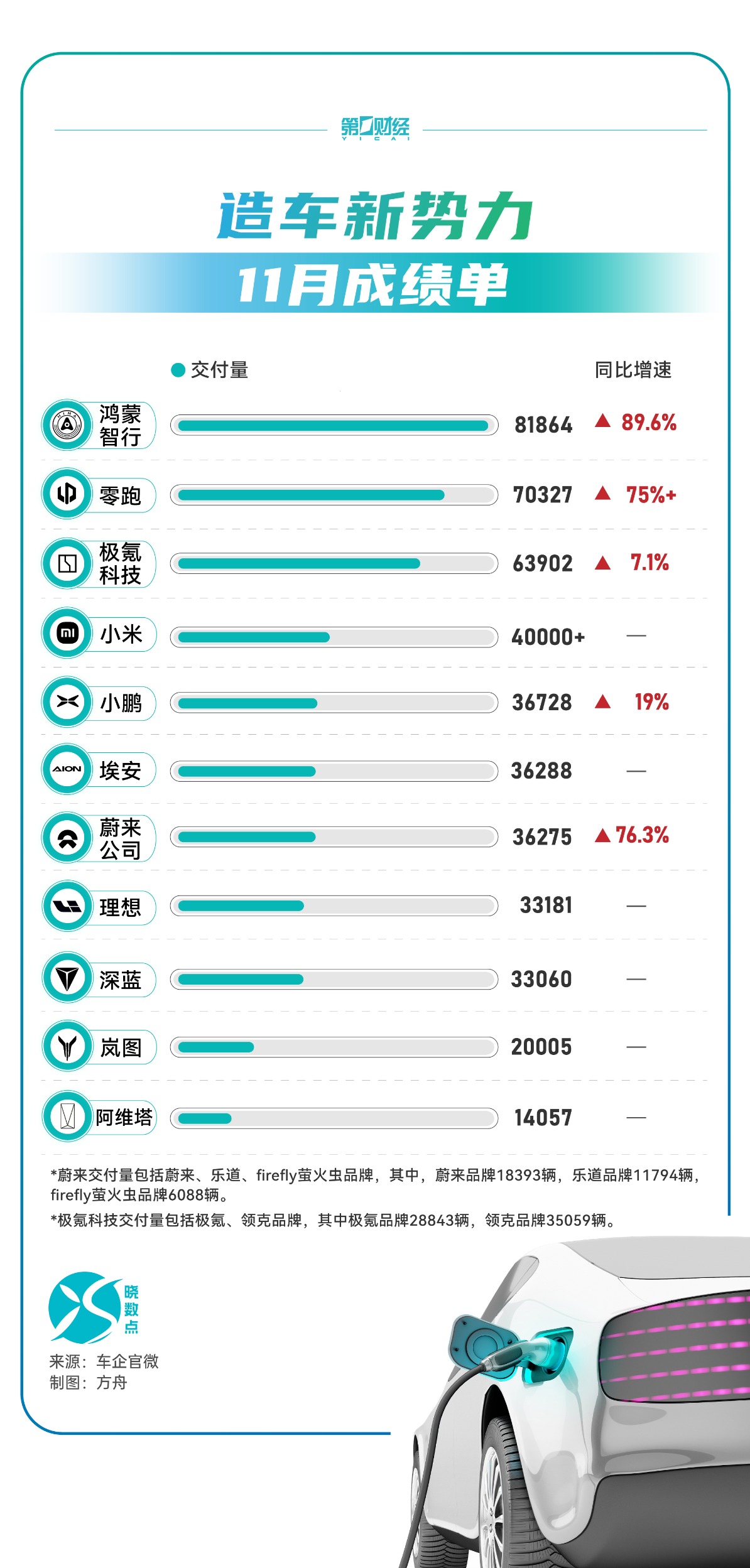
10月新能源车销量“成绩单”:比亚迪销售44万,零跑超7万,蔚来/小鹏/小米破4万
高工锂电· 2025-11-13 11:39
Core Viewpoint - The article highlights the performance of various electric vehicle brands in October 2025, showcasing the sales growth and market dynamics in the Chinese electric vehicle sector, particularly during the traditional peak sales season. Group 1: Overall Market Performance - October 2025 marked a traditional peak sales season for the automotive market, driven by the National Day holiday's customer attraction effect and year-end policy adjustments [5] - Among the 12 tracked automotive brands, most reported positive growth in new energy vehicle sales for October, with only Li Auto and GAC Aion showing negative month-on-month growth [5] Group 2: Brand-Specific Sales Data - BYD sold approximately 441,706 vehicles in October, a month-on-month increase of 11.5% but a year-on-year decrease of 12.1%. Cumulatively, BYD's sales from January to October reached about 3.7 million, reflecting a year-on-year growth of 13.9% [6] - Leap Motor achieved a record high of 70,289 vehicle deliveries in October, marking a year-on-year increase of over 84% and a cumulative total of 465,805 vehicles for the year, up 120.7% [8] - Xpeng Motors delivered 42,013 vehicles in October, a year-on-year increase of 76% and a month-on-month growth of 1%. The cumulative total for the year reached 355,209 vehicles, up 190% [10] - NIO delivered 40,397 vehicles in October, with a year-on-year growth of 92.6%. The cumulative total for the year stands at 913,182 vehicles [13] - Xiaomi's vehicle deliveries exceeded 40,000 in October, maintaining the same level as the previous month but doubling compared to the same period last year. The cumulative total for the year surpassed 290,000, reflecting a growth of 283.2% [17] - Deep Blue Automotive sold 36,792 vehicles in October, with a year-on-year increase of 32.1% and a cumulative total of 269,058 vehicles for the year, up 57.1% [19] - Li Auto delivered 31,767 vehicles in October, showing a year-on-year decline of 38.2% and a cumulative total of 328,916 vehicles for the year, down 16.4% [22] - GAC Aion's sales reached 27,014 vehicles in October, with a year-on-year decrease of 32.6% and a cumulative total of 261,992 vehicles for the year, down 25.9% [24] - Zeekr delivered 21,423 vehicles in October, with a year-on-year decline of 14.5% but a month-on-month increase of 17.3%. The cumulative total for the year is 165,023 vehicles, down 1.7% [27] - Lantu delivered 17,218 vehicles in October, reflecting a year-on-year increase of 70% and a cumulative total of 114,210 vehicles for the year, up 82% [31] - Avita's sales reached 13,506 vehicles in October, with a year-on-year growth of 34.3% and a cumulative total of 104,245 vehicles for the year, up 104.6% [33] - Zhiji Automotive delivered 13,159 vehicles in October, marking a year-on-year increase of 31.6% and a cumulative total of 63,452 vehicles for the year, up 27.1% [36]
幸亏奇瑞没爬上去
3 6 Ke· 2025-11-13 10:33
Core Viewpoint - The incident involving Chery has paradoxically elevated its visibility in the competitive landscape of the Chinese electric vehicle (EV) market, despite being a failure in execution [1][2][9]. Group 1: Chery's Position in the Market - Chery has historically positioned itself as a "technical" and "practical" brand, avoiding conflicts with other automakers and focusing on engineering excellence [2][3][6]. - The recent incident reflects a shift in Chery's marketing strategy, contrasting with its previous image of a reliable and conservative brand [6][8]. Group 2: Industry Dynamics - The current EV market is characterized by intense competition and negative publicity among various brands, leading to a culture of public ridicule rather than serious technical discourse [4][5][10]. - The incident highlights the industry's trend towards sensational marketing tactics as automakers struggle to differentiate themselves in a market with high product homogeneity [5][11]. Group 3: Consumer Perception and Brand Image - The public's reaction to Chery's incident has been mixed, with some defending the brand's willingness to take risks, while others criticize it for poor execution [2][3][4]. - The incident has generated significant online engagement, transforming a negative event into a source of entertainment and discussion, which may not necessarily harm Chery's brand in the short term [2][4][8]. Group 4: Future Implications for the Industry - The incident serves as a cautionary tale for the entire EV sector, emphasizing the need for brands to focus on long-term value and consumer trust rather than short-lived marketing stunts [12][13]. - The industry must recognize that sustainable success relies on delivering consistent and reliable products rather than engaging in a race for attention through extreme marketing [12][13].
百公里加速时间不少于5秒,校准新能源车“航道”
Xin Jing Bao· 2025-11-13 07:54
Core Viewpoint - The recent draft of the national standard for motor vehicle operation safety emphasizes the need for a default acceleration time of no less than 5 seconds for passenger cars, reflecting a regulatory response to the rapid development of new energy vehicles and the associated safety challenges [1][3]. Group 1: Regulatory Changes - The Ministry of Public Security has organized the completion of the draft for the national standard "Technical Conditions for Motor Vehicle Operation Safety," which includes speed limit requirements [1]. - The proposed regulation aims to set a default acceleration time of no less than 5 seconds for passenger vehicles, addressing safety concerns related to the high acceleration capabilities of some new energy vehicles [3]. Group 2: Industry Implications - The focus on acceleration performance in marketing may blur the lines between high-performance and regular vehicles, potentially leading to misuse by drivers lacking the necessary skills [2]. - The automotive industry may face a trend of excessive competition in acceleration performance, diverting resources from critical areas such as overall vehicle safety and technological advancement [2][3]. Group 3: Safety Measures - The draft standard includes various safety enhancements, such as requiring electric and plug-in hybrid vehicles to have the ability to quickly cut off power circuits to reduce fire risks [3]. - Additional provisions aim to prevent driver distraction by automatically disabling entertainment features when the vehicle exceeds 10 km/h [3]. Group 4: Consumer Trust and Industry Development - The industry is encouraged to prioritize safety technology over mere speed and flashy marketing, as this approach is essential for building long-term consumer trust and ensuring sustainable high-quality development in the Chinese automotive sector [4].
新能源暴力反弹!宁德时代飙涨7%,新能源车ETF、创业板新能源ETF华夏涨超5%
Ge Long Hui· 2025-11-13 03:11
Core Viewpoint - The new energy sector experienced a significant rebound, with notable stock price increases for companies like CATL and new energy vehicle ETFs, driven by strong demand for energy storage and strategic partnerships in the industry [1] Group 1: Market Performance - CATL's stock surged by 7%, while Xinzhoubang rose over 17%, and companies like Shengxin Lithium Energy and Tianci Materials hit the daily limit [1] - The new energy vehicle ETF increased by 5.84%, and the ChiNext new energy ETF Huaxia rose by 5.15% [1] Group 2: Industry Developments - Haibosi Chuang and CATL announced a supply cooperation for battery and system products, confirming strong global demand for energy storage and a shortage of high-end products according to Morgan Stanley [1] - The China Photovoltaic Industry Association refuted claims of excessive competition, emphasizing the industry's commitment to avoid destructive competition [1] - The National Energy Administration released guidelines to promote the integrated development of new energy, mentioning the orderly promotion of new energy heating applications and exploring the construction of pumped storage and new energy storage as regulatory power sources [1] Group 3: Notable Products - The largest scale new energy vehicle ETF (515030) includes key stocks such as Huayou Cobalt, Tianqi Lithium, and Ganfeng Lithium, along with battery manufacturers like CATL and Huichuan Technology [1] - The ChiNext new energy ETF Huaxia (159368), which tracks the ChiNext new energy index, includes major stocks like CATL and Huichuan Technology, with over 70% content in energy storage and solid-state batteries [1]
动力电池大会开幕,新能源车ETF(515030)大涨3.14%,新宙邦领涨
Mei Ri Jing Ji Xin Wen· 2025-11-13 02:06
Core Viewpoint - The A-share market experienced a collective rise, with the New Energy Vehicle ETF (515030) leading the gains, reflecting positive sentiment in the sector driven by advancements in battery technology and infrastructure [1] Industry Summary - As of November 13, the New Energy Vehicle ETF (515030) surged by 3.14%, with a trading volume of 57.43 million yuan, indicating strong investor interest [1] - Key stocks within the ETF, such as Xinzhou Bang, Tianhua New Energy, and others, saw significant increases, with Xinzhou Bang rising over 16% [1] - The 2025 World Power Battery Conference held on November 12 highlighted advancements in solid-state battery technology, with CATL's chairman stating that the company is at the forefront of research and industrialization globally [1] - CATL's battery swapping system is designed to be compatible with solid-state batteries, enhancing its market position [1] - The Chocolate Battery Swapping Alliance has established a presence in over 40 cities across China, with plans to build 1,000 battery swapping stations by the end of the year [1] - Long-term growth prospects for Chinese lithium battery companies are optimistic, supported by their leading production capacity and advanced technology in the global market [1] Company Summary - The New Energy Vehicle ETF (515030) is currently the largest themed ETF in the market, tracking the CSI New Energy Vehicle Index (399976) [1] - The ETF includes stocks from companies involved in lithium batteries, charging stations, and new energy vehicles, with battery-related stocks accounting for 51.9% of its composition [1]
新能源车要开始卷充电速度了
虎嗅APP· 2025-11-13 00:09
Core Viewpoint - The article discusses the growth of China's new energy vehicles (NEVs) and charging piles, highlighting the decreasing vehicle-to-pile ratio while emphasizing that the charging difficulties persist due to the imbalance between private and public charging infrastructure [5][6][8]. Group 1: Growth of NEVs and Charging Infrastructure - In 2020, China had 4.92 million NEVs and 1.68 million charging piles, with a vehicle-to-pile ratio of 3.1:1. By 2022, NEV ownership rose to 13.1 million, and charging piles increased to 5.2 million, reducing the ratio to 2.5:1 [5][6]. - Projections for 2024 indicate NEV and charging pile ownership will reach 31.4 million and 13.08 million, respectively, with a further decrease in the vehicle-to-pile ratio to 2.4:1 [6]. - As of mid-2025, NEV ownership is expected to hit 36.89 million, with charging piles around 16.04 million, leading to a vehicle-to-pile ratio of 2.3:1 [6]. Group 2: Charging Difficulties - The article argues that simply observing a declining vehicle-to-pile ratio does not accurately reflect the alleviation of charging difficulties, as it fails to differentiate between public and private charging piles [8]. - By the end of 2024, out of 16.04 million charging piles, 11.94 million will be private piles, leaving owners of vehicles without charging piles reliant on public options [10]. - The growth of private piles has consistently outpaced public piles, with private piles increasing by 373,000 and public piles by only 85,300 in 2024 [11]. Group 3: Public Charging Infrastructure Challenges - The article identifies three critical variables affecting charging difficulties: the percentage of vehicle owners with private charging piles, the ratio of new public piles to vehicles without charging piles, and the ratio of existing vehicles to public piles [14][15]. - The ratio of existing vehicles to public piles has worsened from 6.5:1 in 2021 to 9:1 by mid-2025, indicating that the growth of public charging infrastructure is lagging behind vehicle sales [15][17]. - The annual production of 30 million vehicles contrasts sharply with the addition of only 850,000 public charging piles, highlighting inefficiencies in public charging infrastructure investment and operation [17]. Group 4: Economic Viability of Charging Operators - The article discusses the performance of 特来电 (Telai Electric), which operates 792,000 public charging terminals, holding a 24% market share as of mid-2025 [19]. - Despite a significant number of terminals, the average profit per terminal is low, with each terminal generating only 4.1 yuan in gross profit per day [24]. - The decline in revenue per terminal is attributed to the expansion of partnerships and collaborations, which dilute the profitability of individual charging stations [22]. Group 5: Charging Speed and User Experience - The article emphasizes that the primary issue is not the number of charging piles but the slow charging speed, which contributes to user anxiety regarding vehicle range [29]. - Current average charging power across 18 million charging piles is only 44 kW, leading to long wait times for users [31]. - The article advocates for a "charging revolution" where charging speeds match those of refueling gasoline vehicles, which would significantly improve user experience and operational efficiency for charging operators [31][38]. Group 6: Government Initiatives and Future Outlook - As of September 2025, China aims to have 28 million charging piles by 2027, with a focus on increasing charging speed and efficiency [32]. - The government has recognized the need for faster charging solutions and plans to enhance the infrastructure to support high-power charging stations [32]. - The article concludes that the future of NEV competitiveness will hinge on charging convenience and speed, rather than just battery capacity [41].
A股近日大幅震荡原因,前景如何?|资本市场
清华金融评论· 2025-11-12 12:13
Group 1 - The recent significant adjustments in A-shares are attributed to large funds rebalancing their portfolios, with the Shanghai Composite Index consolidating around the 4000-point mark, indicating potential upward momentum in the future [3][4]. - Data shows that by Q3 2025, large funds increased their positions in the pan-technology sector by over 10%, reaching nearly 40%, a historical high that is unsustainable, prompting a necessary rebalancing [5]. - Historical trends indicate that large funds have previously "herded" into sectors, such as bank stocks in 2009, which were considered growth stocks due to rapid economic expansion [5]. Group 2 - The "anti-involution" stocks and resource stocks (such as precious metals) are highlighted as sectors that have not been discredited, with the Chinese government's focus on high-quality development supporting this trend [7]. - Precious metals like gold are expected to benefit from a weakening dollar and increased demand due to geopolitical risks, while copper is seen as essential for green transformation, with demand surging from sectors like AI and electric vehicles [7][8]. - Aluminum demand is also projected to rise due to its applications in lightweighting for electric vehicles and solar energy, with supply constraints leading to a bullish outlook on prices [7][8]. Group 3 - Recent economic data, particularly the positive CPI figures, have raised expectations for economic recovery, leading to a rebound in some consumer stocks [10]. - The long-term investment perspective emphasizes the importance of patience, as short-term market movements are often driven by emotions rather than fundamentals [10].