
石油和天然气开采业

Search documents
11月化学原料和化学制品制造业同比增长6.7%
Guo Jia Tong Ji Ju· 2025-12-17 00:33
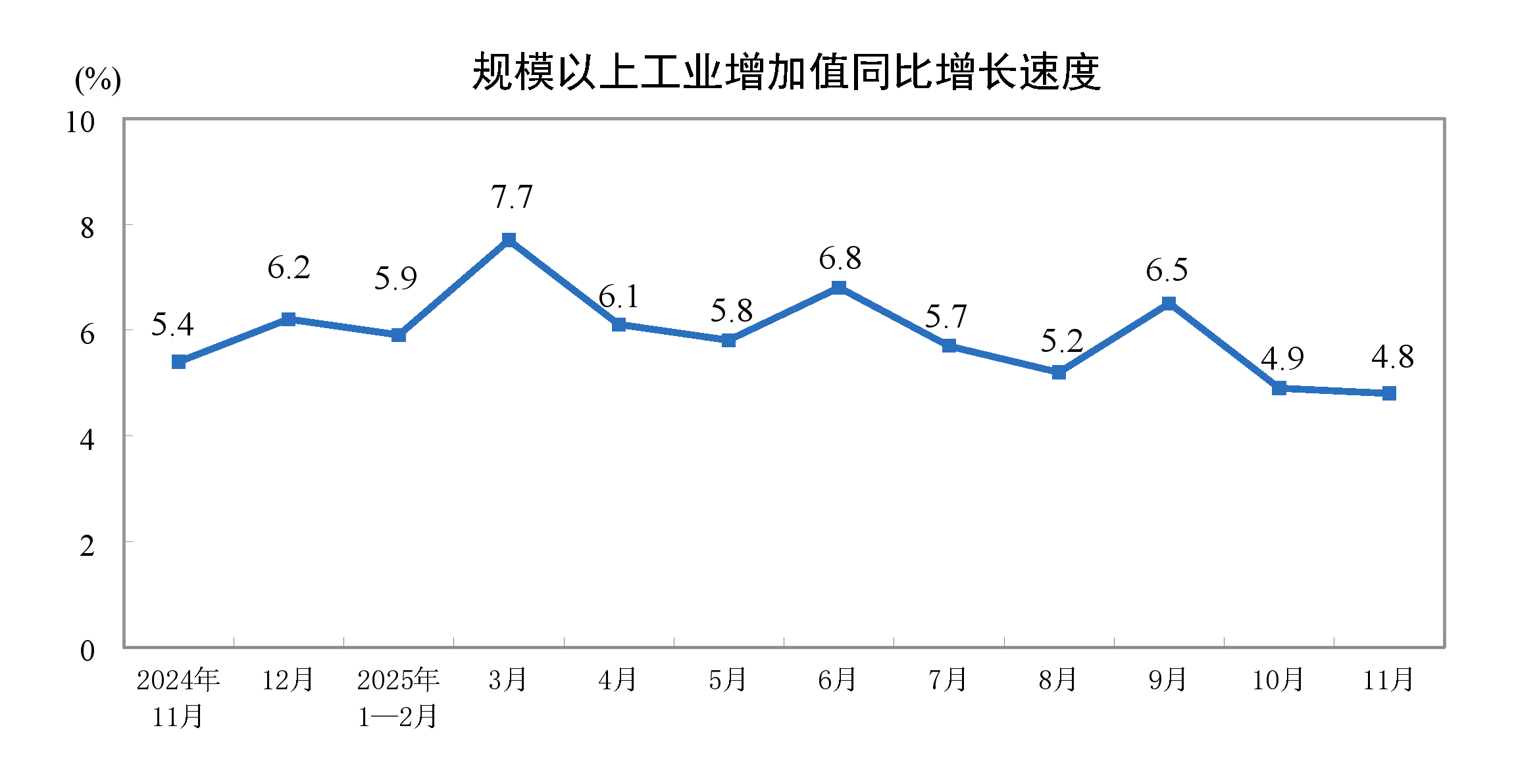
Core Insights - In November, the industrial added value of large-scale enterprises increased by 4.8% year-on-year, with significant growth in the petroleum and natural gas extraction industry at 5.1% and the chemical raw materials and chemical products manufacturing industry at 6.7% [1][2] - From January to November, the industrial added value grew by 6.0% year-on-year, with the petroleum and natural gas extraction industry increasing by 4.2% and the chemical raw materials and chemical products manufacturing industry by 7.8% [1] - The mining industry saw a year-on-year increase of 6.3% in November, while manufacturing and electricity, heat, gas, and water production and supply industries grew by 4.6% and 4.3%, respectively [1] Industry Performance - In November, out of 41 major industry categories, 30 experienced year-on-year growth in added value, with notable increases in coal mining and washing at 7.5%, petroleum and natural gas extraction at 5.1%, and food processing at 1.7% [2] - The automotive manufacturing industry showed a strong performance with an 11.9% increase, alongside transportation equipment manufacturing, which also grew by 11.9% [2] - The production of 310 out of 623 industrial products increased year-on-year in November, with significant growth in ethylene at 7.3% and ten non-ferrous metals at 4.7% [2] Sales and Exports - The product sales rate for large-scale industrial enterprises was 96.5%, reflecting a year-on-year decline of 0.8 percentage points [3] - The export delivery value for large-scale industrial enterprises reached 1.361 trillion yuan, showing a nominal year-on-year decrease of 0.1% [3]
前11月四川规上工业增加值同比增长6.8%
Si Chuan Ri Bao· 2025-12-17 00:21
Economic Overview - The total retail sales of consumer goods in Sichuan Province reached 26,395.7 billion yuan, with a year-on-year growth of 5.5%, surpassing the national average by 1.5% [1] - Among 41 major industries, 33 reported year-on-year growth in added value [1] Industrial Performance - The added value of industrial enterprises above designated size grew by 6.8%, exceeding the national growth rate by 0.8% [1] - Key industries contributing to growth include: - Automotive manufacturing: 18.2% increase - Electrical machinery and equipment manufacturing: 13.7% increase - Computer, communication, and other electronic equipment manufacturing: 12.7% increase - Chemical raw materials and products manufacturing: 12.0% increase - Oil and gas extraction: 11.1% increase [1] High-tech and Green Industries - High-tech manufacturing and green low-carbon industries maintained strong growth, with significant increases in product output: - Smart TVs: 65.6% increase - Lithium-ion batteries: 45.9% increase - Industrial robots: 42.1% increase - Automobiles: 33.9% increase - Integrated circuits: 14.8% increase - Smartwatches: 12.3% increase [1] Consumer Market Insights - The product sales rate for industrial enterprises above designated size was 95.2% [2] - In terms of consumption patterns: - Catering revenue reached 3,614 billion yuan, growing by 3.7% - Retail sales of goods totaled 22,781.7 billion yuan, with a year-on-year growth of 5.8% - Online retail sales by enterprises above designated size reached 2,110.2 billion yuan, increasing by 21.2% [2] Investment Trends - Fixed asset investment (excluding rural households) saw a year-on-year decline of 0.6% - By industry: - Primary industry investment grew by 10.8% - Secondary industry investment increased by 7.7%, with industrial investment up by 8.0% - Tertiary industry investment declined by 4.6% [2]
中国海油12月15日获融资买入8192.34万元,融资余额13.56亿元
Xin Lang Cai Jing· 2025-12-16 02:13
来源:新浪证券-红岸工作室 12月15日,中国海油跌0.28%,成交额7.39亿元。两融数据显示,当日中国海油获融资买入额8192.34万 元,融资偿还3600.72万元,融资净买入4591.62万元。截至12月15日,中国海油融资融券余额合计13.57 亿元。 融资方面,中国海油当日融资买入8192.34万元。当前融资余额13.56亿元,占流通市值的1.60%,融资 余额低于近一年10%分位水平,处于低位。 融券方面,中国海油12月15日融券偿还9500.00股,融券卖出2100.00股,按当日收盘价计算,卖出金额 5.95万元;融券余量4.25万股,融券余额120.36万元,低于近一年10%分位水平,处于低位。 资料显示,中国海洋石油有限公司位于北京市东城区朝阳门北大街25号,香港花园道1号中银大厦65层, 成立日期1999年8月20日,上市日期2022年4月21日,公司主营业务涉及中国海洋石油有限公司是一家主 要从事原油和天然气的勘探、生产及销售的中国公司。该公司经营三个分部。勘探及生产分部从事常规 油气业务、页己油气业务、油砂业务和其他非常规油气业务。贸易业务分部从事原油转口贸易业务。公 司业务分部从 ...

多数关键指标走高飘红!一图看懂11月工业数据
Zhong Guo Jing Ji Wang· 2025-12-15 03:44
Core Viewpoint - In November, China's industrial production showed stable growth, with manufacturing and high-tech industries continuing to grow rapidly, as indicated by key data metrics [1]. Group 1: Industrial Growth Metrics - The industrial added value in November increased by 0.44% month-on-month [4]. - By sector, the manufacturing industry grew by 4.6%, mining industry by 6.3%, and electricity, heat, gas, and water production and supply by 4.3% year-on-year [4]. Group 2: Economic Type Performance - State-owned enterprises reported a growth of 5.2%, while joint-stock enterprises grew by 4.2% [5]. - Foreign and Hong Kong, Macao, and Taiwan enterprises saw a growth of 3.2%, and private enterprises grew by 3.4% [5]. Group 3: Industry-Specific Growth - Among 41 major industries, 30 maintained year-on-year growth in added value [7]. - Notable growth sectors included coal mining and washing (7.5%), petroleum and natural gas extraction (5.1%), and chemical raw materials and products manufacturing (6.7%) [7][8]. - The automotive manufacturing sector experienced significant growth of 11.9% [8]. Group 4: Product-Specific Performance - Out of 623 industrial products, 310 saw year-on-year production growth [11]. - Key products included steel (11.591 million tons, 2.6% growth), ethylene (309,000 tons, 7.3% growth), and new energy vehicles (1.841 million units, 17.0% growth) [12].


2025年1-10月石油和天然气开采业企业有181个,同比增长7.1%
Chan Ye Xin Xi Wang· 2025-12-15 03:22
上市公司:泰山石油(000554),ST实华(000637),沈阳化工(000698),恒逸石化(000703), 岳阳兴长(000819),大庆华科(000985),中国石化(600028),恒力石化(600346),ST海越 (600387),统一股份(600506),上海石化(600688),渤海化学(600800),中国石油 (601857),恒通股份(603223) 数据来源:国家统计局,智研咨询整理 知前沿,问智研。智研咨询是中国一流产业咨询机构,十数年持续深耕产业研究领域,提供深度产业研 究报告、商业计划书、可行性研究报告及定制服务等一站式产业咨询服务。专业的角度、品质化的服 务、敏锐的市场洞察力,专注于提供完善的产业解决方案,为您的投资决策赋能。 2025年1-10月,石油和天然气开采业企业数(以下数据涉及的企业,均为规模以上工业企业,从2011年 起,规模以上工业企业起点标准由原来的年主营业务收入500万元提高到年主营业务收入2000万元)为 181个,和上年同期相比,增加了12个,同比增长7.1%,占工业总企业的比重为0.03%。 2016-2025年1-10月石油和天然气开采业企业数统计 ...

2025年11月份规模以上工业增加值增长4.8%
Guo Jia Tong Ji Ju· 2025-12-15 02:00
分行业看,11月份,41个大类行业中有30个行业增加值同比增长。其中,煤炭开采和洗选业增长7.5%,石油和天然气开采业增长5.1%,农副食品加工业增 长1.7%,酒、饮料和精制茶制造业下降0.6%,纺织业增长1.8%,化学原料和化学制品制造业增长6.7%,非金属矿物制品业下降1.8%,黑色金属冶炼和压延 加工业增长0.9%,有色金属冶炼和压延加工业增长4.8%,通用设备制造业增长7.5%,专用设备制造业增长4.8%,汽车制造业增长11.9%,铁路、船舶、航空 航天和其他运输设备制造业增长11.9%,电气机械和器材制造业增长4.4%,计算机、通信和其他电子设备制造业增长9.2%,电力、热力生产和供应业增长 4.2%。 分产品看,11月份,规模以上工业623种产品中有310种产品产量同比增长。其中,钢材11591万吨,同比下降2.6%;水泥15434万吨,下降8.2%;十种有色 金属699万吨,增长4.7%;乙烯309万吨,增长7.3%;汽车351.9万辆,增长2.4%,其中新能源汽车184.1万辆,增长17.0%;发电量7792亿千瓦时,增长 2.7%;原油加工量6083万吨,增长3.9%。 11月份,规模以上 ...
我国首个深水油田二次开发项目全面投产 有哪些硬核实力?
Huan Qiu Wang· 2025-12-14 00:52
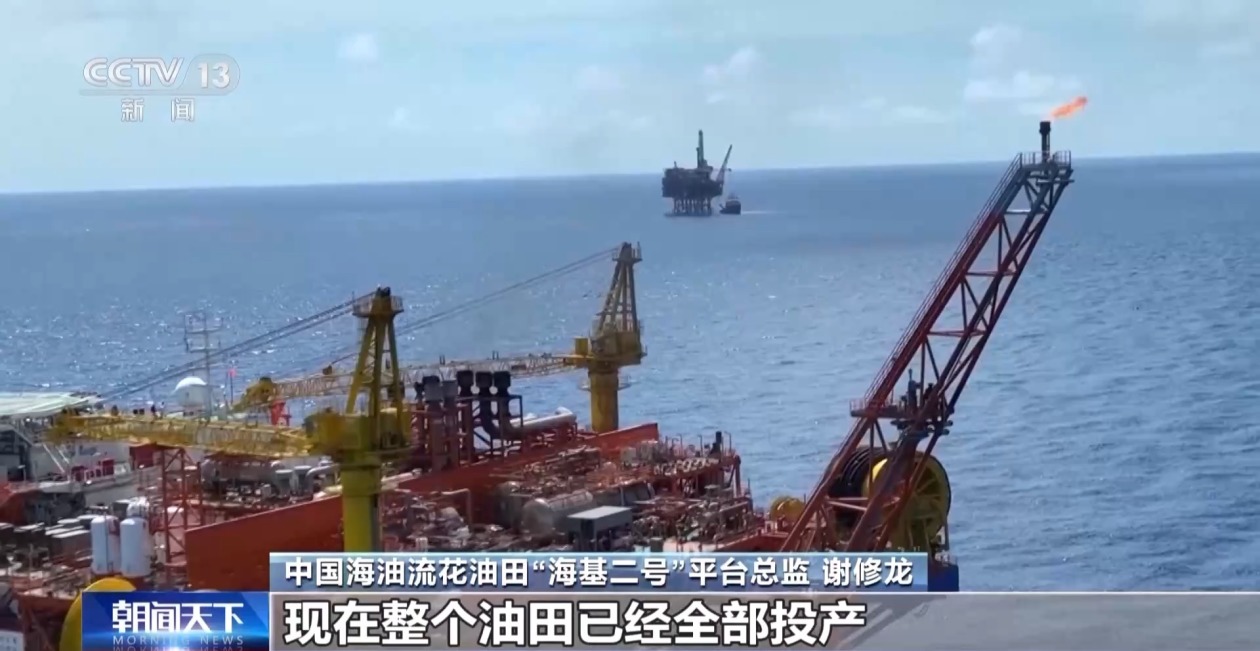
Core Viewpoint - The successful full production of the second development project of the Liuhua Oilfield marks a significant advancement in China's deepwater complex reservoir development, achieving a record daily crude oil output of 3,900 tons and expected to exceed one million tons next year [1][3]. Group 1: Project Overview - The Liuhua Oilfield second development project consists of two oilfields, Liuhua 11-1 and 4-1, located at an average water depth of 305 meters, featuring a deepwater jacket platform and a cylindrical offshore oil and gas processing facility [1][5]. - Since the first production wells were put into operation in September last year, the project has produced over 900,000 tons of crude oil [1]. Group 2: Technological Innovations - The project employs innovative development models using deepwater jacket platforms and cylindrical floating production storage and offloading units, creating a stable oil-water control technology system [7][14]. - The "Haiji No. 2" platform, as the core equipment of the project, integrates multiple leading global technologies and is a symbol of China's autonomous and intelligent marine engineering equipment [7][9]. Group 3: Production Efficiency - The project has designed 32 production wells with a total drilling depth exceeding 75,000 meters, achieving a significant increase in crude oil production by over 190,000 tons through advanced drilling technologies [11]. - The implementation of new extraction processes and construction methods has effectively improved the oil recovery rate and extraction efficiency, extending the oilfield's lifespan by 30 years [14]. Group 4: Industry Impact - China's deepwater oil and gas exploration and development capabilities have made historic leaps, becoming one of the few countries capable of independently conducting deepwater oil and gas exploration [15][17]. - The deepwater oil and gas production capacity has surpassed 12 million tons of oil equivalent, significantly contributing to national energy security [17].
蓝焰控股:12月12日召开董事会会议
Mei Ri Jing Ji Xin Wen· 2025-12-12 11:00
每经AI快讯,蓝焰控股(SZ 000968,收盘价:6.56元)12月12日晚间发布公告称,公司第八届第五次 董事会会议于2025年12月12日以通讯表决的方式召开。会议审议了《关于修订 <公司章程> 的议案》等 文件。 每经头条(nbdtoutiao)——实施城乡居民增收计划、降准降息等工具灵活高效运用、增加普通高中学 位……深度解读中央经济工作会议 (记者 王瀚黎) 2025年1至6月份,蓝焰控股的营业收入构成为:石油和天然气开采业占比96.44%,建筑施工业占比 3.25%,其他业务占比0.31%。 截至发稿,蓝焰控股市值为63亿元。 ...

南华期货早评-20251212
Nan Hua Qi Huo· 2025-12-12 02:56
Report Industry Investment Rating No relevant information provided. Core Views - Overseas markets focus on the Fed's policy direction, and the expectation of finalizing the next Fed chair is rising. The market anticipates that the new chair may push for more aggressive rate cuts, but there is uncertainty about the implementation of rate cuts. Asset prices will show structural differentiation. Domestically, the economy shows marginal improvement, but the foundation for economic recovery is not yet solid. The Politburo meeting has set a positive tone, emphasizing the expansion of domestic demand [1]. - The Fed's rate cut and bond - buying decision are interpreted as "not QE but similar to QE", which is negative for the US dollar index. The central economic work conference aims to keep the RMB exchange rate stable, and the RMB exchange rate is expected to show a two - way fluctuation in the long - term [2]. - The central economic work conference is expected to boost market sentiment, and the stock index is expected to be strong in the short - term, with large - cap stock indexes outperforming [4]. - The bond market has room for growth in the medium - term, and it is recommended to hold long - term positions [5]. - The price of the container shipping European line is expected to be supported before the Spring Festival, but there are both long and short factors in the market, and short - term fluctuations may intensify [6]. - Precious metals prices are expected to rise in the medium - to long - term, driven by factors such as central bank gold purchases and investment demand. Platinum is recommended to be bought on dips, and palladium is expected to fluctuate widely in the short - term [10]. - The copper price is supported by the Fed's rate cut, and it is recommended to hold long positions. The aluminum market is expected to fluctuate strongly in the short - term; the alumina market is expected to be weak; and the cast aluminum alloy market is expected to fluctuate strongly [14]. - The zinc market is expected to maintain a high - level shock in the short - term, and the tin market is expected to be strong and volatile in the short - term. The lead market is expected to fluctuate [16][17]. - The steel product market is expected to fluctuate within a certain range, and attention should be paid to the inventory reduction speed and downstream consumption. The iron ore price is expected to have limited downward space, and the coking coal and coke market is under pressure in the short - term [19][23]. - The ferroalloy market is expected to be weak and volatile, and attention should be paid to the possibility of price rebounds due to production cuts [25]. - The oil price is affected by geopolitical tensions and fundamentals, and the short - term price is mainly affected by the US - Venezuela situation. The LPG market is driven down by multiple factors, and the PX - PTA market has no obvious driving force in the short - term [28][30]. - The ethylene glycol market is expected to be under pressure in the medium - to long - term, and it is recommended to short on rallies. The methanol market is expected to be weak, and the PP market is not recommended to be shorted further at the current valuation [34][39]. - The PE market is expected to maintain a bottom - level shock in the short - term, and the pure benzene - styrene market is expected to be volatile. The fuel oil market is recommended to be observed, and the low - sulfur fuel oil market is also recommended to be observed [42][46]. - The rubber market is expected to fluctuate narrowly, and the urea market is expected to fluctuate. The soda ash market is expected to be under pressure, and the glass market is affected by cold - repair expectations [51][54][55]. - The caustic soda market is expected to be weak and volatile, and the pulp and offset paper markets are recommended to be observed. The log market is not recommended to be shorted at the current price, and the propylene market is expected to be weak [57][59][61]. - The oilseed market is expected to continue the positive spread trend, and the oil market is expected to continue to fluctuate in a range. The cotton market is recommended to be long on dips, and the sugar market is expected to be weak. The apple market is expected to be strong, and the jujube market is expected to have limited downward space [62][63][65]. Summary by Relevant Catalogs Financial Futures - **Macro**: The central economic work conference emphasizes the implementation of a moderately loose monetary policy, stabilizing the real estate market, and resolving local government debt risks. Overseas, the Fed's policy direction and the US economic data affect market expectations [1]. - **RMB Exchange Rate**: The Fed's rate cut and bond - buying decision are negative for the US dollar index. The central economic work conference aims to keep the RMB exchange rate stable, and the RMB is expected to appreciate in the short - term due to seasonal factors [2]. - **Stock Index**: The central economic work conference is expected to boost market sentiment, and large - cap stock indexes are expected to outperform [4]. - **Treasury Bond**: The bond market has room for growth in the medium - term, and it is recommended to hold long - term positions [5]. - **Container Shipping European Line**: The price is expected to be supported before the Spring Festival, but there are both long and short factors in the market, and short - term fluctuations may intensify [6]. Commodities Non - ferrous Metals - **Platinum & Palladium**: The prices of platinum and palladium rose due to the Fed's rate cut. In the medium - to long - term, the prices are expected to be boosted by factors such as central bank gold purchases and investment demand. Platinum is recommended to be bought on dips, and palladium is expected to fluctuate widely in the short - term [9][10]. - **Gold & Silver**: The prices of gold and silver rose. Silver is in an easy - to - rise and difficult - to - fall pattern. In the short - term, gold is expected to be strong and volatile, and silver is recommended to be sold on rallies. In the medium - to long - term, both are expected to rise [10][12]. - **Copper**: The copper price is supported by the Fed's rate cut, and it is recommended to hold long positions [13]. - **Aluminum Industry Chain**: The aluminum market is expected to fluctuate strongly in the short - term; the alumina market is expected to be weak; and the cast aluminum alloy market is expected to fluctuate strongly [14]. - **Zinc**: The zinc market is expected to maintain a high - level shock in the short - term [16]. - **Tin**: The tin market is expected to be strong and volatile in the short - term [17]. - **Lead**: The lead market is expected to fluctuate [17]. Black Metals - **Rebar & Hot - Rolled Coil**: The steel product market is expected to fluctuate within a certain range, and attention should be paid to the inventory reduction speed and downstream consumption [18][19]. - **Iron Ore**: The iron ore price is expected to have limited downward space, and it is affected by macro - factors and fundamentals [19][20]. - **Coking Coal & Coke**: The coking coal and coke market is under pressure in the short - term, and it is recommended to hold short positions in coking coal and avoid shorting coke blindly [23]. - **Silicon Iron & Silicon Manganese**: The ferroalloy market is expected to be weak and volatile, and attention should be paid to the possibility of price rebounds due to production cuts [25]. Energy and Chemicals - **Crude Oil**: The oil price is affected by geopolitical tensions and fundamentals, and the short - term price is mainly affected by the US - Venezuela situation [27][28]. - **LPG**: The LPG market is driven down by multiple factors, including the decline in oil prices, weakening fundamentals, and increased warehouse receipts [29][30]. - **PTA - PX**: The PX - PTA market has no obvious driving force in the short - term, and it is expected to follow the commodity sentiment and cost - side fluctuations [30][33]. - **MEG - Bottle Chip**: The ethylene glycol market is expected to be under pressure in the medium - to long - term, and it is recommended to short on rallies [33][34]. - **Methanol**: The methanol market is expected to be weak, and it is recommended to hold short - call options and 1 - 5 reverse spreads [36]. - **PP**: The PP market is not recommended to be shorted further at the current valuation, and attention should be paid to the PDH device operation and the spot market [38][39]. - **PE**: The PE market is expected to maintain a bottom - level shock in the short - term, and attention should be paid to the spot market and basis changes [40][42]. - **Pure Benzene - Styrene**: The pure benzene - styrene market is expected to be volatile, with pure benzene showing a near - weak and far - strong pattern and styrene showing a near - strong and far - weak pattern [42][44]. - **Fuel Oil**: The fuel oil market is recommended to be observed, with the high - sulfur fuel oil market showing stable supply and weak demand, and the low - sulfur fuel oil market having improved fundamentals [45][46]. - **Rubber**: The rubber market is expected to fluctuate narrowly, and the synthetic rubber is relatively strong. It is recommended to observe the natural rubber - synthetic rubber spread [51][52]. - **Urea**: The urea market is expected to fluctuate, with high supply and export policy regulation affecting the price [52][53]. - **Soda Ash & Glass**: The soda ash market is expected to be under pressure due to over - supply expectations, and the glass market is affected by cold - repair expectations [54][55]. - **Caustic Soda**: The caustic soda market is expected to be weak and volatile, with limited fundamental support and weakening demand [56][57]. - **Pulp - Offset Paper**: The pulp and offset paper markets are recommended to be observed, with the pulp price expected to fluctuate and the offset paper being affected by the pulp price and supply [57][58]. - **Log**: The log market is not recommended to be shorted at the current price, and attention should be paid to the 01 - 03 reverse spread [59]. - **Propylene**: The propylene market is expected to be weak and volatile, with a loose supply - demand situation and cost - side support [60][61]. Agricultural Products - **Oilseeds**: The oilseed market is expected to continue the positive spread trend, with the external soybean market likely to fluctuate near the cost line, and the domestic soybean meal and rapeseed meal markets affected by supply and demand factors [62]. - **Oils**: The oil market is expected to continue to fluctuate in a range, with palm oil being weak, rapeseed oil being strong, and soybean oil being weak [63][64]. - **Cotton**: The cotton market is recommended to be long on dips, with the short - term domestic downstream showing resilience and the overall supply being tight [65]. - **Sugar**: The sugar market is expected to be weak, affected by global supply pressure [65][66]. - **Apple**: The apple market is expected to be strong, and the 01 contract hit a new high [67][68]. - **Jujube**: The jujube market is expected to have limited downward space, and attention should be paid to downstream pre - holiday purchases [69].
2025年11月物价数据点评:菜价金价上行,出行链价格下行
BOHAI SECURITIES· 2025-12-11 02:30
Group 1: CPI Analysis - In November 2025, the CPI increased by 0.7% year-on-year, up from a previous increase of 0.2%[10] - The CPI's month-on-month change shifted from an increase to a decrease, primarily due to seasonal declines in service prices and lower energy prices[3] - Fresh vegetable prices rose significantly by 7.2%, exceeding the seasonal average decline of 3.2%, contributing approximately 0.17 percentage points to the CPI increase[13] - Pork prices decreased by 2.2%, impacting the CPI by approximately 0.07 percentage points due to sufficient market supply[13] Group 2: PPI Analysis - In November 2025, the PPI's year-on-year decline widened, while the month-on-month change remained stable[4] - The PPI is expected to show a month-on-month increase in December, with a year-on-year decline projected at -1.8%[24] - The prices of upstream raw materials, such as coal and gas, are expected to rise seasonally due to increased demand[23] - The "anti-involution" policy is expected to gradually improve prices in key industries, positively impacting the PPI in the long term[24] Group 3: Market Outlook - The CPI is projected to maintain a month-on-month growth rate near zero in December, with a year-on-year growth rate of approximately 0.5% expected for 2025[3] - The ongoing OPEC+ production increase is likely to keep oil prices under pressure, affecting the CPI negatively[3] - Core inflation is anticipated to see reduced support from gold prices, while seasonal increases in service prices are expected[3]