
公用事业

Search documents
世茂能源盘中创历史新高
Zheng Quan Shi Bao Wang· 2026-01-09 03:24
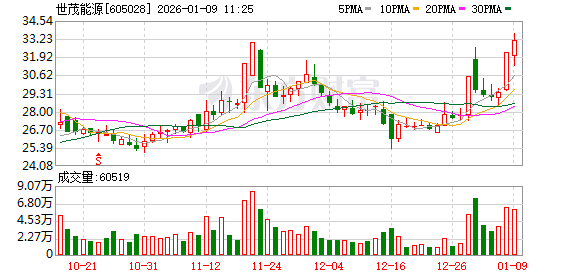
Company Performance - Shimao Energy's stock price reached a historical high, increasing by 2.48% to 33.10 yuan, with a trading volume of 3.7072 million shares and a transaction value of 119 million yuan, resulting in a turnover rate of 2.32% [2] - The latest total market capitalization of Shimao Energy in A-shares is 5.296 billion yuan, with the circulating market capitalization also at 5.296 billion yuan [2] Industry Overview - The public utility sector, to which Shimao Energy belongs, has an overall increase of 0.14%, with 86 stocks rising, including notable gainers such as Suihengyun A (up 4.81%), Zhongtai Co. (up 4.53%), and Dazhong Public Utilities (up 4.41%) [2] - Conversely, 32 stocks in the sector experienced declines, with the largest drops seen in Shengtong Energy (down 6.78%), Baitong Energy (down 1.62%), and Guiguan Electric Power (down 1.59%) [2] Financial Results - In the third quarter report, Shimao Energy reported a total operating revenue of 235 million yuan, a year-on-year decrease of 12.38%, and a net profit of 117 million yuan, down 5.89% year-on-year [2] - The basic earnings per share were reported at 0.7300 yuan, with a weighted average return on equity of 8.55% [2]


2025年业绩高增长股提前看,18股净利润增幅翻倍
Zheng Quan Shi Bao Wang· 2026-01-09 01:43
Core Insights - A total of 74 companies have released their annual performance forecasts, with 58 companies expecting profit increases, representing 78.38% of the total [1] - The overall proportion of companies forecasting positive results is 83.78%, with 4 companies expecting profits and 7 companies anticipating losses [1] - Among the companies predicting profit increases, 18 are expected to see net profit growth exceeding 100%, while 13 companies forecast growth between 50% and 100% [1] Company Performance - Zhongtai Co. is projected to have the highest net profit growth at 677.22%, followed by Zhongke Lanyun at 371.51% and Chuanhua Zhili at 308.82% [1][2] - The average increase in stock prices for companies expecting profit growth has been 10.46% this year, outperforming the Shanghai Composite Index [1] - The best-performing stock this year is Beifang Navigation, with a cumulative increase of 36.64% [1] Industry Insights - Companies expecting to double their profits are primarily concentrated in the electronics, pharmaceutical, and basic chemical industries, with 3, 2, and 2 companies respectively [1] - In terms of market segments, the companies expecting profit growth are distributed across the main board (11 companies), the ChiNext board (5 companies), and the Sci-Tech Innovation board (2 companies) [1]



知名分析师姜涛加盟国金证券!
中国基金报· 2026-01-08 14:32
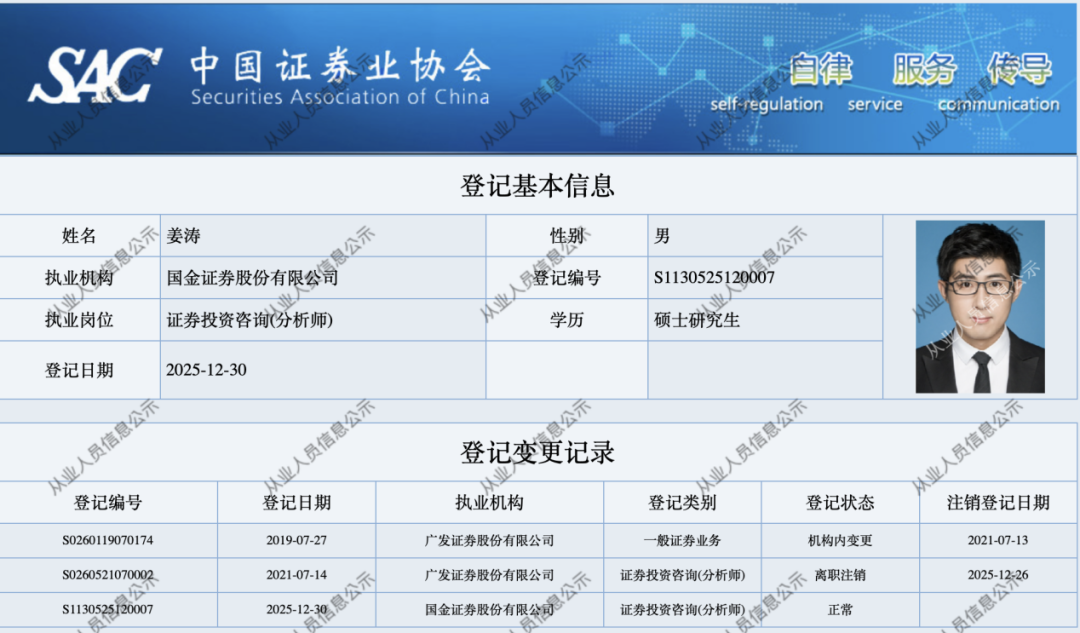
Group 1 - The core viewpoint of the article highlights the personnel change at Guojin Securities, with former chief analyst Jiang Tao from GF Securities joining as the deputy director and chief analyst for public utilities and environmental coal industries [2] - Jiang Tao has a background in financial engineering with bachelor's and master's degrees from Wuhan University and has been involved in environmental industry research since 2018 and public utilities research since 2022 [2][4] - Jiang Tao aims to simplify complex research conclusions and transform dull data into engaging research, focusing on leading the research on dividend assets at Guojin Securities [4] Group 2 - The article notes that Jiang Tao's joining coincides with the deepening of the Guojin Securities Research Institute's 3.0 reform, which has seen a significant increase in research personnel to nearly 180, forming over 30 teams covering various sectors [4] - The director of the research institute, Su Chen, emphasizes the importance of collaborative, digital, and forward-looking research, aiming to enhance the influence and pricing power of core research teams [4] - The article suggests that the landscape of sell-side research institutions will continue to evolve, with increasing demands for research depth, industry chain linkage, and forward-looking insights [4]



知名分析师姜涛加盟国金证券!
Zhong Guo Ji Jin Bao· 2026-01-08 14:31
Group 1 - The core point of the article is the recruitment of Jiang Tao, former chief analyst at GF Securities, to Guojin Securities as the deputy director and chief analyst for the public utility and environmental coal sectors [1][2]. - Jiang Tao holds a bachelor's and master's degree in financial engineering from Wuhan University and has been involved in environmental industry research since 2018 and public utility research since 2022 [1][2]. - After joining Guojin Securities, Jiang Tao will lead the research on dividend assets and aims to explore the prosperity of these assets amid the influx of long-term and patient capital into the market [2]. Group 2 - Guojin Securities Research Institute is undergoing a 3.0 reform phase, which has led to a significant increase in research personnel, now totaling nearly 180, and the formation of over 30 teams covering various sectors and interdisciplinary research [2][3]. - The director of Guojin Research Institute, Su Chen, emphasized the importance of collaborative, digital, and forward-looking research to enhance the influence and pricing power of research teams [3]. - The future landscape of sell-side research institutions is expected to evolve, with increasing demands for research depth, structure, industry chain collaboration, and foresight [3].
兴证策略张启尧团队:2025年并购重组有何新动向?
Xin Lang Cai Jing· 2026-01-08 12:05
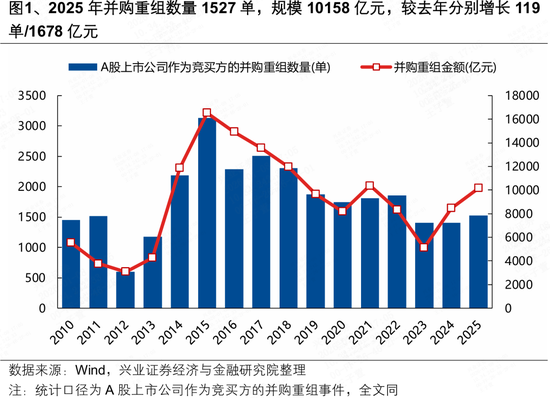
Group 1 - The M&A market in 2025 is expected to be highly active, with a total of 1,527 cases involving a scale of 10,158 billion yuan, marking a new high since 2022, driven by policy support and market recovery [1][30] - The number of M&A cases in the first half of 2025 is projected to be 665, while the second half is expected to see 862 cases, with respective scales of 4,174 billion yuan and 5,984 billion yuan [2][31] Group 2 - The majority of M&A cases in 2025 will be concentrated in new productivity industries, including chemicals, electronics, pharmaceuticals, machinery, power equipment, automotive, and computers, while traditional industries like coal, utilities, transportation, and non-ferrous metals will contribute to large-scale M&A [6][35] - Compared to 2024, industries such as chemicals, environmental protection, electronics, home appliances, automotive, and pharmaceuticals will see a significant increase in the number of M&A cases, while coal, utilities, transportation, electronics, chemicals, and non-ferrous metals will see a larger scale of M&A [8][37] Group 3 - Non-state-owned enterprises (non-SOEs) are expected to see a significant increase in the proportion of M&A amounts, rising from 23.5% in 2024 to 37.2% in 2025, while the number of M&A cases remains stable [11][40] - In traditional industries, M&A activities are primarily led by state-owned enterprises (SOEs), while new productivity industries are mainly driven by non-SOEs [14][43] Group 4 - The proportion of cross-border M&A is expected to increase, with 56.31% of M&A cases classified as cross-border in 2025, up 6.2 percentage points from 2024 [18][47] - Industries such as steel, electrical equipment, construction, transportation, pharmaceuticals, and food and beverage will have a higher proportion of same-industry M&A, while industries like petrochemicals, papermaking, building materials, coal, and durable consumer goods will have a higher proportion of cross-border M&A [19][48] Group 5 - M&A cases involving traditional industries transitioning to new productivity and those focusing on strong supply chain integration in new productivity sectors are expected to yield significant excess returns [23][52] - Traditional industry M&A aims to improve competitive dynamics and create leading enterprises, while new productivity M&A focuses on resource integration and technology acquisition [25][54] Group 6 - Typical cases of traditional industries acquiring new productivity companies include ecological environment companies entering AI sectors and traditional power companies investing in new energy storage projects [29][58] - New productivity industries are expected to enhance their capabilities through same-industry M&A, acquiring technologies and market resources to strengthen their supply chains [29][58]
瀚蓝环境:2026年度第一期中期票据发行完成
Ge Long Hui· 2026-01-08 09:54
Core Viewpoint - The company, Huanlan Environment, has successfully completed the issuance of its first phase of medium-term notes for the year 2026, indicating a strategic move to raise funds through debt instruments [1] Group 1: Issuance Details - The total issuance scale of the medium-term notes is 500 million yuan [1] - The maturity period for the notes is set at 3 years [1] - The coupon rate for the issued notes is 1.86% [1]

反垄断执法后,有药品价格下降超95%
Xin Lang Cai Jing· 2026-01-08 03:31
Group 1 - The core viewpoint emphasizes the importance of antitrust measures in safeguarding public welfare and ensuring fair market competition, as highlighted by the recent achievements in the anti-monopoly sector [1][2] - In the past three years, the National Market Supervision Administration has handled 35 cases of monopoly agreements and 25 cases of abuse of market dominance, resulting in a total fine of 2.93 billion yuan [1] - Antitrust actions have led to significant price reductions in essential medicines, such as a more than 95% decrease in the price of a critical antibiotic, showcasing the direct impact on consumer welfare [1] Group 2 - The antitrust efforts in the public welfare sector serve as a benchmark for eliminating administrative barriers and local protectionism, particularly in industries characterized by natural monopolies [2] - A systematic governance approach is necessary for effective antitrust enforcement, which includes the implementation of fair competition review systems and innovative regulatory tools to address emerging issues [2] - The challenges of uncovering hidden monopolistic agreements and the complexities of market dominance require a strong commitment to reform and regulatory diligence to meet public expectations for a transparent market and fair pricing [2]
53家公司2025年业绩预增
Zheng Quan Shi Bao Wang· 2026-01-08 02:13
Core Insights - A total of 66 companies have announced their annual performance forecasts for 2025, with 53 companies expecting profit increases, representing 80.30% of the total [1] - The overall proportion of companies forecasting positive results is 84.85%, with 3 companies expecting to turn a profit and 6 companies predicting profit declines [1] - Among the companies forecasting profit increases, 15 are expected to see net profit growth exceeding 100%, while 13 companies anticipate growth between 50% and 100% [1] Company Performance - The company with the highest expected net profit growth is Zhongtai Co., with a median increase of 677.22% [1][2] - Other notable companies include Zhongke Lanyun and Chuanhua Zhili, with expected net profit growth of 371.51% and 308.82%, respectively [1][2] - The average increase in stock prices for companies expecting profit growth has been 6.88% this year, outperforming the Shanghai Composite Index [1] Industry Insights - The sectors with companies expecting to double their profits include pharmaceuticals, basic chemicals, and transportation, with 2, 2, and 1 companies, respectively [1] - The companies expecting profit increases are distributed across different boards, with 10 on the main board, 3 on the ChiNext board, and 2 on the Sci-Tech Innovation board [1] Stock Performance - The stock with the highest increase this year is Beifang Navigation, which has risen by 28.53% [1][3] - Zhongtai Co. and Nanxing Co. have also shown significant increases of 14.00% and 10.99%, respectively [1][3]
创业板公司2025年业绩抢先看 12家预增
Zheng Quan Shi Bao Wang· 2026-01-08 01:47
Group 1 - A total of 13 companies listed on the ChiNext board have announced their performance forecasts for 2025, with 12 companies expecting profit increases and 1 company forecasting a profit [1] - The median expected net profit growth for the companies is significant, with the highest forecasted increase being 677.22% for Zhongtai Co., Ltd. [1] - The industries represented include public utilities, telecommunications, basic chemicals, machinery, automotive, retail, electronics, social services, and computing [1] Group 2 - Zhongtai Co., Ltd. (300435) is expected to report a profit increase of 677.22% with a closing price of 25.33 yuan and a year-to-date change of 14.00% [1] - Guangku Technology (300620) anticipates a profit increase of 162.00% with a closing price of 155.26 yuan and a year-to-date change of 5.58% [1] - Other notable companies include Chuanjin (300505) with a forecasted profit increase of 158.44%, Dingtai (301377) with 91.74%, and Taotao Automotive (301345) with 91.30% [1]

投资级企业掀起史上最猛年初融资潮 美元债发行规模创新冠疫情以来新高
Zhi Tong Cai Jing· 2026-01-07 22:28
Group 1 - Investment-grade corporate bonds in the U.S. are experiencing the most intense wave of dollar bond financing since the onset of the COVID-19 pandemic, with issuance reaching $88.4 billion this week, the highest weekly level since May 2020 [1] - Major Wall Street banks, including Morgan Stanley and JPMorgan, predict that the issuance of investment-grade bonds could reach a historical high by 2026, driven by lower borrowing costs and the need for long-term funding for mergers and acquisitions and data center construction related to the AI boom [1] - The strong demand from investors is a significant driving force behind this issuance wave, with some corporate bonds being oversubscribed by four times, and a bond from Orange SA being oversubscribed by 15 times, indicating a preference for long-term assets [1] Group 2 - The new bond issuance premium that companies must pay to attract investors has significantly decreased, further lowering financing costs and enhancing issuance motivation [2] - European banks, including Crédit Agricole and Société Générale, have entered the U.S. market to issue "Yankee bonds," with expectations that U.S. banks will follow suit after major earnings reports next week [2] - The energy, utilities, and automotive finance sectors are key contributors to the current bond issuance, with companies like Total, Public Service Enterprise Group, General Motors, and Ford's financing subsidiaries participating in this wave [2]