芯片制造

Search documents
日本官方否认断供光刻胶,国产化率仍低于20%
Xin Lang Cai Jing· 2025-12-10 14:25
Core Viewpoint - The semiconductor industry heavily relies on lithography technology, with a low domestic production rate of lithography machines and photoresists in China, leading to significant dependence on imports, particularly from Japan and the Netherlands [1][3]. Group 1: Dependency on Japanese Supply - Japan's recent statements have clarified that there is no change in trade policy regarding the supply of photoresists to China, alleviating fears of a supply disruption [3]. - Analysts believe that Japan is unlikely to completely halt supplies due to China's current chip manufacturing capabilities, which do not require advanced EUV photoresists that Japan specializes in [5]. - The demand for ArF photoresists in China is limited due to existing manufacturing processes, with a greater need for more mature KrF photoresists, which can be sourced from both South Korea and domestic producers [8]. Group 2: Potential Supply Chain Challenges - Japan may impose barriers such as requiring approvals rather than outright halting supplies, as a complete stop would leave them with no leverage in negotiations [10]. - Despite Japan's denial of supply disruptions, there is a call for China to strengthen its own capabilities to mitigate risks associated with reliance on foreign suppliers [12].


芯联集成(688469):拐点将至,蓄势待发
China Post Securities· 2025-12-10 09:33
Investment Rating - The investment rating for the company is "Buy" and is maintained [1] Core Insights - The company is experiencing a pivotal moment with its SiC MOSFET vehicle installation surpassing one million units, and its latest generation products achieving globally leading performance. The company has established over 10 new projects for 6-inch SiC MOSFETs and has entered mass production with five automotive clients [4] - The company has strategically positioned AI as its fourth core market, enhancing its offerings with a comprehensive chip system foundry solution that improves the efficiency of end-to-end power systems for data centers. Key products include data transmission chips for AI servers and a second-generation high-efficiency power management chip platform [5] - The company is ramping up production of MEMS sensors for various applications, including voice interaction and autonomous driving, with significant contracts from leading domestic firms expected to enter mass production in Q1 next year [5] Financial Projections - Revenue projections for the company are estimated at 81.0 billion, 101.0 billion, and 126.6 billion yuan for the years 2025, 2026, and 2027 respectively. The net profit attributable to the parent company is projected to be -6.1 billion, 0.5 billion, and 6.0 billion yuan for the same years [6] - The company’s revenue growth rates are expected to be 24.46%, 24.61%, and 25.44% for the years 2025, 2026, and 2027 respectively [8] - The company’s EBITDA is projected to increase significantly, reaching 7462.55 million yuan by 2027, with a corresponding improvement in net profit margins [8]

特朗普为关税影响辩护 但称可能下调“部分”商品的关税
Xin Lang Cai Jing· 2025-12-09 13:47
Core Viewpoint - President Donald Trump indicated a potential consideration for lowering certain U.S. tariffs on goods while reaffirming that broad import taxes are attracting investments and revitalizing long-struggling industries such as automotive and semiconductor manufacturing [1][2]. Tariff Adjustments - Trump mentioned that he might lower "some" tariffs while also suggesting that he would increase tariffs on others, particularly in response to voter concerns about high grocery prices [1][2]. - Recent tariff reductions approved by Trump were described as "insignificant exceptions" and not substantial [2]. Investment and Economic Impact - Trump claimed that there is an influx of $18 trillion into the U.S., referring to investment commitments from companies and countries seeking tariff reductions [2]. - He stated that due to tariffs, all automotive companies are returning to the U.S., highlighting a significant victory with the government's investment in Intel earlier this year, which he claimed resulted in a profit of $40 billion in about ten minutes [2].
贝莱德高管:AI烧钱大战远未见顶,真正的机会在“卖铲人”?
Jin Shi Shu Ju· 2025-12-09 09:12
Core Insights - The capital influx into AI infrastructure is far from peaking, with major tech giants competing aggressively, benefiting "picks and shovels" suppliers like chip manufacturers and energy producers [2][3] - AI-related capital expenditures are surging without signs of slowing down, driving significant market rebounds despite investor skepticism about sustainability [2][3] - Nvidia's GPU chips are central to the AI revolution, briefly making it the first company to surpass a market capitalization of $5 trillion, sparking discussions about an AI bubble [2] - Major companies like Amazon and Meta are allocating budgets of hundreds of billions annually for AI-related investments, indicating a long-term procurement trend across the tech industry [3] Industry Trends - The demand for electricity from data centers is expected to double by 2030, driven by large-scale, enterprise-level, and cryptocurrency mining facilities [3] - Leading tech companies are just beginning to tap into capital markets for the next phase of AI expansion, suggesting more capital is on the way [3] - The competitive mindset among major tech firms drives accelerated spending, even at the risk of over-investment, as they strive to avoid being outpaced in the market [3] Investment Opportunities - Companies involved in chip manufacturing, energy production, and copper wire manufacturing are expected to see positive surprises that could drive stock prices up in the coming year [4]

41.21万亿元,同比增长3.6%!
Jin Rong Shi Bao· 2025-12-09 02:20
Core Viewpoint - China's goods trade import and export value reached 41.21 trillion yuan in the first 11 months of 2025, showing a year-on-year growth of 3.6% [1] Group 1: Export Performance - In November, China's exports grew by 5.9% year-on-year, rebounding significantly from a decline of 1.1% in October, indicating a recovery to normal levels in the second half of the year [1][2] - The increase in exports is attributed to three main factors: a lower base from the previous year, a rebound in global trade, and accelerated growth in exports of chips and automobiles driven by domestic manufacturing upgrades and global AI investment [2][3] - Private enterprises have shown strong growth in imports and exports, with a total of 23.52 trillion yuan in trade, representing a 7.1% increase and accounting for 57.1% of China's total foreign trade [2] Group 2: Import Trends - In November, imports increased by 1.9%, with the growth rate accelerating by 0.9 percentage points compared to the previous month, supported by a lower base from last year [4] - The rebound in exports has a direct positive impact on import growth, reflecting China's "large import and export" characteristics [4] - Future import growth may be supported by domestic policies aimed at boosting internal demand, including the introduction of new financial tools and local government bond limits for project construction [4] Group 3: Sector Contributions - Mechanical and electrical products, along with high-tech products, continue to play a crucial role in China's export stability, with mechanical and electrical product exports reaching $205.9 billion in November, growing by 9.65% [3] - High-tech product exports exceeded $88.1 billion in November, with a growth rate of 7.68%, indicating a significant contribution to overall export performance [3]
可编程声波芯片精准操控微小目标
Ke Ji Ri Bao· 2025-12-09 02:04
在实验中,研究团队尝试利用声波"抓取"人体血栓或培养皿中的微小细胞,但传统IDT产生的平面声波 只能推动目标在平面内移动,难以实现空间操控。为此,需要构建能在微尺度上完成复杂运动和精细操 作的"声学手指",以实现微小目标的精准操控。 研究团队还开发了多种新型片上器件方案,可在不同尺度和功率下运行,并生成不同能量分布的声波。 通过相位编码调控,这些器件能以前所未有的方式对声波进行倾斜、弯曲和耦合。最终,这一整套机制 被集成在单一电子芯片上,形成一体化声波操控平台。实验结果显示,该平台产生的声波能量束在传播 距离和能量集中度方面均优于传统IDT。 美国弗吉尼亚理工大学研究团队在片上声波操控领域取得新进展。他们研制出一种新型可编程声波芯 片,可在电子芯片上对流体和颗粒等微小目标进行灵活精准操控。该技术拓展了医学和工程领域的应用 前景,有望应用于非侵入性手术或体外血液成分分离。相关研究成果发表于最新一期《自然·通讯》杂 志。 该技术的核心优势在于"适应性"。团队能精确控制声波的能量传播方式,使其适用于不同需求,如声波 路径引导、流体和颗粒操控。这项成果不仅开创了可编程片上声波操控的新方法,也为未来在微纳制 造、半导体 ...
“十四五”山东工业增加值将由2.3万亿元提升至3.3万亿元
Da Zhong Ri Bao· 2025-12-09 01:02
五年来,山东加力突破创新壁垒,发展动能竞相奔涌释放。规上工业企业研发机构覆盖率从2020年 13.3%提升至现在的近40%,创建国家制造业创新中心4家、工业设计中心54家,数量均居全国前列。引 育泰山产业领军人才730名,培育人才引领型企业60家。累计培育推广"四首"新产品4700余项,高热效 率柴油机、"山河号"智能盾构机、8K画质处理芯片等一批打破国外垄断、填补国内空白的重大技术实 现突破,C919大飞机、"蓝鲸一号"等国之重器都有"山东制造"的贡献。 发展人工智能是实现新型工业化的必答题。山东一手抓好产业培育、一手抓好赋能应用,2025年, 全省人工智能核心产业营收预计突破1200亿元,占全国10%左右,正加快构建起从智能算力、数据语 料、模型算法到智能应用的全栈式人工智能产业链。其中,纳入全省重点监测范围的大模型企业已达 170家、大模型产品249个,29个生成式大模型通过人工智能服务备案,预计今年完成大模型业务收入60 亿元。(记者 付玉婷) "十四五"山东工业增加值将由2.3万亿元提升至3.3万亿元 省政府新闻办12月8日召开新闻发布会,介绍"十四五"时期山东加快建设先进制造业强省相关情 况。"十 ...
韩股收高 市场等待美联储利率决议
Xin Lang Cai Jing· 2025-12-08 11:17
Core Viewpoint - The South Korean stock market rose on Monday due to investor expectations that the Federal Reserve will lower interest rates later this week [1][11]. Market Performance - The KOSPI index increased by 54.80 points or 1.34%, closing at 4154.85 points [2][12]. - The KOSPI index has risen 73.16% year-to-date [9]. Investor Sentiment - There is an 84% probability that the Federal Reserve will cut rates by 25 basis points during its upcoming meeting [3][13]. - Lower U.S. interest rates are expected to boost global risk appetite, making emerging markets, including South Korea, more attractive for investors [4][14]. Key Stocks Movement - Major stocks saw significant movements: - Samsung Electronics rose by 1.01% - SK Hynix increased by 6.07% - LG Energy Solution surged nearly 6% after winning a $1.4 billion order from Mercedes-Benz for electric vehicle batteries [4][6][14]. - Other notable movements include: - Hyundai Motors and Kia Motors rose by 0.16% and 1.62% respectively - POSCO Holdings increased by 2.57% - Samsung Biologics fell by 0.73% [4][15]. Foreign Investment - Foreign investors net bought 3.21335 trillion KRW in the KOSPI [7][15]. Currency and Bond Market - The Korean won strengthened against the U.S. dollar, closing at 1466.9, up 0.44% from the previous day [8][15]. - The yield on the three-year government bond rose to 3.037%, while the ten-year bond yield increased by 2.4 basis points to 3.399% [10][15].
《华尔街日报》:中国不只稀土,还有三把刀悬在美国脖子上
Sou Hu Cai Jing· 2025-12-08 09:54
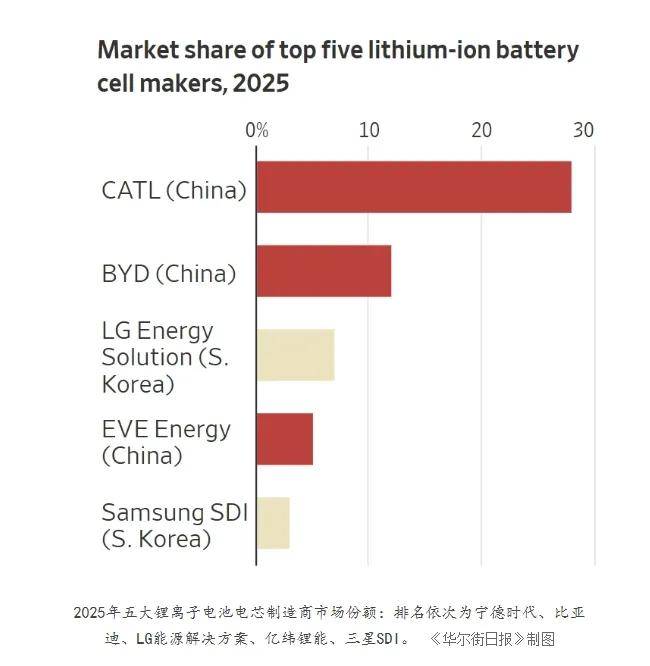
Group 1 - The core point of the article highlights that the U.S. has been focused on China's rare earths but has overlooked the greater threat posed by China's dominance in lithium batteries, mature process chips, and pharmaceutical raw materials [1] Group 2 - In the lithium battery sector, China has established a near monopoly over the entire supply chain, with major companies like CATL and BYD leading the market [2][5] - By 2025, three out of the top five battery manufacturers globally will be Chinese, with China producing 79% of cathode materials, 92% of anode materials, 98% of refined graphite, 80% of refined cobalt, and 63% of lithium chemical products [5] - This dominance is attributed to strategic government policies since 2015, including substantial subsidies and requirements for local automakers to use domestic batteries [6] Group 3 - In the mature chip sector, China controls about one-third of the global production capacity for chips above 28 nanometers, which are critical for automotive, home appliances, and defense equipment [7][8] - China also holds 99% of the global gallium supply and a significant portion of germanium, with recent export licensing requirements impacting U.S. companies [8] Group 4 - The pharmaceutical sector is heavily reliant on Chinese raw materials, with over 80% of active pharmaceutical ingredients in common medications like Tylenol and Advil imported from China [9] - This creates a hidden supply chain dependency between China, India, and the U.S., where American consumers are largely unaware of their reliance on Chinese pharmaceutical inputs [9][13]
美专家:就算中国原地不动20年,美国也追不上!
Xin Lang Cai Jing· 2025-12-08 09:24
Core Insights - The article emphasizes that even if China's manufacturing sector stagnates for the next twenty years, the U.S. is unlikely to catch up to China's overall manufacturing capacity and industrial system advantages [1] Manufacturing Scale and Economic Comparison - In 2024, China's manufacturing value added is projected to reach $4.7 trillion, accounting for approximately 25% of its GDP, while the U.S. manufacturing scale is about $2.9 trillion, making up around 10% of its GDP [1] - When calculated using purchasing power parity (PPP), China's overall economic scale is $33.6 trillion, significantly higher than the U.S. at $25.7 trillion [1] - China's actual manufacturing output is estimated at $8.4 trillion, which is more than three times the U.S. output of $2.6 trillion [1] Structural Advantages - China's manufacturing density is characterized by a highly concentrated industrial chain, allowing for rapid production and assembly of components within close proximity [2][1] - The U.S. has a low-density, high-cost, and fragmented industrial ecosystem, making it difficult to replicate China's structural advantages [2] U.S. Economic Structure - The U.S. economy has become deeply financialized and service-oriented, with major tech brands like Apple and NVIDIA outsourcing hardware production to Asia [3] - U.S. companies have focused on design, branding, and software ecosystems, leading to a strategic offshoring of manufacturing, which has resulted in a decline in domestic manufacturing capabilities [4] Policy Challenges in U.S. Manufacturing - Recent U.S. policies aimed at bringing manufacturing back, such as the CHIPS and Science Act and Inflation Reduction Act, face contradictions and challenges [5] - The U.S. government offers subsidies to attract companies like TSMC to set up factories while simultaneously imposing tariffs on key equipment and components [5] - Political instability and changes in administration hinder the continuity of industrial policies, complicating long-term investment decisions in manufacturing [5] China's Strategic Positioning - China maintains a clear and stable strategic positioning for its manufacturing sector, with consistent policy direction [6] - In response to U.S. technology restrictions, China is rapidly advancing its self-sufficiency in key technologies and components [6] - China employs asymmetric measures, such as rare earth export controls, to counter external pressures [8] Market Dynamics and Case Studies - China has the world's largest single consumer market, providing a complete market loop for domestic companies to innovate and scale [8] - Companies like BYD and CATL have rapidly grown due to the substantial domestic demand for electric vehicles and batteries, respectively [9] Conclusion on Manufacturing Ecosystem - The article concludes that while the U.S. may maintain a lead in specific advanced technology areas, China has established a formidable moat in the breadth, depth, and resilience of its overall manufacturing ecosystem [10] - A significant national-level re-industrialization revolution would be required for the U.S. to bridge the gap with China, which seems unlikely under the current political and social structures [10]