
贵金属

Search documents
黄金白银,调整!知名品牌,调价!
Sou Hu Cai Jing· 2026-02-20 06:04
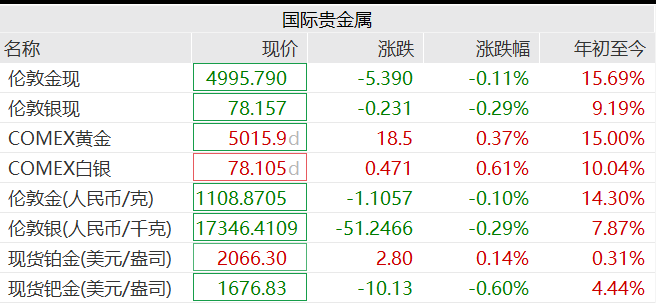
Group 1 - On February 19, spot gold reached $5000 per ounce, with a daily increase of 0.48%, but faced resistance due to cooling expectations of Federal Reserve rate cuts and profit-taking by investors, leading to downward price pressure [1] - As of February 20, spot gold was priced at $4995.790, down 0.11% year-to-date, while COMEX gold was at $5015.9, reflecting a year-to-date increase of 15.00% [1] - HSBC's chief precious metals analyst noted that gold's status as a safe-haven asset does not prevent price volatility, with market fluctuations expected to be a key feature of the precious metals market by 2026 [2] Group 2 - Goldman Sachs projected that central bank gold purchases and increased exposure from private investors due to Federal Reserve rate cuts could gradually raise gold prices to $5400 per ounce by the end of 2026 [2] - The old gold brand announced a price increase starting February 28, 2026, with a strategy of "fixed price + regular adjustments," differing from traditional pricing models [5] - Various gold brands have already adjusted their "fixed price" products this year, with some price increases ranging from 15% to 30%, particularly in high-end gold jewelry [5] Group 3 - There has been a significant consumer response to the anticipated price increase, with long queues forming at old gold stores as customers aim to purchase before the price adjustment [5][26] - As of February 20, the stock price of old gold fell to 762 HKD per share, a decline of over 3% [26] - The Hang Seng Index Company announced an adjustment to its index components, with old gold being added to the Hang Seng Index, effective March 9 [28]

金荣中国:美国对伊朗动武风险预期上升,金价扩大涨幅维持震荡
Sou Hu Cai Jing· 2026-02-20 01:46
Market Overview - International gold maintained a volatile trend on February 19, with an opening price of $4998.09 per ounce, a high of $5022.21, a low of $4960.62, and a closing price of $5013.83 [1] Economic Indicators - Initial jobless claims in the U.S. fell by 23,000 to 206,000 for the week ending February 14, exceeding economists' expectations of 225,000, indicating a stabilization in the labor market [3] - Continuing claims rose to 1.87 million, the highest level since early January, suggesting some underlying weakness in the labor market despite the drop in initial claims [3] - The Federal Reserve's meeting minutes indicated that most policymakers see signs of stabilization in the labor market, although concerns about downside risks remain [3] - The probability of a U.S. recession within the next 12 months is estimated at 20%-25%, down from 30% in September [4] Geopolitical Developments - President Trump indicated that a decision on a potential agreement with Iran could be made in about ten days, emphasizing that Iran must not possess nuclear weapons for peace in the Middle East [5] - Reports suggest Trump is considering limited military strikes against Iran to compel compliance with nuclear agreement terms, with discussions shifting towards larger-scale actions [6] Gold ETF Holdings - The SPDR Gold Trust, the world's largest gold ETF, increased its holdings by 3.14 tons to a total of 1078.75 tons [7] Federal Reserve Outlook - According to CME's FedWatch, the probability of a 25 basis point rate cut by March is 5.9%, with a 94.1% chance of maintaining current rates [7] - By June, the probability of a cumulative 25 basis point rate cut rises to 49.8% [7] Technical Analysis - Gold prices showed a slight upward trend, with short-term indicators suggesting a gradual upward crossover [11] - The trading strategy includes cautious high short and low long positions, with specific entry and exit points outlined for aggressive and conservative traders [11]

美三大股指全线下跌!黄金、白银上涨
Zhong Guo Zheng Quan Bao· 2026-02-20 01:40
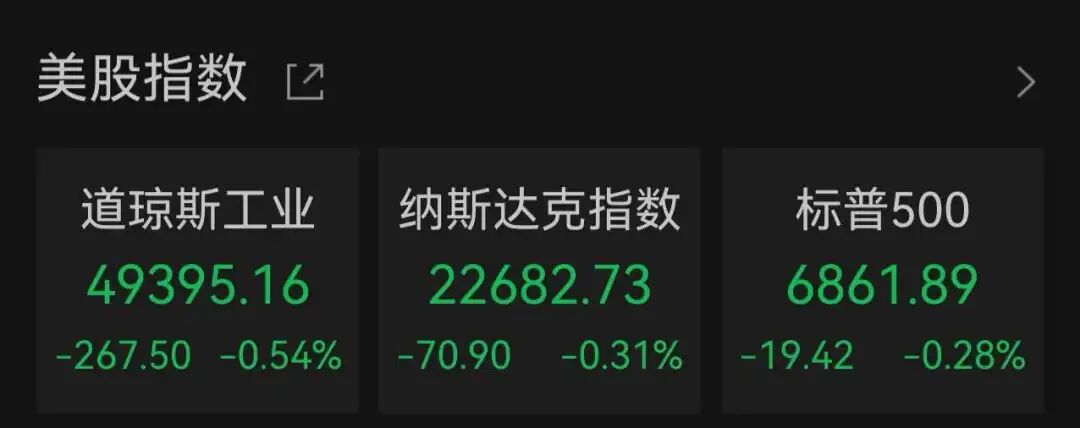
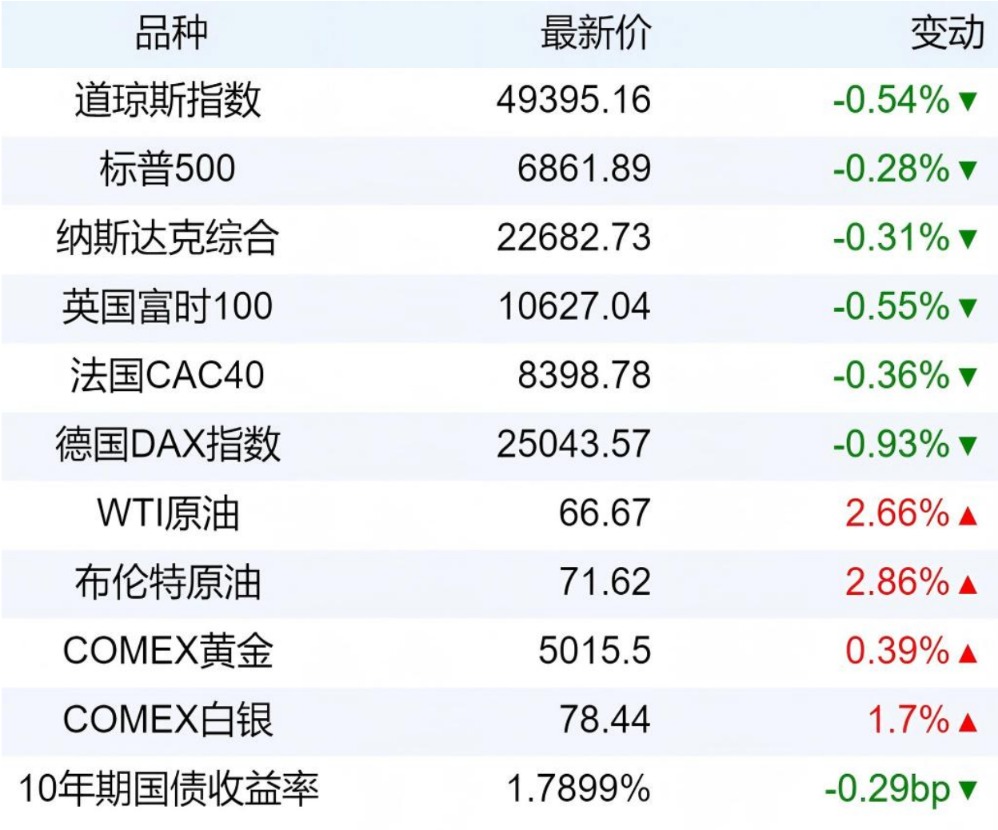
Market Performance - On February 19, US stock indices closed lower, with the Dow Jones down 0.54% at 49,395.16 points, the S&P 500 down 0.28% at 6,861.89 points, and the Nasdaq down 0.31% at 22,682.73 points [3] - The large-cap tech stocks showed mixed performance, with the Wind US Tech Seven Giants Index declining by 0.29%. Apple fell over 1%, while Google, Microsoft, and Nvidia experienced slight declines; Meta, Tesla, and Amazon saw slight increases [5][6] - The Nasdaq China Golden Dragon Index fell by 0.35%, with notable declines in stocks like Huya, JinkoSolar, Yum China, and Qifu Technology, while Hesai Technology, Huazhu Group, and Pony.ai saw gains [8][9] Commodity Market - International precious metals prices generally rose, with COMEX gold futures up 0.12% at $5,015.50 per ounce and London gold up 0.49% at $5,000.22 per ounce. COMEX silver futures increased by 1.09% to $78.44 per ounce, and London silver rose by 1.74% to $78.549 per ounce [11][12] - Oil prices also increased, with light crude oil futures for March delivery rising by $1.24 to $66.43 per barrel (up 1.9%), and Brent crude oil for April delivery increasing by $1.31 to $71.66 per barrel (up 1.86%) [12] Trade Deficit - The US Commerce Department reported a record merchandise trade deficit of $1,240.9 billion for 2025, an increase of $25.5 billion or 2.1% from the previous year. Total exports and imports were $2,197.5 billion and $3,438.4 billion, respectively [14] - The trade deficit with the EU decreased by $17.1 billion to $218.8 billion, while deficits with Mexico and Vietnam increased by $25.4 billion and $54.7 billion, respectively [14] - The December 2025 merchandise and services trade deficit was $70.3 billion, a month-on-month increase of $17.3 billion or 32.6%, marking the second consecutive month of significant increase [15]
新华财经早报:2月20日
Xin Hua Cai Jing· 2026-02-20 00:53
Group 1 - The State Council's Safety Committee and the Ministry of Emergency Management held an emergency video meeting to enhance safety control over the entire chain of fireworks and firecrackers, emphasizing strict implementation of safety measures to prevent accidents [1] - The total box office for the 2026 Spring Festival film season, including pre-sales, has surpassed 2.8 billion yuan, with "Flying Life 3," "Silent Awakening," and "Boon Year" ranking as the top three films [1] - The Ministry of Transport reported that on February 18, the total cross-regional passenger flow reached 32.2988 million, a 9.7% increase compared to the same period in 2025, marking the first time daily traffic exceeded 300 million during the Spring Festival [1] Group 2 - The U.S. Department of Commerce reported that the merchandise trade deficit for 2025 reached a record $1.2409 trillion, an increase of $25.5 billion or 2.1% from the previous year, indicating that tariffs have had little effect on the overall deficit level [1] - The Indonesian central bank announced that it would maintain the benchmark 7-day reverse repurchase rate at 4.75%, aligning with market expectations [2] - Argentina's regulatory agency reported a decrease of nearly 22,000 companies over the past two years, with registered companies dropping from over 510,000 in November 2023 to over 490,000 in November 2025, resulting in a loss of nearly 300,000 jobs [2]
RYOEX:逢低买盘提振贵金属
Xin Lang Cai Jing· 2026-02-19 11:55
Core Viewpoint - International gold prices showed resilience, rebounding to approximately $4934.16 per ounce, driven by market bottom-fishing despite a previous drop of over 2% due to reduced risk aversion [1][2][3] Market Environment - Overall trading volume remains relatively low due to some regions being on holiday, which amplifies price volatility [3] - The easing of concerns over conflict escalation due to the "guiding principles" from US-Iran negotiations has compressed the gold risk premium [3] Currency and Commodity Trends - The US dollar index increased by 0.3% on Tuesday, raising the cost of metals priced in dollars [3] - Silver and platinum saw rebounds of 3% and 2% respectively, while copper rose by 1% to $12,705.20 per ton, indicating a cyclical recovery in the overall commodity market [3] Trader Sentiment and Future Outlook - Traders are generally cautious and are closely monitoring the upcoming release of the Federal Reserve's January policy meeting minutes, which will serve as a key indicator for future monetary easing [2][4] - The PCE price index, set to be released on Friday, is expected to directly influence the urgency of interest rate cuts, with minor changes in inflation data potentially triggering new volatility in the metals market [4] - Despite short-term pressure on gold prices from a stronger dollar and delayed rate cut expectations, this price pullback may provide a viable entry point for long-term investors [4]

春节前最后一刻,人民币送了个大红包——你接到了吗?
Sou Hu Cai Jing· 2026-02-19 10:58
Group 1 - The core viewpoint of the article highlights the significant appreciation of the Chinese yuan, which has surpassed the 6.9 mark against the US dollar, marking a new high since April 2023, and indicating a potential shift in global investment dynamics [1][10][13] - The yuan's rise is attributed to a strong trade surplus, with China's goods trade surplus reaching a historical high of 1.19 trillion USD in 2025, leading to a substantial influx of foreign exchange back into the country [5][11] - The depreciation of the US dollar's credibility is noted, particularly due to ongoing investigations into the Federal Reserve and the impact of US economic policies, which have diminished the attractiveness of dollar-denominated assets [7][10] Group 2 - The decline in gold and silver prices, with gold dropping over 3% and silver over 11%, is linked to geopolitical developments, particularly Iran's recent statements that have reduced perceived risks in the Middle East, prompting a shift in investment from precious metals to yuan assets [3][8] - The article discusses the implications of the yuan's appreciation for export-oriented companies, indicating that while it may reduce competitiveness for those relying on low-end manufacturing, it reflects the overall strengthening of China's manufacturing capabilities [10][11] - The breakthrough of the yuan above 6.9 is seen as a potential starting point for further appreciation, with market dynamics suggesting a target of 6.5 in the future, supported by strong trade surpluses and a controlled monetary policy approach by the People's Bank of China [11][13]
美股盘前,白银概念股走强,泛美白银涨4.6%
Mei Ri Jing Ji Xin Wen· 2026-02-19 09:17
Group 1 - Silver-related stocks showed strength in pre-market trading on February 19, with Pan American Silver rising by 4.6% [1] - Hecla Mining increased by 1.9% in the same trading session [1] - First Majestic Silver saw a rise of 1.3% [1]
金价,彻底沸了!"1公斤金条卖断货",有人不问价直接出手
Sou Hu Cai Jing· 2026-02-19 09:13
Group 1 - The core viewpoint of the article highlights the rising international precious metal prices, with spot gold surpassing $5000 per ounce and experiencing a daily increase of over 2.5% [1][3]. - The market is anticipating the upcoming release of the Federal Reserve's January monetary policy meeting minutes and important U.S. inflation data, which are expected to influence the Fed's monetary policy direction [3]. - There is a strong expectation that the Federal Reserve is likely to begin interest rate cuts in June, contributing to the upward trend in gold and silver prices [3]. Group 2 - Despite gold prices reaching historical highs, consumer enthusiasm for purchasing gold remains strong, with reports of significant sales at Beijing Caibai Hall during the Spring Festival [4]. - Notably, large gold items, particularly 1000-gram investment gold bars, have seen exceptional demand, with some products selling out quickly [5]. - The base gold price at Caibai Hall was reported at 1112 yuan per gram, indicating that a 1000-gram investment gold bar would cost approximately 1.112 million yuan [5][6]. Group 3 - Analysts indicate that while gold is considered a safe-haven asset, its prices are still subject to volatility, with market fluctuations expected to be a significant characteristic of the precious metals market in 2026 [8]. - The next Federal Reserve Chairman, Kevin Warsh, has expressed a stance on reducing the Fed's balance sheet, which could have a continued negative impact on international gold prices [8]. - Central banks are likely to increase their gold reserves as a strategy to reduce exposure to dollar risks, even as the dollar remains the global reserve currency [8].

Gold (XAUUSD) & Silver Price Forecast: Fed Pressure Builds – Will Gold Smash $5,020 or Stall?
FX Empire· 2026-02-19 07:59
Core Viewpoint - Investors are concerned that political interference may weaken the Federal Reserve's ability to manage interest rates, which diminishes confidence in the US dollar and supports gold prices amid rising geopolitical tensions [1]. Group 1: US Dollar and Federal Reserve - The US dollar has gained strength, reaching a one-week high, primarily due to the hawkish Minutes from the Federal Reserve's January monetary policy meeting [2]. - The Minutes indicate a division among Fed officials regarding the need for potential rate cuts, with some advocating for cuts if inflation decreases, while others caution against premature cuts that could jeopardize the 2% inflation target [3]. - Strong US economic data, including better-than-expected industrial production and significant manufacturing output growth, has further supported the dollar and pushed Treasury yields higher [3][4]. Group 2: Gold Market Dynamics - Gold prices are currently below the $5,000 level, influenced by the strengthening US dollar and the Fed's hawkish stance [2]. - Despite the dollar's strength, gold is receiving support from escalating global tensions, particularly the ongoing conflict between Ukraine and Russia, which has seen little progress in diplomatic talks [5].

美股异动|贵金属价格大涨,黄金白银股集体上涨
Ge Long Hui· 2026-02-18 14:47
科尔黛伦矿业涨3.5%,Vista黄金涨2.8%,First Majestic Silver、Endeavour Silver涨2.6%,埃氏金业涨 2.4%,纽曼矿业、泛美白银涨超2%,金田、哈莫尼黄金涨1.2%。消息面上,贵金属价格大涨,现货黄 金涨超2%,站上4980美元/盎司;现货白银涨超5%,站上77美元/盎司。(格隆汇) ...