
建材

Search documents
超500亿元,“跑了”
Zhong Guo Ji Jin Bao· 2026-01-21 06:10
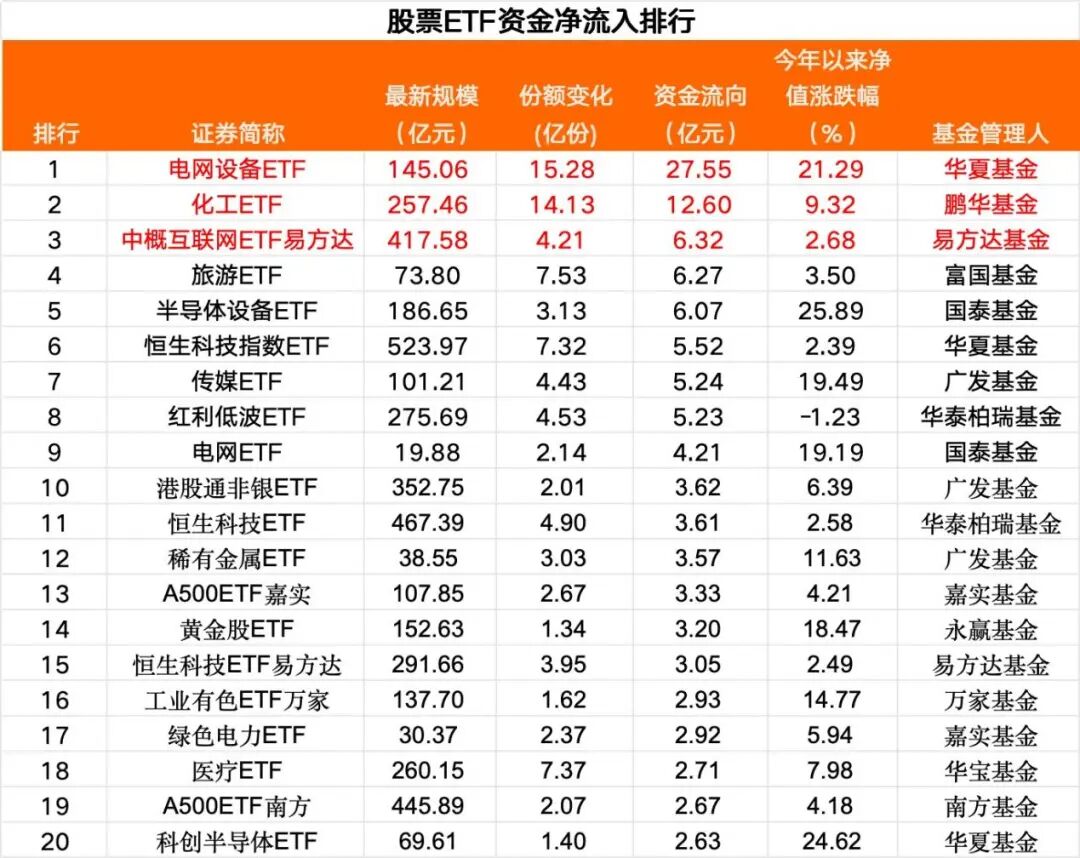
Group 1 - On January 20, the A-share market experienced a decline, with all three major indices falling, and over 500 billion yuan in net outflows from stock ETFs [1][2] - In the past four trading days, the total net outflow from stock ETFs exceeded 240 billion yuan, with over 920 billion yuan in net outflows in the first two days of the week [2] - The total scale of stock ETFs in the market reached 4.75 trillion yuan as of January 20, 2026, with a trading volume of 3.13 trillion yuan on that day [3] Group 2 - The building materials and real estate sectors led the gains among stock ETFs, with the top three performing ETFs all from the building materials sector, each rising over 3.3% [4] - The worst-performing ETFs included those related to satellites, aviation, and communication equipment, with many experiencing declines exceeding 3% [4] - On January 20, the net outflow from stock ETFs was approximately 505 billion yuan, with 51 ETFs seeing inflows of over 100 million yuan [5] Group 3 - The top five inflow sectors included new energy (net inflow of 2.91 billion yuan), gold (2.75 billion yuan), and petrochemical (1.87 billion yuan) [5] - The leading ETFs by net inflow included the Electric Grid Equipment ETF with a net inflow of 2.755 billion yuan, followed by the KI ETF and the China Concept Internet ETF [6] - The top outflow ETFs included the CSI 300 ETF from Huatai-PineBridge, which saw a net outflow of 10.984 billion yuan, and the CSI 500 ETF with a net outflow of 9.143 billion yuan [7] Group 4 - Major public fund companies continue to see inflows into their ETFs, with E Fund's China Concept Internet ETF attracting 640 million yuan and the Gold ETF attracting 360 million yuan on January 20 [8] - The market is expected to remain stable due to supportive monetary policy and positive macroeconomic data, with a potential spring rally anticipated [8] - Short-term market fluctuations may occur due to regulatory measures aimed at preventing excessive volatility, but a spring rally is expected to resume around the Chinese New Year [9]

港股午评:恒指跌0.15%,科技股分化,黄金股强势,招金矿业等多只个股续创新高!
Ge Long Hui· 2026-01-21 04:12
Group 1 - The Hong Kong stock market opened lower due to the significant decline in European and American stock markets, with the Hang Seng Index down by 0.15% and the National Enterprises Index down by 0.26% [1] - The Hang Seng Technology Index saw a slight increase of 0.14%, indicating mixed performance among major technology stocks [1] - Baidu's stock rose over 3%, while Xiaomi's stock fell more than 2%, reaching a new low for the current phase [1] Group 2 - Gold prices surpassed $4,830, leading to historical highs for companies such as Zijin Mining, Zhaojin Mining, and Lingbao Gold [1] - The consumer electronics and semiconductor sectors showed active performance, contrasting with the overall market trend [1] - The sportswear sector experienced significant declines, and previously rising domestic real estate stocks fell back into a sluggish state, with building materials and cement stocks also declining [1]
未知机构:华福建筑建材地产及地产链大涨点评上层态度变化政策渴望以及板块高低切的共振-20260121
未知机构· 2026-01-21 02:15
Summary of Conference Call Notes Industry Overview - The real estate and building materials sector experienced a significant increase, primarily driven by market rumors regarding policy relaxation in Shanghai and expectations of more substantial policy measures to follow [1][2] Core Insights and Arguments - A reassessment of the real estate and related sectors is deemed necessary at this juncture [2] - Key points highlighted in the commentary from "Qiushi" include: 1. Recognition of real estate as a significant financial asset, central to household wealth [3] 2. The need for comprehensive policy measures rather than incremental adjustments, indicating potential for new expectations regarding policy strength and breadth [3] - Statistical data from the National Bureau of Statistics indicates a decline in real estate investment by 17% year-on-year, new construction down by 20%, completions down by 18%, sales area down by 9%, and sales revenue down by 13% [3] - Despite the overall decline in data, the marginal negative impact on the building materials industry has noticeably weakened [3] - The fundamental investment logic in the building materials sector is centered on "supply-side improvement" preceding "demand-side recovery" [3] - Under the "anti-involution" policy direction, price coordination in industries like cement is beginning to show results, with profit levels continuing to recover [3] - The consumer building materials sector, including waterproofing and coatings, is entering the final phase of clearing out excess, with an improved competitive landscape and positive changes in gross margins and expense ratios for leading companies in specific segments [3] Recommendations - Recommended to focus on high-credit, high-quality real estate developers benefiting from policy rumors, such as China Merchants Shekou and Binjiang Group [4] - Suggested to pay attention to leading companies in the real estate supply chain that are expected to benefit from anticipated demand recovery, including Oriental Yuhong, Beixin Building Materials, Sankeshu, and Tubao [4]



【省委“十五五”规划《建议》解读之三】深刻把握“十五五”时期我省的发展方位和发展思路
Xin Lang Cai Jing· 2026-01-21 01:01
Core Viewpoint - The "14th Five-Year Plan" period is a crucial time for Shanxi to achieve high-quality development and deepen comprehensive transformation, laying a solid foundation for the realization of socialist modernization [1] Group 1: Development Opportunities - The overall judgment for Shanxi's development during the "14th Five-Year Plan" period is that opportunities outweigh challenges, with favorable conditions stronger than unfavorable factors [2] - Xi Jinping's personal attention and guidance for Shanxi's development provide significant confidence and support for the province [2] - The upcoming national policies and strategic measures during the "14th Five-Year Plan" period, such as constructing a new energy system and modern industrial system, offer broad space and rare opportunities for Shanxi's development [2] Group 2: Development Advantages - Shanxi is an important birthplace of Chinese civilization and a key energy base, with rich resources in coal and other minerals, as well as a strong foundation in traditional industries like electricity, steel, and chemicals [2] - The province has a unique geographical position and is well-connected, which enhances its importance in the national development landscape [2] - Achievements during the "13th Five-Year Plan" period have laid a solid foundation for high-quality development and modernization in the "14th Five-Year Plan" period [2] Group 3: Challenges and Issues - Shanxi faces prominent issues of unbalanced and insufficient development, with structural, institutional, and quality-related contradictions in its resource-based economy [2] - The transition from old to new growth drivers is still in progress, and there are significant shortcomings in ecological protection and public welfare [2] - The peak in coal consumption expected in the next five years poses urgent demands for industrial transformation and upgrading [2] Group 4: Development Principles - The overall requirements for economic and social development during the "14th Five-Year Plan" period include adherence to Marxism, comprehensive implementation of Xi Jinping's thoughts, and alignment with national strategic deployments [3] - Key principles include maintaining the Party's leadership, prioritizing high-quality development, and ensuring effective market and government collaboration [3] - The focus is on promoting economic growth, enhancing people's well-being, and ensuring decisive progress towards socialist modernization [3]
盘前资讯 | 国际金价再创新高,黄金主题ETF出现小幅溢价
Sou Hu Cai Jing· 2026-01-21 00:56
Group 1 - The construction and real estate sectors showed strength on January 20, with multiple related ETFs rising over 3% [1] - The precious metals sector gained momentum in the afternoon, with several gold-themed ETFs increasing by over 2%, indicating a slight premium [1] - Recent market trends indicate a capital outflow from broad-based ETFs and an inflow into industry-specific themed ETFs [1] Group 2 - International gold prices reached a new historical high on January 20, with both New York Mercantile Exchange gold futures and London spot gold prices surpassing $4,700 per ounce [2] - On the same day, international silver prices also hit a record high, with London spot silver and New York silver futures prices exceeding $95 per ounce [2] Group 3 - On January 20, the Ministry of Finance and other departments announced several policy notifications, including the extension of loan interest subsidy policies for service industry operators and personal consumption loans [3] - The implementation of a special guarantee plan for private investment and optimization of equipment renewal loan subsidy policies were also highlighted [3] Group 4 - A press conference will be held by the State Council Information Office on January 21, where the Deputy Minister of Industry and Information Technology, Zhang Yunming, will discuss the achievements in industrial and information technology development by 2025 [4]
申万宏源证券晨会报告-20260121
Shenwan Hongyuan Securities· 2026-01-21 00:43
Group 1: Lin Qingxuan (02657HK) Overview - Lin Qingxuan is a leading high-end domestic skincare brand in China, established in 2003, focusing on the "oil-based skincare" concept using camellia oil as a core ingredient [2][11][13] - The company's revenue is projected to grow from 690 million yuan in 2022 to 1.21 billion yuan in 2024, with a CAGR of 32.7%, while net profit is expected to turn from a loss of 6 million yuan to a profit of 187 million yuan, representing a 120% year-on-year increase in 2024 [2][11][13] - The brand's market share in the high-end skincare segment is 1.4%, making it the only domestic representative among the top 15 high-end skincare brands in China for 2024 [11][13] Group 2: Market Trends and Opportunities - The skincare market in China has reached a scale of 400 billion yuan, with significant growth potential in per capita spending compared to Western markets [11][13] - The segment of facial essence oils is expected to grow at a CAGR of 42.8% from 2019 to 2024, significantly outpacing the overall industry growth [11][13] - The high-end skincare market is projected to expand to 218.5 billion yuan by 2029, driven by the mainstream adoption of the "oil-based skincare" concept [11][13] Group 3: Product and Channel Strategy - Lin Qingxuan has successfully upgraded its core product, the camellia essence oil, to its fifth generation, achieving cumulative sales of over 45 million bottles and maintaining the top position in the national facial essence oil sales for 11 consecutive years [11][13] - The company is enhancing its product matrix with stable growth in other products like creams and essence waters, while also focusing on R&D breakthroughs to improve product efficacy [11][13] - The brand's omnichannel strategy includes nearly 600 physical stores and a strong online presence, with online sales accounting for 65.4% of total revenue in the first half of 2025 [11][13] Group 4: Financial Projections - The projected net profits for Lin Qingxuan from 2025 to 2027 are 347 million yuan, 577 million yuan, and 820 million yuan, respectively, with year-on-year growth rates of 86%, 66%, and 42% [11][13] - The price-to-earnings (PE) ratios for the same years are expected to be 31, 18, and 13 times, indicating a favorable valuation outlook [11][13] Group 5: Hong Kong Stock Market Analysis - The "January Effect" in the Hong Kong stock market is attributed to the return of overseas investors and the gradual inflow of foreign capital into Chinese assets, which is expected to continue [4][12][14] - The market's liquidity environment has improved compared to the end of the previous year, with a notable increase in trading activity and a decrease in short-selling [14] - Despite the positive trends, the market remains sensitive to fluctuations in overseas risk appetite and domestic economic conditions [14]
零碳工厂建设目标出台 激发工业企业节能降碳动力
Zheng Quan Ri Bao· 2026-01-20 16:25
Core Viewpoint - The joint release of the "Guiding Opinions on the Construction of Zero Carbon Factories" aims to drive carbon reduction and green transformation in key industrial sectors, injecting strong momentum into energy conservation and carbon reduction in China's industrial field [1][2]. Group 1: Zero Carbon Factory Development - The "Guiding Opinions" propose a phased approach to cultivate zero carbon factories, prioritizing industries with urgent decarbonization needs and primarily electric energy consumption [1][2]. - By 2026, a selection of zero carbon factories will be established as benchmarks, with a focus on sectors such as automotive, lithium batteries, photovoltaics, electronics, light industry, machinery, and computing facilities [2]. - By 2030, the initiative will expand to include high-energy industries like steel, non-ferrous metals, petrochemicals, building materials, and textiles, exploring new decarbonization pathways [2]. Group 2: Technological and Operational Implications - The construction of zero carbon factories is a comprehensive and systematic project that involves energy structure, process technology, funding, and management services, with varying implementation paths across regions and industries [2][3]. - The initiative is expected to stimulate industrial enterprises to increase investment in energy-saving and emission-reduction technology research and application, promoting production technology transformation [3]. - Zero carbon factory construction will encourage the optimization of production methods, leading to intelligent, green, and integrated development, enhancing energy resource output efficiency and reducing production costs [3]. Group 3: Digital Technology Integration - The demand for digital technology in zero carbon factory construction presents unprecedented business growth opportunities for the digital industry [4]. - Digital industry companies can leverage their expertise in 3D modeling and simulation analysis to create high-precision digital twin models for manufacturing enterprises, optimizing factory layout and energy consumption [4]. - The complexity and high standards of zero carbon factory construction will drive innovation in digital technologies, fostering deep integration and collaborative development between the digital industry and manufacturing sectors [4].
金融工程日报:沪指震荡调整,化工、贵金属、房地产板块领涨-20260120
Guoxin Securities· 2026-01-20 13:51
- The report discusses the market performance of various indices, including the Shanghai Composite Index, which performed relatively well, and the CSI 300 Value Index, which also showed positive performance[2][6] - The report highlights the performance of different industry indices, with the petroleum and petrochemical, building materials, real estate, construction, and transportation industries performing well, while the defense, communications, computer, comprehensive finance, and electrical industries performed poorly[7] - The report provides data on market sentiment, including the number of stocks that hit their daily limit up or down, and the performance of these stocks the following day[13][14] - The report includes information on market capital flows, such as the balance of margin financing and securities lending, and the proportion of these balances relative to the total market capitalization[19][22] - The report discusses the premium and discount rates of ETFs, highlighting the ETFs with the highest premiums and discounts on a specific day[23][25] - The report provides data on block trading, including the average daily transaction amount and discount rate over the past six months[26][28] - The report includes information on the annualized discount rates of the main contracts of stock index futures for various indices, such as the Shanghai 50, CSI 300, CSI 500, and CSI 1000[28][30] - The report highlights the stocks that received the most institutional attention over the past week, with specific stocks being mentioned[30][32] - The report provides data on the top ten stocks with the highest net inflows and outflows from institutional seats and the Shanghai-Hong Kong Stock Connect[36][37][38][40]
资金涌入,行业主题ETF
Xin Lang Cai Jing· 2026-01-20 13:39
Group 1 - The real estate and building materials sectors showed strength on January 20, with multiple related ETFs rising over 3% [1][4][15] - The precious metals sector, represented by gold stocks, also gained momentum in the afternoon, with several gold-themed ETFs increasing by over 2% [1][4][15] - The commercial aerospace sector has recently entered a high volatility range, with several satellite-themed ETFs dropping over 4% [2][16] Group 2 - There has been a noticeable trend of capital flowing out of broad-based ETFs and into industry-specific ETFs, with significant net inflows into semiconductor materials and non-ferrous metals ETFs exceeding 10 billion yuan [3][17] - On January 19, the electric grid-themed ETF saw a net inflow of over 2.5 billion yuan, while gold ETFs and semiconductor materials equipment also attracted over 1 billion yuan each [10][24] - The broad-based ETFs continued to experience net outflows, with the CSI 300 ETF seeing a net outflow of over 30 billion yuan on January 19, although this was a decrease from over 58 billion yuan on January 16 [10][24] Group 3 - The leading broad-based ETFs remain highly active in trading, with several ETFs achieving transaction volumes exceeding 10 billion yuan [8][22] - The A500 ETF, which is the first to "go abroad" under the mutual market access mechanism, was listed on the Singapore Exchange on January 20, marking a significant milestone for cross-border ETF investment [13][27] - Analysts suggest that the domestic equity market remains active, with a focus on sectors supported by performance, as the market prepares for upcoming earnings reports [12][26]
ETF收评 | 内需板块全线上扬,建材ETF涨近4%
Ge Long Hui· 2026-01-20 13:02
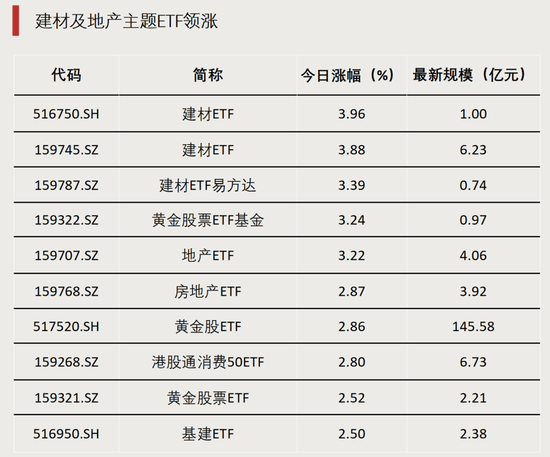
Market Performance - The A-share market experienced a collective decline, with the Shanghai Composite Index down 0.01%, the Shenzhen Component Index down 0.97%, the ChiNext Index down 1.79%, and the Beijing Stock Exchange 50 Index down 2% [1] - The total trading volume across the three markets reached 28,041 billion yuan, an increase of 720 billion yuan compared to the previous day, with over 3,100 stocks in the three markets showing losses [1] Sector Performance - The top-performing sectors included epoxy propylene, precious metals, glyphosate, cultivated diamonds, real estate, construction materials, banking, and airport shipping [1] - Conversely, the sectors that saw the largest declines were commercial aerospace, military equipment, CPO, copper cable high-speed connections, and photovoltaic equipment [1] ETF Performance - Domestic demand sectors saw a broad increase, with the real estate industry chain leading the gains; notable ETFs included: - Fuguo Fund Construction Materials ETF up 3.96% - Guotai Fund Construction Materials ETF up 3.88% - E Fund Construction Materials ETF up 3.39% - Huabao Fund Real Estate ETF up 3.22% - Yinhua Fund Real Estate ETF up 2.87% [1] - Gold prices reached a new historical high, with Ping An Fund Gold Stock ETF rising by 3.24% [1] - Hong Kong consumer stocks also rose, with the Huitianfu Fund Hong Kong Stock Connect Consumer 50 ETF increasing by 2.8% [1] Declining ETFs - The commercial aerospace sector led the declines, with satellite ETFs such as Satellite ETF, Satellite ETF Penghua, and Satellite ETF Guangfa falling by 4.69%, 4.63%, and 4.58% respectively [1] - The photovoltaic sector experienced a pullback, with the Kexin New Energy ETF down 3.94% [1] - The CPO sector also declined, with the communication equipment ETF down 3.76% [1]