
家用电器

Search documents
近一月953公司被调研, 半导体、高端制造成焦点,多股已大涨
2 1 Shi Ji Jing Ji Bao Dao· 2025-11-07 01:48
Core Insights - The article highlights the increasing activity of broker research following the disclosure of third-quarter reports by listed companies, with a notable focus on sectors such as solar energy, semiconductor materials, and consumer electronics [2][5]. Group 1: Broker Research Trends - As of early November, over 35 brokers have conducted research on companies in the solar component supply chain, semiconductor materials, and leading consumer electronics firms [2]. - From October 1 to November 5, a total of 953 listed companies in A-shares received broker research, with 42 companies receiving research from 40 or more brokers [5]. - The most researched companies include Aibo Medical, Huace Testing, and Jinpan Technology, which received 65, 64, and 62 broker inquiries respectively, all categorized under the new productivity label [5]. Group 2: Sector Focus - Brokers are particularly interested in sectors such as semiconductors, industrial automation, and high-end manufacturing, reflecting ongoing market attention to technology-driven industries [2][6]. - Companies like Zhaoyi Innovation and Canadian Solar have also attracted significant broker interest, receiving 55 and 49 inquiries respectively [5]. - The research interest extends to various industries, including medical devices, power equipment, and gaming, indicating a broad focus on high-growth sectors [6]. Group 3: Investment Strategies - Broker investment strategies are concentrated on high-prosperity industries, with a focus on sectors like AI, semiconductor equipment, and consumer electronics [10]. - The research teams from CITIC Securities and CICC suggest that the electronic sector's performance is expected to remain strong, driven by AI and domestic production growth [10][11]. - Recommendations for November include focusing on new economic sectors such as AI software and semiconductor equipment, while traditional sectors like coal and steel are also highlighted [11].






近一月953公司被调研, 半导体、高端制造成焦点,多股已大涨
21世纪经济报道· 2025-11-07 01:38
Core Viewpoint - The article highlights the increasing activity of broker research in various sectors following the disclosure of Q3 financial reports, with a particular focus on technology and new productivity sectors [1][2]. Group 1: Broker Research Activity - As of early November, over 953 A-share listed companies have been researched by brokers, with 42 companies receiving attention from 40 or more brokers [3]. - The most popular companies include Aibo Medical, Huace Testing, and Jinpan Technology, which received 65, 64, and 62 broker research reports respectively, all associated with new productivity [3]. Group 2: Sector Focus - Brokers are particularly interested in the semiconductor industry, high-end equipment, and companies with strong technological barriers and growth potential [5][6]. - Notable companies receiving significant attention include storage chip leader Zhaoyi Innovation and solar component leader Artis, which received 55 and 49 broker research reports respectively [3]. Group 3: Investment Strategies - Broker investment strategies are concentrated on high-growth industries, with a focus on sectors like AI, semiconductor equipment, and consumer electronics [8][9]. - The research teams suggest that the electronic sector is expected to maintain its performance, driven by AI and domestic production growth [8]. Group 4: Market Trends and Recommendations - The article emphasizes the importance of monitoring annual performance expectations and the quality of corporate earnings, as well as the potential for market funds to shift between technology, consumer, and defensive sectors [10]. - Investors are advised to consider policy direction, industry hotspots, valuation rationality, and risk control when making investment decisions [10].

佛山A股上市公司 总营收超6000亿
Sou Hu Cai Jing· 2025-11-07 00:19
Core Insights - The performance of A-share listed companies in Foshan serves as a barometer for the city's industrial development, with total revenue exceeding 600 billion yuan in the first three quarters, and nearly 60% of companies reporting positive revenue growth [2][3] Group 1: Overall Performance - Foshan's A-share listed companies achieved total revenue of 605.7 billion yuan and net profit of 53.98 billion yuan in the first three quarters, marking a year-on-year increase of 10.1% and 17.1% respectively [3] - Among the 55 companies, 32 reported revenue growth, accounting for 58.2%, which is a slight increase from 56.36% in the first half of the year [4] Group 2: Key Contributors - The growth is significantly driven by leading companies, with Midea Group alone contributing nearly 80% of the total revenue increase, reporting a revenue of 363.06 billion yuan, a year-on-year growth of 13.8% [4] - Other notable contributors include Foshan's three companies with revenues exceeding 20 billion yuan: Foshan Energy and Haitian Flavoring, with revenues of 23.50 billion yuan and 21.63 billion yuan, growing by 5.38% and 6.02% respectively [4] Group 3: Sector Performance - Companies in the machinery and home appliance sectors performed well, with 75% of companies in these sectors reporting positive revenue growth [6] - In contrast, companies in light manufacturing, automotive parts, and building materials showed potential for improvement, with all five automotive parts companies experiencing negative growth [6] Group 4: Small and Medium Enterprises - Some small and medium-sized A-share listed companies also showed strong performance, such as Xidi Micro, which reported a revenue growth of 107.81% to 717 million yuan, and Jushen Co., which grew by 82.46% to 1.30 billion yuan [5] Group 5: Strategies for Improvement - Companies facing performance pressures are actively seeking solutions, such as Arrow Home's international expansion and product innovation, which led to a 4.54% increase in domestic retail revenue [7] - Wencan Co. is adjusting its European operations in response to economic challenges, focusing on cost reduction and optimizing its business layout [7] Group 6: Economic Context - Foshan's GDP grew by 1.6% in the first three quarters, with the secondary industry increasing by only 1.2%, indicating significant pressure on traditional industries [8] - The resilience of Foshan's A-share listed companies amidst macroeconomic challenges reflects their role as a stabilizing force in the local economy and highlights the effectiveness of the "manufacturing-led" strategy [8]

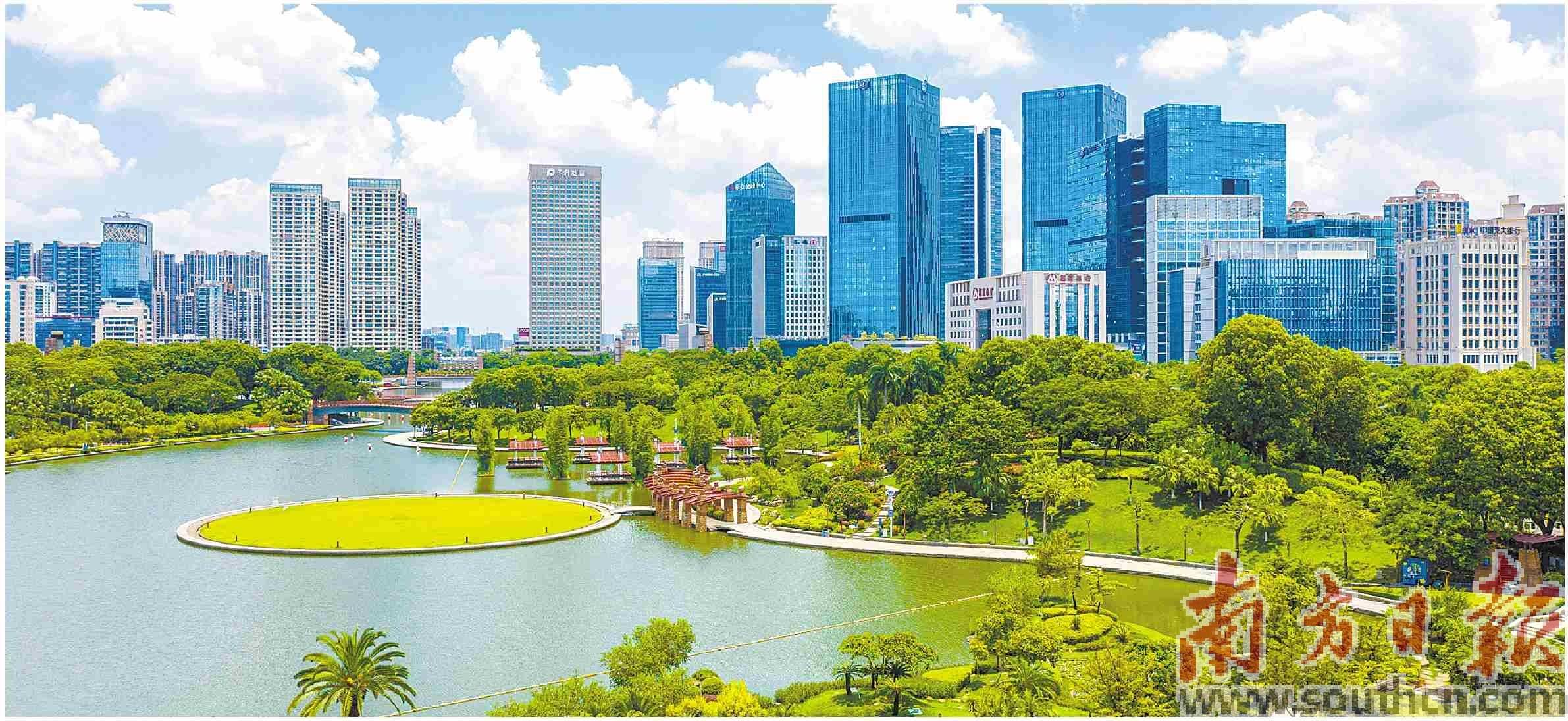
2025“中国南京周”走进德国 开启“未来城市”发展对话
Yang Zi Wan Bao Wang· 2025-11-06 10:56
Group 1 - The "Future City" dialogue and Nanjing city promotion event in Munich marks the beginning of the 2025 "Nanjing Week" and celebrates the 50th anniversary of diplomatic relations between China and the EU [1] - Nanjing has a strong manufacturing base and numerous higher education institutions, while Munich excels in high-end manufacturing and engineering, indicating significant potential for technological cooperation and industrial synergy [1][2] - Jiangsu province has over 400 investment projects in Germany, totaling over $4 billion, and aims to enhance the business environment for foreign enterprises [1] Group 2 - Nanjing has historically been a key node for East-West trade and cultural exchange, maintaining good economic and cultural relations with several German cities [2] - The event featured discussions on deepening cooperation in sectors such as automotive, artificial intelligence, and green industries, with an invitation for German partners to experience Nanjing's unique charm [2] - The event included presentations from Nanjing's investment promotion bureau, showcasing the city's investment environment and industrial advantages, particularly in alignment with Germany's "Industry 4.0" initiative [2][3] Group 3 - Qinhuai District contributes 8.3% of GDP and 38% of total tourism revenue with only 0.75% of the city's land, highlighting its economic effectiveness [3] - Jianye District focuses on finance and digital economy, positioning itself as a modern international city center [3] - Representatives from various sectors engaged in discussions on joint research, talent cultivation, and shared opportunities, emphasizing the ongoing industrial collaboration between China and Germany [3] Group 4 - The Bosch global R&D center in Nanjing is the largest of its kind for the group, showcasing the city's role in international cooperation [4] - The event coincided with the China International Import Expo, providing a platform for Nanjing's cooperation with Stuttgart, including a special exhibition for friendly cities [4] - The event aimed to strengthen industrial connections between Nanjing and Munich, creating a key platform for building a cooperative ecosystem [4] Group 5 - Nanjing's cultural outreach strategy includes the 2025 "Nanjing Week" in various German cities, promoting cultural heritage and deepening Sino-German integration [5] - The collaboration includes vocational training projects with German enterprises, fostering friendship and mutual trust between the two nations [5]
2025Q3家电行业财报综述:基数压力初显,经营无惧挑战
Guolian Minsheng Securities· 2025-11-06 09:18
Investment Rating - The report maintains an "Outperform" rating for the home appliance industry [8]. Core Insights - The home appliance sector reported a revenue increase of 2.68% year-on-year to 389.7 billion yuan in Q3 2025, with a net profit increase of 4.50% to 32.5 billion yuan. The gross margin improved by 0.66 percentage points, while the net profit margin increased by 0.14 percentage points [4][19][28]. Summary by Sections Overall Performance - The home appliance sector showed resilience despite challenges such as the decline of domestic subsidies and external tariff disruptions. The sector achieved steady growth, with revenue and profit margins performing better than expected [4][19]. White Goods - The white goods segment saw a revenue increase of 3.83% year-on-year to 269.7 billion yuan, with net profit rising by 3.32% to 25.6 billion yuan. The gross margin remained stable at 26.00% [10][30]. Black Goods - The black goods segment experienced a revenue decline of 2.64% to 48.6 billion yuan, but net profit improved significantly by 37.21% to 1.5 billion yuan, driven by better profitability from leading brands [11][30]. Post-Cycle Appliances - The post-cycle segment (kitchen appliances and electrical lighting) reported a revenue decline of 4.09% to 11.7 billion yuan, with net profit down 12.73% to 1.6 billion yuan. The segment continues to face low demand [12][30]. Smart Home - The smart home segment achieved a remarkable revenue growth of 24.81% to 11.4 billion yuan, with net profit soaring by 93.18% to 0.9 billion yuan, reflecting strong market demand [13][30]. Traditional Small Appliances - The traditional small appliances segment saw a revenue decline of 4.03% to 22.5 billion yuan, with net profit down 28.32% to 1.0 billion yuan, primarily due to external sales pressures [14][30]. Upstream Performance - The upstream sector reported a slight revenue increase of 2.91% to 25.9 billion yuan, with net profit rising by 22.75% to 1.9 billion yuan, indicating improved performance in raw material supply [19][30].


万联晨会-20251106
Wanlian Securities· 2025-11-06 03:53
Core Insights - The A-share market showed a positive trend with the Shanghai Composite Index closing up 0.23% at 3969.25 points, and the Shenzhen Component Index rising 0.37% [2][8] - The trading volume in the A-share market reached approximately 1.87 trillion RMB, with nearly 3200 stocks experiencing gains [2][8] - The power equipment sector led the gains among industries, while the computer sector lagged behind [2][8] - The Hong Kong market saw a slight decline, with the Hang Seng Index down 0.07% [2][8] - U.S. stock indices all closed higher, with the Dow Jones up 0.48% and the Nasdaq up 0.65% [2][8] Important News - Premier Li Qiang emphasized the importance of the China International Import Expo as a bridge connecting the Chinese economy with the world, highlighting the growth potential of China's vast market [3][9] - The recent approval of the "14th Five-Year Plan" by the Communist Party's Central Committee is expected to provide more certainty for China's economic development [3][9] Industry Analysis Consumer Sector - The heavy holding ratio in the consumer sector has continued to decline, with a decrease of 1.15 percentage points to 4.69%, significantly below the historical average of 11.15% since 2018 [10][11] - The food and beverage sector saw a substantial drop in heavy holdings, particularly in the liquor segment, which has been consistently shrinking [18][19] - The food and beverage sector's heavy holding ratio ranked fifth among 31 industries, with a total market value of 2530.95 billion RMB, reflecting a downward trend [18][19] Diamond Industry - The recent abolition of tax incentives for diamonds is expected to impact the entire diamond industry chain, particularly affecting upstream mining and midstream processing sectors [15][16] - The tax burden on upstream diamond miners will increase from 0% to 13%, potentially leading to higher costs for downstream retailers [15][16] - The policy change is anticipated to promote market competition and may accelerate industry consolidation [17] Food and Beverage Performance - The performance of Guangzhou Restaurant (603043) showed steady growth, with a revenue of 4.285 billion RMB for the first three quarters of 2025, reflecting a year-on-year increase of 4.43% [24][25] - The company has initiated a mid-term dividend distribution, indicating confidence in future profitability [26][27] - The overall consumer environment remains under pressure, but there are structural investment opportunities in the beverage and snack sectors [21][27]

11月5日电子、通信、非银金融等行业融资净卖出额居前
Zheng Quan Shi Bao Wang· 2025-11-06 01:55
Core Insights - As of November 5, the latest market financing balance is 24,735.44 billion yuan, showing a slight decrease of 1.43 billion yuan from the previous trading day [1] Industry Summary - **Industries with Increased Financing Balance**: - The power equipment industry saw the largest increase, with a financing balance up by 27.39 billion yuan, totaling 2,111.34 billion yuan, reflecting a growth of 1.31% [1] - Other notable increases include: - Basic chemicals: up by 2.67 billion yuan to 971.28 billion yuan (0.28% increase) [1] - Steel: up by 2.52 billion yuan to 172.81 billion yuan (1.48% increase) [1] - Construction decoration: up by 2.46 billion yuan to 390.62 billion yuan (0.63% increase) [1] - **Industries with Decreased Financing Balance**: - The electronics industry experienced the largest decrease, down by 18.55 billion yuan to 3,602.21 billion yuan, a decline of 0.51% [2] - Other significant decreases include: - Communication: down by 9.28 billion yuan to 1,096.84 billion yuan (0.84% decrease) [2] - Non-bank financials: down by 5.81 billion yuan to 1,924.73 billion yuan (0.30% decrease) [2] - Light industry manufacturing: down by 1.38 billion yuan to 142.82 billion yuan (0.96% decrease) [1] - **Financing Balance Changes by Industry**: - The steel industry had the highest increase percentage-wise, with a financing balance of 172.81 billion yuan, reflecting a 1.48% growth [1] - Conversely, the light industry manufacturing, communication, and construction materials industries saw the largest percentage declines, with decreases of 0.96%, 0.84%, and 0.73% respectively [1][2]
天风证券晨会集萃-20251106
Tianfeng Securities· 2025-11-05 23:46
Group 1 - The report highlights that the pricing of 30Y bonds may be overvalued, with liquidity premiums already fully priced in, suggesting a potential adjustment in yield spreads between different bond types [1][21][23] - The report indicates that the demand for long-term bonds may not be sustainable due to insufficient buying power from institutional investors and ongoing duration risks in the market [1][24] - The report notes that the overall performance of the bond market has been influenced by recent positive sentiment, but warns against impulsive buying in the current environment [1][24] Group 2 - The chemical industry report emphasizes that over 75% of global spandex production capacity is concentrated in China, with significant growth in Asian production since 2000 [2] - The report states that China's spandex consumption is expected to grow from 121,000 tons in 2005 to 1,012,000 tons by 2024, reflecting a CAGR of 11.8% [2] - The report highlights that differentiated spandex production in China is around 23%, compared to 60% in developed countries, indicating potential for market expansion [2] Group 3 - The telecommunications company reported a revenue of 3.763 billion yuan for the first three quarters of 2025, a decrease of 9% year-on-year, but a reduction in losses compared to the previous year [4][36] - The company has increased its market share in system equipment, benefiting from the largest 5G network globally, with over 66% of the world's 5G base stations located in China [4][37] - The report anticipates future growth opportunities in satellite internet and 5G technologies, despite short-term performance pressures [4][38] Group 4 - The home appliance company reported a revenue of 71.53 billion yuan for the first three quarters of 2025, with a slight increase of 1.4% year-on-year, while net profit rose by 0.7% [9] - The report indicates that the company's air conditioning business is under pressure due to weak real estate trends, but its white goods segment remains resilient [9] - Future profitability improvements are expected through cost reduction and product optimization strategies [9] Group 5 - The gas company reported a revenue of 930 million yuan for Q3 2025, a decline of 8% year-on-year, with net profit down 30.1% [16] - The report highlights that increased costs from upstream resource acquisition are impacting short-term performance, but long-term growth is anticipated due to resource reserves [16] - The company is expected to achieve net profits of 1.2 billion yuan, 1.43 billion yuan, and 1.69 billion yuan from 2025 to 2027 [16] Group 6 - The mining company has undergone significant changes with the entry of a new controlling shareholder, which is expected to drive growth in lithium and potassium production [17] - The report notes that the lithium market is improving, with demand expected to rise due to energy storage and electric vehicle trends [17] - The company is projected to achieve net profits of 6.482 billion yuan, 7.062 billion yuan, and 7.825 billion yuan from 2025 to 2027, reflecting strong growth potential [17]
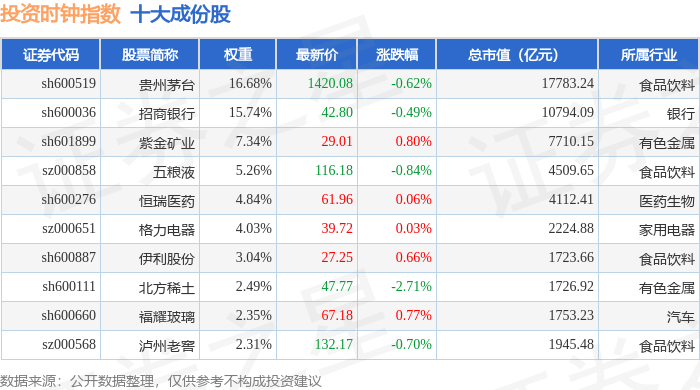
11月5日投资时钟(399391)指数涨0.03%,成份股国城矿业(000688)领涨
Sou Hu Cai Jing· 2025-11-05 09:55
Market Overview - The Investment Clock Index (399391) closed at 3348.13 points, up 0.03%, with a trading volume of 78.792 billion yuan and a turnover rate of 0.81% [1] - Among the index constituents, 71 stocks rose while 28 stocks fell, with Guocheng Mining leading the gainers at a 9.42% increase and Dalian Shengya leading the decliners at a 9.99% decrease [1] Top Constituents - The top ten constituents of the Investment Clock Index are as follows: - Kweichow Moutai (sh600519) holds a weight of 16.68% and closed at 1420.08 yuan, down 0.62% with a market cap of 1778.324 billion yuan [1] - China Merchants Bank (sh600036) has a weight of 15.74%, closing at 42.80 yuan, down 0.49% with a market cap of 1079.409 billion yuan [1] - Yunnan Tin Company (sh601899) has a weight of 7.34%, closing at 29.01 yuan, up 0.80% with a market cap of 771.015 billion yuan [1] - Wuliangye Yibin (sz000858) has a weight of 5.26%, closing at 116.18 yuan, down 0.84% with a market cap of 450.965 billion yuan [1] - Hengrui Medicine (sh600276) has a weight of 4.84%, closing at 61.96 yuan, up 0.06% with a market cap of 411.241 billion yuan [1] - Gree Electric Appliances (sz000651) has a weight of 4.03%, closing at 39.72 yuan, up 0.03% with a market cap of 222.488 billion yuan [1] - Yili Industrial Group (sh600887) has a weight of 3.04%, closing at 27.25 yuan, up 0.66% with a market cap of 172.366 billion yuan [1] - Northern Rare Earth (sh600111) has a weight of 2.49%, closing at 47.77 yuan, down 2.71% with a market cap of 172.692 billion yuan [1] - Fuyao Glass (sh600660) has a weight of 2.35%, closing at 67.18 yuan, up 0.77% with a market cap of 175.323 billion yuan [1] - Jilin Chemical (sz000568) has a weight of 2.31%, closing at 132.17 yuan, down 0.70% with a market cap of 194.548 billion yuan [1] Capital Flow - The net outflow of main funds from the index constituents totaled 677 million yuan, while retail investors saw a net inflow of 708 million yuan [3] - Detailed capital flow for selected stocks includes: - China Zhongjin (601888) saw a main fund net inflow of 36.4 million yuan, while retail funds had a net outflow of 93.414 million yuan [3] - Jiangxi Copper (600362) had a main fund net inflow of 18.2 million yuan, with retail funds experiencing a net outflow of 70.3612 million yuan [3] - Weichai Power (000338) had a main fund net inflow of 13.5 million yuan, while retail funds had a net inflow of 1.60758 million yuan [3] - Giant Network (002558) had a main fund net inflow of 11.8 million yuan, with retail funds experiencing a net outflow of 65.0268 million yuan [3] - China Coal Energy (601898) had a main fund net inflow of 11.7 million yuan, while retail funds had a net outflow of 79.0666 million yuan [3]





广东TCL空调器控股公司成立 注册资本约18亿元
Zheng Quan Shi Bao Wang· 2025-11-05 07:26
人民财讯11月5日电,企查查APP显示,近日,广东TCL空调器控股有限公司成立,法定代表人为彭 攀,注册资本约18.18亿元,经营范围包括以自有资金从事投资活动、家用电器制造、家用电器研发 等。企查查股权穿透显示,该公司由TCL AeroWell(HK)Holdings Limited全资持股。 ...