汽车产业

Search documents
内卷的根源与治理小议
董扬汽车视点· 2025-08-29 10:32
Core Viewpoint - The phenomenon of "involution" in competition has become a national consensus, with large enterprises reporting improvements while small enterprises feel little change [1] Group 1: Causes of Involution - Involution is a market phenomenon deeply rooted in social and cultural factors, stemming from a collective desire for rapid economic development and national rejuvenation since the establishment of New China [1] - Major enterprises leverage their competitive advantages to intensify competition, aiming to eliminate other players, which is a significant cause of involution [2] - Government bias towards large enterprises and neglect of small and medium-sized enterprises in market regulation contributes to the formation of involution [2] Group 2: Governance Methods - Effective governance requires a combination of a well-functioning market and proactive government intervention, aiming to establish a sound competitive order in the socialist market economy [3] - The governance process is expected to take a long time, potentially requiring one or two generations to establish a high-quality development market order [3] Group 3: Thoughts on Governance - Involution is not a criminal act; the focus should be on the strict enforcement of existing laws and regulations [4] - Overly strict management can stifle market vitality and increase governance costs [5] - Indicators such as average profit margins can help assess the severity of involution in industries like the automotive sector [5] - Involution encompasses more than just price competition; it also includes other competitive aspects, and there are suggestions to focus on technological competition instead [5] - Governance of involution is a gradual process, requiring continuous adaptation of management models based on new market developments [6]


如何在新一轮城市竞争中胜出
Zhong Guo Fa Zhan Wang· 2025-08-21 07:25
Group 1 - The competition among the top 30 cities in terms of economic total is ongoing, with cities needing to consolidate advantages and avoid complacency, while those lagging must accelerate transformation efforts [1] - Cities like Guangzhou, Foshan, and Dongguan are encouraged to develop clear industrial upgrade plans, including a negative list of industries to guide resource allocation towards high-tech and high-value-added sectors [1][2] - The importance of talent upgrade is emphasized, with local governments needing to attract high-end talent and optimize educational programs to meet industry demands [2] Group 2 - Foshan's economic foundation lies in traditional manufacturing, and its upgrade is crucial for stability, with potential for AI applications in manufacturing processes [3] - The cultivation of emerging industries is vital for Foshan to secure future competitive advantages, focusing on specific sectors like semiconductors and renewable energy [3] - Cities with slower growth should leverage cross-border e-commerce to enhance their industrial strengths and build independent brands, while local governments should facilitate resource integration and global innovation networks [4]
21社论丨破除消费堵点,释放内需潜能
21世纪经济报道· 2025-08-21 00:20
Core Viewpoint - The recent State Council meeting emphasizes strengthening domestic circulation by removing restrictive measures in the consumption sector, which is crucial for unleashing domestic demand and promoting high-quality economic development [1]. Group 1: Consumer Potential and Market Dynamics - Systematic removal of restrictive measures in the consumption sector will empower consumers with more autonomy, allowing them to make consumption decisions based on their needs and economic capabilities, thereby enhancing quality of life [1]. - The removal of restrictions will break down market barriers, attract more market participants, stimulate competition, and encourage companies to innovate, optimize products and services, reduce costs, and improve quality, leading to industry innovation and transformation [1]. Group 2: Specific Sector Policies - Optimizing automobile purchase restrictions is essential as the automotive industry is a pillar of the national economy, and normal consumption will benefit both automotive manufacturers and their supply chains, facilitating industry transformation [2]. - Adjusting real estate market policies to release improvement housing demand is critical; removing housing-related restrictions can enhance market circulation and invigorate related industries, thus boosting economic growth [2]. - Accelerating the development of service consumption and new consumption models, such as online education and shared economy, by lowering market entry barriers will better meet the public's needs for a better life and represent a significant growth potential [2]. Group 3: Implementation Principles - The process of removing consumption restrictions should follow scientific, orderly, and coordinated principles, avoiding a one-size-fits-all approach and ensuring a stable and transparent market environment [3]. - In the automotive sector, shifting from purchase management to usage management through improved transportation systems can alleviate traffic pressure and meet consumer demand [3]. - In real estate, comprehensive cancellation of purchase, sale, and price restrictions is necessary to establish a new mechanism for the interaction of housing, land, and finance, promoting reasonable circulation and moderate consumption [3]. Group 4: Service and New Consumption Areas - In the service consumption sector, breaking down hidden market entry barriers and promoting diverse high-quality services in health, elderly care, and tourism will meet the growing demands of residents and create job opportunities [4]. - For new consumption areas, creating a favorable environment for the development of digital economy and green consumption will accelerate the application of new technologies and business models, fostering new economic growth points [4]. Group 5: Market Regulation and System Construction - Strengthening market regulation and building a fair competitive environment is essential to protect consumer rights and ensure market order while promoting consumption [5]. - Different government departments should adopt a systematic approach to dismantle consumption restrictions and continuously release consumption potential, supporting steady progress in high-quality economic development [5].

破除消费堵点,释放内需潜能
2 1 Shi Ji Jing Ji Bao Dao· 2025-08-20 22:31
Group 1 - The State Council's ninth plenary session emphasizes strengthening domestic circulation by removing restrictive measures in the consumption sector to stimulate consumer potential and promote high-quality economic development [1][2] - Systematic removal of restrictions will empower consumers with more autonomy, enhance their quality of life, and stimulate demand [1][3] - Optimizing policies in the automotive sector is crucial as it is a pillar industry that supports various supply chain segments, leading to overall industry development and transformation [1][2] Group 2 - Adjusting real estate market policies is essential to release potential demand for improved housing, which is interconnected with multiple industries such as construction and furniture [2][3] - Accelerating the growth of service consumption and new consumption models, such as online education and shared economy, is necessary to meet the evolving needs of consumers [2][4] - The execution of removing consumption restrictions should follow a scientific and orderly approach, avoiding a one-size-fits-all strategy while optimizing the business environment [3][4] Group 3 - In the automotive sector, transitioning from purchase management to usage management can alleviate traffic pressure and meet consumer needs more effectively [3][4] - The real estate sector requires a comprehensive cancellation of purchase, sale, and price restrictions to promote healthy market development [3][4] - In the service consumption area, breaking down invisible market entry barriers and enhancing the supply of high-quality services can create job opportunities and drive economic growth [4]
美欧贸易协议:美国酿制苦酒 欧盟无奈下咽(环球热点)
Ren Min Ri Bao Hai Wai Ban· 2025-08-15 21:29
Group 1 - The US-EU trade agreement imposes a 15% tariff on EU products entering the US, effective from August 7, which is significantly higher than the previous 10% tariff imposed by the US on EU goods [1][2] - The agreement includes commitments from the EU to invest $600 billion in the US and purchase $750 billion worth of US energy products over the next three years, along with military equipment [1][6] - The agreement has faced criticism within the EU, with concerns that it primarily benefits the US and undermines EU interests, particularly in key sectors like automotive and pharmaceuticals [2][4][8] Group 2 - The US aims to restructure trade relations to achieve a trade surplus, support domestic re-industrialization, and alleviate fiscal pressures, which aligns with its broader economic goals [3][4] - The EU's acceptance of the agreement is largely driven by its political and security dependence on the US, particularly in the context of ongoing geopolitical tensions [3][4] - The agreement's terms may exacerbate the EU's economic recovery challenges, as the high tariffs on EU exports could lead to reduced competitiveness in certain industries [4][5] Group 3 - The agreement has been described as a "political gesture" rather than a market-driven arrangement, with skepticism about the EU's ability to meet the investment and procurement commitments outlined [6][7] - The potential for increased US energy dependence and the impact on the EU's climate goals have raised alarms among EU officials and environmental advocates [6][8] - The ongoing negotiations and the ambiguity in the agreement's terms could lead to future trade disputes, particularly regarding agricultural products and other contentious sectors [9][10]
31省份半年报:粤苏鲁总量领跑 新兴产业成增长“新势力”
2 1 Shi Ji Jing Ji Bao Dao· 2025-08-02 04:37
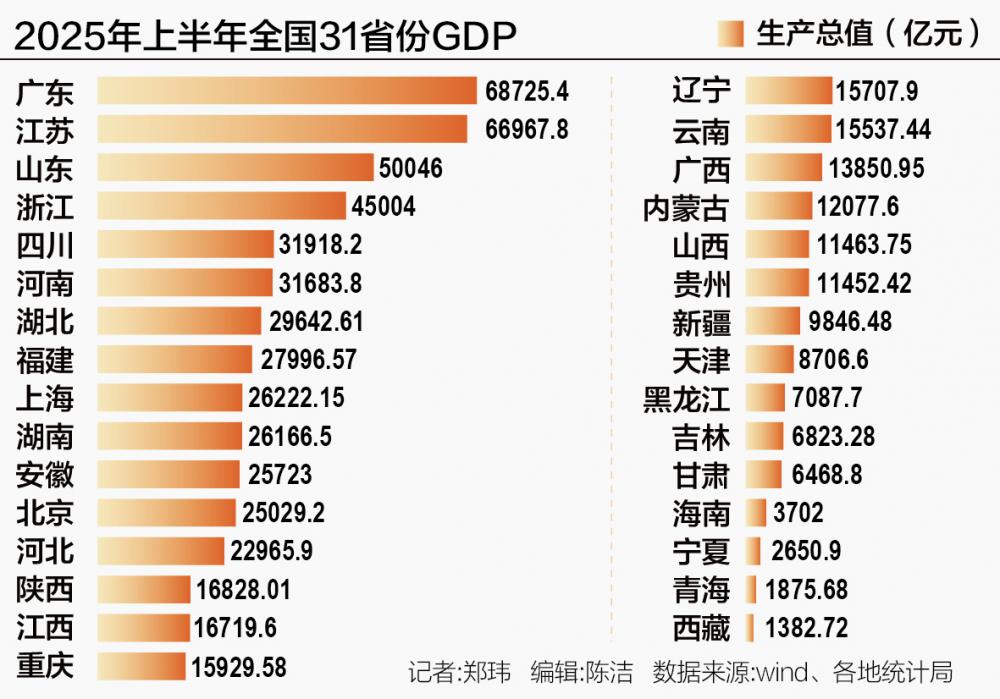
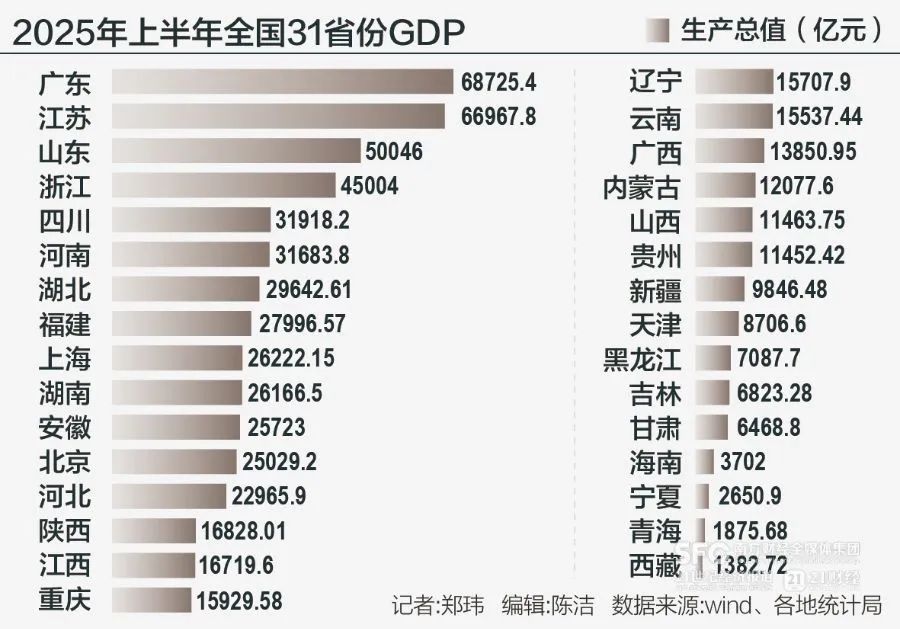
Economic Overview - The economic performance of various provinces in China during the first half of 2025 shows a clear distinction between traditional economic powerhouses leveraging innovation and emerging provinces igniting growth through new industries and unique consumption points [1][2] - The GDP totals for the top three provinces are Guangdong at 68,725.4 billion, Jiangsu at 66,967.8 billion, and Shandong at 50,046 billion, maintaining their positions as the leading economic regions [3][4] Regional Performance - Eastern provinces continue to lead in overall economic output, while central provinces like Hubei show impressive growth rates, with Hubei's GDP reaching 29,642.61 billion, growing by 6.2% [6][4] - The industrial sector has been a significant driver of economic growth across many provinces, with 27 provinces reporting industrial value-added growth rates surpassing regional GDP growth [7][4] Industrial Growth - The equipment manufacturing sector, particularly in automotive and electronics, has shown strong performance, with high-tech products in Guangdong and Hubei experiencing double-digit growth [7][9] - In the first half of 2025, the industrial value-added in Fujian grew by 8.7%, with the equipment manufacturing sector increasing by 15.2% [8][9] Investment and Consumption - Beijing's economic growth is supported by a 14.1% increase in fixed asset investment, with equipment purchase investments soaring by 99.0% [5][4] - Hubei's consumption and investment growth rates exceeded GDP growth, with retail sales increasing by 6.9% and exports rising by 38.5% [6][4] Emerging Industries - New industries are becoming a significant force for economic growth, with provinces focusing on robotics, drones, and other high-tech sectors to drive development [11][10] - Guangdong's production of high-tech products, including lithium-ion batteries and industrial robots, saw substantial increases, with lithium-ion battery production up by 42.2% [9][10]
31省份半年报全部出炉,广东、江苏、山东GDP位列前三
2 1 Shi Ji Jing Ji Bao Dao· 2025-08-02 04:24
Economic Overview - As of mid-2025, all 31 provinces in China have released their economic reports, showing a stable economic landscape with no changes in the top 10 GDP provinces compared to the first quarter [2][5] - The eastern provinces continue to lead in overall economic output, with Guangdong, Jiangsu, and Shandong maintaining the top three positions in GDP, achieving 68,725.4 billion yuan, 66,967.8 billion yuan, and 50,046 billion yuan respectively [2][5] Regional Performance - The eastern provinces exhibit stable growth, while central provinces show impressive economic growth rates, with Hubei's GDP growing by 6.2%, surpassing the national average of 5.3% [7] - In the first half of 2025, Hubei's fixed asset investment increased by 6.5%, and its total retail sales of consumer goods rose by 6.9%, with exports growing significantly by 38.5% [7] Industrial Growth - Industrial growth has been a key driver for many provinces, with 27 provinces reporting industrial value-added growth rates exceeding regional GDP growth [3][9] - The equipment manufacturing sector, particularly in automotive and electronics, has shown strong performance, with high-tech products like lithium-ion batteries and industrial robots in Guangdong and Hubei experiencing double-digit growth [3][9][11] Emerging Industries - New industries are emerging as significant contributors to economic growth, with provinces like Guangdong and Hubei focusing on high-tech manufacturing, including substantial increases in the production of lithium-ion batteries and robotics [12][13] - The industrial robot sector is entering a crucial development phase, with Guangdong becoming a major hub for smart robotics, aiming to enhance overall economic efficiency [12][13] Investment and Consumption - In Beijing, fixed asset investment grew by 14.1%, with equipment purchase investments skyrocketing by 99%, indicating strong industrial expansion [6] - In Fujian, social retail sales reached 12,560.88 billion yuan, growing by 6.0%, supported by an 8.7% increase in industrial value-added [6][10]
美商务部长:和欧盟还有很多讨价还价,数字服务税和钢铝是重点
Hua Er Jie Jian Wen· 2025-07-29 22:26
Group 1 - The US and EU trade negotiations are ongoing, with key areas such as digital services tax and steel and aluminum trade still requiring extensive discussions [1][2] - A preliminary framework agreement was reached, where the US will impose a 15% tariff on EU products, and the EU will increase investments in the US by $600 billion and purchase $750 billion worth of US energy [1][3] - The pharmaceutical and automotive industries are identified as critical sectors for the trade agreement, with significant tariffs expected on non-US produced pharmaceuticals [3] Group 2 - The EU is pushing for a quota system on metal exports to reduce the 50% tariffs currently imposed by the US on specific EU metal products [2] - A non-legally binding joint statement is sought by August 1 to clarify parts of the agreement, which will lead to the US beginning to lower tariffs on certain EU industries [3] - There is skepticism in the market regarding the EU's ability to fulfill its commitment to purchase $750 billion worth of US energy within three years, given that last year's imports were less than $80 billion [5] Group 3 - The US aims to finalize all equivalent tariffs by August 1, with different timelines for negotiations with China [6]
8轮谈判后,特朗普宣布:和日本达成贸易协议!对中国有何影响?
Sou Hu Cai Jing· 2025-07-23 10:36
Group 1 - The trade agreement between the US and Japan was reached after eight rounds of negotiations, with significant implications for both economies [1][2] - The agreement includes a reduction of tariffs on Japanese products exported to the US from 25% to 15%, and Japan will invest $550 billion in the US, with the US retaining 90% of the profits [2][4] - Japan will open its market to US products, including automobiles, rice, and other agricultural goods, which indicates a major concession from Japan [2][4] Group 2 - In the short term, the agreement is seen as a relief for Japan, particularly for its automotive industry, which exports 1.37 million vehicles to the US, accounting for 34% of Japan's total exports to the US [4] - Following the announcement, the Nikkei 225 index surged by over 800 points, closing up 1,396.40 points or 3.51%, indicating increased market confidence [4] - However, the long-term implications suggest that Japan's concessions may lead to significant fiscal pressure and potential hollowing out of domestic industries as companies shift operations to the US [4][5] Group 3 - The trade agreement may alter the competitive landscape for China, as Japan's increased imports of US agricultural products could reduce its imports from other countries, including China [7] - Japanese companies may invest more in the US to avoid tariffs, potentially decreasing their investments in China, which could impact China's related industries [7] - The strengthened supply chain cooperation between Japan and the US in sectors like semiconductors and steel may marginalize Chinese industries, leading to challenges in stability and upgrading of China's industrial chain [7][8]
总编有约·“两高四着力”调研行丨中牟新区“新”在哪
He Nan Ri Bao· 2025-07-23 00:46
Core Insights - The article discusses the transformation of Zhongmu County into a new urbanization model, emphasizing the development of a coordinated urban-rural structure centered around county towns, with a focus on the establishment of the Zhongmu New District as a key area for regional growth and integration with Zhengzhou and Kaifeng [1][5]. Group 1: Urban Development and Integration - Zhongmu County has evolved from an agricultural base to a cultural and entertainment hub, now labeled as "China's Theme Park County" [1]. - The establishment of the Zhongmu New District aims to facilitate the integration of the Zhengzhou metropolitan area, serving as a bridgehead for urbanization and a new engine for development [5][11]. - The district covers an area of 730 square kilometers and is designed to promote coordinated development, innovation, and cultural tourism [5]. Group 2: Infrastructure and Public Services - The new district will enjoy the same level of public services and infrastructure as Zhengzhou, including the implementation of low-capacity rail transit and integration into the city's metro system [6][7]. - Key transportation projects are underway, including the Zhengkai intercity railway and various road upgrades, contributing to a comprehensive traffic network [7][8]. Group 3: Economic Growth and Industry - The Zhongmu New District is set to attract significant investment, with the Yishow Town Fashion Industry Service Center projected to have a total investment of 10 billion yuan, focusing on the integration of culture, tourism, and fashion [4]. - The automotive industry is also a focal point, with over 100 companies generating an annual output value exceeding 20 billion yuan [12]. - The district aims to create a modern industrial system supported by advanced manufacturing, cultural tourism, and other emerging sectors, enhancing its competitiveness and innovation capacity [12][13]. Group 4: Cultural and Tourism Development - Zhongmu County has developed a unique cultural identity, attracting over 36 million tourists in the past year, with significant contributions from various theme parks and cultural attractions [11]. - The "Only Henan: Drama Wonderland" has seen visitor numbers reach 16 million in 2024, surpassing even Shanghai Disneyland, indicating a strong cultural tourism market [11]. Group 5: Community and Quality of Life - The focus on human-centered urbanization is evident in the influx of quality educational and healthcare resources, enhancing the overall living standards in Zhongmu [8][9]. - The integration of industry and urban development is creating job opportunities, allowing residents to transition from traditional agriculture to urban employment [12].