
消费品制造业

Search documents
11月制造业PMI回升至49.2%
Mei Ri Jing Ji Xin Wen· 2025-11-30 14:53
市场需求有所修复 11月,制造业PMI小幅回升。体现市场需求的制造业新订单指数回升0.4个百分点至49.2%,表明市场需求有所修复。 从需求结构上看,新订单指数与新出口订单指数差值在10月份出现跳升后,回落1.3个百分点至1.6个百分点。新出口订单指数回升1.7 个百分点至47.6%,是11月制造业新订单指数上升的重要推动因素。 东方金诚首席宏观分析师王青在接受《每日经济新闻》记者微信采访时表示,10月末中美经贸会谈取得积极成果,对11月出口形成一 定拉动。 王青指出,9月末至10月初推出"两个5000亿"稳增长政策,其中5000亿元新型政策性金融工具已在10月投放完毕,会在11月对基建投资 和制造业投资形成拉动;财政部10月份明确中央财政从地方政府债务结存限额中安排5000亿元下达地方,这将补充地方财力,其中为 项目建设提供2000亿元新增资金。这些都会拉动国内市场需求。 11月30日,国家统计局公布11月中国采购经理指数(PMI)运行情况。 数据显示,11月,中国制造业PMI为49.2%,比10月回升0.2个百分点,景气水平有所改善。其中,生产指数和新订单指数分别为50.0% 和49.2%,分别比上月上升 ...

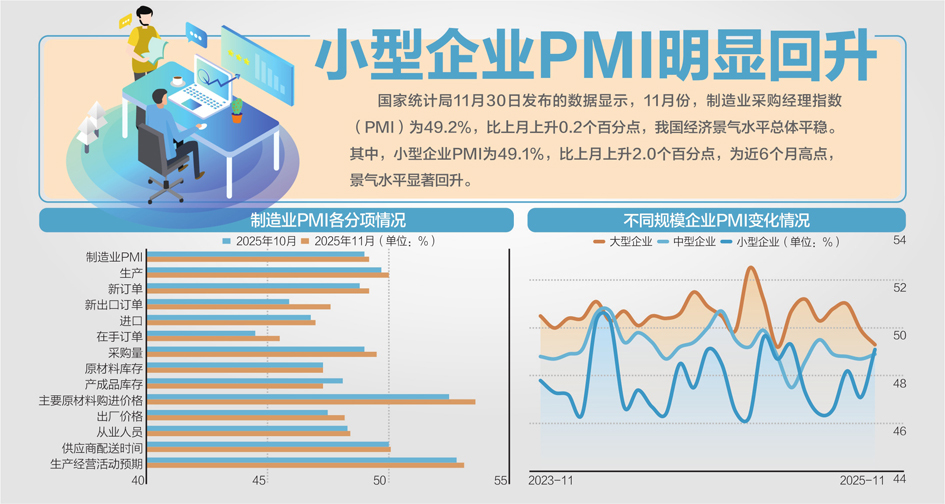
产需两端均有改善 11月制造业PMI回升
Di Yi Cai Jing· 2025-11-30 13:56
Group 1: Manufacturing Sector Overview - The manufacturing PMI for November is reported at 49.2%, an increase of 0.2 percentage points from October, but it has remained below the critical line for eight consecutive months [1] - The production index and new orders index for November are 50.0% and 49.2%, respectively, indicating improvements in both production and demand [4] - High-tech manufacturing PMI stands at 50.1%, remaining above the critical point for ten months, suggesting continued growth in this sector [4] Group 2: Economic Indicators and Market Sentiment - The production expectations index for November is 53.1%, reflecting increased confidence among manufacturing enterprises regarding market development [5] - The new export orders index has risen to 47.6%, up 1.7 percentage points from October, indicating a stabilization in manufacturing exports [5] - The overall manufacturing market demand is showing signs of recovery, with the new orders index increasing by 0.4 percentage points from October [5] Group 3: Price Trends and Inventory Levels - The purchasing price index for raw materials is at 53.6%, up 1.1 percentage points from October, indicating rising input costs [7] - The finished goods inventory index is at 47.3%, down 0.8 percentage points from October, suggesting smoother sales activities for enterprises [6] Group 4: Service Sector Performance - The non-manufacturing business activity index is reported at 49.5%, a decrease of 0.6 percentage points from October, indicating a slowdown in service sector activities [9] - The financial services sector shows strong performance, with business activity and new orders indices both exceeding 55%, indicating robust growth [13] - The construction industry business activity index has improved to 49.6%, up 0.5 percentage points from October, signaling a recovery in construction activities [14]
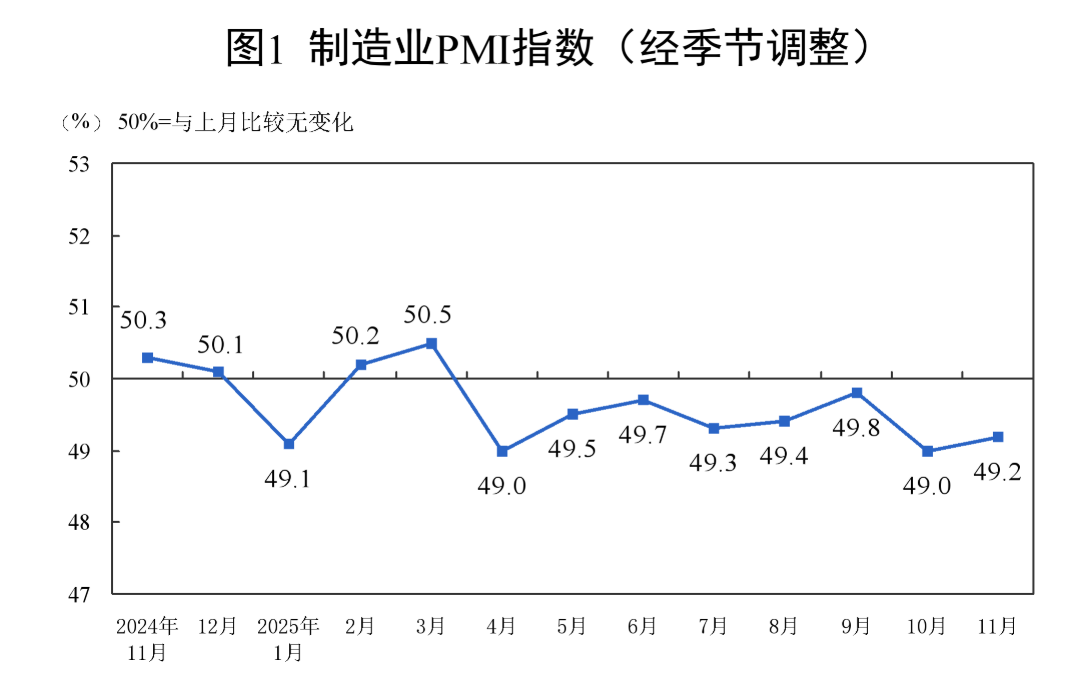
产需两端均有改善,11月制造业PMI回升
Di Yi Cai Jing· 2025-11-30 13:40
Manufacturing Sector - The manufacturing PMI for November is reported at 49.2%, showing a slight increase of 0.2 percentage points from October, but remains below the growth threshold for eight consecutive months [1][4] - The production index and new orders index for November are 50.0% and 49.2%, respectively, indicating improvements in both production and demand, with the production index returning to the critical point [4][5] - High-tech manufacturing PMI stands at 50.1%, remaining above the critical point for ten consecutive months, indicating continued growth in this sector [1][4] Economic Outlook - Analysts suggest that the slight recovery in the manufacturing PMI reflects improved market confidence, driven by the "14th Five-Year Plan" and recent positive outcomes from US-China trade talks [4][5] - Despite the improvements, there are still significant downward pressures on the economy, particularly due to external uncertainties and ongoing adjustments in the real estate market [6][8] - The production activity expectation index for November is 53.1%, indicating increased confidence among manufacturing enterprises regarding market development [5] Export and Demand - The new export orders index for November is 47.6%, up 1.7 percentage points from October, suggesting a stabilization in manufacturing exports [5] - All major manufacturing sectors, including high-tech and consumer goods, have seen increases in new export orders, with high-tech manufacturing new export orders rising over 3 percentage points [5][6] Price Trends - The purchasing price index for raw materials is at 53.6%, up 1.1 percentage points from October, indicating rising costs for manufacturers [7][8] - The factory price index is at 48.2%, showing a slight recovery but still in the contraction zone, suggesting that price increases are primarily affecting upstream sectors [7][8] Service Sector - The non-manufacturing business activity index for November is 49.5%, down 0.6 percentage points from October, reflecting a seasonal decline in consumer-related services [9][12] - The financial services sector shows strong performance, with business activity and new orders indices both exceeding 55%, indicating robust growth in this area [12][13] - The construction sector's business activity index has improved to 49.6%, signaling a recovery in construction activities, supported by recent policy measures [13][14]
11月中国制造业采购经理指数总体向好
Yang Shi Wang· 2025-11-30 12:40
央视网消息(新闻联播):国家统计局、中国物流与采购联合会11月30日公布,11月份中国制造业采购经理指数为49.2%,较上月上升0.2个百分点,大部分 分项指数较上月有所上升。 制造业产需两端有所改善,生产指数和新订单指数双回升。新出口订单指数为47.6%,较上月上升1.7个百分点,指数升幅较为明显。高技术制造业新出口订 单指数较上月上升超过3个百分点。 11月生产指数为50%,较上月上升0.3个百分点。装备制造业、高技术制造业和消费品制造业生产指数都保持在扩张区间。 ...
——2025年11月PMI点评:出口改善推动制造业PMI回稳
EBSCN· 2025-11-30 12:18
Manufacturing Sector - The manufacturing PMI for November 2025 is 49.2%, a slight increase of 0.2 percentage points from the previous month, but still below the seasonal level[2][5] - New export orders index rose significantly by 1.7 percentage points to 47.6%, driven by the easing of US-China tariffs and improved trade conditions[5][19] - Small enterprise PMI increased by 2.0 percentage points to 49.1%, marking a six-month high, indicating a recovery in the external trade environment[5][12] Non-Manufacturing Sector - The non-manufacturing PMI decreased to 49.5%, down 0.7 percentage points from the previous month, reflecting a decline in service-related activities post-holiday[2][28] - The construction PMI rose by 0.5 percentage points to 49.6%, indicating a low-level recovery in building activities, supported by ongoing infrastructure projects[32][34] Price and Inventory Dynamics - Raw material purchase prices and factory gate prices indices increased to 53.6% and 48.2%, respectively, showing an improvement in the supply-demand relationship[24][25] - The finished goods inventory index fell by 0.8 percentage points to 47.3%, indicating a faster reduction in inventory levels, which may support future price increases[24][27]
11月制造业PMI回升至49.2%:高技术制造业PMI为50.1%,连续10个月位于临界点以上
Mei Ri Jing Ji Xin Wen· 2025-11-30 12:07
Group 1: Manufacturing Sector - In November, China's manufacturing PMI rose to 49.2%, an increase of 0.2 percentage points from October, indicating an improvement in economic conditions [1] - The production index and new orders index were reported at 50.0% and 49.2%, respectively, with increases of 0.3 and 0.4 percentage points from the previous month [1] - The high-tech manufacturing PMI stood at 50.1%, remaining above the critical point for ten consecutive months, reflecting ongoing expansion in this sector [1][3] Group 2: Market Demand and Orders - The new orders index for manufacturing increased by 0.4 percentage points to 49.2%, suggesting a recovery in market demand [2] - The new export orders index rose by 1.7 percentage points to 47.6%, contributing significantly to the increase in the new orders index [2] - Recent policy measures, including the introduction of 500 billion yuan in new policy financial tools, are expected to stimulate infrastructure and manufacturing investments, thereby boosting domestic market demand [2] Group 3: Inventory and Production Trends - The raw materials inventory index remained below the prosperity line at 47.3%, indicating a continued destocking trend, while the finished goods inventory index also decreased, suggesting accelerated destocking [3] - The difference between the new orders index and the finished goods inventory index expanded by 1.2 percentage points, indicating that companies are focusing on reducing inventory levels [2][3] Group 4: Sector-Specific Insights - The high-tech manufacturing sector continues to show resilience and growth, with a PMI of 50.1%, despite a slight decline from the previous month [3] - The equipment manufacturing PMI fell to 49.8% and the consumer goods manufacturing PMI dropped to 49.4%, both entering contraction territory, indicating a potential need for policy adjustments to stimulate these sectors [3] - The construction sector's business activity index improved to 49.6%, driven by the completion of the 500 billion yuan policy financial tool, which is expected to support infrastructure investment [5]
11月制造业PMI回升至49.2%,制造业出口趋稳
第一财经· 2025-11-30 04:34
Core Viewpoint - The article discusses the recent trends in China's manufacturing and non-manufacturing sectors, highlighting improvements in manufacturing PMI and challenges in the non-manufacturing sector due to seasonal factors and economic pressures [3][10]. Manufacturing Sector - The manufacturing PMI for November is reported at 49.2%, a slight increase of 0.2 percentage points from the previous month, indicating a modest recovery in market confidence [3][4]. - New export orders index rose to 47.6%, up by 1.7 percentage points, reflecting a stabilization in manufacturing exports across various industries, including high-tech and consumer goods [5]. - The production index for manufacturing stands at 50%, indicating a return to the expansion zone after a brief contraction, with equipment manufacturing, high-tech manufacturing, and consumer goods all showing positive growth [4][5]. - Finished goods inventory index decreased to 47.3%, suggesting smoother sales activities for enterprises [6]. - Raw material prices are on the rise, with the purchasing price index at 53.6%, indicating upward pressure on production costs [8]. Non-Manufacturing Sector - The non-manufacturing business activity index fell to 49.5%, down 0.6 percentage points, primarily due to the seasonal decline in consumer-related services following the holiday peak [10][11]. - The construction industry showed improvement with a business activity index of 49.6%, indicating a slight recovery in construction activities [11]. - Despite the slowdown in non-manufacturing activities, there are positive indicators such as sustained financial activities and optimism in the construction sector, which may support economic stability towards year-end [11].

11月制造业PMI回升至49.2%,制造业出口趋稳
Di Yi Cai Jing· 2025-11-30 03:49
随着稳增长政策不断落地见效,以及10月末中美经贸会谈取得积极成果,国家统计局11月30日发布的11 月份中国制造业采购经理指数(PMI)为49.2%,比上月上升0.2个百分点。 受上月黄金周假期高基数影响,消费相关服务业活动呈现淡季回落特征。11月份,非制造业商务活动指 数为49.5%,比上月下降0.6个百分点。综合PMI产出指数为49.7%,比上月下降0.3个百分点。 中国物流与采购联合会特约分析师张立群认为,11月份制造业PMI指数小幅回升,表明市场信心有所改 善。"十五五"发展目标鼓舞人心,对市场信心产生积极影响。同时也要注意到制造业PMI指数仍处于荣 枯线之下,市场引导的需求收缩仍比较突出,经济仍有下行压力。 张立群强调,要围绕"十五五"良好开局进一步加强宏观经济政策逆周期调节力度,显著加大政府公共产 品、公共服务投资规模,有效有力带动企业订单增加,尽快扭转市场引导的需求收缩发展趋势。 尽管国际经济环境仍然复杂,但中美经贸磋商达成主要成果共识带动11月我国外贸环境有所改善,制造 业出口也趋稳运行。新出口订单指数为47.6%,较上月上升1.7个百分点,指数升幅较为明显。出口趋稳 运行带动制造业市场需求整 ...
全年实现利润超7.4万亿元
Ren Min Ri Bao Hai Wai Ban· 2025-11-28 09:47
Core Viewpoint - In 2024, China's industrial enterprises above designated size achieved a revenue of 137.77 trillion yuan, marking a 2.1% increase from the previous year, while total profits reached 74,310.5 billion yuan, a decrease of 3.3% year-on-year. However, there are signs of recovery in the industrial sector, particularly in high-tech manufacturing and consumer goods manufacturing, driven by timely policy measures [4][5][10]. Group 1: Industrial Performance - In December 2024, profits of industrial enterprises turned from a year-on-year decline of 7.3% in November to a growth of 11%, with revenue increasing by 4.2%, an acceleration of 3.7 percentage points from November [5]. - Over 90% of industries and 60% of products reported growth in 2024, with 39 out of 41 major industrial sectors showing an increase in value added, representing a growth rate of 95.1%, up 26.8 percentage points from the previous year [5]. - The industrial capacity utilization rate improved to 75% in 2024, with quarterly rates rising from 73.6% in Q1 to 76.2% in Q4, indicating a continuous improvement in industrial capacity utilization [6]. Group 2: High-Tech Manufacturing and New Growth Drivers - High-tech manufacturing profits grew by 4.5% in 2024, surpassing the average growth rate of 7.8 percentage points for industrial enterprises, contributing to a 0.8 percentage point increase in overall industrial profits [7]. - Specific sectors such as optical electronic device manufacturing and aerospace manufacturing saw profit increases of 66.9% and 13.4%, respectively, while smart device manufacturing sectors experienced even higher growth rates [7]. Group 3: Consumer Goods Manufacturing - Consumer goods manufacturing profits increased by 3.4% in 2024, supported by policies aimed at expanding domestic demand and rising industrial exports [8]. - Key sectors within consumer goods, including chemical fibers and beverages, reported significant profit growth, with increases of 33.6% and 7.1%, respectively [8]. Group 4: Sector-Specific Growth - The non-ferrous metal smelting and rolling industry grew by 15.2%, while the oil and gas extraction industry saw a 14.2% increase in profits in 2024 [9]. - The electricity, heat, gas, and water production and supply sector achieved a profit total of 7,897.6 billion yuan, reflecting a growth of 14.5% [9].
企业利润率出现不寻常的下滑
Xinda Securities· 2025-11-28 05:11
Group 1: Profit Margin Decline - Industrial enterprises experienced an unusual decline in profit margins from January to October 2025, contrasting with the historical trend of improvement during the same period from 2020 to 2024[6] - The profit margin for industrial enterprises fell to a year-on-year growth rate of 1.9%, a decrease of 1.3 percentage points compared to previous values[6] - Financial expenses are identified as a significant factor contributing to the decline in profit margins, with October 2025 showing negative profit growth year-on-year[6] Group 2: Consumer Goods Manufacturing Impact - The decline in profit margins is particularly pronounced in state-owned and foreign enterprises, while private enterprises maintained relatively stable margins[10] - Consumer goods manufacturing is the only sector within manufacturing that saw a decrease in profit margins, attributed to uneven domestic consumption recovery and challenges in passing on increased costs[10] - Public utility enterprises also faced a decline in profit margins, dropping from 7.05% to below 7%[11] Group 3: Ongoing Constraints on Profitability - The recovery of industrial enterprise profitability remains unstable, with ongoing constraints affecting the pace of recovery[17] - Limited recovery in factory gate prices and a slowdown in production rhythms due to anti-involution policies are contributing factors[17] - If price recovery in November and December is insufficient, there is a risk of a further decline in profit growth rates by year-end[17] Group 4: Risk Factors - Potential risks include domestic policy measures falling short of expectations and geopolitical uncertainties[19]