
3C数码

Search documents
天猫年货节开启,1月4日起现货开售
Xin Lang Cai Jing· 2026-01-04 03:25
Group 1 - Tmall's New Year Goods Festival has officially started, offering discounts starting from 12% off and additional coupons for consumers [1][2] - Consumers can receive up to 3,421 yuan in category coupons for industries such as beauty, apparel, 3C digital products, and outdoor sports [1] - The first wave of 88VIP coupons includes three tiers: 25 yuan off for purchases over 200 yuan, 60 yuan off for purchases over 480 yuan, and 200 yuan off for purchases over 2,000 yuan [1] Group 2 - A new round of national subsidies has begun, allowing major appliances like air conditioners, televisions, washing machines, refrigerators, and water heaters to be available at up to 50% off [2] - The category of national subsidies has expanded to include AI glasses, which experienced explosive growth on Tmall last year, with transaction volume increasing over 15 times year-on-year as of now [2]
京东:2025年3C趋势品类白皮书
Xin Lang Cai Jing· 2026-01-04 01:29
Core Insights - The Chinese 3C digital product market is projected to reach $19.4 billion by 2025, driven by both mature and emerging product categories [6][8][9]. Market Overview - The growth of the 3C industry is supported by stable sales in mature categories like smartphones and laptops, with AI-related technologies contributing positively [9][10]. - Emerging categories such as smart wearables, XR devices, and action cameras are experiencing significant growth, with smart wearables seeing a year-on-year increase of 612% [9][10]. Growth Drivers - The growth of the 3C industry is driven by four key factors: policy guidance, technological penetration, supply chain upgrades, and expanding consumer demand [10][12]. - Policies aimed at stimulating market activity and consumer demand are expected to continue in 2025, enhancing the efficiency of market conversion [12][13]. Technological Innovations - The transition from "point intelligence" to "ecological collaboration" in technology is evident, with platforms like JD leveraging AI and green technologies to enhance the 3C ecosystem [15][16]. Consumer Demand Trends - There is a shift in consumer demand towards personalized, high-quality, and health-oriented products, moving the focus from merely selling hardware to providing value based on user identity and interests [20][21]. - The demand for products that offer a blend of functionality and aesthetic appeal is increasing, particularly among younger demographics [21][60]. Consumption Scenarios - The 3C consumption landscape is evolving from a focus on product functionality to an emphasis on experiential and scenario-based usage, driven by efficiency, self-satisfaction, and community recognition [22][23]. - Various consumption scenarios such as home entertainment, efficient office setups, and outdoor activities are emerging, with brands innovating to meet diverse consumer needs [29][45]. User Preferences - Users are increasingly looking for products that offer seamless integration across devices, emphasizing the importance of multi-device compatibility and smart functionalities [50][57]. - The trend towards stylish and practical wearable technology is gaining traction, with consumers prioritizing both aesthetic and functional attributes in their purchasing decisions [59][61].



2026年广西“国补”第一单落地
Guang Xi Ri Bao· 2026-01-03 03:43
Core Viewpoint - The Guangxi region has officially launched a consumption subsidy program for replacing old products with new ones, starting from January 1, 2026, aimed at stimulating consumer spending and supporting the automotive and home appliance sectors [1][2][3] Group 1: Automotive Subsidies - Consumers can receive a one-time subsidy for scrapping old vehicles registered before specific dates and purchasing new energy vehicles or fuel-efficient cars, with subsidies up to 20,000 yuan for new energy vehicles and 15,000 yuan for fuel-efficient vehicles [1][2] - The subsidy for replacing old cars with new energy vehicles is set at 12% of the new car sales price, while for fuel-efficient vehicles, it is 10% [1] - For vehicle trade-ins, consumers can receive an 8% subsidy for new energy vehicles and a 6% subsidy for fuel-efficient vehicles, with maximum amounts of 15,000 yuan and 13,000 yuan respectively [2] Group 2: Home Appliances and 3C Products - The program includes subsidies for purchasing home appliances such as refrigerators, washing machines, televisions, air conditioners, computers, and water heaters, with a 15% subsidy on the sales price, capped at 1,500 yuan per item [2] - The subsidy for 3C products has been expanded to include digital and smart devices like smartphones, tablets, smartwatches, and smart glasses, offering a 15% subsidy on sales prices, limited to 500 yuan per item [3] - Each consumer can receive subsidies for one item per category, promoting the purchase of energy-efficient products [2][3]
“国补”继续!浙江接续开展消费品以旧换新
Xin Lang Cai Jing· 2026-01-01 17:42
Core Viewpoint - Zhejiang Province will implement a consumer goods trade-in program from January 1 to December 31, 2026, focusing on vehicle and home appliance upgrades, with specific subsidies for consumers [1][2][3]. Vehicle Trade-in and Upgrade - Consumers can receive a 12% subsidy on the purchase price for new energy vehicles (NEVs) and a 10% subsidy for fuel vehicles with an engine size of 2.0 liters or less when trading in older vehicles [1] - The maximum subsidy for NEVs is 20,000 yuan, while for fuel vehicles, it is 15,000 yuan [1] - Consumers can only receive one subsidy for either vehicle scrapping or vehicle trade-in during 2026 [3] Home Appliance and Electronics Subsidies - Consumers purchasing energy-efficient home appliances (TVs, refrigerators, air conditioners, washing machines, water heaters, and computers) will receive a 15% subsidy, capped at 1,500 yuan per item [3] - For digital products (phones, tablets, smartwatches, smart glasses) priced at 6,000 yuan or below, a 15% subsidy will also be provided, with a maximum of 500 yuan per item [3] Funding and Implementation - The trade-in subsidy funds will be managed on an annual basis, with a "first come, first served" mechanism for monthly allocations [3] - If the annual funding is exhausted, consumers will not be able to apply for subsidies in subsequent months [3] - Specific implementation details will be released later, and any discrepancies with national guidelines will defer to the national documents [3] Regulatory Oversight - A collaborative regulatory mechanism will be established to monitor the use of subsidy funds and market behaviors, with strict penalties for fraudulent claims [4]
指数显示消费者购买品牌商品趋势持续增强
Xin Hua Cai Jing· 2025-12-25 13:57
Core Insights - The "China Online Consumption Brand Index" (CBI) for Q3 2025 was officially released, showing a value of 62.65, which represents a 0.92% increase compared to the same period last year, indicating a sustained growth trend in consumer emphasis on quality and brand during online shopping [1][2] Industry Performance - There are significant differences in CBI scores across various industries, with higher scores indicating fewer non-branded products and a concentration of sales among leading brands, while lower scores suggest greater competition for brand recognition [1] - The industries with the highest CBI scores include 3C digital products, home appliances, beauty products, and sports outdoor goods, reflecting a higher consumer demand for product quality, functionality, and brand recognition in these sectors [1] Brand Purchasing Power - Several industries, including women's clothing, 3C smart products, daily beauty products, sports outdoor goods, pet supplies, men's clothing, and home furnishings, have shown growth in their CBI scores compared to the previous year [2] - First-tier cities continue to lead in brand purchasing power rankings, emphasizing the importance of quality competition over mere cost competition [2] Consumer Trends - The CBI results indicate a growing trend among Chinese consumers towards preferring high-quality and branded products when shopping online [2] - Despite discussions around the rise of "white-label" products, the overall trend of the CBI suggests that brand consumption is still in an expansion phase, with many brands facing strategic dilemmas between low-cost customer acquisition and value innovation [2]
“中国线上消费品牌指数”同比继续增长,女装、运动户外等行业品质升级加速
Di Yi Cai Jing· 2025-12-25 08:41
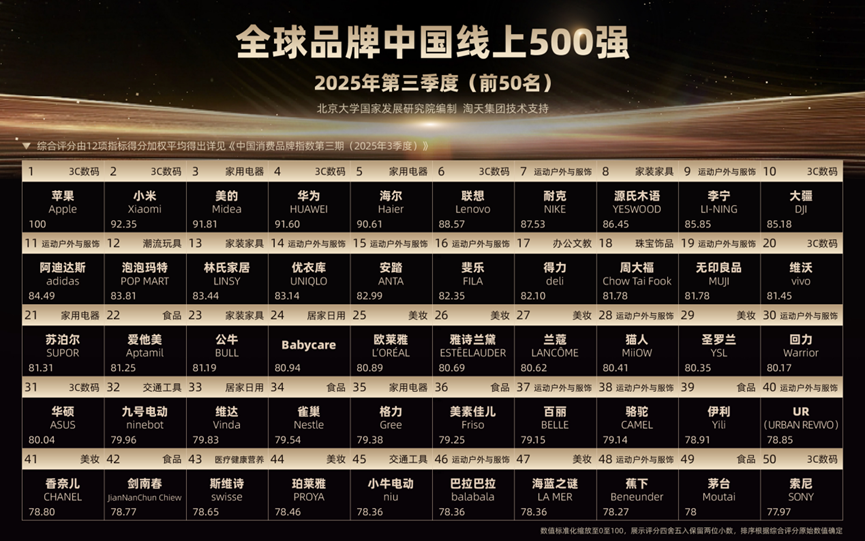
Core Insights - The latest quarterly "China Online Consumption Brand Index" (CBI) indicates a continued preference for brand goods among online consumers, with a CBI score of 62.65, reflecting a year-on-year increase of 0.92% [1] - DJI and Pop Mart have shown rapid growth, with DJI entering the top 10 of the "Global Brand China Online 500" list for the first time, ranking 10th, while Pop Mart ranks 12th [1] Industry Performance - The CBI index has shown significant growth in sectors such as women's clothing, 3C electronics, daily beauty products, outdoor sports, pet supplies, men's clothing, and home furnishings, indicating a heightened consumer focus on quality and brand [4] - The women's clothing sector saw a notable increase of over 5 points in its index, suggesting a rapid upgrade in brand and quality, driven by Taobao's support for original clothing brands [4] - The food and trendy toy sectors experienced a year-on-year decline in their CBI scores, attributed to cyclical fluctuations and policy constraints affecting the high-end liquor market [5] Brand Rankings - The top five brands in the "Global Brand China Online 500" list remain consistent with Apple, Xiaomi, Midea, Huawei, and Haier [6] - Brands like DJI and Pop Mart have risen significantly in rankings due to innovative product offerings and strong consumer engagement, with DJI entering the top 10 and Pop Mart achieving a new high at 12th place [8] Consumer Behavior Trends - Seasonal demand and product innovation are key drivers for brand ranking improvements, with brands like DJI enhancing user experience through differentiated product features [8] - The CBI series emphasizes quality and innovation, aiming to shift the market focus from cost competition to quality and brand differentiation, ultimately enhancing consumer living standards [9]
最新“全球品牌中国线上500强”季度榜单出炉:大疆首次进入前10、泡泡玛特上升显著
Zhong Guo Jing Ji Wang· 2025-12-25 07:19
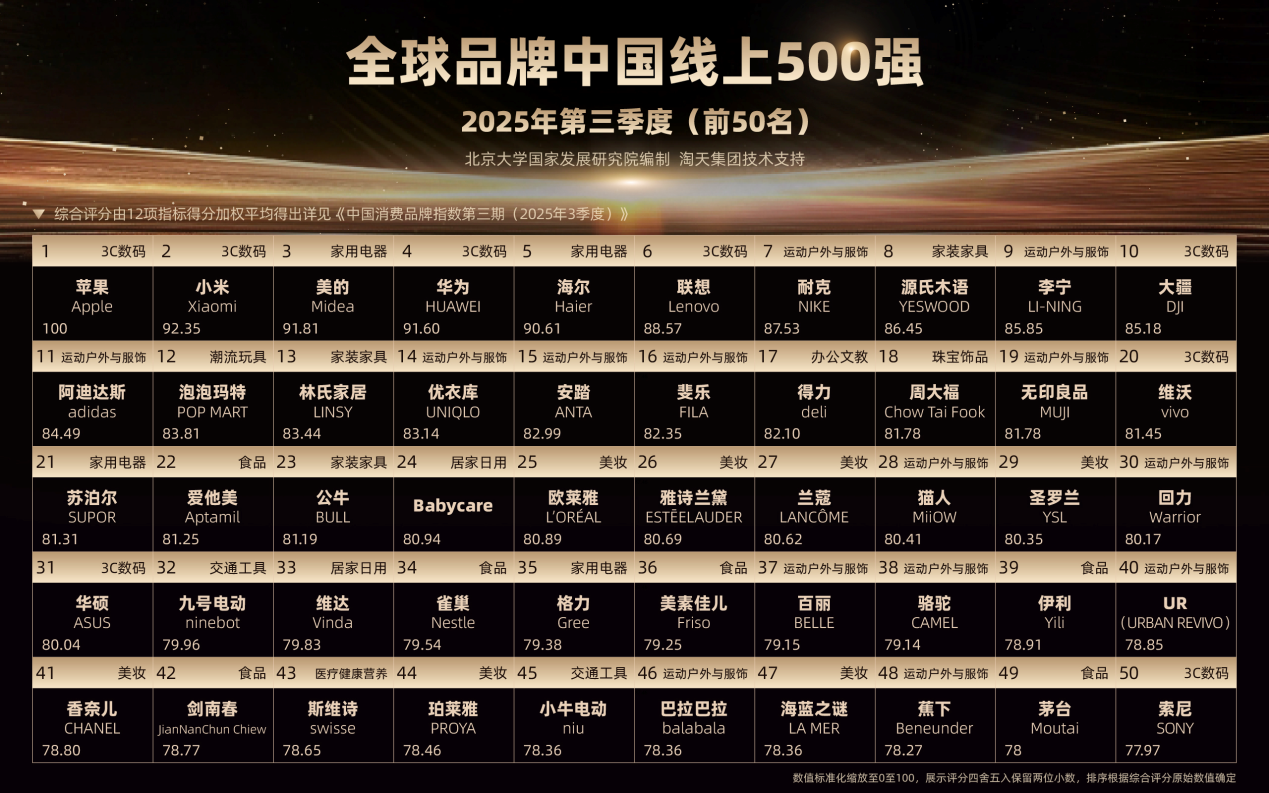
Core Insights - The latest quarterly "China Online Consumption Brand Index" (CBI) indicates a year-on-year increase of 0.92%, reflecting a growing preference for branded products among online consumers [1] - DJI and Pop Mart have made significant strides, with DJI entering the top 10 of the "Global Brand China Online 500" list for the first time, while Pop Mart ranks 12th [1][6] Industry Trends - The CBI index shows notable growth in sectors such as women's apparel, 3C electronics, daily cosmetics, outdoor sports, pet products, men's apparel, and home furnishings, indicating a heightened consumer focus on quality and brand [4] - The women's apparel sector saw a significant increase of over 5 points in its index, suggesting rapid brand and quality upgrades driven by supportive operational strategies from platforms like Taobao [4] - The food and trendy toy sectors experienced a decline in their CBI, attributed to cyclical fluctuations and policy constraints affecting high-end liquor consumption [5] Brand Performance - The top five brands in the "Global Brand China Online 500" for Q3 are Apple, Xiaomi, Midea, Huawei, and Haier, with DJI and Pop Mart showing remarkable growth [6] - Seasonal demand and product innovation are key drivers for brand performance, with DJI leveraging new product features to enhance user experience and Pop Mart capitalizing on its original IPs [8] - The index emphasizes real consumer purchasing behavior, moving beyond traditional metrics like revenue and profit to assess brand competitiveness based on sales, pricing, search, and customer reviews [8] Strategic Insights - The CBI series aims to promote quality and innovation in online consumption, encouraging brands to compete on quality rather than just cost, which is essential for fostering a positive market cycle [9]





最新"全球品牌中国线上500强"季度榜单出炉,大疆首次进入前10、泡泡玛特上升显著
Ge Long Hui· 2025-12-25 06:54
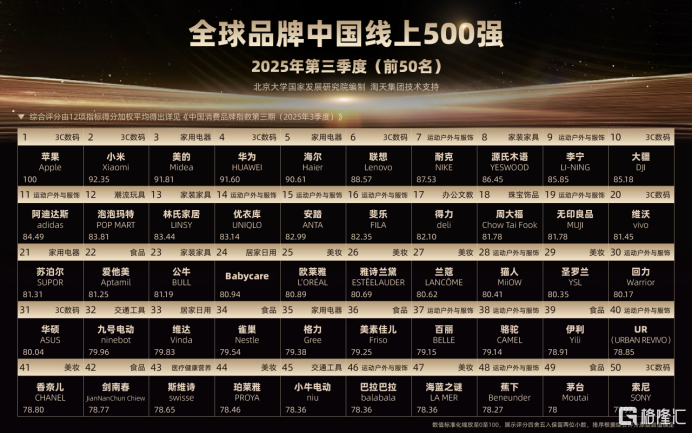
Core Insights - The latest quarterly "China Online Consumption Brand Index" (CBI) and "Global Brand China Online Top 500" (CBI500) indicate a continued rise in consumer preference for brand goods, with the CBI reaching 62.65, a year-on-year increase of 0.92% [1] - DJI and Pop Mart have shown rapid growth, with DJI entering the top 10 of the CBI500 for the first time, and Pop Mart ranking 12th [1] Industry Trends - The CBI series indices reflect a macroeconomic trend of consumption recovery and a shift towards high-quality development, with a notable increase in the core CPI by 0.6% year-on-year in the first three quarters [1][4] - Significant growth in the CBI index was observed in sectors such as women's clothing, 3C smart products, daily beauty products, outdoor sports, pet supplies, men's clothing, and home furnishings, indicating a heightened consumer focus on quality and brand [4][5] - The women's clothing sector saw a notable increase of over 5 points in its index, driven by intensified competition and a focus on quality upgrades [4] Brand Performance - The top five brands in the CBI500 remain consistent with previous quarters: Apple, Xiaomi, Midea, Huawei, and Haier [6] - Brands like DJI and Pop Mart have improved their rankings significantly due to product innovation and seasonal demand, with DJI leveraging unique features in its products and Pop Mart capitalizing on its original IP [6][7] - New entrants in the food category, such as Guangzhou Restaurant and Crab Taotai, benefited from seasonal demand for mooncake gift boxes, while educational brands like Deli and Morning Glory also saw significant improvements [6] Consumer Behavior - The CBI500 rankings are based on real consumer purchasing behavior, utilizing 12 metrics including sales, price, search volume, and positive reviews to assess brand competitiveness [7] - The emphasis on quality and innovation is seen as a key driver for brand strength, moving away from cost-based competition towards a focus on quality, brand differentiation, and value [8]

埃森哲:中国消费市场的新主张和新机遇
财富FORTUNE· 2025-12-18 13:06
Core Insights - The article discusses the evolving landscape of consumer behavior in China, emphasizing the shift from passive acceptance to active engagement in the market, driven by changing values, emotional connections, and technological advancements [1][2]. Group 1: Changes in Consumer Preferences - Domestic brands are gaining popularity, with consumers prioritizing local products over international ones. For instance, the percentage of consumers preferring domestic beauty and skincare brands rose from 12% in 2021 to 43% in 2025, while preference for domestic 3C digital products increased from 23% to 55%, and for home appliances from 33% to 69% [3]. - Consumers are re-evaluating their life priorities, focusing more on health and financial stability. The proportion of consumers valuing health increased by 9 percentage points to 87%, and those valuing wealth rose by 12 percentage points to 47% [8]. Group 2: Shifts in Information Channels and Brand Loyalty - The channels through which consumers obtain shopping information are diversifying, with traditional marketing methods becoming less effective. E-commerce platforms remain the primary source for 60% of consumers, but video platforms like Douyin and Kuaishou have become significant, with usage rising to about 50% [9]. - Brand loyalty is diminishing, with 55% of consumers frequently comparing multiple brands even if they have a favorite, an increase of 13 percentage points since 2021. Nearly 70% of consumers feel indifferent or resistant to marketing content [10]. Group 3: The Role of AI in Consumer Behavior - AI is becoming a crucial factor in consumer decision-making, with nearly 80% of Chinese consumers using AI weekly or daily. About 37% have utilized AI tools in shopping, primarily for assistance in unfamiliar categories or for quick comparisons [10][21]. - Brands must adapt to interact with AI as a representative of consumers, providing structured and accurate content to influence AI-generated recommendations, which will affect brand visibility and conversion rates [18][21]. Group 4: Brand Strategies in a Changing Landscape - Brands are encouraged to demonstrate tangible value to consumers, moving beyond just price to emphasize visible and verifiable product benefits. This shift is evident in the focus on quantifiable effects and scientific backing in product descriptions [12][15]. - Creating integrated experiences that resonate emotionally with consumers is essential. Brands should aim for a multi-channel ecosystem that combines online and offline experiences, enhancing consumer engagement and satisfaction [16]. Group 5: Consumer Expectations and Brand Accountability - Consumers are increasingly seeking stability and meaningful engagement from brands, evaluating their relevance, consistency, and ability to fulfill promises. This reflects a deeper human need for trust and connection [22]. - Companies aiming to capture the Chinese consumer market face challenges from outdated growth models but also have opportunities to respond effectively to these profound changes with courage and adaptability [22].


中国银河证券:提振消费政策重要性凸显 对消费业明年海外业务发展看法乐观
智通财经网· 2025-12-18 08:43
Core Viewpoint - The report from China Galaxy Securities emphasizes the importance of the medium- to long-term consumption goals outlined in the "14th Five-Year Plan" and highlights the need for specific consumption policies to be implemented by 2026 [1] Group 1: Consumption Industry Outlook - The global consumption recovery is slow, with high tariffs pushing up prices and high interest rates suppressing credit demand, leading to weakened consumer confidence in Europe and the US [1] - The Central Economic Work Conference has proposed a focus on domestic demand, aiming to build a strong domestic market and implement actions to boost consumption, including plans to increase urban and rural residents' income [1] - The report expresses a more optimistic view on service consumption compared to goods consumption, noting recent policies that enhance the focus on service consumption and the removal of unreasonable restrictions in the consumption sector [1] Group 2: Domestic Demand and Retail Performance - In November, the retail sales growth rate was +1.3% year-on-year, with a month-on-month decline of 1.6 percentage points, marking a continuous decrease since May [2] - The reduction in national subsidies is reflected in the retail sales of household appliances and audio-visual equipment, which saw declines of -14.6% and -19.4% year-on-year in October and November, respectively [2] - Retail sales in the furniture category showed a year-on-year increase of +9.6% in October, while daily necessities experienced a growth of +7.4%, indicating a weakening trend [2] Group 3: Category-Specific Insights - The gold and jewelry category saw significant growth of +37.6% and +8.5% year-on-year in October and November, influenced by new tax policies affecting gold jewelry [3] - The clothing, footwear, and textile categories maintained stable growth rates of +6.3% and +3.5% year-on-year, supported by seasonal changes [3] - The cosmetics sector also showed improvement, with year-on-year growth rates of +9.6% and +6.1% in October and November, aided by promotional activities [3] Group 4: Global Consumer Sentiment - Consumer confidence in Europe and the US remains weak, with the US consumer confidence index at 53.3, close to historical lows, and the EU consumer confidence index at -13.6, indicating a relatively low level of optimism [4] - Overall retail performance in the US has been subdued, with a year-on-year increase of +3.9% in September, reflecting a decline from August [4] - Online sales during the holiday shopping week showed modest growth, with Black Friday and Cyber Monday experiencing increases of +9.3% and +7.1% year-on-year, respectively, amidst intense competition [4]
