AI产业链

Search documents
华泰证券:市场走势或仍以震荡为主,沿高性价比方向布局
Mei Ri Jing Ji Xin Wen· 2025-11-16 15:17
Core Viewpoint - The report from Huatai Securities indicates that short-term uncertainties persist, leading to a market trend characterized by fluctuations. However, there is a shift towards a balanced "barbell" investment structure due to rapid changes in market focus [1] Group 1: Market Focus - The high cost-performance mainline remains one of the market's focal points, with the AI industry chain's congestion level dropping to its lowest since July. Attention is drawn to low-positioned targets in sectors such as Hang Seng Technology, domestic computing power, AI edge applications, and related fields [1] - There are opportunities for left-side positioning in sectors with performance improvement at low levels, including engineering machinery, textile manufacturing, photovoltaic equipment, general equipment, rail and road, building materials, and certain mass consumer sectors [1] Group 2: Investment Opportunities - Given the impact of domestic and international uncertainties, there are still potential investment opportunities in banks and certain cyclical dividend stocks [1]

申万宏源:科技“性价比不足”,顺周期“逻辑有断点”,“牛市2.0”条件不具备,现在是“牛市1.0”高位震荡
Hua Er Jie Jian Wen· 2025-11-16 09:51
Core Viewpoint - The current A-share market is in the high position of "Bull Market 1.0," with insufficient long-term cost-effectiveness in the technology sector and logical breaks in the cyclical market. Conditions for the initiation of Bull Market 2.0 are not yet complete [1] Group 1: Market Conditions - The A-share AI industry chain is in a state of "long-term low cost-effectiveness" similar to previous years in various sectors, indicating a high-level consolidation phase followed by an adjustment phase [2] - The high-level consolidation phase typically lasts at a quarterly level, and adjustments are triggered by mid-level disturbances in the industry trend, but this does not signify the end of the industry trend [2] Group 2: Cyclical Market Analysis - The recent cyclical market is characterized by short-term price increases and expectations of PPI turning positive by mid-2026, but there is significant divergence regarding the pace of PPI improvement [3] - The cyclical market is approaching a differentiation phase as cost-effectiveness decreases, and the sustainability of price increases becomes more critical [3] Group 3: Future Challenges - By spring 2026, the A-share market may face three major challenges: the technology sector's long-term low cost-effectiveness, a critical verification period for demand, and immature conditions for the transition to Bull Market 2.0 [4][5] - The market is expected to experience a two-stage bull market, with the first stage being the structural bull market in 2025 and a potential peak in spring 2026 [4][6] Group 4: Investment Opportunities - In the current high-level consolidation phase, the focus should be on Alpha opportunities in both cyclical and technology sectors, with an emphasis on sectors with favorable supply-demand dynamics and high dividend yields [7] - Short-term opportunities in technology growth are expected to arise from small rebounds, particularly in sectors with new catalysts or significant industry space, such as energy storage and innovative pharmaceuticals [7]

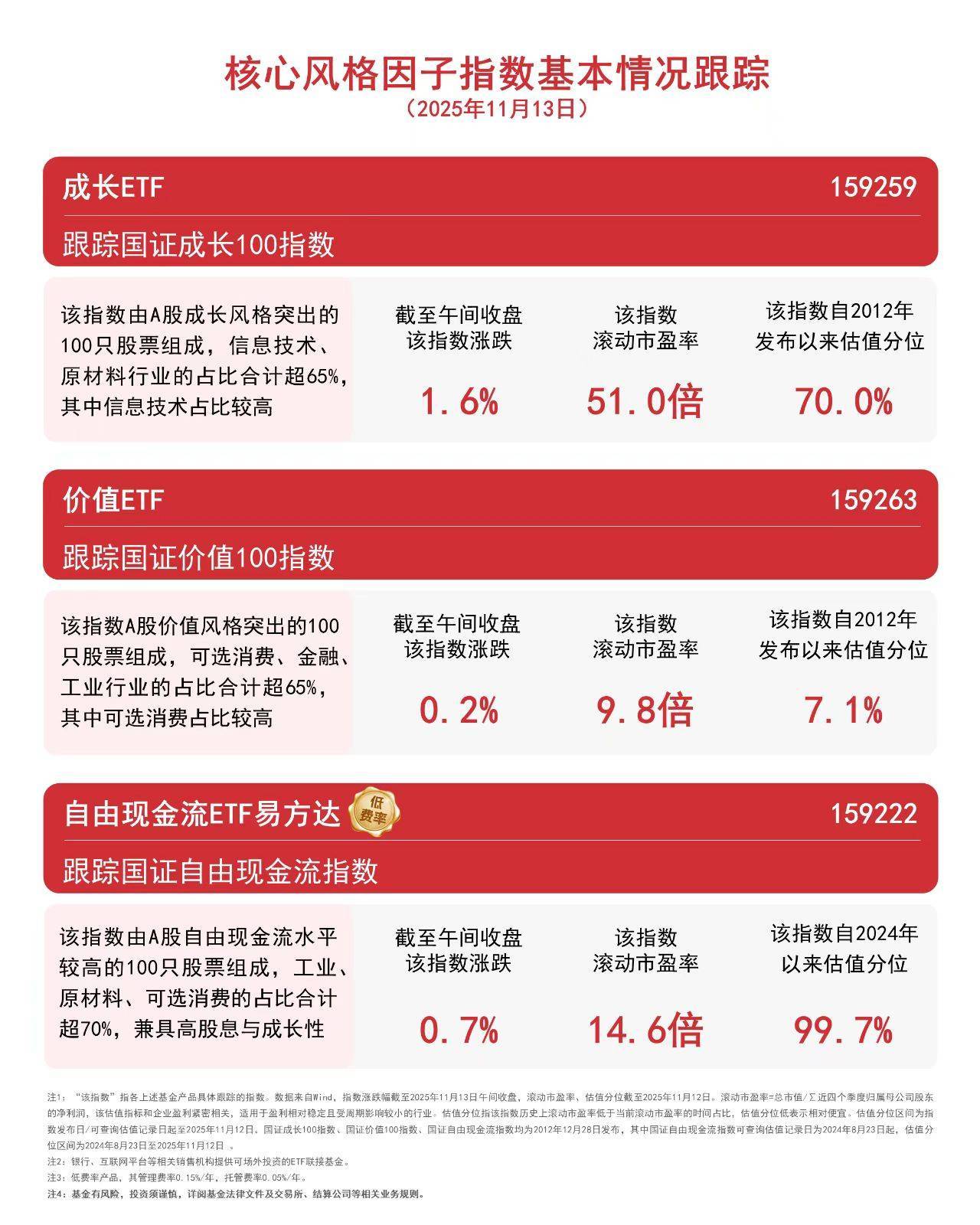
成长风格早盘走强,关注成长ETF(159263)、自由现金流ETF易方达(159222)等投资价值
Sou Hu Cai Jing· 2025-11-13 05:08
Core Viewpoint - Technology growth stocks have made a strong comeback, with significant increases in the new energy and AI sectors, as evidenced by the performance of various indices [1] Group 1: Index Performance - The Guozheng Growth 100 Index rose by 1.6%, indicating a strong performance in growth-oriented stocks within the A-share market [1] - The Guozheng Free Cash Flow Index increased by 0.7%, reflecting a focus on companies with high free cash flow rates, combining high dividends and growth potential [1] - The Guozheng Value 100 Index saw a modest rise of 0.2%, suggesting a stable performance in value-oriented stocks [1] Group 2: Investment Opportunities - The Guozheng Growth 100 Index emphasizes stocks in high-growth sectors such as electronics, communications, and computers, aligning with the economic transformation trends [1] - The Growth ETF (159263) and the E Fund Free Cash Flow ETF (159222) track the aforementioned indices, providing investors with tools to capitalize on these investment styles [1]

帮主郑重:中长线布局几个靠谱方向及回调入场信号
Sou Hu Cai Jing· 2025-11-13 04:08
Industry Directions - The AI industry chain, particularly B-end application sectors such as AI programming and industrial intelligence, is seeing real monetary investment from companies, indicating a solid long-term growth potential [3] - The demand for renewable energy storage, including solar and energy storage solutions, continues to rise, supported by favorable policies; leading companies with stable orders and sufficient capacity present good entry points after market corrections [3] - Consumer upgrade-related sectors, such as high-quality food and smart home products, are expected to benefit from economic recovery, with reasonable valuations [3] - High-end manufacturing, including humanoid robotics and low-altitude economy support, represents future trends, making early investments advantageous [3] Entry Signals After Corrections - Two out of three signals should be met for entry: First, valuation metrics such as the CSI 300 price-to-book ratio falling below 1.4 or leading stocks in desired sectors correcting by 10%-15% to reach reasonable valuation levels [3] - Second, technical indicators showing market stabilization after sideways movement, such as two consecutive trading days without new lows and increasing trading volume [3] - Third, during corrections, a gradual decrease in trading volume indicates that selling pressure is diminishing; a subsequent increase in volume during price rises signals a good entry point [3]

红利打底+科技进攻!香港大盘30ETF(520560)量价齐升涨1%,短线多头信号确立
Xin Lang Ji Jin· 2025-11-12 09:04
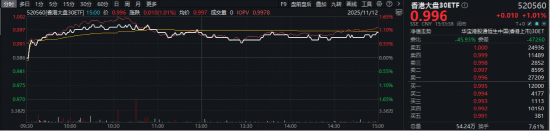
Core Viewpoint - The Hong Kong stock market continues its rebound, with all three major indices closing in the green, driven by the performance of the Hang Seng China (Hong Kong-listed) 30 Index [1] Group 1: Market Performance - The Hong Kong stock market saw a significant increase in trading volume, with the Hong Kong Large Cap 30 ETF (520560) rising over 1% and achieving a trading volume exceeding 54 million HKD, indicating a strong bullish sentiment [1] - Southbound funds have consistently net bought for 16 consecutive trading days, with a net inflow of 4.2 billion HKD on November 12, bringing the total net inflow for the year to over 1.3 trillion HKD [2][3] Group 2: Investment Strategy - The sustained inflow of southbound funds is expected to drive the capital market back to fundamentals and value-driven investments, supporting a "slow bull" market for Hong Kong stocks [3] - Analysts suggest a "barbell strategy" for investment, focusing on technology stocks for growth and dividend-paying stocks for stability [5] - Key sectors to watch include consumer discretionary, utilities, and sectors benefiting from policy support, such as the AI industry and consumer sectors [5] Group 3: ETF and Index Composition - The Hong Kong Large Cap 30 ETF passively tracks the Hang Seng China (Hong Kong-listed) 30 Index, which includes major companies like Alibaba (18.07% weight) and Tencent (15.44% weight) [6] - The top ten holdings of the index account for 72.84% of its total weight, indicating a concentrated investment in a few large-cap stocks [6]
招商证券:港股调整后仍有空间 配置上重回哑铃策略
Zhi Tong Cai Jing· 2025-11-12 08:40
Group 1 - The core viewpoint of the report is that the recent fluctuations in the Hong Kong stock market present investment opportunities, despite external volatility and investor sentiment leaning towards securing profits [1] - The report suggests that the market is expected to recognize various positive factors and discrepancies, leading to potential upward movement after a period of consolidation [1] - The recommended investment strategy is a "barbell strategy," focusing on aggressive investments in technology (AI chain) and non-ferrous metals, while defensive investments should concentrate on high-dividend stocks and turnaround situations [1] Group 2 - The "turnaround" strategy focuses on essential consumer goods, which are showing signs of supply-demand inflection after four years of difficulties, with valuations still at historical lows [2] - Companies with competitive advantages are expected to increase market share and profit margins, leading to alpha growth, and the industry competitive landscape is anticipated to improve [2] - The high dividend strategy highlights the Hang Seng High Dividend Yield Index, which has a dividend yield of 6%, supported by stable dividend capabilities and increasing demand for dividend stocks due to the growth of southbound capital [2]

招商证券:外部流动性预期存在向上修正空间 配置上建议重回哑铃策略
智通财经网· 2025-11-11 22:33
Core Viewpoint - The recent fluctuations in the Hong Kong stock market present investment opportunities, driven by external volatility and investor sentiment to secure profits. The market is expected to recognize various positive factors, leading to potential upward movement after a period of consolidation [1]. Group 1: Macroeconomic and Policy Insights - The macroeconomic environment in China continues to show marginal slowdown, but the new economy, particularly technology, is experiencing strong growth with a half-year profit growth rate of 31.7%, providing robust support for the stock market [2]. - There are signs of easing tensions in US-China relations, with recent high-level talks resulting in several temporary measures, supporting the view of "competition without conflict." The government's upcoming policies are expected to focus on technology innovation, expanding domestic demand, and macroeconomic adjustments [2]. Group 2: Liquidity and Valuation - Continuous net inflows from foreign and southbound funds are observed, with the Federal Reserve expected to lower interest rates by 25 basis points in December and three additional cuts next year, totaling 75 basis points [3]. - The end of the Fed's balance sheet reduction in December is anticipated to alleviate liquidity pressures, further encouraging overseas capital to flow into the Hong Kong stock market [3]. - The combination of fundamental support, favorable policies, and improved liquidity positions the Hong Kong stock market in a valuation trough, which is expected to drive a rebound [3]. Group 3: Investment Strategy - The recommended investment strategy is a return to a "barbell strategy," focusing on offensive positions in technology (AI chain) and non-ferrous metals, while defensive positions should emphasize dividend stocks and turnaround opportunities [4]. - The AI industry chain is highlighted as a resilient growth sector with significant long-term potential, with recommendations for investments in internet-related AI, humanoid robots, autonomous driving, and electric power [4]. - Non-ferrous metals are expected to benefit from a combination of dollar depreciation, low interest rates, and liquidity, with gold also gaining from global central bank purchases and safe-haven demand [4]. Group 4: Defensive Strategies - The "turnaround" strategy focuses on essential consumer goods, which are showing signs of supply-demand inflection after four years of challenges, with valuations still at historical lows [5]. - Companies with competitive advantages are expected to increase market share and profit margins, suggesting a phased buying approach for long-term holding [5]. - High dividend strategies are emphasized, with the Hang Seng High Dividend Yield Index offering a stable dividend yield of 6%, driven by increasing demand for "fixed income plus" products from southbound funds [5].
科技核心资产月报:科技产业趋势仍在延续-20251110
Bank of China Securities· 2025-11-10 09:20
Group 1: AI Industry Chain - The AI industry chain is entering a period of adjustment, particularly with significant pressure on overseas computing power, but the long-term logic remains clear with a focus on storage chips, domestic computing power, and AI applications [2][9][21] - North American cloud service providers continue to show strong capital expenditure, with Q3 2025 spending reaching $1.67 billion for Microsoft, $2.40 billion for Google, $3.42 billion for Amazon, and $1.88 billion for Meta, reflecting a year-on-year growth of 75.08% [10][12] - The storage cycle is experiencing a steep price increase, with DDR4 1Gx8 3200MT/s chip prices rising by 9.86% week-on-week, and NAND flash wafer prices increasing by 15% to 20% [13][16] Group 2: AI Applications - AI applications are witnessing a reversal of previous difficulties, with significant growth in penetration rates and initial commercial success in vertical applications, as evidenced by a rise in monthly active users to 729 million for mobile AI applications [19][20] - Companies like 360 and Kingsoft have reported substantial increases in net profit growth rates, with 360's growth rising from 17.43% to 78.88% and Kingsoft's from 3.57% to 13.32% [19][20] - The overall performance of AI applications is improving, driven by the acceleration of application penetration and the successful commercialization of vertical applications [21] Group 3: Military Industry - The military industry continues to adjust, with October showing a slight easing in the extent of adjustments, ranking at the bottom among 28 industries in terms of growth [22][27] - The year 2025 marks the end of the "14th Five-Year Plan," while 2026 will begin the "15th Five-Year Plan," indicating potential acceleration in military orders [22] - Key military stocks have shown significant performance, with companies like *ST Dali and North China Long Dragon seeing growth rates of 34% and 31% respectively in October [27][30]
沪指围绕4000点震荡蓄势,后市关注结构性机会
British Securities· 2025-11-10 02:15
Market Overview - The A-share market is currently experiencing fluctuations around the 4000-point mark, with the Shanghai Composite Index showing signs of consolidation after previous rebounds, leading to reduced attractiveness for new capital due to valuation corrections in some sectors [3][4][13] - The market is characterized by a lack of strong catalysts following the completion of Q3 reports and the interim results of Sino-US trade talks, resulting in a cautious stance from investors [3][4][13] Sector Analysis - **Chemical Sector**: The chemical industry is showing signs of recovery from a cyclical low, with significant growth in earnings for companies in agricultural chemicals, fluorine chemicals, and electronic chemicals due to policy support and increasing demand [8][9] - **New Energy Sector**: Stocks in the new energy sector, including batteries and photovoltaic equipment, are expected to rebound, driven by ongoing global efforts to achieve carbon neutrality and the anticipated demand for lithium batteries and solar energy [9][10] - **High Dividend Stocks**: High dividend yield stocks, particularly in banking and public utilities, continue to attract investor interest, providing a safety margin during market volatility [12][14] Investment Strategy - Investors are advised to focus on structural opportunities rather than fixating on the index level, with a balanced allocation strategy recommended across technology growth, high dividend defensive sectors, and cyclical styles [4][14] - Specific investment themes include technology growth areas such as AI, semiconductors, and robotics, as well as cyclical sectors like photovoltaic, battery, and rare earth industries, which are expected to benefit from policy changes and improving profitability [4][14]
超八成投顾看涨四季度 科技板块仍是主线——上海证券报·2025年第四季度券商营业部投资顾问调查报告
Shang Hai Zheng Quan Bao· 2025-11-05 18:41
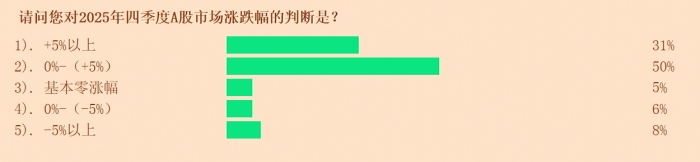
Core Viewpoint - The investment advisory community shows a continued optimistic sentiment towards the macroeconomic outlook and A-share market for the fourth quarter of 2025, with over 80% of advisors bullish on the A-share market and a significant upward adjustment in the expected range for the Shanghai Composite Index [4][10][23] Economic Outlook - Approximately 79% of advisors hold a neutral or optimistic view on the macroeconomic situation, an increase of 8 percentage points from the previous quarter [6] - 38% of advisors believe the economy is in a "bottoming out" phase, while 24% think it is operating normally [6] - Nearly 70% of advisors expect economic growth to improve compared to the third quarter [6] - The ongoing implementation of stable growth policies is seen as a primary driver for a stronger stock market [7] Market Sentiment - Over 81% of advisors are bullish on the A-share market for the fourth quarter, marking a new high for the year [10] - The expected range for the Shanghai Composite Index has been raised to between 3900 and 4100 points, up from the previous range of 3300 to 3500 points [10][23] - Advisors predict that the index will fluctuate between 3800 and 3900 points at the lower end [10] Investment Preferences - Advisors recommend that nearly 60% of investors focus on equities as the most valuable asset class for the fourth quarter [14][15] - 34% of advisors suggest investing in equity funds, while 32% recommend direct stock investments [15] - Technology stocks remain the most favored sector, with 46% of advisors optimistic about AI-related technology stocks [11] Client Behavior - 82% of advisors report that high-net-worth clients achieved profits in the third quarter, with a notable increase in their willingness to increase positions [19] - The majority of clients are expected to allocate additional funds to technology stocks, with 41% of advisors indicating this trend [19][21] - Advisors observe a "cash migration" trend among clients, with funds primarily sourced from cash deposits and redemptions of bank wealth management products [18][21] ETF and Fund Preferences - 47% of advisors noted that high-net-worth clients subscribed to ETF products in the third quarter, with a shift towards broad-based ETFs [20] - The popularity of the ChiNext ETF has increased, with 24% of advisors reporting client purchases [20] Conclusion - The overall sentiment among advisors indicates a positive outlook for the macroeconomic environment and A-share market, with recommendations for maintaining high equity positions and adopting flexible thematic investment strategies to capture opportunities in a structural market [23]