
TMT

Search documents
券商晨会精华 | 9月产业催化密集下科技或仍有表现
智通财经网· 2025-09-01 00:44
中信建投:长期趋势仍未改变,最优策略是切入低估值消费与周期板块 中信建投表示,总体来看,TMT板块拥挤度虽未见顶,但已接近预警线,消费、周期等低热度板块可 能在下一阶段的行情中拥有更高性价比。市场资金从避险逐步转向攻守兼备,青睐稳健型与成长性资 产。长期趋势仍未改变,最优的策略是切入低估值消费与周期板块,如大消费、有色、新能源等。重点 关注:大消费、新能源、非银、创新药、TMT、有色、卫星互联网。 广发证券:各地供应趋紧 预计煤价下行有限 上周五A股8月收官,8月市场总体呈现单边震荡上行态势,三大指数月线均大涨,其中创业板指8月累 计涨超24%,沪指站上3800点创10年新高,科创50指数8月大涨28%。从板块来看,8月市场热点主要集 中在算力和芯片方向,算力板块中,新易盛等多股创历史新高,工业富联(601138.SH)总市值超万亿; 芯片股中,寒武纪(688256.SH)本月股价翻倍,超越贵州茅台成为A股"股王"。 在今天的券商晨会上,华泰证券认为,9月产业催化密集下科技或仍有表现;中信建投指出,长期趋势 仍未改变,最优策略是切入低估值消费与周期板块;广发证券表示,各地供应趋紧,预计煤价下行有 限。 华泰证 ...



广发证券:对于已经持有本轮牛市科技主线的投资者,建议继续坚守科技主线
Xin Lang Cai Jing· 2025-09-01 00:08
Group 1 - The core viewpoint is that the market has established a "bull market mentality," and once this trend is formed, it is difficult to reverse in the short term [1] - For investors already holding positions in the current bull market's technology sector, there is not a strong necessity to engage in "high-low switching" given the current level of valuation differentiation [1] - New incremental funds entering the market and investors with limited holdings in the main sectors may consider "low-position call options" as a strategy [1] Group 2 - Besides the TMT sector, other growth areas such as automotive parts/robotics, which have recently lagged, consumer electronics, AI applications, and cyclical consumer goods (like leisure food, home appliances, and retail) are also highlighted [1] - The report also mentions cyclical resource products, particularly in the chemical sector, as potential investment opportunities [1]
在赌场门口卖茶叶蛋——A股一周走势研判及事件提醒
Datayes· 2025-08-31 14:44
Core Viewpoint - The article discusses the current state of the market, highlighting the challenges faced by consumer stocks amidst a strong performance from technology stocks, and suggests a potential shift in market leadership towards new sectors in the coming week [1][2]. Market Overview - The trading volume exceeded 3 trillion yuan over two trading days, indicating a potential turning point in market activity [1]. - The TMT sector's concentration has reached 38.98%, nearing historical highs, suggesting increased risk in this area [1]. Fund Flow Analysis - There has been a significant net redemption in the ChiNext and STAR Market ETFs, indicating a shift in investor sentiment towards high valuation and growth themes [2]. - Institutional funds have been in a net outflow since early August, reflecting a more cautious approach from institutions towards the market [2]. Sector Performance - The manufacturing PMI for August was reported at 49.4, indicating continued contraction, while the non-manufacturing PMI rose to 50.3, suggesting a slight recovery in the service sector [39]. - The service sector's business activity index reached its highest point of the year at 50.5, driven by seasonal factors and active capital markets [12]. Company Insights - Alibaba's cloud revenue for Q1 FY2026 was 33.398 billion yuan, a 26% year-on-year increase, significantly outperforming the previous quarter's growth [14]. - Alibaba plans to invest over 380 billion yuan in cloud and AI hardware infrastructure over the next three years [14]. Lithium Battery Sector - The lithium battery industry is seeing a production increase, with battery production expected to reach 124.8 GWh in September, a 7.4% month-on-month increase [16]. - The launch of the new MG4 model by SAIC, featuring a semi-solid-state battery, has generated significant market interest, with over 10,000 pre-orders within 40 minutes [16]. Economic Indicators - The inventory index for finished products decreased by 0.6 percentage points to 46.8%, while raw material inventory and procurement volumes increased, indicating a potential shift towards inventory depletion [9]. - The overall economic environment is characterized by a cautious outlook, with various sectors experiencing different levels of growth and contraction [36][37].

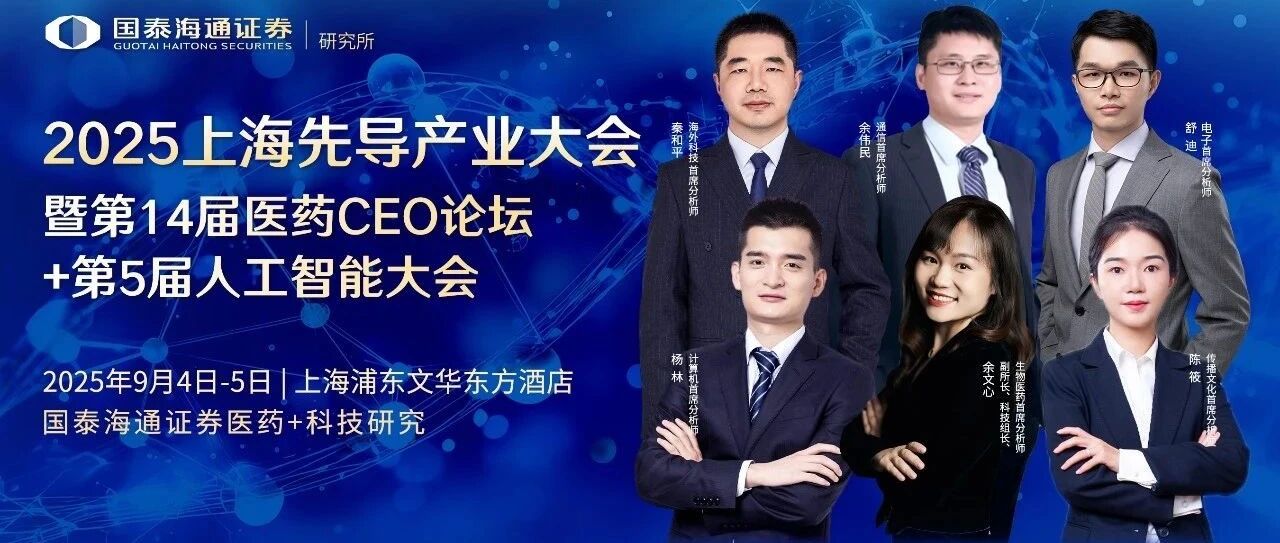
国泰海通|2025上海先导产业大会暨第14届医药CEO论坛+第5届人工智能大会
国泰海通证券研究· 2025-08-30 09:02
Core Viewpoint - The article discusses the upcoming 2025 Shanghai Leading Industries Forum and the 14th Pharmaceutical CEO Forum, highlighting the focus on innovation and global expansion in the pharmaceutical industry, as well as the integration of artificial intelligence in various sectors [1][4]. Summary by Sections Pharmaceutical Main Venue - September 4 Morning - The forum will feature a series of roundtable discussions and keynote speeches, including topics such as the global expansion of Chinese pharmaceutical companies and the search for the next blockbuster drug [4]. - Key discussions will include the future of drug development, focusing on next-generation weight loss drugs and the competitive landscape of Chinese pipelines [4][5]. Pharmaceutical Main Venue - September 4 Afternoon - Afternoon sessions will cover the potential of pharmaceutical assets in various disease and technology fields, as well as the commercialization challenges faced by innovative drugs in a global competitive environment [4][6]. - Discussions will also explore advancements in drug development platforms and the implications of brain-machine interfaces [6]. TMT Sub-Forum - September 4 Afternoon - The TMT sub-forum will address the impact of AI on various industries, including gaming, e-commerce, and video innovation [7][8]. - Key topics will include the evolution of AI applications and their potential to reshape the mobile internet ecosystem [8]. Pharmaceutical Sub-Forum - September 5 Afternoon - The pharmaceutical sub-forum will focus on ADC technology, probiotic delivery systems, and the future of dual antibodies and XDC development [9]. - Discussions will also cover the integration of medical insurance and the innovation of multi-level medical security systems in China [9]. Participating Companies - A diverse range of companies from the pharmaceutical, medical device, and technology sectors are expected to participate, including major players like Hengrui Medicine, Innovent Biologics, and Mindray Medical [12][14].
兴业证券:TMT成交占比到什么位置了?
智通财经网· 2025-08-28 13:29
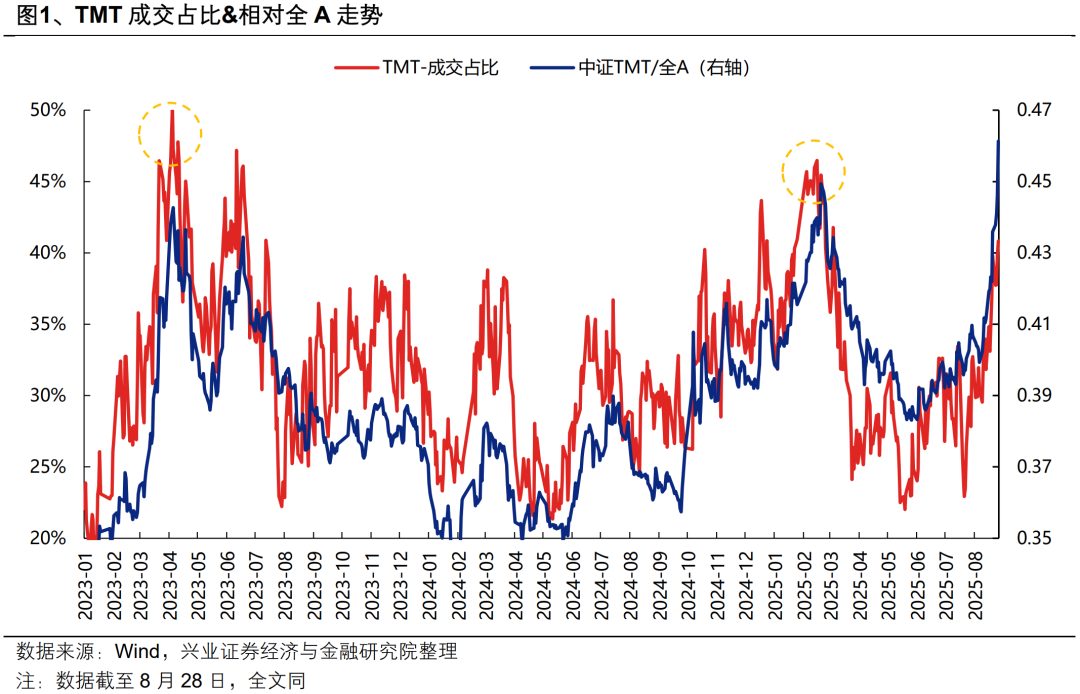
Core Insights - As of August 28, TMT transaction share stands at 40.8%, with the highest levels for Deepseek and ChatGPT at 46.5% and 50.24% respectively in 2023 [1][4] Group 1: TMT Market Performance - The current TMT transaction share is 40.8%, with the highest recorded for Deepseek at 46.5% and ChatGPT at 50.24% in 2023 [1] - The adjusted metric of transaction share to free float market cap ratio is currently at 1.57, compared to 1.93 for Deepseek and 2.44 for ChatGPT earlier this year [4] Group 2: Electronics and Communication Sector - The transaction share for the electronics and communication sectors is currently at 25.6%, reaching the highest level since the beginning of 2023 [7] - The adjusted transaction share to free float market cap ratio for these sectors is at 1.49, which is not extreme compared to past peaks above 1.7 [7] Group 3: Market Concentration - The concentration of the top 20% stocks by transaction volume in the communication sector is at 70%, while in the electronics sector it is at 68%, indicating a recent increase but not reaching historical extremes [10]

联易融科技-W(09959):减值压力释放,轻装上阵,12月内回购不低于8000万美元
First Shanghai Securities· 2025-08-28 09:05
Investment Rating - The report maintains a "Buy" rating for the company with a target price raised to HKD 4.0, indicating a potential upside of 45% from the current price of HKD 2.8 [4][8]. Core Insights - The company has released historical impairment pressures and is positioned for future growth, with a total supply chain asset volume of CNY 203.6 billion expected by H1 2025, driven by strong performance in its multi-level circulation cloud segment [2]. - Despite a year-over-year revenue decline of 9.3% to CNY 375 million, the company is optimizing its business structure and maintaining a cautious impairment provision strategy, resulting in an adjusted net loss of CNY 372 million [2][3]. - The company has committed to a share buyback of no less than USD 8 million in the next 12 months, reflecting its focus on shareholder returns [2][4]. Financial Performance - For the fiscal year ending December 31, 2023, the company reported total revenue of CNY 867.76 million, a decrease of 6.1% from the previous year, with a projected revenue of CNY 1.03 billion for 2024 [6][10]. - The adjusted net profit for 2023 was a loss of CNY 286.27 million, with forecasts indicating a continued loss of CNY 748.18 million in 2024, but a return to profitability is expected by 2026 with a net profit of CNY 171.95 million [6][10]. - The company’s gross margin is projected to improve significantly, reaching 80.3% by 2026, up from 60.7% in 2023 [10]. Business Segments - The core business, particularly the multi-level circulation cloud, is expected to handle supply chain assets totaling CNY 1.332 trillion by H1 2025, marking a year-over-year growth of 54.4% [3]. - The AMS cloud segment is currently under pressure, with a 20.2% decline in supply chain asset handling to CNY 29.9 billion, primarily due to market conditions [3]. - The company is also expanding its global footprint, with cross-border cloud assets and revenues growing by 20.3% to CNY 26 million, driven by increased financing and service fees [4].
2025年8月策略月报:市场情绪受提振,风险偏好回升-20250827
Wanlian Securities· 2025-08-27 06:07
Market Overview - The A-share market showed a positive trend in August, with major indices rising significantly, including the Shanghai Composite Index which closed at 3,883.56 points, up 8.69% from the end of July [2][12] - The market sentiment improved, driven by positive signals from the political bureau meeting and better-than-expected economic data, leading to increased investor confidence [8][12] - The liquidity in the A-share market improved, with the total trading volume rising and new equity fund subscriptions increasing by 7.41% [24][28] Industry Performance - All 31 Shenwan first-level industries experienced gains in August, with the non-ferrous metals sector leading with a 25.40% increase [13][42] - The TMT (Technology, Media, and Telecommunications) sector saw significant capital inflows, reflecting heightened investor interest in technology growth opportunities [3][32] - The healthcare and machinery sectors also attracted market attention, indicating a broad recovery in various industry segments [3][32] Valuation Levels - As of August 25, the dynamic price-to-earnings (PE) ratio for the Sci-Tech 50 index reached a historical percentile of 92.84%, indicating high valuation levels compared to historical data [41] - Most Shenwan first-level industries showed rising valuations, with 15 industries exceeding the historical 50th percentile in terms of PE ratios [42][44] Policy Analysis - The government emphasized the importance of domestic circulation and the implementation of policies to stimulate domestic demand, which is expected to support economic growth and industry performance [46][48] - Recent policies aimed at enhancing financial support for new industrialization and promoting consumption upgrades are likely to benefit various sectors, particularly those aligned with technological innovation and sustainable development [46][48]
Semtech's AI Growth Turning From Hype To Reality - Q2 Earnings Review (Rating Upgrade)
Seeking Alpha· 2025-08-26 16:35
Core Insights - Semtech Corporation (NASDAQ: SMTC) released its 2Q26 earnings report, with the stock showing little change initially but experiencing a brief decline before reversing gains shortly after the earnings call [1] Company Performance - The stock of Semtech Corporation remained relatively unchanged until the morning following the earnings release, indicating a stable market reaction to the results [1] - There was a notable moment where the stock slid in the initial minutes leading into the earnings call but managed to completely reverse this decline within 15 minutes [1] Market Context - The commentary reflects a broader perspective on market dynamics, particularly in the technology sector, emphasizing the importance of momentum in investment strategies [1]


早盘直击 | 今日行情关注
申万宏源证券上海北京西路营业部· 2025-08-26 01:55
Group 1 - The core viewpoint of the article highlights that the dovish stance of the Federal Reserve has stimulated a global stock market rally, with expectations of interest rate cuts rising due to increased risks in the employment sector [1] - The Shanghai Composite Index (沪指) has reached a new high in the current market rally, with significant trading volume exceeding 30 trillion yuan, indicating strong investor confidence and a bullish sentiment in the market [1][2] - The market is showing a clear upward trend, with the Shanghai Composite Index breaking through previous resistance levels and approaching the top of a new trading range, suggesting a potential continuation of the bullish momentum [2]

快手-W(01024):收入利润全面超预期,重视股东回报首次派息
First Shanghai Securities· 2025-08-25 09:21
Investment Rating - The report assigns a "Buy" rating to the company with a target price of HKD 100, representing a potential upside of 34% from the current price of HKD 74.9 [2] Core Insights - The company's revenue and profit exceeded expectations, with a notable focus on shareholder returns, marking the first dividend distribution since its listing [5] - The company reported a total revenue of RMB 350.46 billion for Q2 2025, reflecting a year-on-year growth of 13.1%, driven by user engagement, a thriving content ecosystem, and AI-enabled business [5] - The adjusted net profit for Q2 2025 reached RMB 56.18 billion, a 20.1% increase year-on-year, with an adjusted net profit margin of 16% [5] - The company has a robust financial position, with cash and cash equivalents amounting to RMB 123 billion and total available funds of RMB 1,019 billion as of March 31 [5] Revenue and Profit Summary - Total operating revenue for the fiscal year ending December 31 is projected to grow from RMB 113,470 million in 2023 to RMB 165,167 million by 2027, with a compound annual growth rate (CAGR) of approximately 11.8% [4] - Net profit is expected to increase significantly from RMB 6,399 million in 2023 to RMB 24,707 million by 2027, reflecting a CAGR of 39.5% [4] - The adjusted net profit is forecasted to rise from RMB 10,271 million in 2023 to RMB 27,056 million in 2027, indicating a strong growth trajectory [4] Business Performance Highlights - The company's online marketing services revenue reached RMB 198 billion, up 12.8% year-on-year, attributed to active customer expansion and AI technology optimization [5] - E-commerce gross merchandise volume (GMV) grew by 17.6% year-on-year to RMB 358.9 billion, with an average monthly buyer count of 134 million [5] - The live streaming business generated RMB 100 billion in revenue, marking an 8.0% increase year-on-year, showcasing strong performance in differentiated online and offline scenarios [5] AI Strategy and Market Potential - The company launched the Keling AI 2.1 series in May, establishing a tiered service and pricing model, with revenue exceeding RMB 2.5 billion in Q2 2025 [5] - Keling AI has begun to penetrate industrial-grade applications, including game production and professional film creation, indicating a clear monetization path and vast market potential [5] Shareholder Returns and Financial Health - The company announced its first special dividend of HKD 0.46 per share, totaling approximately HKD 2 billion, reflecting its commitment to shareholder returns [5] - Since announcing a buyback program of HKD 16 billion in May 2024, the company has repurchased HKD 8.8 billion worth of shares, demonstrating strong financial health and confidence in future growth [5]
