
矿业

Search documents
2月6日外盘头条:比特币暴跌 亚马逊预计今年资本支出将达2000亿美元 交易员料美联储将比预期...
Xin Lang Cai Jing· 2026-02-05 21:40
Group 1: Middle East Negotiations - Multiple Middle Eastern countries urgently lobbied the Trump administration to resume the US-Iran nuclear talks originally scheduled for February 6, which will now take place in Oman [4][6] - Concerns arose in the region regarding potential military actions by the Trump administration if negotiations were canceled, prompting at least nine countries to contact the White House [6] Group 2: Cryptocurrency Market - Bitcoin experienced a significant drop, falling below $65,000, erasing all gains since Trump's election, with a peak decline of 11% reported at $64,944, marking the lowest level since October 2024 [7][9] - The decline in Bitcoin's value has also affected other cryptocurrencies and related exchange-traded funds (ETFs) [7] Group 3: Amazon's Capital Expenditure - Amazon projected its capital expenditures for 2026 to reach $200 billion, significantly exceeding market expectations of $144.67 billion, indicating continued investment in artificial intelligence [9][10] - The company's forecast for Q1 operating profit was between $16.5 billion and $21.5 billion, lower than the market expectation of $22.04 billion, leading to a drop in stock price by over 11% in after-hours trading [10] Group 4: Mining Industry Developments - Rio Tinto announced its withdrawal from negotiations to acquire Glencore, as the two companies could not agree on valuation, resulting in the collapse of a potential merger that would have created the world's largest mining company [12] - Following the news of the failed merger talks, Glencore's stock price fell by 11% [12] Group 5: Federal Reserve Interest Rate Expectations - Traders have adjusted their expectations for the Federal Reserve's next interest rate cut to June, earlier than the previously anticipated July, with a second cut expected before October [16] - This shift in expectations was influenced by recent labor market data indicating weakness, leading to a decline in overnight financing rates [16]

超2000亿矿业巨无霸"夭折":力拓放弃并购谈判,嘉能可盘中跌超10%
Hua Er Jie Jian Wen· 2026-02-05 18:45
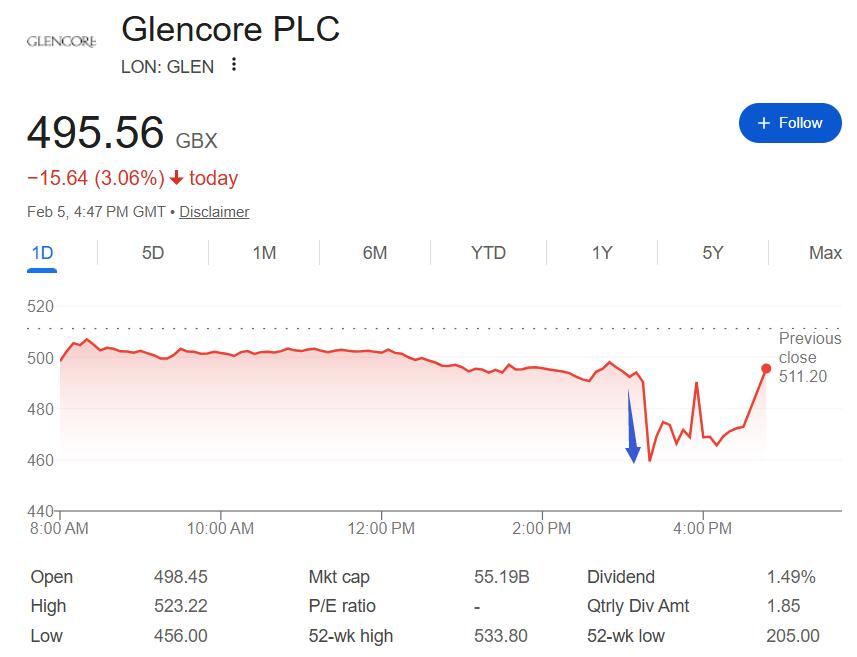
Core Viewpoint - The merger negotiations between Rio Tinto and Glencore have collapsed due to disagreements over valuation and management control, marking the third failed attempt at a merger between the two mining giants [1][3]. Group 1: Merger Negotiation Breakdown - Rio Tinto announced it could not reach an agreement that would create value for its shareholders, leading to the abandonment of the merger talks [1]. - Glencore criticized Rio Tinto's proposal, stating it severely underestimated Glencore's potential value contribution, particularly regarding its copper business and growth pipeline [1][3]. - The negotiations failed as Rio Tinto was unwilling to accept the high acquisition premium Glencore demanded, while Glencore refused to adjust its position [1][3]. Group 2: Market Reaction and Future Implications - Following the announcement, Glencore's stock price fell significantly, dropping to 456 pence with an intraday decline of 10.8%, while Rio Tinto's stock also hit a new low, decreasing by 2.9% [1]. - According to UK takeover rules, Rio Tinto is prohibited from seeking to acquire Glencore again for at least six months unless specific conditions are met [1][3]. Group 3: Industry Context and Trends - The failed merger is part of a broader trend of increased merger and acquisition activity among mining companies, driven by rising demand for copper due to the growth of electric vehicles and renewable energy infrastructure [4]. - Rio Tinto's market capitalization is approximately $156 billion, while Glencore's is around $75 billion, and the merger would have doubled Rio Tinto's existing copper production [4]. - The mining sector is experiencing a shift in attitude towards mergers, with transaction values reaching a 13-year high in 2025, indicating a renewed interest in consolidation among mining executives [4]. Group 4: Glencore's Independent Strategy - In light of the failed negotiations, Glencore emphasized its strong independent growth prospects, highlighting its diversified business across various commodities and its operational efficiency [5]. - Glencore expressed confidence in its copper projects, stating it aims to become one of the largest copper producers in the next decade [5]. - The company remains focused on achieving its operational targets and reducing risks to create long-term value for shareholders [5].

欧洲股市走低 诺和诺德下跌
Xin Lang Cai Jing· 2026-02-05 18:24
Market Overview - European stock markets declined due to weak U.S. employment data impacting market sentiment, with investors focusing on the busy earnings season and key interest rate decisions [1][2] - The Stoxx Europe 600 index closed down by 1%, with mining stocks being the largest drag, particularly Glencore, which fell by 7%, marking its largest drop since April [1][2] Company-Specific Developments - Novo Nordisk's stock dropped by 7.9% following the announcement by U.S. telehealth company Hims & Hers Health Inc. to launch a cheaper generic version of its weight loss drug Wegovy [1][3] - Rio Tinto and Glencore terminated their merger talks, contributing to the decline in Glencore's stock [3] - Thyssenkrupp's stock fell by 6.5% after a conference call with analysts raised expectations for a downward revision of consensus forecasts for the defense company [3] - Banco de Sabadell experienced its largest drop in ten months after reporting higher provisions in key markets such as Turkey and Mexico [3] Economic Indicators - Challenger, Gray & Christmas Inc. reported that U.S. companies announced the highest number of layoffs for January since the severe recession in 2009 [3] - The number of new unemployment claims in the U.S. exceeded economists' expectations due to harsh winter weather suppressing business activity [3] - Panmure Liberum's strategy chief, Joachim Klement, noted that the weak U.S. employment data reflects a K-shaped economic recovery, with the tech sector thriving while other sectors struggle due to rising tariffs and declining demand [3]
紫金矿业集团股份有限公司关于15亿美元零息可转换公司债券发行完成的公告
Xin Lang Cai Jing· 2026-02-05 18:10
Core Viewpoint - Zijin Mining Group Co., Ltd. has successfully completed the issuance of $1.5 billion zero-coupon convertible bonds, with the net proceeds expected to be approximately $1.527 billion, primarily allocated for the construction of the Arinac copper-gold project in Peru and for general corporate purposes [2][5]. Group 1: Bond Issuance Details - The bonds are issued by Jinkai Investment Holdings Limited, a wholly-owned subsidiary of Zijin Mining, and are guaranteed unconditionally and irrevocably by the company [2][5]. - The bonds will mature on February 5, 2031, and can be converted into Zijin Mining's ordinary shares [7][8]. - The bonds were listed and traded on the Vienna MTF on February 5, 2026 [2]. Group 2: Guarantee Information - Zijin Mining will provide an unconditional and irrevocable guarantee for the $1.5 billion convertible bonds issued by Jinkai Investment [5][8]. - The guarantee ensures that all payments due under the bond terms will be made appropriately and on time [8][10]. - As of the announcement date, the company has no overdue external guarantees [6][11]. Group 3: Financial and Corporate Structure - Jinkai Investment Holdings Limited was established on June 19, 2025, with a registered capital of $1 and is primarily engaged in overseas financing and fund management [8]. - The total amount of external guarantees provided by the company amounts to approximately RMB 39.42 billion, with 91.61% of this amount related to guarantees for wholly-owned and controlling subsidiaries [11].

AI涨上天,有色不动如山?懂了滞后性就知道该拿还是该跑,看懂的人已在悄悄布局
Sou Hu Cai Jing· 2026-02-05 16:20
Core Viewpoint - The current stagnation in the non-ferrous metals sector is not a sign of failure but rather a characteristic of its inherent lagging nature, which differs from the rapid movements seen in technology stocks [1][3] Group 1: Lagging Nature of Non-Ferrous Metals - Lagging nature means that positive developments do not immediately reflect in stock prices, requiring time for the market to react [3] - The non-ferrous metals industry has a long lead time for production, with mining projects taking 5 to 10 years from exploration to production, leading to limited new supply in the coming years [3] - The demand from sectors like electric vehicles and renewable energy takes time to translate into actual metal consumption, creating a growing supply-demand gap [3] Group 2: Market Dynamics and Capital Rotation - Market funds tend to focus on the most attractive sectors, currently dominated by AI and technology, which limits immediate investment in non-ferrous metals [4] - The narrative surrounding non-ferrous metals is less compelling compared to technology, making it harder to attract short-term speculative capital [4] - A rotation of funds from technology to non-ferrous metals requires a trigger point and typically occurs over a quarterly timeframe rather than daily [4] Group 3: Strategic Value of Non-Ferrous Metals - Non-ferrous metals are increasingly viewed as strategic assets rather than just cyclical commodities, with copper being likened to "new oil" and rare earths being essential for high-tech applications [4] - Recent actions by countries to regulate exports of key metals indicate a shift in how these assets are valued, necessitating a longer-term perspective on pricing [4] Group 4: Key Catalysts for Non-Ferrous Metals - The first catalyst is a shift in global liquidity, with expectations of a potential interest rate cut by the Federal Reserve, which could weaken the dollar and boost non-ferrous metal prices [6] - The second catalyst is the need for concrete data on the demand for renewable energy, such as consistent monthly sales figures for electric vehicles and actual orders for equipment [6] - The third catalyst is the observation of inventory levels, with low global inventories indicating that any unexpected demand increase could lead to significant price spikes [7] Group 5: Investment Strategies - Investors should focus on data-driven decisions rather than emotional reactions to market fluctuations, monitoring key industry metrics [9] - A gradual investment approach is recommended, utilizing a dollar-cost averaging strategy to mitigate risks associated with market volatility [9] - Concentrating on specific non-ferrous metals with the most favorable supply-demand dynamics, such as copper and strategic rare earths, is more effective than a broad investment strategy [9]

矿业“世纪合并”告吹 力拓(RIO.US)退出收购嘉能可(GLNCY.US)谈判
智通财经网· 2026-02-05 16:04
知情人士称,历次谈判受阻的核心原因包括力拓不愿支付高额溢价,以及双方在管理文化上的差异。最 近一轮磋商虽被认为是双方距离达成交易最近的一次,但在嘉能可庞大且复杂的采矿与大宗商品交易业 务估值问题上,双方仍然僵持不下,最终未能跨越关键门槛。 随着谈判破裂,全球矿业整合版图短期内难现颠覆性变化,行业并购热潮也再度面临现实约束。 两家公司于今年1月初披露正在进行接触,此后围绕力拓需要支付的收购溢价问题展开拉锯。消息公布 后,嘉能可股价一度暴跌逾11%,截至发稿,该股跌超6.5%。嘉能可随后在另一份声明中表示,公司具 备稳健的独立发展逻辑,将继续专注于自身既定战略重点。 事实上,力拓与嘉能可合并的设想已被讨论十余年。该构想最早出现在2008年全球金融危机之前;2014 年,嘉能可曾对力拓进行非正式接触,但很快遭到拒绝;直至2024年,双方才再次认真恢复谈判。 智通财经APP获悉,全球矿业巨头力拓(RIO.US)表示,已退出与嘉能可(GLNCY.US)的收购谈判,双方 因估值分歧未能达成一致,一桩可能缔造全球最大矿业公司的超级并购随之流产。 力拓在声明中称,不打算对规模较小的竞争对手嘉能可提出收购要约。按照英国并购规则 ...

专精特新中小企业年营收超八千亿!广州将建设培育赋能中心
Nan Fang Du Shi Bao· 2026-02-05 14:30
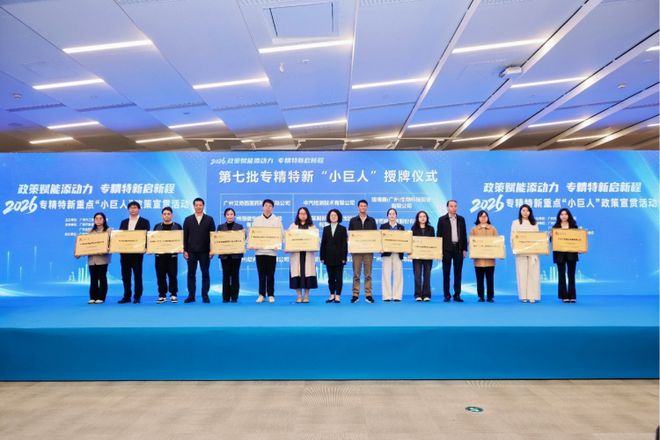
部分传统产业企业有望成为"小巨人" 今年1月,工业和信息化部发布新版《优质中小企业梯度培育管理办法》(以下简称《办法》),对专 精特新中小企业认定标准、"小巨人"企业认定标准进行了完善。 活动现场,广东省工信厅、广东省发改委、广东省科技厅评审专家曾国富以"政策解读+案例分析"的形 式,对重点"小巨人"、专精特新"小巨人"企业申报要点展开解读。 《办法》中,专精特新"小巨人"企业认定标准有较大的变化,企业主导产品的范围有所拓展。属于改造 提升传统产业、培育壮大新兴产业、布局建设未来产业,位于产业链关键环节,对提升产业链供应链韧 性和安全水平发挥重要作用的产品均可纳入。曾国富指出,这一变化将使部分传统产业企业,如矿业、 冶金、化工、轻工、纺织、机械、船舶、建筑等产业领域企业认定专精特新"小巨人"成为可能。 2月4日,广州市工业和信息化局举办全市重点专精特新"小巨人"政策宣贯活动。南都N视频记者从活动 中获悉,截至2025年底,广州市全市累计培育专精特新"小巨人"企业482家、重点"小巨人"企业74家、 专精特新中小企业7175家,专精特新企业年度营业总收入超过8000亿元,成为本市发展新质生产力的重 要力量。 曾 ...
媒体关注自然资源部、国家林草局通报去年四季度8个违法违规典型问题
Xin Lang Cai Jing· 2026-02-05 14:07
Core Viewpoint - The Ministry of Natural Resources and the National Forestry and Grassland Administration reported eight typical cases of illegal land use and ecological damage identified in the fourth quarter of 2025, highlighting issues such as illegal occupation of arable land, destruction of permanent basic farmland, and violations of spatial planning regulations [10][20]. Summary by Relevant Categories Illegal Land Use - In Xiqing District, Tianjin, a horse training facility illegally occupied 58.7 acres of arable land for construction without proper authorization, despite previous warnings in 2024 and 2025 [10][23]. - In Mengjin District, Henan Province, 32.04 acres of permanent basic farmland were illegally used for soil extraction to produce bricks, with inadequate regulatory oversight [10][20]. - In Wanzhou District, Chongqing, 216 acres of permanent basic farmland were improperly used for planting decorative grass, again highlighting regulatory failures [10][20]. Ecological Damage - In Hubei Province, illegal logging activities affected 286.05 acres of forest land, indicating significant ecological harm [10][20]. - In Xinjiang, a coal mining company illegally occupied 113.67 acres of natural pasture land, further contributing to ecological degradation [10][20]. Regulatory Oversight and Response - The authorities emphasized the need for local governments to rectify these issues in accordance with the principles established by the 20th National Congress of the Communist Party, ensuring compliance with farmland protection and ecological conservation regulations [11][13]. - Continuous monitoring and follow-up on the rectification of these issues will be conducted by the Ministry of Natural Resources and the National Forestry and Grassland Administration [11][20].

河钢资源(000923) - 2026年2月5日投资者关系活动记录表(二)
2026-02-05 13:24
Group 1: Production and Operational Challenges - The company has implemented safety measures in response to extreme weather conditions, including a comprehensive drainage system and emergency evacuation plans [2] - Due to heavy rainfall in January 2026, underground water inflow exceeded drainage capacity, leading to water accumulation in some tunnels [2] - Despite the challenges, the company successfully executed a production halt and evacuation, preventing any casualties or major safety incidents [2] Group 2: Project Updates and Delays - The progress of the No. 6 crusher project for the copper phase II has been affected by the underground water issues, causing delays in the construction schedule [3] - The expected production commencement for the copper phase II project will be postponed due to the impact of the recent flooding [3] Group 3: Iron Ore Processing Enhancements - The company plans to upgrade its processing techniques to increase the iron ore grade from 58% to 65%, targeting an annual output of 6 million tons [3] - Although costs per ton may slightly increase, the price differential (approximately $13 per ton) between 62% and 65% grade will enhance overall economic benefits [3] Group 4: Dividend Policy and Investor Relations - The company emphasizes sustainable development in its dividend policy, aiming to balance profitability, cash flow, and investment needs to ensure stable returns for investors [3]

铁货(01029.HK)完成“2供1”供股 筹集最多约3.26亿港元
Ge Long Hui· 2026-02-05 13:09
Core Viewpoint - The company has successfully completed a rights issue, with a total of 638,974,294 shares offered, and has received valid applications for 466,622,154 shares, representing approximately 73.03% of the offered shares [1] Group 1: Rights Issue Details - The underwriter has subscribed to 415,050,642 shares based on a firm commitment, leaving 172,352,140 shares unsold, which accounts for about 26.97% of the offered shares [2] - The rights issue became unconditional as all conditions in the placement and underwriting agreements were met, and no shares were left unsold due to ineligible shareholders [1][2] Group 2: Financial Implications - The total proceeds from the rights issue amount to approximately HKD 326 million (around USD 41.8 million), with a net amount of approximately HKD 324 million (around USD 41.5 million) after expenses [2] - The company plans to allocate the net proceeds as follows: approximately 68% (HKD 219.2 million or USD 28.1 million) for repaying loans to MIC; about 22% (HKD 71.7 million or USD 9.2 million) for K&S mining operations; and around 10% (HKD 32.7 million or USD 4.2 million) for general working capital [2]