卫星互联网

Search documents
微软、Meta季度业绩超预期,资本开支有望延续高增长
Tianfeng Securities· 2025-08-05 02:17
Investment Rating - Industry Rating: Outperform the market (maintained rating) [7] Core Insights - Microsoft reported revenue of $76.442 billion for the latest quarter, a year-on-year increase of 18.1%, with net profit reaching $27.233 billion, up 23.58%, driven primarily by its intelligent cloud business [1][12] - Meta's Q2 revenue was $47.52 billion, a 22% year-on-year increase, exceeding market expectations, with ad revenue of $46.56 billion [2][15] - The overseas computing power industry remains robust, unaffected by DeepSeek and trade frictions, with a strong fundamental resonance in the related supply chain [3][28] Summary by Sections 1. Artificial Intelligence and Digital Economy - Key recommendations include optical modules and devices, with a focus on companies like Zhongji Xuchuang, Xinyi Sheng, Tianfu Communication, and Yuanjie Technology [5][31] - For switch server PCBs, recommended companies include Hudian Co., ZTE, and Unisplendour [5][31] - Low valuation and high dividend opportunities are identified in major telecom operators like China Mobile, China Telecom, and China Unicom [5][31] - AIDC and cooling solutions are highlighted, with key recommendations for companies like Yingweike and Runze Technology [5][31] - AIGC applications and edge computing are emphasized, recommending companies such as Guohua Communication and Meige Intelligent [5][31] 2. Marine Wind and Submarine Cables - Key recommendations for submarine cable companies include Hengtong Optic-Electric, Zhongtian Technology, and Oriental Cable [6][32] - The recovery of overseas markets and concentration on leading companies is noted, with recommendations for Huace Navigation and Weisheng Information [6][32] 3. Satellite Internet and Low-altitude Economy - The acceleration of national defense informatization and low-orbit satellite development is highlighted, with key recommendations for Huace Navigation and Haige Communication [6][33] - The successful launch of low-orbit satellites for broadband communication services is noted, marking significant progress in China's satellite internet initiatives [26][27] 4. Recent Industry Trends - The report indicates that the computing power industry is expected to maintain high growth, with AI as a key investment theme for 2025 [3][28] - The government has included "deep-sea technology" in its work report, indicating a positive trend for the marine wind and cable industry [3][28] - The report emphasizes the importance of AI and digital economy as long-term trends, with a focus on ICT equipment, optical modules, and cloud computing infrastructure [30][29]






2025年中期通信行业投资策略报告:算力引擎强驱动,星地空网共发展-20250801
Wanlian Securities· 2025-08-01 11:08
Core Insights - The communication industry has significantly outperformed the Shanghai and Shenzhen 300 indices in the first seven months of 2025, ranking third among 31 primary industries [1][12] - The valuation of the communication industry as of July 2025 is comparable to the beginning of the year but remains at a higher level than the historical three-year average [1][15] - The industry is experiencing stable operations in the first half of 2025, with emerging businesses playing a prominent role in driving growth [1][17] - The report emphasizes investment opportunities in the AI computing industry chain and the integration of space and ground networks [1][30] Investment Themes AI Computing Industry Chain - Major domestic and international companies are increasing capital expenditures, indicating a global arms race in computing power [2][37] - The demand for AI infrastructure is accelerating, with liquid cooling technology becoming mainstream in data center construction [2][37] - The demand for optical modules is transitioning to higher speeds, while high-speed copper connections still have market demand [2][37] Space and Ground Integration - The low-altitude economy is optimizing infrastructure, with leading eVTOL companies obtaining necessary certifications for commercial operations [6][30] - China's satellite internet industry is continuously launching low-orbit satellites, with advancements in mobile direct satellite connectivity accelerating commercialization [6][30] Industry Performance - The communication industry index has shown a cumulative increase of 21.16% from January to July 2025, outperforming both the Shanghai and Shenzhen 300 indices [12][14] - Emerging business revenues, including cloud computing and big data, have increased significantly, contributing to overall revenue growth in the telecommunications sector [19][25] - The number of fixed broadband users is steadily increasing, with a notable rise in users with gigabit access speeds [20][27] Policy and Future Outlook - The government report emphasizes the importance of nurturing emerging and future industries, including commercial aerospace and low-altitude economies [30][31] - The Ministry of Industry and Information Technology is working on standardizing emerging and future industries, which will support the development of the communication sector [32][34] - The report suggests that investment opportunities should focus on AI computing infrastructure and the integration of space and ground networks, driven by policy support and technological advancements [7][30]
“星链”半年来变轨14万多次防碰撞
Ke Ji Ri Bao· 2025-07-31 23:57
Core Insights - SpaceX's Starlink satellites executed over 144,000 maneuvers to avoid collisions in the six months from December to May, which is 2.8 times more than the previous six months [1] - The first generation of Starlink satellites performed 59,414 maneuvers, while the second generation executed 84,990 maneuvers, totaling 144,404 maneuvers [1] - Currently, there are over 8,000 Starlink satellites in orbit, and if the number reaches 12,000, it is estimated that 90% of near-miss incidents will involve Starlink satellites [1] Group 1 - SpaceX reported that its collision avoidance measures led to a significant increase in the number of maneuvers, with 50,666 maneuvers in the previous six months [1] - The company stated that it proactively deorbits satellites before critical subsystem failures occur, which results in many satellites being removed from orbit that may never fail [1] - SpaceX criticized competitor AST's Bluebird satellite for underestimating collision risks and failing to assess the potential threat to human life from satellites re-entering the atmosphere [2] Group 2 - Experts noted that while Starlink's maneuvers aim to prevent collisions, they may complicate collision predictions for other organizations [2] - In 2021, 50% of near-miss incidents involving spacecraft were related to Starlink, despite having only 1,700 satellites at that time [1] - The reliance on autonomous collision avoidance systems by Starlink may introduce additional complexities in collision prediction for other space entities [2]
建起“超链接” 助力中国经济向新而行
Xin Hua She· 2025-07-31 22:16
Core Viewpoint - The integration of technological innovation and industrial innovation is crucial for enhancing productivity and driving economic growth in China, as emphasized by various industry leaders and government officials [2][18]. Group 1: Technological Achievements - The AS700D electric airship has successfully completed its first scientific flight, showcasing advancements in technology [1]. - High-tech manufacturing in China has seen significant growth, with a 9.5% increase in value-added output in the first half of the year, outpacing overall industrial growth by 3.1 percentage points [4]. - The production of 3D printing equipment, electric vehicles, and industrial robots has increased by 43.1%, 36.2%, and 35.6% respectively [4]. Group 2: Innovation Ecosystem - The establishment of over 1,600 national-level technology business incubators has been pivotal in fostering innovation and technology transfer [5]. - Collaborative efforts between universities and enterprises, such as the joint laboratory with Beijing University of Posts and Telecommunications, are enhancing the practical application of new technologies [5]. - The Long Triangle National Technology Innovation Center has successfully connected over 1,200 technology demand projects with enterprises [7]. Group 3: Challenges and Solutions - There is a need to align technological innovations with actual industrial demands to ensure effective application [11][12]. - The disconnect between enterprise research needs and institutional R&D projects highlights the necessity for more effective platforms to bridge these gaps [13]. - The efficiency of technology transfer needs improvement, requiring a comprehensive policy framework and a market-oriented service system [15]. Group 4: Future Directions - Strengthening the role of enterprises as the main drivers of innovation is essential for the integration of technology and industry [18][19]. - The concept of "use first, pay later" for technology transfer can lower the risk for small and medium enterprises, encouraging them to adopt new technologies [26][27]. - Continuous reforms in the technology transfer mechanism and the establishment of a supportive innovation environment are critical for advancing the integration of technological and industrial innovations [28].
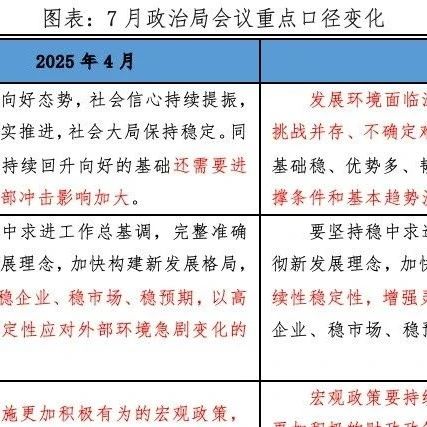
二季度政治局会议传递积极信号
水皮More· 2025-07-31 10:37
Core Viewpoint - The article emphasizes the continuation of a stable yet progressive macroeconomic policy, focusing on maintaining policy stability while enhancing flexibility and timely adjustments to stimulate economic recovery [1][3]. Fiscal Policy - The fiscal policy aims for detailed implementation, emphasizing structural optimization, with a focus on enhancing social welfare and targeted spending for specific groups [4]. - The government plans to accelerate the issuance of long-term special bonds, with net financing reaching 7.66 trillion yuan in the first half of 2025 [4]. Monetary Policy - A moderately loose monetary policy is anticipated, with potential interest rate cuts to lower overall financing costs for society [5]. - The central bank has already implemented a 10 basis point interest rate cut and a 50 basis point reserve requirement ratio reduction, with further easing expected [5]. Industry Policy - The industry policy focuses on fostering technological innovation and promoting healthy competition, with an emphasis on emerging industries and strategic sectors [6][8]. - Key areas for support include quantum computing, artificial intelligence, and biotechnology, with a push for collaboration between research institutions and enterprises [6]. Real Estate Policy - The real estate policy highlights the importance of high-quality urban renewal and managing local government debt risks, with a focus on stabilizing the housing market [9]. - Recent data shows a decline in property sales, with June's sales area and revenue down by 5.5% and 10.8% year-on-year, respectively [9]. Domestic Demand Expansion - The strategy for expanding domestic demand involves enhancing both consumption scenarios and consumer capacity, with potential policies to optimize social security contributions and tax structures [11][12]. - Recent retail sales data indicates a 4.8% year-on-year growth, but a decline in consumer confidence remains a concern [11]. Employment and Social Welfare - The employment policy prioritizes job creation for key demographics, including recent graduates and migrant workers, while ensuring social safety nets are in place [13]. - The approach combines development with safety nets to stabilize society and rebuild consumer confidence [13]. Capital Market - The capital market is encouraged to enhance its attractiveness and inclusivity, with recent positive performance in A-shares and Hong Kong stocks [14]. - The government has introduced various supportive measures to stabilize and invigorate the capital market, including optimizing monetary policy tools [14]. High-Level Opening Up - The policy aims to maintain a stable foundation for foreign trade and investment, with measures to support foreign trade enterprises and promote integrated development of domestic and foreign trade [15]. - The focus is on enhancing the resilience of enterprises and the support capabilities of open platforms in a complex external environment [15].

建起“超链接” 助力中国经济向新而行
Jing Ji Ri Bao· 2025-07-31 01:56
Core Insights - The integration of technological innovation and industrial innovation is crucial for driving China's economic growth, with a focus on transforming scientific achievements into practical productivity [1][3][4] Group 1: Technological Advancements - The AS700D electric manned airship has completed its first scientific flight, and humanoid robots are rapidly evolving in application [1] - In the first half of the year, China's high-tech manufacturing industry saw a value-added growth of 9.5%, outpacing the overall industrial growth by 3.1 percentage points [3] - Production of 3D printing equipment, new energy vehicles, and industrial robots increased by 43.1%, 36.2%, and 35.6% respectively [3] Group 2: Innovation Ecosystem - Over 1,600 national-level technology business incubators have been cultivated in China, facilitating the transformation of technology from initial stages to practical applications [4] - The establishment of innovation centers in the Yangtze River Delta has led to successful collaborations with over 500 companies, addressing more than 1,200 technology demand projects [4] Group 3: Policy and Standardization - The Ministry of Industry and Information Technology is forming industry standardization committees in emerging fields like artificial intelligence and the Internet of Things to support new quality productivity [5] - Recent reforms aim to enhance the efficiency of technology transfer and establish a market-oriented service system for technology achievements [7][8] Group 4: Challenges and Solutions - There is a need to align technological innovations with actual industrial demands to ensure effective application and iteration [6] - The integration of large and small enterprises is essential, with initiatives to lower innovation costs for small businesses and enhance their access to innovation resources [7] Group 5: Future Directions - The focus is on empowering enterprises as the main drivers of innovation, with policies being developed to support their roles in innovation demand, investment, and application [11] - The concept of "use first, pay later" for technology achievements is being promoted to reduce risks for small enterprises and stimulate innovation [13]
许丰娜:“星链”断网,敲响太空组网风险的警钟
Huan Qiu Wang Zi Xun· 2025-07-29 23:14
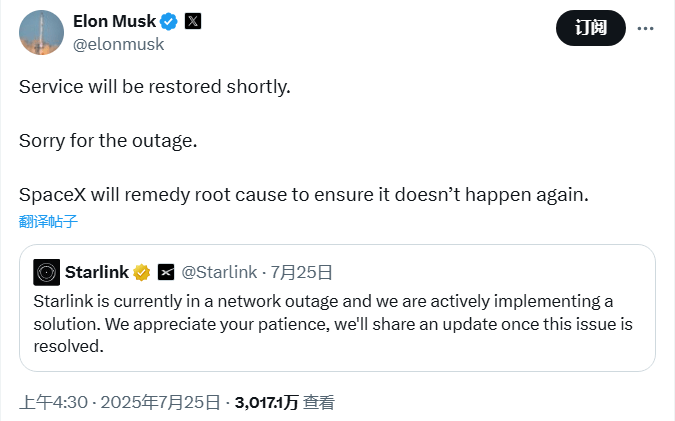
Core Insights - The Starlink satellite internet service experienced a significant outage affecting over 61,000 users globally, disrupting remote medical services, online education, and military communications in Ukraine for approximately 2.5 hours [1] - The outage was attributed to a failure in key internal software services, with ongoing investigations to determine the exact cause [1] - The incident highlights the strategic security risks associated with the rapid expansion of satellite internet services, particularly under extreme space weather conditions [2] Group 1: Incident Overview - The Starlink outage occurred on July 24, 2025, leading to widespread service disruptions across various sectors [1] - The failure of the Starlink system is part of a broader trend of increasing satellite losses, with 1,163 out of 8,875 launched satellites confirmed to have fallen since 2019 [1] - The current solar activity is significantly impacting the orbital stability of Starlink satellites, exacerbating the risks associated with their deployment [2] Group 2: Security Risks - Satellite internet security risks encompass network system vulnerabilities, data security challenges, and threats to the space environment [3][4] - The complexity of satellite internet systems makes them susceptible to software vulnerabilities, service sniffing, and network hijacking [3] - Data transmitted via satellite networks faces risks of interception and tampering, which can lead to privacy breaches and data authenticity crises [3] Group 3: Strategic Implications - The Starlink incident underscores the systemic risks of having a single entity dominate global satellite internet services, prompting calls for diversified governance and technological redundancy [2] - The lack of sufficient attention to satellite internet security risks by various countries poses a challenge as nations rush to deploy satellite networks [2] - The increasing number of planned large satellite constellations raises collision risks in orbit, necessitating improved global governance of space activities [4] Group 4: Recommendations for Improvement - Technological advancements should focus on enhancing satellite physical security, including collision avoidance systems and secure communication protocols [5] - Regulatory frameworks need to be strengthened, particularly regarding data security and international cooperation on space traffic management [5] - International collaboration should be expanded to share threat intelligence and coordinate frequency resource management, ensuring sustainable satellite operations [5]
建起“超链接” 助力中国经济向新而行——“中国经济圆桌会”共话科技创新与产业创新深度融合
Xin Hua She· 2025-07-29 08:55
Group 1 - The core theme of the "China Economic Roundtable" is the deep integration of technological innovation and industrial innovation to drive new productive forces in the economy [3][5][12] - In the first half of the year, China's high-tech manufacturing industry saw a value-added growth of 9.5%, outpacing the overall industrial growth by 3.1 percentage points [5] - The production of 3D printing equipment, new energy vehicles, and industrial robots increased by 43.1%, 36.2%, and 35.6% respectively [5] Group 2 - The establishment of over 33 national manufacturing innovation centers and the launch of significant technological projects are aimed at enhancing the matching of technology and industry [22] - The "先用后付" (use first, pay later) model is being promoted to lower the trial and error costs for small and medium enterprises, thereby activating existing patent resources [28][29] - The integration of large, medium, and small enterprises is emphasized, with initiatives to encourage large enterprises to share innovation resources and support the entry of small enterprises into supply chains [21][22] Group 3 - The focus on creating a collaborative innovation ecosystem involves breaking down barriers to resource flow and leveraging the advantages of a large market and industrial system [28][29] - The government is implementing reforms to enhance the efficiency of technology transfer and establish a market-oriented service system for technology commercialization [21][22] - The importance of establishing trust mechanisms between enterprises and platforms to improve collaborative research and development efficiency is highlighted [19][22]
马斯克意识到危险,为什么把老爹送俄罗斯而不是中国?
Sou Hu Cai Jing· 2025-07-27 07:54
Core Viewpoint - Elon Musk's decision to send his father to Russia is a strategic business move rather than a personal or emotional one, aimed at risk mitigation and strategic positioning in the global market [3][10][13]. Group 1: Business Strategy - Musk's business interests span multiple high-tech industries, including electric vehicles (Tesla), satellite internet (Starlink), space exploration (SpaceX), and brain-computer interfaces (Neuralink), all of which are critical in international competition [3][5]. - The relationship between Musk and China has been beneficial, particularly with the establishment of the Tesla Gigafactory in Shanghai, which has received significant support from the Chinese government [5][10]. - Musk recognizes the risks of relying too heavily on a single market, especially given the fluctuating nature of U.S.-China relations, which could lead to sudden policy changes affecting his business in China [5][8]. Group 2: Geopolitical Considerations - Sending his father to Russia serves as a signal to both China and the U.S. that Musk is not overly reliant on any one country, thereby maintaining a balance in his international business dealings [10][11]. - Russia, despite its current economic challenges, possesses valuable space technology and experience, which could be advantageous for Musk's ambitions in space exploration [7][11]. - The U.S. government closely monitors Musk's activities due to his influence in strategic sectors, making it essential for him to navigate relationships carefully to avoid perceptions of favoritism towards China [8][13]. Group 3: Risk Management - Musk's approach reflects a broader understanding of the importance of maintaining multiple avenues for business operations, akin to diversifying investments to mitigate risks [13][14]. - The decision to establish a presence in Russia, while seemingly simple, is a calculated move to ensure that Musk has options and can adapt to changing geopolitical landscapes [10][15].


星链系统罕见断网,马斯克公开致歉并承诺彻查原因
Sou Hu Cai Jing· 2025-07-27 01:34
Core Points - SpaceX's Starlink satellite internet service experienced a significant outage on July 24, affecting approximately 61,000 users globally [1][2] - The outage lasted about two and a half hours, and services were restored within hours [1] - The cause of the outage was identified as an issue with "critical internal software services" [1][2] Company Response - SpaceX quickly responded to the outage, promising a thorough investigation into the root cause [1] - Michael Nichols, Vice President of Starlink, apologized for the inconvenience caused to users and emphasized the company's commitment to preventing future incidents [1][2] - Elon Musk expressed regret on social media and assured users that SpaceX would take fundamental measures to avoid similar events in the future [2] Industry Implications - The incident highlights the challenges of reliability and stability faced by satellite internet services [3] - Experts speculate that the outage could be attributed to hardware failure, software update issues, or potential cyberattacks [2] - The event poses a significant challenge for SpaceX's commercial operations, as maintaining user trust and service reliability is crucial for its business prospects [3]