家电

Search documents
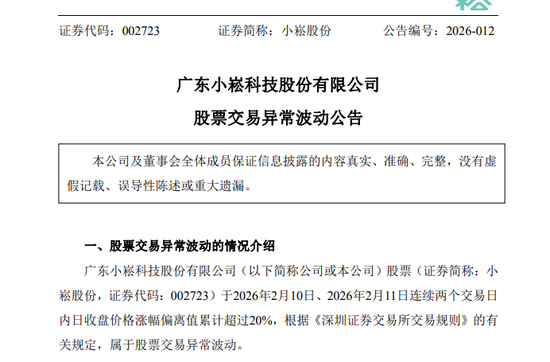
002723,两连涨停!紧急提示!
Xin Lang Cai Jing· 2026-02-11 13:38
Core Viewpoint - Xiaosong Co., Ltd. (002723) announced that its investment in Songguo Digital Culture (Jiangxi) Co., Ltd. is still in the early investment stage and will not significantly impact the company's business at this time [1][5]. Group 1: Investment and Shareholding - On September 16, 2025, Xiaosong Co. invested 10.5 million yuan to acquire a 51.22% stake in Songguo Digital Culture (Jiangxi), which was included in the consolidated financial statements from October 2025 [2][6]. - On December 17, 2025, Xiaosong Co. disclosed that its controlling shareholder, Huaxin Chuangli, signed a share transfer agreement to transfer 30.7379 million shares (9.25% of total shares) to Shanghai Jiasheng Times, at a price of 9.32 yuan per share, totaling 286 million yuan [2][6]. Group 2: Management and Control Changes - If the share transfer is completed, Jiasheng Times will become the new controlling shareholder of Xiaosong Co., with the actual controllers changing to Luo Minghua and Liu Lingshuang [2][6]. - Jiasheng Times was established on November 18, 2025, with a registered capital of 200 million yuan, and its partners include Shanghai Yanxi Chuangji and Zhongshan Hengdeshun Technology [3][7]. Group 3: Business Operations and Financial Performance - Xiaosong Co. primarily engages in home appliance and engineering construction businesses, with a projected loss of 15 million to 22.5 million yuan for 2025 [3][7]. - The company stated that the revenue and profit from Songguo Jiangxi's short drama business are currently low and will not have a significant impact on overall business performance [3][7].



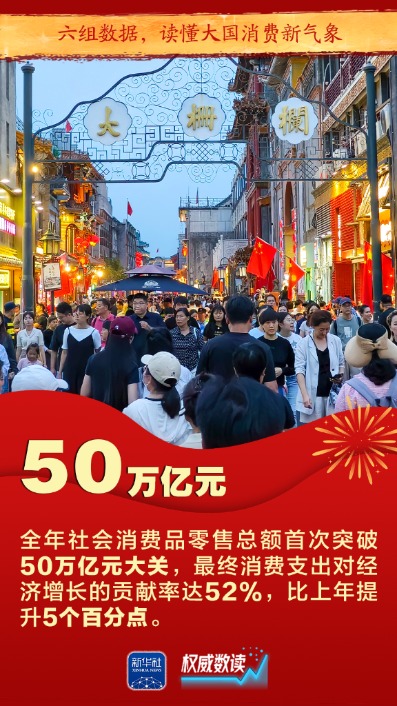
商务部:2025年全年社会消费品零售总额首次突破50万亿
Zhong Guo Jing Ying Bao· 2026-02-11 13:28
Core Insights - The article discusses the 2025 consumer market performance in China, highlighting significant growth in retail sales and consumer spending, with a total retail sales exceeding 50 trillion yuan for the first time and a contribution rate of final consumption expenditure to economic growth reaching 52% [1] Group 1: Consumer Market Performance - In 2025, the total retail sales of consumer goods reached over 50 trillion yuan, marking a significant milestone [1] - The contribution rate of final consumption expenditure to economic growth increased by 5 percentage points compared to the previous year, reaching 52% [1] Group 2: Key Features of Consumer Work - The expansion and upgrading of goods consumption included a focus on the "old for new" consumption policy, with related sales reaching 2.61 trillion yuan, benefiting 366 million people [1] - The automotive sector saw sales of 34.4 million vehicles, while sales of home appliances and communication equipment both surpassed 1 trillion yuan [1] Group 3: Service Consumption and Diverse Scenarios - The service consumption sector experienced a growth of 5.5%, supported by the implementation of a "1+N" policy system and new service consumption initiatives [1] - Various promotional activities, such as "China Shopping" and "Export China" brands, were organized, with over 60 events held to enhance the international consumption environment [1] - The sales of tax refund goods increased by 95.9% year-on-year, indicating a growing trend of international consumers shopping in China [1]
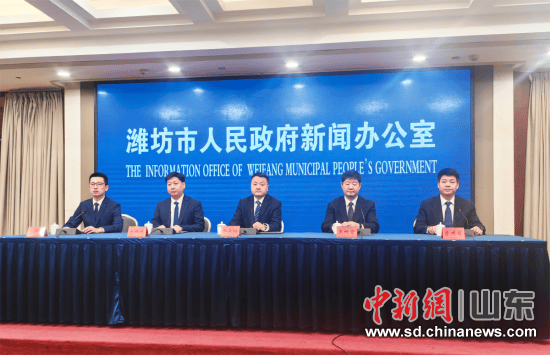
山东潍坊:消费品以旧换新政策升级扩围再发力
Sou Hu Cai Jing· 2026-02-11 11:29
Core Insights - The core viewpoint of the article emphasizes the significant impact of the "old-for-new" consumption policy in Weifang City, projecting a direct consumption boost of 16 billion yuan by 2025, with a year-on-year growth exceeding three times [1][3]. Group 1: Consumption Growth - In 2025, Weifang's total retail sales of consumer goods reached 358.49 billion yuan, marking a 6.3% year-on-year increase, largely driven by the "old-for-new" policy [3]. - The policy facilitated 1.29 million people receiving government subsidies totaling 2.034 billion yuan, directly stimulating consumption by 16 billion yuan [3]. Group 2: Policy Optimization - The 2026 policy adjustments focus on three main areas: more precise subsidy categories, enhanced energy efficiency requirements, and a more scientific subsidy method [4]. - Subsidities for home appliances are now limited to six specific categories, and new digital products include smart glasses [4]. - The subsidy method for automobiles has shifted from a fixed amount to a percentage of the new car price, while home appliances and digital products receive a 15% subsidy based on sales price [4]. Group 3: Automotive Replacement - The automotive "old-for-new" policy has been refined, with subsidy standards now differentiated by vehicle type and energy source, favoring electric vehicles over fuel vehicles [5]. - Consumers can apply for subsidies directly when purchasing new cars from January 1 to March 31, streamlining the process [5]. Group 4: Home Appliances and Digital Products - The process for replacing home appliances and digital products is straightforward, allowing consumers to apply for subsidies through specific apps and receive immediate discounts at participating stores [6]. - Over a thousand merchants are involved in the program, facilitating easy access for consumers [6]. Group 5: Future Outlook - The Weifang Municipal Bureau of Commerce aims to leverage the "old-for-new" policy to convert policy benefits into consumption momentum, thereby stimulating market potential and promoting steady growth in the local consumption market [6]. - In 2025, Weifang conducted over 600 promotional consumption activities, generating more than 10 billion yuan in consumption [6].
历史的“春节后”
Guotou Securities· 2026-02-11 10:42
Group 1 - The report highlights a high probability of style switching in A-shares around the Spring Festival, with a historical tendency for value and large-cap stocks to dominate before the festival, while growth and small-cap stocks tend to perform better afterward [1][8][23] - From 2010 to 2025, there were only two years (2020 and 2022) without a clear switch between growth and value styles, indicating a strong historical pattern of style rotation [8][18] - The report identifies that in 62.5% of the years analyzed, there was a significant switch from large-cap to small-cap stocks after the Spring Festival, suggesting a high likelihood of this trend continuing [1][8] Group 2 - Historical analysis shows that the sectors leading in performance before the Spring Festival often do not repeat their success in the following month, indicating a high probability of sector rotation [2][8] - The report notes that in years where value stocks led after the Spring Festival (2011, 2016, 2021), there were common factors such as liquidity tightening or unexpected risk events that suppressed growth stocks [2][23] - The macro environment in 2015 and 2019, characterized by ample liquidity and weak fundamentals, is compared to the upcoming 2026 Spring Festival, suggesting potential for similar market dynamics [2][3] Group 3 - The report assesses that the current market style is shifting towards value before the 2026 Spring Festival, with technology and growth stocks receding [3][4] - It suggests that if the value style continues post-festival, it will be driven by expectations of domestic economic recovery and policy support, although there are concerns regarding inflation metrics [3][4] - The analysis indicates that the performance of small-cap stocks is expected to rebound significantly after the Spring Festival, driven by liquidity recovery and risk appetite [18][19]
节前探店丨政策“焕新”生暖意
Xin Hua Wang· 2026-02-11 10:22
Group 1 - The new round of consumer goods trade-in policy officially started on January 1, 2026, with differences from last year's policy aimed at boosting consumption [1] - In Yinchuan, Ningxia, sales in stores are expected to increase due to the "national subsidy" support, indicating a positive market response [1] - In 2025, over 11.5 million vehicles were traded in under the old-for-new policy, with nearly 60% being new energy vehicles, reflecting a significant shift in consumer preferences [1] Group 2 - The implementation of the new "national subsidy" policy is expected to enhance industry confidence, stabilize market expectations, and drive an expansion and upgrade of automotive consumption across the entire supply chain [1] - Promotional activities in various stores and sales venues have surged, stimulating the consumption market ahead of the Spring Festival [1]

康平科技拓展智能装备业务,前三季度业绩承压
Jing Ji Guan Cha Wang· 2026-02-11 09:49
Core Viewpoint - Kangping Technology (300907) is actively expanding its business and improving corporate governance through strategic acquisitions and partnerships in the smart equipment control unit sector [1] Business Development - The company signed a letter of intent to acquire Suzhou Lingchen Collection Computer Co., Ltd. in November 2025, aiming to enhance its smart equipment control unit business [1] - In December 2025, during an investor survey, the company indicated that there has been progress on the acquisition, with attention needed on the formal agreement and integration [1] - Kangping Technology is advancing collaborations in the home appliance, automotive, and robotics sectors, having partnered with companies like Midea in the home appliance field and achieved mass production in automotive motor projects [1] - The acquisition of the target company will allow Kangping Technology to enter the robotics industry chain, providing motion control and precision transmission solutions [1] Financial Performance - For the first three quarters of 2025, the company's operating revenue decreased by 7.50% year-on-year, while the net profit attributable to shareholders dropped by 27.11% year-on-year [1] - Future attention is warranted on the release of the 2025 annual report for the latest performance data [1]
广发证券郭磊:抢占2026年先机,要紧盯这三大关键时间节点
2 1 Shi Ji Jing Ji Bao Dao· 2026-02-11 09:18
Group 1 - The first key time point is early March during the National People's Congress (NPC), where the annual economic growth target and major policy resource allocations will be clarified, particularly focusing on fiscal funding directions [2] - The second key time point is in mid to late March, when local investment conditions will start to become clear, coinciding with the traditional peak construction season, allowing for assessment of overall investment density and strength through key physical workload indicators [2] - The third key time point is the second quarter, which serves as an important window for observing consumer activity, as specific policy frameworks and benefits will be released following the NPC's direction to enhance consumption rates [3]

上海青浦区:建设长三角创新枢纽
Ke Ji Ri Bao· 2026-02-11 09:03
Core Insights - The Shanghai Midea Global Innovation Park has recently opened in Qingpu District, symbolizing the area's commitment to enhancing technological innovation capabilities and contributing to the integrated development of the Yangtze River Delta [1][2] - Qingpu District aims to establish itself as a core hub for innovation in the Yangtze River Delta, leveraging its strategic location and fostering collaboration between various sectors [2][3] Economic Development - Qingpu District's GDP is projected to reach 182.5 billion yuan in 2024, which is 1.5 times that of the end of the 13th Five-Year Plan [1] - The district is focusing on the "3+3+3" industrial layout, which includes three trillion-yuan industrial clusters in high-end equipment manufacturing, new-generation information technology, and modern logistics [4] Innovation and Technology - The district has seen a significant increase in strategic emerging industries, which now account for 37.2% of the economy, up nearly 12.5 percentage points from the end of the 13th Five-Year Plan [3] - Major companies like Midea and Huawei are playing crucial roles in driving innovation within Qingpu, with Midea's medical robotics and Huawei's AI innovation center being notable examples [3][6] Talent and Infrastructure - The Shanghai Midea Global Innovation Park is designed to accommodate 8,000 to 10,000 high-end R&D talents, focusing on nine key research areas including industrial internet and smart manufacturing [7] - Qingpu District is enhancing its innovation ecosystem by establishing national-level innovation platforms and incubators, which support various high-tech sectors [6][5]

权威数读丨六组数据 读懂大国消费新气象
Xin Hua She· 2026-02-11 06:05
Group 1 - The core viewpoint of the article highlights the characteristics of consumption in China by 2025, which include the expansion and upgrading of goods consumption, improvement of service consumption to benefit the public, and increasingly diverse consumption scenarios [1] Group 2 - By 2025, the sales of related goods from the implementation of the old-for-new consumption policy are expected to reach 2.61 trillion yuan, benefiting 366 million people, with a significant number of green and smart products entering households [3] - The projected automobile sales for 2025 are 34.4 million units, while the sales of home appliances and communication equipment are expected to exceed 1 trillion yuan each [6] - The service retail sector is anticipated to grow by 5.5% due to the improvement of the "1+N" policy system for service consumption and the implementation of actions to enhance service consumption [7] - Over 60 events will be organized to promote the "Buy in China" and "Export from China" brands, including high-quality consumption months and international consumption seasons, along with pilot projects for international consumption environment construction and optimization of tax refund policies for departing tourists [8]
小米之家痛揍理发店
半佛仙人· 2026-02-11 05:20
Core Viewpoint - The article discusses the potential of Xiaomi's business model in the hairdressing industry, suggesting that Xiaomi could revolutionize the sector by integrating its technology and customer experience into hair salons, making them more appealing and efficient [5][9]. Group 1: Xiaomi's Unique Approach - Xiaomi's stores provide a unique shopping experience that encourages customers to explore its ecosystem, contrasting with traditional hair salons that often have a more rigid and less engaging atmosphere [5][6]. - The integration of Xiaomi products in the hairdressing process enhances customer experience, from using Xiaomi's heated towel racks to massage chairs, creating a seamless blend of service and technology [6][7]. Group 2: Pricing Strategy - Xiaomi's pricing strategy is highlighted as being significantly lower than traditional salons, with services priced at just 8.8 yuan, positioning it as a cost-effective alternative in the market [9][11]. - The article emphasizes that Xiaomi does not rely on high margins, instead focusing on volume and customer retention, which could disrupt the traditional pricing models in the hairdressing industry [9][11]. Group 3: Precision and Quality - The article asserts that Xiaomi's technological expertise allows for greater precision in haircuts, with a focus on data and accuracy, which could redefine standards in the hairdressing industry [11][12]. - The use of advanced technology in hairdressing, such as precise temperature control and high-quality hairdryers, enhances the overall service quality, making it a competitive advantage for Xiaomi [11][12]. Group 4: Market Impact - The potential impact of Xiaomi's entry into the hairdressing market could lead to a significant transformation, not only in hair salons but also in related retail sectors, as customers may be drawn to the innovative experience [11][12]. - The article suggests that if successful, Xiaomi's model could lead to a proliferation of its stores, creating a new standard in the industry and potentially leading to a renaissance in consumer experiences [11][12].