农产品

Search documents
解锁北京年味新地图,这些“天津籍”选手火了!
Bei Jing Ri Bao Ke Hu Duan· 2026-02-05 13:15
Core Insights - The article highlights the increasing integration of the Beijing-Tianjin-Hebei region, particularly in the floral industry, showcasing how products from Tianjin are gaining popularity in Beijing as the Spring Festival approaches [1][3]. Group 1: Floral Industry Collaboration - The Beijing Flower Trading Center serves as a key hub for floral sales, with 100% of the "Baolian Lantern" flowers sold there sourced from Tianjin, indicating a strong production and sales linkage between the regions [3]. - The collaboration among the Beijing-Tianjin-Hebei floral industry has evolved into a clear development pattern, with Tianjin focusing on production, Hebei on cultivation, and Beijing on distribution and sales [3]. - A digital platform has been established at the Beijing Flower Trading Center, enhancing transaction efficiency and reducing logistics costs, with over 700 merchants registered, 30% of which are from Tianjin [5]. Group 2: Market Dynamics and Consumer Preferences - The "Baolian Lantern" flowers, cultivated in Tianjin, are popular during the Spring Festival, with sales expected to reach three to four times the normal volume during this period [5]. - The trading center has become a modern floral complex, offering various services and experiences, including a flower auction center and a themed night market, enhancing its commercial and recreational appeal [7]. - The center will extend its operating hours during the Spring Festival to accommodate increased consumer demand, with various themed activities planned [8]. Group 3: Local Market Engagement - The article also discusses local vendors from Tianjin participating in the Yongle Market in Tongzhou, showcasing a variety of traditional foods and agricultural products, which are well-received by consumers [10][12]. - Vendors report strong sales, with some achieving daily revenues of up to 6,000 yuan, indicating a robust demand for local specialties [10][15]. - The Yongle Market has undergone renovations to enhance its appeal, attracting a significant number of visitors and facilitating the integration of products from the Beijing-Tianjin-Hebei region [20][22].


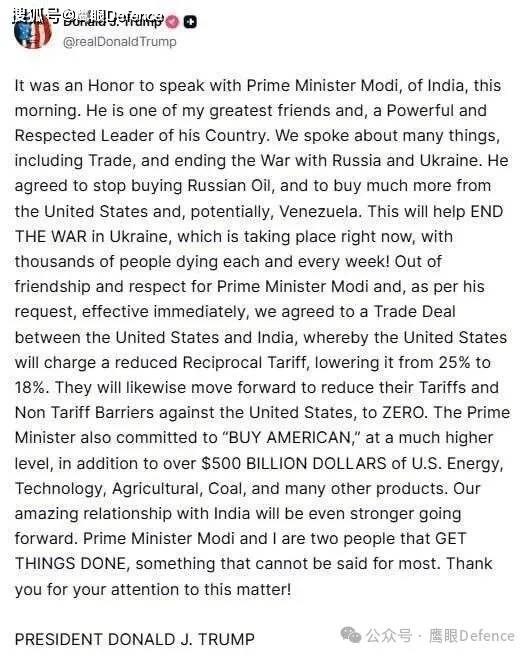
美印联手背刺俄罗斯?5000亿天价订单曝光,细节却一个字没写
Sou Hu Cai Jing· 2026-02-05 11:29
Core Viewpoint - The recent announcement of a "landmark trade agreement" between the US and India, which includes a significant reduction in tariffs and a shift in energy sourcing, is more complex than it appears, revealing underlying geopolitical strategies and challenges [1][3]. Group 1: Trade Agreement Details - The US plans to reduce tariffs on Indian goods from 50% to 18%, while India is expected to stop purchasing oil from Russia and instead import energy from the US [1]. - The agreement lacks specific implementation dates, detailed procurement lists, and a timeline for India's cessation of Russian oil purchases, indicating a lack of concrete commitments [3]. - There are discrepancies in the reported tariff reductions, with Trump claiming a drop from 50% to 18%, while India stated it would decrease from 25% to 18%, highlighting the differing narratives for domestic audiences [5]. Group 2: Geopolitical Implications - The agreement serves multiple purposes for the US: it strengthens its strategic position in Asia, disrupts India's energy ties with Russia, and opens up significant market opportunities for US companies in energy, agriculture, and high-tech sectors [3]. - For India, the choice to comply with the US demands is driven by the economic pressure of high tariffs, but abandoning cheaper Russian oil could lead to increased costs and financial strain [3][5]. - The agreement is viewed as a geopolitical maneuver rather than a straightforward economic partnership, with both nations seeking to leverage the situation for their own strategic advantages [5]. Group 3: Future Considerations - Key questions remain regarding India's ability to meet its energy needs without Russian oil, the US's commitment to lowering tariffs, and the potential repercussions for Russia as a significant energy supplier [7]. - The relationship between major powers is characterized by shifting interests rather than lasting alliances, suggesting that the apparent cooperation may be built on fragile foundations [7].

USDA 2月报告前瞻:阿根廷炒天气,国内豆粕要反转?
对冲研投· 2026-02-05 10:00
文 | 聂波 来源 | NB的农产品 编辑 | 杨兰 审核 | 浦电路交易员 往年USDA 2月报告会对南美大豆产量调整,尤其是最近阿根廷天气炒作,巴西大豆发运缓慢,CBOT美大豆从 底部反弹,那么本次报告中美国和南美大豆平衡表将有哪些变化?阿根廷干旱问题是否对国内豆粕市场产生较 大影响? 短期南美炒作天气,长期南美丰产 01 本次美国农业部(USDA)2月供需报告将于当地2月10日下午12点公布,通常2月报告不会对美豆供应方面进 行调整,25/26年度美豆产量在今年的2-9月的供需报告中不再有变化,进口方面即使调整也将会很小,本次报 告的修正将集中在需求端的压榨和出口。 美国12月大豆压榨量预估为2.304亿蒲式耳,将比2024年11月的2.177亿蒲式耳增加5.9%,较11月份的2.205 亿蒲式耳增加4.5%,压榨量处于历史次新高的水平。由于生产生物燃料所需的豆油需求不断增加,美国大豆压 榨产能扩大,推动大豆压榨率飙升至历史高位。9-12月累计压榨8.924亿蒲式耳,同比增加7.29%,高于1月报 告中年度压榨目标增速5.11%,但是增速略低于9-11月的7.99%。在1月报告中,25/26年度美豆压榨 ...

1月中国大宗商品价格指数创近三年半来新高
Zhong Guo Xin Wen Wang· 2026-02-05 08:21
Core Viewpoint - In January, China's Commodity Price Index (CBPI) reached 125.3 points, marking a month-on-month increase of 6.3% and a year-on-year increase of 12.7%, the highest since July 2022 [1] Group 1: Market Trends - The increase in the CBPI indicates a continued recovery and positive market sentiment, supported by national strategic policies and optimistic business expectations [1][2] - The rise in prices is influenced by international geopolitical changes, expectations of loose monetary policy, and significant fluctuations in commodity futures prices, leading to rapid increases in prices of non-ferrous metals and chemicals [1] Group 2: Sector Analysis - The non-ferrous price index saw a substantial increase, while the chemical price index also rose quickly; the black series price index continued to recover, and agricultural product prices increased slightly [1] - Among the 50 monitored commodities, 33 (66%) experienced price increases, while 17 (34%) saw price declines in January [1] - The top three commodities with the highest price increases were lithium carbonate, refined tin, and refined nickel; the top three with the largest declines were corrugated paper, caustic soda, and coke [1]
清远丝苗米品牌宣传推广培训班再升级!第二期解锁品牌营销+数字化新玩法
Nan Fang Nong Cun Bao· 2026-02-05 04:00
Group 1 - The core idea of the article is the launch of the second phase of the promotional training program for the Qingyuan Silk Rice brand, focusing on brand marketing and digital strategies [1][6][29] - Qingyuan Silk Rice is recognized as an important product in the "Cantonese delicacies" category, transitioning from "product value" to "brand value" [2][3] - The training program aims to enhance the brand influence of Qingyuan Silk Rice and cultivate marketing management capabilities among enterprises [6][14] Group 2 - The second training session will take place on February 6 at the Guangdong Silk Rice Cross-County Cluster Industrial Park, organized by the Qingyuan Agricultural Investment Group [7][29] - The training will cover brand promotion, market marketing, and new media applications, utilizing a combination of field observation and centralized teaching methods [9][12] - Selected enterprises will provide immersive learning experiences in brand marketing, promotional platform construction, and e-commerce live marketing [11][12] Group 3 - Two industry experts will lead the training, focusing on practical applications rather than theoretical concepts to help Qingyuan Silk Rice enterprises overcome marketing and digital management challenges [13][14] - The brand marketing instructor, Yang Hong, will customize courses for the Qingyuan Silk Rice industry, discussing brand system construction and collaborative development strategies [19][20] - The information technology instructor, Lan Li, will introduce the information service platform for the Qingyuan Silk Rice Cross-County Cluster Industrial Park, guiding participants on using digital tools for management and marketing [25][27]

2026-02-05:五矿期货农产品早报-20260205
Wu Kuang Qi Huo· 2026-02-05 03:22
Report Industry Investment Rating There is no information about the report industry investment rating in the provided content. Core Viewpoints - For sugar, the current international sugar price may rebound after the northern hemisphere finishes the sugar - crushing season in February. The downward space of domestic sugar prices is limited, and it is recommended to wait and see [3][4]. - For cotton, in the short - term, Zhengzhou cotton fluctuates widely at a high level. In the long - term, due to the reduction of planting area and positive macro - expectations, cotton prices have room to rise. It is advisable to pay attention to the opportunity of low - buying before the Spring Festival [6][9]. - For protein meal, the January USDA report is slightly bearish, but the overall balance sheet is better than that of 2024/25. The short - term fundamentals are improving, and protein meal prices may be bottoming out [12][13]. - For oils, in the short - term, oil prices have fallen from high levels. In the long - term, the bottom of oil prices may have appeared. It is recommended to wait for a pullback and then try to go long [15][19]. - For eggs, the spot price is about to realize seasonal price increases, which will drive the futures price down. The near - term contracts may fluctuate weakly, and the far - end contracts may continue to correct their valuations, maintaining a short - selling idea [20][21]. - For pigs, the current supply is large, and the spot and near - term expectations are pessimistic. The near - term contracts may still be under pressure, and it is recommended to short on rebounds. The long - term contracts may have support after following the decline [23][24]. Summary by Commodity Sugar - **Market Quotes**: On Wednesday, the Zhengzhou sugar futures price rebounded slightly. The closing price of the May contract was 5210 yuan/ton, up 43 yuan/ton or 0.83% from the previous trading day. The spot price of Guangxi sugar - making groups was 5260 - 5340 yuan/ton, unchanged from the previous trading day [2]. - **Supply and Demand Data**: StoneX expects a global sugar surplus of 2.9 million tons in the 2025/26 season. As of January 31, 2026, India's sugar production reached 19.305 million tons, a year - on - year increase of 16.8%. In December 2025, China imported 580,000 tons of sugar, a year - on - year increase of 190,000 tons. In 2025, China's total sugar imports were 4.92 million tons, a year - on - year increase of 570,000 tons. As of the end of December in the 2025/26 season, China's cumulative sugar imports were 1.77 million tons, a year - on - year increase of 310,000 tons. In December, China produced 2.63 million tons of sugar, and the cumulative production in the 2025/26 season was 3.68 million tons, a year - on - year decrease of 720,000 tons. The cumulative sales volume was 1.57 million tons, and the cumulative sales - to - production ratio was 31.2%, a year - on - year decrease of 25.56 percentage points. The industrial inventory was 2.11 million tons, a year - on - year increase of 210,000 tons [3]. Cotton - **Market Quotes**: On Wednesday, the Zhengzhou cotton futures price fluctuated. The closing price of the May contract was 14,680 yuan/ton, up 30 yuan/ton or 0.2% from the previous trading day. The China Cotton Price Index (CCIndex) 3128B was 16,002 yuan/ton, up 15 yuan/ton from the previous trading day [6]. - **Supply and Demand Data**: As of the week of January 30, the spinning mill operating rate was 64.2%, a 0.4 - percentage - point decrease from the previous week. The national commercial cotton inventory was 5.65 million tons, a decrease of 50,000 tons from the previous week. From January 15 to January 22, the US current - year cotton export sales were 51,800 tons, and the cumulative export sales were 1.7722 million tons, a year - on - year decrease of 194,900 tons. Among them, the export to China was 8800 tons that week, and the cumulative export to China was 97,400 tons, a year - on - year decrease of 66,000 tons. The January forecast for the 2025/26 global cotton production was 26 million tons, a decrease of 80,000 tons from the December forecast and an increase of 200,000 tons from the previous year. The inventory - to - consumption ratio was 62.63%, a decrease of 1.42 percentage points from the December forecast and an increase of 0.62 percentage points from the previous year [6]. Protein Meal - **Market Quotes**: On Wednesday, the protein meal futures price fell slightly. The closing price of the May soybean meal contract was 2623 yuan/ton, down 4 yuan/ton or 0.15% from the previous trading day. The closing price of the May rapeseed meal contract was 2247 yuan/ton, down 2 yuan/ton or 0.09% from the previous trading day. The spot price of Dongguan soybean meal was 3080 yuan/ton, unchanged from the previous trading day, and the spot price of Huangpu rapeseed meal was 2460 yuan/ton, unchanged from the previous trading day [11]. - **Supply and Demand Data**: From January 15 to January 22, the US exported 820,000 tons of soybeans, and the current - year cumulative export was 33.85 million tons. Among them, the export to China was 230,000 tons that week, and the current - year cumulative export to China was 9.65 million tons. From January 23 to January 30, the domestic sample soybean arrivals were 1.82 million tons, an increase of 350,000 tons from the previous week. The sample soybean port inventory was 6.71 million tons, a decrease of 500,000 tons from the previous week. The sample oil - mill soybean meal inventory was 860,000 tons, an increase of 50,000 tons from the previous week. The January forecast for the 2025/26 global soybean production was 425.67 million tons, an increase of 3.13 million tons from the December forecast and a decrease of 1.48 million tons from the previous year. The inventory - to - consumption ratio was 29.4%, an increase of 0.39 percentage points from December and a decrease of 0.44 percentage points from the previous year [12]. Oils - **Market Quotes**: On Wednesday, the oils futures price fluctuated. The closing price of the May soybean oil contract was 8140 yuan/ton, up 54 yuan/ton or 0.67% from the previous trading day. The closing price of the May palm oil contract was 9138 yuan/ton, up 44 yuan/ton or 0.48% from the previous trading day. The closing price of the May rapeseed oil contract was 9243 yuan/ton, up 28 yuan/ton or 0.3% from the previous trading day. The spot price of Zhangjiagang first - grade soybean oil was 8670 yuan/ton, up 20 yuan/ton from the previous trading day. The spot price of 24 - degree palm oil in Guangdong was 9180 yuan/ton, up 20 yuan/ton from the previous trading day. The spot price of rapeseed oil in Jiangsu was 10,040 yuan/ton, up 70 yuan/ton from the previous trading day [15]. - **Supply and Demand Data**: From January 23 to January 30, the domestic sample data showed that the inventory of the three major oils decreased slightly by 60,000 tons to 1.89 million tons. The January forecast for US soybean oil consumption was 1.32 million tons, a decrease of 249,000 tons from the December forecast and an increase of 1 million tons from the previous year. In December, India's total vegetable oil imports were 1.38 million tons, an increase of 200,000 tons from November [16][18]. Eggs - **Market Quotes**: On the previous day, most egg prices in China declined, and a few remained stable. The average price in the main production areas dropped 0.07 yuan to 3.56 yuan/jin. The price in Heishan remained at 3.3 yuan/jin, and the price in Guantao dropped 0.24 yuan to 3 yuan/jin. The supply was normal, the market digestion was gentle, and the terminal caution increased. It is expected that most egg prices in China may decline in the short - term, and a few areas may remain stable [20]. Pigs - **Market Quotes**: On the previous day, domestic pig prices generally declined with a large margin. The average price in Henan dropped 0.32 yuan to 12.22 yuan/kg, and the average price in Sichuan dropped 0.09 yuan to 11.77 yuan/kg. The trading volume of the breeding side was limited, most of them did not complete the daily slaughter plan, and the price - cutting sentiment was strong. In addition, the incremental space of the downstream slaughter side was limited. It is expected that pig prices may continue to decline today [23].
中原期货晨会纪要-20260205
Zhong Yuan Qi Huo· 2026-02-05 03:22
Report Industry Investment Rating No information provided. Core Viewpoints of the Report - The A-share market shows a mixed trend, with the spring market still likely to continue, but the market performance may not be smooth. Before the Spring Festival, the market may be volatile, and investors are advised to adopt a more conservative style and focus on high-dividend sectors [27]. - The commodity market has different trends. Precious metals generally rise, while base metals show mixed performance. The energy market is affected by factors such as geopolitical risks and inventory changes, and oil prices rise [10][11][12]. Summary by Relevant Catalogs 1. Macro News - China's President Xi Jinping had a phone call with US President Trump, emphasizing the importance of the Taiwan issue and the need for the US to handle arms sales to Taiwan carefully [7]. - Market rumors that Musk's team visited Chinese photovoltaic companies led to a surge in A-share photovoltaic concept stocks. However, some companies announced that they had not carried out any cooperation with the relevant team, and the China Photovoltaic Industry Association pointed out that space photovoltaic technology is still in the early exploration stage [7]. - Google's parent company Alphabet's Q4 2025 revenue exceeded expectations, and its 2026 capital expenditure is expected to be much higher than investors' expectations [8]. - The A-share market showed a trend of first decline and then rise. The coal and photovoltaic sectors saw a wave of daily limit increases, while the semiconductor, computing hardware, and AI application sectors were sluggish [8]. - The Ministry of Industry and Information Technology emphasized the need to strengthen the technological supply of future industries and promote breakthroughs in fields such as 6G, quantum technology, brain-computer interfaces, and embodied intelligence [8]. - The number of newly opened margin trading accounts in the market in January increased significantly compared with the previous month and the same period last year [9]. - The US dollar index rose, and most non-US currencies fell. The offshore RMB against the US dollar fell [9]. - China's first domestically developed 12-inch silicon carbide ingot thinning equipment and substrate thinning equipment were successfully delivered, marking a new breakthrough in the field of large-size silicon carbide processing [9]. - The Federal Reserve announced that it will not adjust the capital levels of large banks in the 2026 stress test cycle and is considering reforms to improve transparency [9]. - The US stock market closed mixed. The Dow rose, while the S&P 500 and Nasdaq fell. The labor market data showed that the number of private sector employment in the US in January was far lower than expected [10]. - The domestic commodity futures market mostly rose, with precious metals leading the gains. The international precious metals futures market also generally rose [10][11]. - The London base metals market mostly fell [11]. - The European stock market closed mixed. The French stock market rose due to the rebound of the luxury goods sector and the stability of the European Central Bank's interest rate; the British stock market was boosted by the strengthening of the pound; the German stock market fell due to the difficulties in the auto parts industry and geopolitical concerns [11]. - Iran's Foreign Minister clarified the official position on the talks with the US in Oman, and the meeting is scheduled to be held on February 6 [12]. - The yields of treasury bonds in the interbank market showed mixed trends, and the treasury bond futures closed lower. The central bank carried out reverse repurchase operations, and the interbank market liquidity returned to a stable and loose state [12]. - The prices of US and Brent crude oil futures rose due to concerns about the risk of military conflict and the unexpected decrease in US EIA crude oil inventory [12]. 2. Morning Meeting Views on Major Varieties 2.1 Agricultural Products - **Sugar**: The price of the sugar futures main contract continued to rebound. Although the supply pressure remains, the rebound of international sugar prices and the tightening of domestic import policies have alleviated some downward pressure. It is expected to maintain a bottom - shock repair in the short term [14]. - **Corn**: The price of the corn futures main contract fluctuated narrowly, and the pre - holiday selling pressure continued to be realized, putting pressure on the price. It is recommended to wait and see and pay attention to the support at 2250 yuan/ton [14]. - **Peanuts**: The price of the peanut futures main contract fluctuated narrowly, and the supply and demand contradiction is not prominent. It is expected to maintain a bottom - shock pattern in the short term [14]. - **Pigs**: As the Spring Festival approaches, the supply of pigs is abundant, and the downstream demand is limited. The futures market is expected to remain volatile before the festival [14][16]. - **Eggs**: The spot price of eggs dropped significantly, and the futures market reflected the decline in spot prices and the expectation of post - festival decline, maintaining a volatile trend [16]. - **Red Dates**: The price of red dates is expected to remain stable in the short term, and the futures market is looking for support [16]. - **Cotton**: The supply of cotton is expected to decrease, and the demand is resilient. It is recommended to treat it with an interval - shock idea and consider going long at the lower edge of the interval [16]. 2.2 Energy and Chemicals - **Caustic Soda**: The caustic soda market is in a state of high supply and high inventory, and the fundamentals remain in an oversupply pattern [15][16]. - **Coking Coal and Coke**: The supply of coking coal and coke is expected to shrink, and the downstream demand is also weak. It is expected to show a weak - shock trend in the short term [16]. - **Logs**: The price of log futures continued to be strong, but there is a risk of a decline in demand before the festival. It is recommended to wait and see [18]. - **Pulp**: The supply pressure of pulp continues, and the demand support is weak. It is necessary to pay attention to whether the price can stand firm at the spot price level [18]. - **Double - offset Paper**: The supply of double - offset paper is abundant, and the demand is weak. The price may be restricted if there is no substantial improvement in demand [18]. - **Urea**: The domestic urea market price is stable. The daily output is rising, and the inventory is decreasing. The UR2605 contract should pay attention to the support at 1750 - 1760 yuan/ton [18][20]. 2.3 Non - ferrous Metals - **Copper and Aluminum**: The price of copper is boosted by the proposed key mineral strategic reserve plan and the easing of market uncertainties. The supply of aluminum is increasing, and the demand shows signs of stabilization, but the structural contradiction has not been eliminated. Both are expected to continue to run at a high level [22]. - **Alumina**: The alumina market is in an oversupply pattern, waiting for new market drivers [23]. - **Rebar and Hot - rolled Coil**: The spot market of rebar and hot - rolled coil is inactive, and the demand is limited. The steel price is expected to fluctuate and adjust in the short term [23]. - **Ferroalloys**: The supply and demand of ferroalloys changed little this week. The fundamentals of silicon iron and manganese silicon are relatively healthy. The short - term trend is expected to be callback - biased and long, and the impact of the macro environment should be noted [25]. - **Lithium Carbonate**: The price of lithium carbonate futures is under pressure. The supply is expected to shrink in February, and the demand is in the peak season. It is recommended to wait and see before the festival and look for long - buying opportunities after the price stabilizes [25]. 2.4 Options and Finance - **Stock Index Options**: On February 3, the A - share market rose, and the trading volume of stock index options changed. Trend investors can pay attention to the arbitrage opportunities between varieties, and volatility investors can hold short - straddle positions to short volatility [25]. - **Stock Index**: The stock market may be volatile before the Spring Festival. It is recommended to focus on high - dividend sectors and adopt a more conservative investment style. The spring market is still likely to continue in February after short - term adjustment [27].
文旅上新 一口“桐庐味道”迎新春
Hang Zhou Ri Bao· 2026-02-05 03:02
Group 1 - The event "2026 'Tonglu Flavor' Year Goods Exhibition" in Hangzhou showcased local delicacies, attracting significant consumer interest and sales [1] - The exhibition highlighted the transformation of traditional local foods into standardized products, expanding their reach into urban markets through cold chain logistics and branding [1] - The event served as a platform for local agricultural products, featuring direct supply of mushrooms, spicy sauces, and other specialties, enhancing consumer engagement [1] Group 2 - A promotional campaign for tourism in Tonglu was launched, featuring local accommodations, rural tourism routes, and cultural products, emphasizing the theme "Celebrating the New Year in Tonglu" [2] - The establishment of the Tonglu County Catering Industry Association in Hangzhou and the awarding of "Tonglu Flavor" brand licenses to seven local restaurants signify the growth of the brand, which now includes 137 authorized enterprises with a fourfold increase in sales since its inception in 2021 [2] - Strategic cooperation agreements were signed between Tonglu County's agricultural and cultural departments and commercial entities to enhance the marketing of agricultural products and cultural promotions, leveraging urban commercial advantages for rural industry growth [2]
互降关税,特朗普称印度将不再买俄油:俄罗斯人不愿相信这个噩耗
Sou Hu Cai Jing· 2026-02-05 02:41
Group 1 - The core viewpoint of the articles revolves around India's potential shift in oil purchasing strategy, influenced by a conversation between former President Trump and Prime Minister Modi, where Modi allegedly agreed to stop buying Russian oil and increase purchases from the US and possibly Venezuela [1] - India has been a major customer of Russian oil since the outbreak of the war in 2022, primarily due to the low prices of Russian oil, which has become increasingly attractive as supply has built up due to attacks on Russian refineries [4] - The Kremlin has not received any official statement from India regarding the cessation of Russian oil purchases, indicating that Russia still hopes for continued trade relations with India, as Russian oil remains a cost-effective option for India [4][8] Group 2 - The decision for India to stop purchasing Russian oil is not solely based on commercial factors but is also influenced by political pressures from the US, which could provide tariff compensations beneficial for Modi's "Make in India" initiative [7] - Modi's decision could have significant domestic implications, particularly concerning the agricultural sector, as Indian farmers may be adversely affected by an influx of cheaper US agricultural products [7][8] - Historically, the relationship between Moscow and New Delhi has been primarily commercial, with minimal geopolitical or ideological interference, suggesting that a shift away from Russian oil could severely impact Russia's energy sector, especially after losing the EU market [8]
【财经分析】中国大宗商品价格指数创3年半新高 行业分化明显
Zhong Guo Jin Rong Xin Xi Wang· 2026-02-05 02:36
Core Insights - The China Commodity Price Index (CBPI) for January 2026 reached 125.3 points, marking a month-on-month increase of 6.3% and a year-on-year increase of 12.7%, the highest since July 2022 [1][10] - The rise in commodity prices is attributed to supportive policies and optimistic market expectations, while challenges remain from international geopolitical changes and volatile global commodity futures prices [1][10] Price Index Summary - The non-ferrous price index surged to 159.6 points, with a month-on-month increase of 9.9% and a year-on-year increase of 26.6%. Key drivers include the depreciation of the US dollar and geopolitical factors [4] - Lithium carbonate prices increased by 48.4% month-on-month, driven by strong demand from the electric vehicle and energy storage sectors, alongside supply concerns [4] - The chemical price index rose to 99.3 points, with a month-on-month increase of 3.8% but a year-on-year decrease of 9.8%. This increase is influenced by rising international oil prices and pre-holiday inventory demands [6] - The agricultural product price index slightly increased to 98.3 points, with a month-on-month rise of 0.2% and a year-on-year increase of 5.7%, attributed to pre-festival stocking [6] Sector-Specific Insights - The mineral price index fell to 71.3 points, with a month-on-month decrease of 0.3% and a year-on-year decrease of 10.3%, due to seasonal demand slowdowns [8] - The energy price index declined to 94.6 points, with a month-on-month drop of 3.2% and a year-on-year decrease of 11.6%, primarily due to lower downstream demand during the traditional off-season [8] - The black metal price index rose to 79.2 points, with a month-on-month increase of 2.2% but a year-on-year decrease of 1.6%, reflecting mixed market sentiments and pressures on steel production [8] Commodity Price Movements - Among 50 monitored commodities, 33 saw price increases while 17 experienced declines in January. The top three gainers were lithium carbonate, refined tin, and refined nickel, with increases of 48.4%, 20.2%, and 19.5% respectively [9] - The largest declines were observed in corrugated paper, caustic soda, and coke, with decreases of 13.1%, 7%, and 6.9% respectively [9]