健康

Search documents
天猫2025年度新品牌发展报告:超15万个优质商家创立品牌
Zheng Quan Shi Bao Wang· 2026-01-12 05:07
Core Insights - Tmall's 2025 New Brand Development Report indicates that over 150,000 quality new merchants established brands on the platform in the past year, marking a historical high in scale [1] - The number of brands achieving over 100 million yuan in sales in their opening year increased by over 40% year-on-year [1] - Among new brands established within three years, 276 brands achieved annual sales exceeding 100 million yuan, and 5,026 brands surpassed 10 million yuan, all setting historical records [1] Industry Breakdown - The top ten industries with the highest number of new brands achieving over 10 million yuan in sales in 2025 include apparel, home appliances, home decoration, 3C digital products, health, sports and outdoor, maternal and infant products, home goods, food and fresh produce, and jewelry [1] - The cities with the most new merchants in 2025 are Guangzhou, Shenzhen, Jinhua, Hangzhou, Quanzhou, Xiamen, Wuhan, Xuzhou, Dongguan, and Zhengzhou, with Guangzhou leading for three consecutive years [1] - In 2025, over 18,000 new merchants opened stores in Guangzhou, doubling the number from 2023 [1] Emerging Opportunities - A new wave of brands is rapidly emerging by addressing niche demands with differentiated high-quality products [1] - The report also highlights 50 blue ocean opportunity tracks for 2026, including smart robots, AI glasses, skin science, personalized makeup, wearable home clothing, vegetable-tanned HOBO bags, light customization in home decoration, smart mattresses, titanium kitchenware, small ball sports, lightweight sports gear, professional trail running, and outdoor pet products, indicating significant growth potential in these areas [1]
旅游消费以40%增长意愿登顶榜首
Jiang Nan Shi Bao· 2026-01-05 23:18
Core Insights - Consumption is a persistent driver of economic growth and reflects the quality of life for residents in Jiangsu, with a significant shift towards high-quality, intelligent, and green consumption patterns expected by 2026 [1] Group 1: Consumer Trends - The survey indicates that by 2026, tourism is expected to see a nearly 40% increase in spending, making it the top area of growth, followed by education and health-related consumption [2] - 46% of respondents plan to increase their investment in quality education, with this figure rising to 51.6% in rural areas, highlighting a collaborative improvement in educational consumption perspectives between urban and rural residents [2] - The younger demographic (ages 18-25) and women are identified as the main consumers, with 51.8% of young individuals planning to increase their travel expenditures in 2026 [2] Group 2: Health and Wellness Consumption - The shift in health consumption from disease treatment to preventive measures is evident, with expected growth in sports and wellness spending ranking third and fourth respectively by 2026 [3] - Different age groups exhibit varying preferences, with younger consumers favoring smart wearables and image management, while older consumers are willing to pay a premium for high-end nutritional products and traditional Chinese medicine [3] - 59.6% of residents prefer home-based elderly care, but 48.2% prioritize community health services, indicating a strong demand for integrated healthcare solutions [3] Group 3: Emerging Consumption Areas - The cultural and entertainment sector shows robust growth, with Jiangsu being the second-largest movie ticket market in China, where 58% of respondents choose to spend on films [4] - The demand for home services is expanding, particularly among the 26-45 age group, which constitutes 66.7% of high-spending consumers, reflecting a trend towards professional and customized services [4] - The "pet economy" is gaining traction, with 64.1% of pet owners being from the post-80s and post-90s generations, indicating a shift from functional to emotional spending on pets [4]
江淮观察|安徽最大两个城市,与北上广深一起进行一项试点
Sou Hu Cai Jing· 2026-01-05 13:01
Core Viewpoint - The central economic work conference emphasizes "domestic demand as the main driver, building a strong domestic market" as a priority for economic tasks in 2026, with specific deployments such as "deeply implementing special actions to boost consumption" and "releasing the potential of service consumption" [2] Group 1: Pilot Cities and Economic Context - Hefei and Wuhu, as the largest cities in Anhui, have been selected as part of a national pilot program to explore new consumption formats, models, and scenarios, alongside major cities like Beijing and Shanghai [2][5] - The pilot program aims to stimulate consumption through supply-side reforms, creating new demand and gradually establishing a long-term mechanism to promote consumption and activate the market [2][5] Group 2: Implementation Focus - The pilot program will focus on three main areas: 1. Establishing a service system for the "first launch economy" [7] 2. Innovating diversified service consumption scenarios [7] 3. Supporting cross-industry collaborations with well-known IPs [7] - Hefei and Wuhu are expected to receive 400 million yuan and 300 million yuan in central government subsidies, respectively, to support these initiatives [8] Group 3: Local Economic Development - Hefei has shown significant growth in its consumption sector, with 21 national-level pilot projects approved, accumulating over 1 billion yuan in national funding [10] - Wuhu's retail sales of consumer goods have grown from 189.3 billion yuan in 2020 to 201.8 billion yuan in 2024, with an average annual growth rate of about 7% [13] Group 4: Strategic Goals - Hefei aims to become an "international consumption center city," while Wuhu targets the establishment of a landmark "new product launch center" [3][16] - Both cities plan to attract high-profile domestic and international brands to set up flagship stores and host high-end launch events [16] Group 5: Innovation in Consumption Scenarios - Hefei plans to develop new cultural facilities and immersive experiences, while Wuhu will leverage digital technology to create new tourism consumption scenarios [17][18] - The focus will also be on revitalizing traditional brands and creating themed experiences to enhance consumer engagement [20]


2026年大家打算把钱花在哪?旅游排第一,学习教育位列第二
Sou Hu Cai Jing· 2026-01-05 02:19
Core Insights - Consumption is a persistent driver of economic growth and reflects the quality of life for residents in Jiangsu, with a significant transformation towards high-quality, intelligent, and green consumption patterns expected by 2026 [2][4] Consumption Trends - The "Su New Consumption" initiatives and improved livelihood policies are expected to lead to three main characteristics in consumer expectations: the release of service consumption potential, the collaboration between urban and rural markets, and the emphasis on quality experiences [2][4] - The survey covered over 6,000 residents across ten key consumption areas, revealing a strong focus on education, tourism, health, and wellness, indicating a shift from material satisfaction to spiritual enjoyment [4] Sector-Specific Insights - Tourism is projected to see a nearly 40% increase in spending, leading the consumption growth, followed by education and health-related sectors [4][5] - In education, 46% of respondents plan to increase spending on quality education, with rural areas showing a higher inclination at 51.6% [4] - Health consumption is shifting towards proactive health measures, with significant interest in sports and wellness, particularly among different age groups [6] Emerging Consumption Patterns - The cultural and entertainment sectors are thriving, with 58% of respondents engaging in movie consumption, and a notable interest in local sports events [7] - The pet economy is also growing, with 64.1% of pet owners being from the 80s and 90s generations, indicating a shift towards emotional companionship rather than just functional ownership [7] Rural Consumption Dynamics - There is a positive trend of consumption moving towards rural areas, supported by policies aimed at enhancing county-level commercial systems and rural e-commerce [8] - Consumers are becoming more rational, prioritizing value for money in sectors like tourism and home services [8] Future Outlook - The Jiangsu consumption market is expected to evolve towards greater vitality, creativity, and sustainability, driven by technological advancements and the growth of new consumer groups [9]
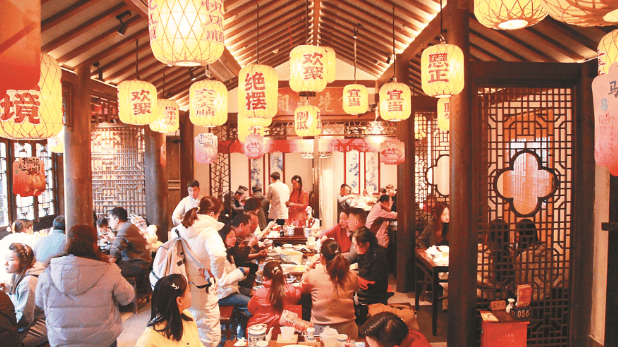
旅游教育是热点、品质化个性化成主流
Xin Hua Ri Bao· 2026-01-04 23:06
Core Viewpoint - The consumption market in Jiangsu is undergoing a profound transformation towards high quality, intelligence, and sustainability, driven by the "Su New Consumption" initiatives and improved livelihood policies, with expectations for 2026 highlighting the release of service consumption potential, urban-rural market synergy, and a shift from material satisfaction to spiritual enjoyment [1][2][3][4][5][6] Group 1: Consumption Trends - The survey indicates that tourism is expected to see a nearly 40% increase, leading the consumption growth, followed by education, health, and wellness, with service consumption becoming the main driver of growth [2][3] - In the education sector, 46% of respondents plan to increase investment in quality education, with rural areas showing a higher intention at 51.6%, reflecting a collaborative improvement in urban and rural education consumption concepts [2] - The health consumption trend is shifting towards "proactive health," with expectations for sports and wellness consumption ranking third and fourth, respectively, and a notable willingness to pay more for traditional health practices [3] Group 2: Demographic Insights - Young consumers show a preference for smart wearables and image management, while middle-aged consumers are willing to pay a premium for high-end nutritional products and traditional Chinese medicine [3] - Female participation in educational spending is significantly higher than male, with a 12.9 percentage point difference in 2025, indicating a growing awareness of self-improvement under gender equality [2] Group 3: Emerging Consumption Areas - The cultural and entertainment consumption sector is vibrant, with Jiangsu being the second-largest movie ticket market in China, and a significant percentage of respondents willing to travel for sports events [4] - The pet economy is evolving from functional care to emotional companionship, with 30.8% of pet owners planning to increase spending, highlighting a shift in consumer priorities [4] Group 4: Rural Consumption Dynamics - The consumption of health, wellness, and domestic services is increasingly penetrating rural areas, supported by policies promoting county-level commercial systems and comprehensive rural e-commerce [5] - The willingness of rural residents to consume is steadily increasing, reflecting a positive trend in the "rural revitalization" strategy [5] Group 5: Future Outlook - The Jiangsu consumption market is expected to evolve towards greater vitality, creativity, and sustainability, fueled by the widespread application of new technologies and continuous policy support [6]
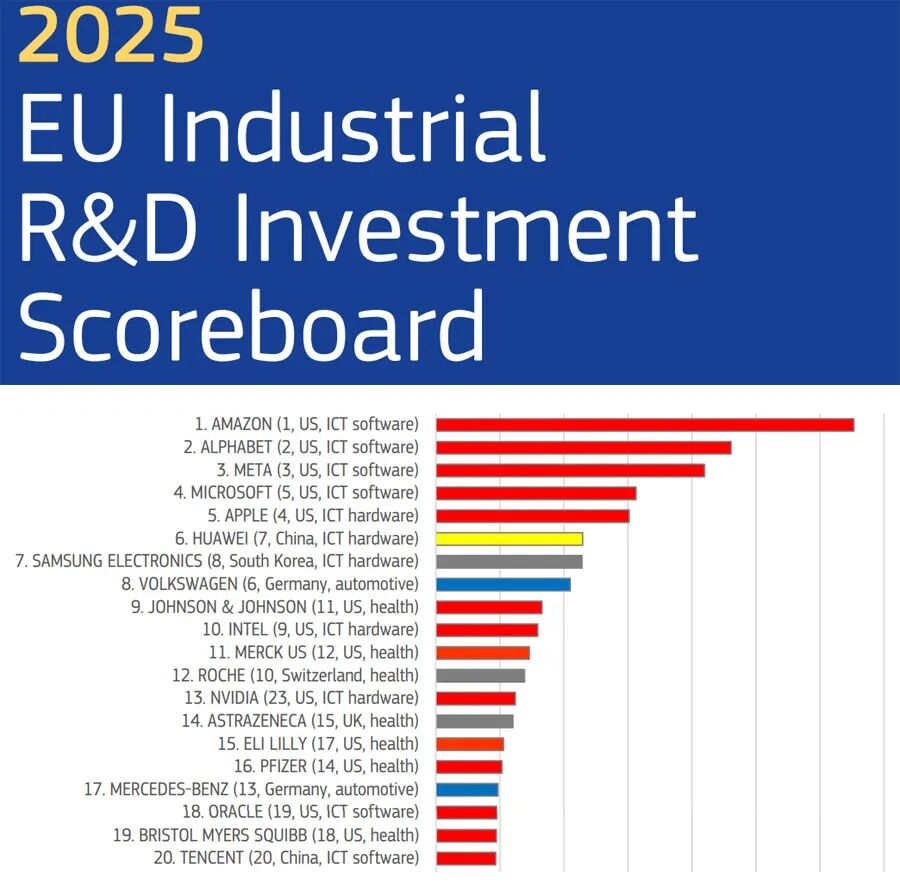
欧盟公布 2024 年全球研发投入百强企业:亚马逊第一,华为成唯一进前十的中国企业
Xin Lang Cai Jing· 2026-01-04 12:25
IT之家 1 月 4 日消息,欧盟委员会于 2025 年 12 月底公布了 2025 全球研发投入百强企业榜单,追踪并比较 2024 年欧盟领先的 工业研发投资者与其全球同行的表现。自 2004 年以来,该榜单为公司、研究人员和政策制定者提供见解和数据。 作为一项新举措,2025 年排名榜首次纳入了亚马逊,其预计的研发投资使其成为全球最大的研发投资者(650 亿欧元)。 2024 年,全球研发投资增长了 6.3%(按通胀调整为 4.0%),略高于 2023 年的增长,但低于过去十年的平均增长率 7.5%。欧盟 企业名义上的研发投资仅增长了 2.9%,落后于其他地区:世界其他地区(8.1%)、美国(7.8%)、日本(7.1%)和中国 (3.9%)。美国的科技大公司,尤其是在 ICT 软件和硬件领域,推动了大部分增长。 674 家美国企业(占总研发投资的 47.1%) 525 家中国企业(16.1%) 318 家欧盟企业(16.2%) 192 家日本企业(7.8%) 291 家其他地区企业(12.9%) ICT 软件行业占全球研发投资的 24.9%,其中美国企业贡献了 77%。这种集中程度是自 20 多年前首次发 ...





中国—白俄罗斯服务贸易和投资协定正式生效
Zheng Quan Shi Bao Wang· 2025-12-31 09:24
Core Points - The "Agreement on Trade in Services and Investment between the Government of the People's Republic of China and the Government of the Republic of Belarus" will be signed on August 22, 2024, and will officially take effect on January 1, 2026 [1] - The agreement aims for high-level mutual openness in service trade and investment between China and Belarus, utilizing a positive list approach for service trade commitments [1] - Specific facilitation rules are established for seven key service sectors: telecommunications, transportation and logistics, finance, postal and express delivery, health, tourism and travel, and computing [1] - For non-service investment, a "pre-establishment national treatment plus negative list" model is adopted, along with comprehensive investment protection rules [1] - The agreement also includes provisions on temporary movement of natural persons, e-commerce, intellectual property, competition, small and medium-sized enterprises, and dispute resolution [1] - This agreement marks the first free trade agreement signed by China with a member of the Eurasian Economic Union, enhancing bilateral trade and investment cooperation potential between China and Belarus [1]
美国GDP增长4.3%!2025-2026年中国卖家如何抢占市场先机(策略+合规指南)
Sou Hu Cai Jing· 2025-12-31 03:12
Group 1: Economic Overview - The U.S. GDP growth for Q3 2025 reached 4.3%, surpassing the previous quarter's 3.8% and exceeding market expectations of 3.9%-4.0%, marking the fastest growth in two years [3][4] - The growth was driven by a 3.5% increase in consumer spending, expanded business investments, and stable trade policies, while the core PCE inflation rate rose to 2.9%, indicating some inflationary pressure [3][5] - The Federal Reserve plans to implement only one more interest rate cut in 2026, maintaining a cautious monetary policy stance to balance economic growth and inflation control [5] Group 2: Impact on Chinese Sellers - Strong consumer spending growth in the U.S. presents significant opportunities for Chinese cross-border sellers, particularly in categories like electronics, home decor, and leisure products [6][8] - Increased business investments in the U.S. indicate a rising demand for industrial equipment and digital solutions, creating a favorable environment for Chinese B2B sellers [6] - The stability in U.S. trade policies reduces risks associated with tariffs on Chinese goods, allowing for better long-term inventory planning and pricing strategies [6][8] Group 3: Strategies for Chinese Sellers - Chinese sellers should optimize product positioning and market strategies to align with U.S. consumer trends, focusing on high-demand categories [7][8] - Enhancing supply chain resilience and logistics capabilities is crucial, especially in light of ongoing global supply chain challenges [7][8] - Establishing a local entity in the U.S. can improve brand credibility and operational efficiency, with services like those offered by lngStart facilitating this process [9][10]
上海发文扩大服务消费:推动文博场馆延时开放,培育国际美食集聚区
Sou Hu Cai Jing· 2025-12-29 11:27
Core Viewpoint - Shanghai government has announced measures to enhance service consumption, focusing on high-quality supply, brand innovation, integrated consumption scenarios, and an optimized environment to stimulate growth in the service sector [1]. Group 1: Enhancing High-Quality Service Consumption Supply - The initiative aims to elevate cultural and tourism service levels by extending operating hours for museums and tourist attractions, encouraging innovative exhibition methods, and supporting the creation of high-quality cultural products [1][2]. - The sports service market will be invigorated through the development of event economies and the promotion of the "Shanghai Sports" brand, alongside enhancing public sports facilities [2]. - The education sector will see improved access for non-academic training institutions, with streamlined approval processes and the introduction of diverse learning products for the elderly [2]. - Health consumption will be internationalized, promoting specialized medical services and encouraging collaboration between medical institutions and insurance companies [2]. Group 2: Brand Innovation to Stimulate New Service Consumption Dynamics - There will be increased efforts in brand cultivation, including the establishment of mechanisms to discover new service brands and support for industry organizations in brand development [5]. - A robust standard support system will be developed for various service sectors, ensuring quality and service norms are met [6]. - The foundation for brand development will be strengthened through enhanced capabilities of industry organizations and the establishment of a professional talent pool [6]. Group 3: Creating Integrated Consumption Scenarios - The initiative promotes the creation of cross-sector integrated service consumption scenarios, such as "tourism+", "sports+", and "health+", encouraging collaboration among various service providers [7]. - Support for the "IP+" model will be provided to leverage cultural IPs for driving consumption, particularly in entertainment and digital sectors [7]. - The application of digital technologies like AR and VR will be encouraged to create immersive and sustainable service consumption experiences [7]. Group 4: Optimizing Environment to Stimulate New Service Consumption Growth - A service consumption credit system will be established, promoting credit evaluation and public disclosure of credit ratings for businesses [9]. - Financial institutions will be encouraged to enhance their customer evaluation and risk management systems, supported by third-party credit service providers [9].
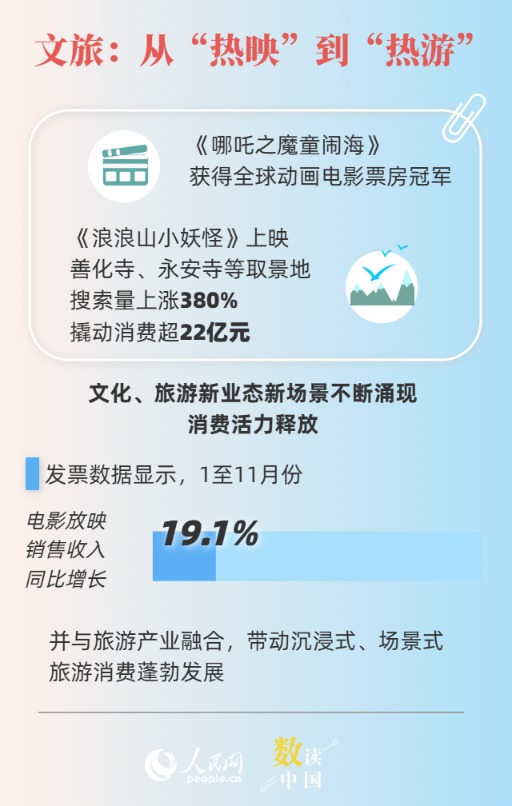
数读2025经济答卷 服务消费“火出圈” 你体验过哪些?
Ren Min Wang· 2025-12-29 06:15
Group 1: Service Consumption - The report highlights the strong growth in service consumption across various sectors such as culture, tourism, dining, sports, health, and elderly care, driven by government policies and new consumption models [1] - From January to November, the total revenue from the dining sector reached 52,245 billion yuan, reflecting a year-on-year increase of 3.2% [2] - In November alone, dining revenue was 6,057 billion yuan, indicating a robust performance in the sector [2] Group 2: Sports Sector - The sports sector has seen a significant increase in engagement, with the 2025 season of the Chinese Super League achieving record attendance [5] - The rise in local sports events has created a multiplier effect on consumption, with sports exhibition services and retail of sports goods growing by 29.7% and 6.6% respectively from January to November [5] Group 3: Health Sector - The health sector is experiencing a shift towards innovative products, with smart assistive devices gaining popularity [7] - From January to November, retail sales of health auxiliary treatment devices and health consulting services increased by 14.1% and 11.9% respectively [7] Group 4: Elderly Care Sector - The demand for elderly care services is diversifying, driven by the increasing consumption needs of the elderly population [10] - From January to November, spending on elderly care, social assistance, and nursing home services grew by 33.6%, 9.6%, and 14.6% respectively [10] - The popularity of travel services for the elderly is also notable, with 972 tourist trains launched in the first half of the year, marking a 23.2% increase year-on-year [12]