宠物食品

Search documents
路斯股份20260205
2026-02-10 03:24
Summary of the Conference Call for Lusi Co., Ltd. Company Overview - **Company**: Lusi Co., Ltd. - **Industry**: Pet food and related products Key Financial Metrics - **Total Revenue**: Approximately 620 million CNY for the first three quarters, a year-on-year increase of 7.6% [2][3] - **Net Profit**: 46.78 million CNY, a year-on-year decrease of 21%, primarily due to the appreciation of the RMB [2][3] - **Overseas Revenue**: 380 million CNY, a year-on-year increase of 7.1% [2] - **Domestic Revenue**: 230 million CNY, a year-on-year increase of 9.2% [2] Product Performance - **Meat Jerky Products**: Slight decline in revenue [2] - **Staple Foods**: Revenue increased by 30% [2] - **Canned Products**: Revenue increased by 44% [2] - **Biscuits with Bones**: Revenue increased by 36% [2] Market Insights - **Russia**: Market growth exceeded 20% [2][5] - **USA**: Strong performance, benefiting from the operation of the Cambodian factory [5] - **Europe**: Market decline due to a challenging consumer environment and increased competition [2][5] - **Southeast Asia**: Successful expansion in staple food products, though the base is small [2][5] Future Outlook - **2026 Expectations**: - Stable consumption in the USA but with slowing growth [3][5] - Continued growth in the Russian market [3][5] - Focus on emerging markets in Southeast Asia and Latin America to offset declines in Europe [2][5] Operational Efficiency - **Cambodia Factory**: - Phase I utilization rate exceeds 50% [4][7] - Phase II expected to commence production in Q4 2026 or Q1 2027 [4][7] Supply Chain and Cost Management - **OEM Business**: Lower gross margins in Southeast Asia and the USA due to raw material costs and tariffs [6] - **Cost Optimization**: Plans to source raw materials from Brazil and Bangladesh to reduce costs and improve margins [6] Brand Strategy - **Dual Brand Strategy**: - Lusi and Miaoguan brands targeting different consumer segments [4][9] - Focus on enhancing the positioning of the Lusi brand while catering to price-sensitive consumers with Miaoguan [9] - **Future Goals**: Increase gross margin for staple foods from 20%-22% to 25% [9] Online Sales Growth - **E-commerce Growth**: Online channels grew approximately 30%-40% in the first three quarters, primarily through traditional e-commerce platforms [4][13] - **Market Share**: Tmall accounts for about 40% of online sales [13] Product Development - **New Product Focus**: Development of high-value functional products such as gastrointestinal regulation and joint health [11][12] - **High-End Brand Strategy**: Plans to enhance the Lusi brand before launching high-end products [12] M&A Considerations - **Acquisition Strategy**: Considering acquisitions of other pet food brands and partnerships within the industry [15] Competitive Landscape - **Market Dynamics**: Intense competition in the domestic pet food market with many emerging brands building their own factories [16] - **Export Focus**: Maintaining supply chain advantages while expanding into diverse international markets [16] Conclusion - **Growth Potential**: With improved operational efficiency and a strategic focus on emerging markets, Lusi Co., Ltd. is positioned for continued growth despite challenges in certain regions [17]
宠物食品行业2026年展望
2026-02-10 03:24
Summary of Pet Food Industry Conference Call Industry Overview - The pet food market is experiencing sluggish overall growth, with leading OEM companies facing performance pressures due to a slowdown in pet consumption in China and major brands building their own supply chains, resulting in reduced OEM orders. The number of new brands entering the market is also declining [1][3][5]. - The concentration of domestic pet food brands is increasing, with the CR5 market share surpassing 30% and CR10 approaching 50%. This high concentration is raising the barriers for new brands entering the market, leading to diminishing opportunities [1][4][5]. Market Dynamics - Online channels such as Taotian, JD.com, and Pinduoduo dominate the market, accounting for approximately 70% of sales. In contrast, traditional offline channels are seeing a decline in sales, with their share dropping below 7% [1][6]. - Supermarkets and convenience stores are experiencing faster growth, although their absolute sales figures remain low. For example, the supermarket sector grew by about 5% compared to 2024 [1][6]. - Douyin (TikTok) as a sales channel has a dual nature; brands with strong content can acquire customers at a low cost, but traditional omnichannel brands struggle to achieve profitability on this platform [1][7]. Future Outlook - The pet food industry is expected to face destocking, defoaming, and a cooling off in 2026, leading to intense competition. Small enterprises will face significant challenges, while large channels like department stores and supermarkets are expected to grow [1][8]. - The industry is likely to see increased consolidation and mergers, particularly among supply chain companies with revenues of 200-500 million and brand companies with revenues of 100-300 million. New opportunities are anticipated in the medical field and functional products, such as prescription food for senior dogs [1][9]. Growth Drivers - The primary growth driver for the pet food market over the next three to five years will be volume growth, with an expected annual growth rate of 10%-15%. However, due to intense price competition, overall consumption growth is not expected to exceed 10% [2][16]. Competitive Landscape - The competition among high-end cat food brands during the 2025 Double Eleven shopping festival is expected to be fierce, with no significant decline in advertising spending anticipated in 2026 [12][13]. - Domestic brands have a competitive advantage in the prescription food sector, with the potential for both volume and price growth as new medical needs arise [17]. International Expansion - Chinese pet food brands face challenges in international markets, particularly in Southeast Asia, which has significant potential due to high pet ownership rates. However, they must overcome local market policies and competition from established Western brands [10][12][11]. E-commerce and Retail Trends - Alibaba's platforms, including Taobao, remain the most critical online channels for businesses. The application of AR systems to enhance customer service and operational efficiency is also seen as a key growth strategy [18]. - The instant retail sector is rapidly developing, with Meituan and other players capturing significant market shares. The scale of instant retail is expected to reach 4-4.5 billion yuan, with a year-on-year growth of 30%-40% [19][20]. Conclusion - The pet food industry is at a critical juncture, with increasing concentration, evolving consumer preferences, and the need for brands to adapt to a competitive landscape. Companies must focus on cost efficiency and explore new market opportunities to sustain growth in a challenging environment [1][8][9].
未知机构:申万农业行业景气依旧迎接科学养宠时代2025年宠物食品行业回顾及202-20260210
未知机构· 2026-02-10 01:55
Summary of Pet Food Industry Conference Call Industry Overview - The pet food industry is experiencing sustained growth, driven by an increase in new pet owners and resilient long-term customer spending patterns. The primary demographic for pet ownership in China is individuals aged 20-35, with a projected increase in new pet owners supported by a steady rise in the number of graduates from 2025 to 2038 [1][2] Long-term Trends - The number of new pet owners is expected to remain strong over the next 15-20 years, contributing to industry expansion [1] - The pet food sector is undergoing a consumption upgrade, with significant growth in the mid-to-high-end price segments for cat and dog food expected between 2024 and 2025 [1] Mid-term Developments - Product innovation and the upgrading of raw materials are key drivers of consumption upgrades in the pet food industry [2] - The trend towards scientific pet care is emerging, with consumers increasingly aware of specialized pet food needs, which will further support consumption upgrades [2] Short-term Insights - Despite overall consumer pressure, the pet food industry continues to show strong growth resilience, with projected GMV for online sales on platforms like Tmall, JD, and Douyin reaching 30.71 billion yuan in 2025, reflecting a year-on-year increase of 10.2% [2] Market Concentration - The industry is witnessing an acceleration in market concentration, with a clear trend towards the dominance of leading brands [3] - Online market concentration rates for pet food in China are increasing, with CR5, CR10, and CR20 reaching 25.3%, 38.3%, and 51.9% respectively in 2025, marking increases of 3.4 percentage points, 5.0 percentage points, and 3.5 percentage points year-on-year [4] Competitive Landscape - The "two super, many strong" market structure is re-emerging, with leading brands like Maifudi and Royal Canin maintaining their positions at the top for eight consecutive years from 2018 to 2025 [4] - The peak cycle for strong domestic brands is approximately 3-4 years, indicating a dynamic competitive environment [4] Investment Recommendations - The pet food industry is expected to see continued brand concentration and a trend towards higher-end product structures [5] - Leading companies benefit from comprehensive brand and product portfolios, achieving growth rates that exceed the industry average while maintaining upward profitability [6] - Recommended companies for investment include Guibao Pet, Zhongchong Co., and Petty Co. [7] Future Trends - The trend of consumption upgrades is expected to persist [8] - Market share for leading foreign brands is likely to continue increasing [8] - The industry is entering a phase of micro-innovation, with rising brand awareness among consumers [8] - Functional and prescription pet food may become new trends in the industry [8] - Industry consolidation is increasing, with smaller brands seeking pathways for survival [8]
温氏股份挤入宠物食品赛道
Bei Jing Shang Bao· 2026-02-09 17:07
Core Viewpoint - Company Wens Foodstuff Group is entering the pet food market by acquiring a stake in Qingdao Shuang'an Biotechnology Co., aiming to leverage synergies and enhance sustainable development capabilities amid declining profits in its main business [1][2]. Group 1: Investment Details - Wens Investment, a wholly-owned subsidiary of Wens Foodstuff Group, plans to invest up to 147 million yuan in Qingdao Shuang'an, acquiring 14.8684 million yuan of registered capital for 44.3854 million yuan and subscribing to an additional 34.4579 million yuan of registered capital for 103 million yuan [1]. - Post-transaction, Wens Investment will hold 48.18% of Qingdao Shuang'an, becoming its largest shareholder [1]. Group 2: Market Context - The pet food market in China is experiencing significant growth, with the urban pet consumption market surpassing 312.6 billion yuan in 2025, a 4.1% increase year-on-year, and the pet food market reaching 167.9 billion yuan, growing by 5.9% [2]. - The competitive landscape includes major foreign players like Mars and Nestlé Purina, as well as domestic brands such as Zhongchong Co., Guai Bao Pet, and Peidi Co., all vying for market share [2]. Group 3: Industry Trends - Major meat companies are recognizing opportunities in the pet food sector, with several, including Shengnong Development and Deli Foods, establishing joint ventures and production projects for pet food [3]. - Experts highlight that Wens Foodstuff Group's advantage lies in its upstream resources and established supply chain, allowing for cost control and quality assurance in pet food production [3].

农牧巨头切入宠物赛道!温氏拟1.47亿元收购青岛双安股权
Nan Fang Du Shi Bao· 2026-02-09 13:08
Core Viewpoint - The investment by Wens Foodstuff Group in Qingdao Shuang'an Bio-Tech Co., Ltd. aims to strengthen its core business while exploring strategic opportunities in the pet food sector, enhancing sustainable development and risk resilience [1][3]. Investment Details - Wens Investment plans to invest no more than 147 million yuan in Qingdao Shuang'an, acquiring approximately 22.19% of its equity and subscribing to an additional capital increase of 103 million yuan [4]. - After the transaction, Wens Investment will hold 48.18% of Qingdao Shuang'an's equity, making it the largest shareholder [4][5]. Company Background - Qingdao Shuang'an, established in 2010, operates in the pet food industry, including the development and production of pet food and health products, with brands like Black Nose and Cat Doctor [5]. - The company is projected to achieve revenues of 407 million yuan and a net profit of 12.16 million yuan by 2025, with total assets of 506 million yuan and net assets of 144 million yuan [6]. Market Context - The pet consumption market in China is expected to grow significantly, reaching 405 billion yuan by 2028, with pet food accounting for 53.7% of the market share [7]. - The competitive landscape includes major players like Guai Bao Pet and Zhong Chong Co., with significant revenue figures, highlighting the challenges faced by Qingdao Shuang'an [9]. Strategic Implications - The investment is seen as a strategic move for Wens Foodstuff Group to diversify and stabilize its business amid declining profits, with a projected net profit drop of 40.73%-46.12% in 2025 [9][10]. - By acquiring Qingdao Shuang'an, Wens aims to leverage synergies in cost reduction, product upgrades, and channel sharing, potentially enhancing future profit growth [10].

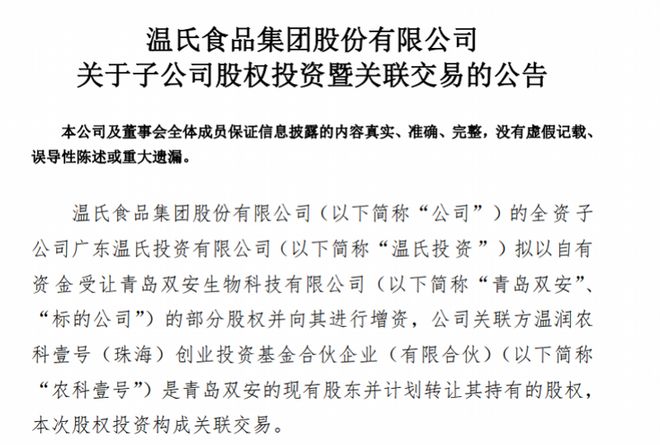
佩蒂股份:新西兰主粮工厂目前正处于商业化运营的初期关键阶段
Zheng Quan Ri Bao· 2026-02-09 12:37
Core Viewpoint - Petty Co. is in the early critical stage of commercial operation for its New Zealand staple food factory, focusing on brand building and contract manufacturing to enhance capacity utilization [2] Group 1 - The company is implementing a dual strategy of "factory brand building" and "contract manufacturing" to drive growth [2] - Significant growth in capacity utilization is expected by 2026 based on current business expansion progress [2]

拟投资不超过1.47亿元,温氏股份杀入宠物食品赛道
Bei Jing Shang Bao· 2026-02-09 12:05
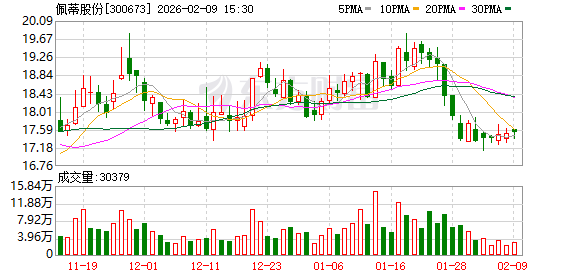
温氏股份加入宠物食品混战。近日,温氏股份发布公告,公司全资子公司广东温氏投资有限公司(以下简称"温氏投资")拟受让青岛双安生物科技有限公司 (以下简称"青岛双安")部分股权并向其进行增资,进而切入宠物食品这一细分赛道。 公告显示,此次交易,温氏投资拟投资不超过1.47亿元。其中,温氏投资拟受让温润农科壹号(珠海)创业投资基金合伙企业(有限合伙)等4名交易对手 持有的青岛双安合计1486.84万元的注册资本,交易对价为4438.54万元。同时,温氏投资拟以1.03亿元认购青岛双安新增注册资本3445.79万元。交易完成 后,温氏投资将持有青岛双安48.18%的股权,成为其第一大股东。 公开信息显示,青岛双安是一家从事宠物食品业务的公司,成立于2010年,业务涉及宠物食品、宠物保健品研发生产及供应链服务和销售渠道运营等,打造 了黑鼻头、猫博士等自有品牌。2025年,青岛双安实现营收4.07亿元,净利润为1216.6万元。 对于此次投资,温氏股份称,旨在继续巩固现有主业优势的基础上,积极探索并布局具备协同效应及战略价值的优质细分赛道,提升公司可持续发展能力与 抗风险能力。这一选择或与其主业承压有关,业绩预告显示,由 ...

佩蒂股份:公司当前生产经营一切正常
Zheng Quan Ri Bao· 2026-02-09 11:06
Core Viewpoint - Petty Co. reported that its current production and operations are normal, with all tasks progressing according to the established business plan [2] Group 1: Overseas Market Strategy - The company is effectively reducing external disturbances and ensuring steady business growth by continuously launching new products, expanding new customers and markets, and optimizing production capacity [2] Group 2: Domestic Market Focus - In the domestic market, the company is focusing on its own brand, aiming to develop high-quality and differentiated staple food products as the core growth engine [2] Group 3: Future Reporting - The company will disclose specific operational data for the first quarter of 2026 in accordance with relevant regulations on April 2026, and investors are encouraged to pay attention to subsequent announcements [2]
宠物食品行业系列深度报告之八:行业景气依旧,迎接科学养宠时代
Shenwan Hongyuan Securities· 2026-02-09 09:43
Investment Rating - The report maintains a positive outlook on the pet food industry, highlighting the continued growth and resilience of leading brands in the market [3][5]. Core Insights - The pet food industry is experiencing a consumption upgrade driven by product innovation and changing consumer demands, with a notable shift towards high-end and functional pet food products [3][5]. - The market is witnessing a significant concentration of leading brands, with top players expanding their market share amidst increasing competition [5][3]. - The aging pet population in China is expected to further drive demand for specialized and high-quality pet food products [5][3]. Long-term Trends - The report indicates that the number of new pet owners is expected to grow, supported by a stable increase in the population of young adults aged 20-35, who are the primary pet owners [4][12]. - The pet population in urban areas is projected to continue increasing, with dog and cat numbers reaching 53.43 million and 72.89 million respectively by 2025, reflecting a year-on-year growth of 1.6% and 1.9% [12][4]. Mid-term Trends - Product innovation is leading to a consumption upgrade, with mid to high-end price segments (60-100 RMB/kg) showing significant growth rates compared to lower price segments [3][28]. - The report notes that the demand for specialized pet food, including functional and prescription diets, is on the rise as pet owners become more aware of their pets' nutritional needs [5][45]. Short-term Trends - The pet food industry is expected to maintain strong growth, with online sales projected to reach 30.71 billion RMB in 2025, reflecting a year-on-year increase of 10.2% [5][3]. - The concentration of market share among top brands is increasing, with the top five brands accounting for 25.3% of the market, indicating a trend towards fewer but stronger players in the industry [5][3]. Future Outlook - The report anticipates that the trend towards consumption upgrades will continue, with high-end and functional pet food products leading the market [5][3]. - The increasing recognition of brand quality and the aging pet population are expected to enhance the market share of foreign brands, particularly in the prescription food segment [5][3]. - The report highlights that product innovation will be crucial for companies to differentiate themselves in a competitive market, with functional and prescription diets likely to become the next growth drivers [5][3].
农林牧渔板块2025年年报业绩前瞻:畜禽景气分化,食用菌周期反转,宠食龙头境内高增延续
Shenwan Hongyuan Securities· 2026-02-09 09:43
Investment Rating - The report maintains an "Overweight" rating for the agricultural, forestry, animal husbandry, and fishery sector, indicating a positive outlook for the industry compared to the overall market performance [1][4]. Core Insights - The total net profit for the tracked companies in the agricultural, forestry, animal husbandry, and fishery sector is projected to be CNY 30.949 billion for 2025, reflecting a year-on-year decrease of 20%. The top three sub-sectors by profit growth are animal health (+76%), planting industry (+54%), and pet food (+3%) [3][4]. - The report highlights significant performance disparities among different sectors, with the animal husbandry sector facing challenges due to oversupply and declining prices, particularly in pig farming, where the average price of pigs dropped by 29.9% year-on-year [3][5]. - The pet food sector shows resilience in domestic markets despite a slowdown in overseas growth, with a projected online sales growth of 10.2% in 2025 [3][4]. Summary by Relevant Sections Animal Husbandry - The pig farming sector is expected to see a net profit of CNY 20.908 billion in 2025, down 26% year-on-year, with significant losses reported in Q4 [5][8]. - The chicken farming sector remains profitable, with white chicken prices stable and yellow chicken prices showing a 9.5% increase year-on-year [3][4]. Pet Food - Domestic pet food sales are projected to grow, with major companies like Guobao Pet and Zhongchong Co. expected to report net profits of CNY 0.678 billion and CNY 0.433 billion, respectively [3][4]. Planting Industry - The report notes a recovery in edible mushroom prices, with a projected net profit increase of 154% for Zhongxing Junye in 2025 [3][4]. - Blueberry prices have slightly decreased, but companies are expected to maintain profitability through volume sales [3][4]. Animal Health - The animal health sector is projected to see a net profit increase of 76%, driven by new product launches and increased demand for veterinary vaccines [3][4]. Seed Industry - The seed industry is facing challenges with low grain prices, leading to a mixed performance among companies, with Dabeinong expected to report a significant loss [3][4].