
家电

Search documents
白电排产数据点评:内需偏弱、出口分化,三大白电排产小幅收缩
Orient Securities· 2026-03-29 04:44
Investment Rating - The report maintains a "Positive" outlook for the home appliance industry [4] Core Insights - Domestic demand is weak, and export performance is mixed, leading to a slight contraction in the production of the three major white goods [7] - The report highlights that the production of air conditioners, refrigerators, and washing machines has decreased by 3.6% compared to the same period last year, with total production in April 2026 amounting to 37.64 million units [7] - The report suggests that the short-term production of domestic sales will remain low and fluctuate, while the export side may see a recovery in certain regions once geopolitical factors diminish [2][7] Summary by Sections Air Conditioners - Total production in April 2026 was 21.32 million units, down 4.9% year-on-year, with domestic production at 12.70 million units, a slight decrease of 0.5% [7] - Export production fell by 12.2% to 8.62 million units, influenced by high raw material costs and reduced dealer inventory due to unclear end-user demand [7] Refrigerators - Total production in April 2026 was 8.21 million units, a minor decline of 0.1% year-on-year, with domestic production at 3.41 million units, down 8.2% [7] - Export production increased by 5.1% to 4.80 million units, driven by low inventory levels in overseas channels and a return of orders to China due to supply chain issues in Southeast Asia [7] Washing Machines - Total production in April 2026 was 8.11 million units, down 3.7% year-on-year, with domestic production at 4.10 million units, a decrease of 2.4% [7] - Export production also fell by 3.7% to 4.01 million units, facing challenges from tariff changes and increased logistics costs due to regional conflicts [7]



大手笔回购!A股、港股公司,密集行动!
证券时报· 2026-03-29 04:13
Core Viewpoint - The recent increase in share buybacks in both the Hong Kong and A-share markets is seen as a positive trend that stabilizes the market and rewards investors [2][12]. Group 1: Hong Kong Market Buybacks - The number of companies conducting share buybacks in the Hong Kong market has significantly increased, with 50 companies reported to have engaged in buybacks this week, compared to fewer than 30 in the previous three weeks [4]. - The total number of shares repurchased in the Hong Kong market has exceeded 150 million this week, while the previous six weeks saw weekly totals below 100 million [4]. - The total amount spent on buybacks in the Hong Kong market has surpassed 4 billion HKD this week, which is several times higher than the amounts in previous weeks [4]. - Notable companies like Pop Mart and Kuaishou initiated buybacks after significant stock price declines following their earnings reports, with Pop Mart repurchasing 3.94 million shares for nearly 600 million HKD on March 26, marking its highest single-day buyback amount [5]. - Companies engaging in buybacks generally reported revenue growth, with Pop Mart's revenue increasing by 184.7% to 37.12 billion CNY and Kuaishou's revenue growing by 12.5% to 142.8 billion CNY in 2025 [5]. Group 2: A-share Market Buybacks - The A-share market has also seen a rise in share buyback activities, with a noticeable increase in the number of companies announcing buyback plans this week [7]. - For instance, Haier Smart Home announced a buyback plan with a total fund of up to 6 billion CNY and executed its first buyback of 7.65 million shares at prices between 21.55 and 22.40 CNY per share, totaling approximately 168 million CNY [8]. Group 3: Expert Opinions on Buybacks - Experts view share buybacks positively, suggesting they enhance market stability and reflect companies' confidence in their value [10][12]. - It is noted that substantial buybacks are more indicative of a company's belief that its stock is undervalued, while smaller buybacks may serve more as a symbolic gesture [11].


陆家嘴财经早餐2026年3月29日星期日
Wind万得· 2026-03-28 22:24
Group 1 - The Houthis in Yemen have launched military actions against Israel, indicating a new front in the Iran conflict and exposing the Bab-el-Mandeb Strait to risks [4] - Following military actions against Venezuela and Iran, US President Trump has threatened Cuba, stating it is next on the list [4] - Energy prices are rising, leading to inflation expectations and forcing central banks to reconsider interest rate cuts, negatively impacting stocks, bonds, and gold [4] Group 2 - The State Council's Food Safety Office has held discussions with local government officials in Chengdu and Chongqing regarding food safety issues exposed during the CCTV "3.15" gala [5] - The Ministry of Commerce announced a temporary implementation arrangement for the WTO e-commerce agreement, aiming to promote inclusive and sustainable digital trade development [6] - China's central fiscal childcare subsidies for 31 provinces have been disclosed, with significant funding allocated to several provinces [7] Group 3 - Major Chinese banks, including ICBC and CCB, reported steady growth in asset quality and profitability, with a combined net profit exceeding 900 billion yuan [8] - A subsidiary of Xilinmen, a leading mattress company, is facing internal issues with illegal fund misappropriation amounting to 100 million yuan [8] - Sanhua Intelligent Controls received attention from 284 institutions, indicating strong interest in its prospects in the global electric vehicle market [8] Group 4 - China's innovative drug transactions exceeded $60 billion in Q1, nearing half of the expected total for 2026 [9] - A significant breakthrough in nuclear medicine has been achieved with the production of medical-grade alpha isotopes in China [9] - Shanghai aims to become a leading city for developers, showcasing advancements in AI and smart technology [9] Group 5 - The global shipping industry has faced increased fuel costs due to the ongoing conflict in the Middle East, with additional costs exceeding 4.6 billion euros since February [13] - Russia plans to ban gasoline exports starting April 1 to stabilize domestic prices amid market turmoil [13] - The new Noida International Airport in India has officially opened, with an investment of approximately $1.18 billion [13] Group 6 - Thailand is negotiating with Iran to ensure safe passage for oil tankers through the Strait of Hormuz amid rising domestic oil prices [14] - The Philippines government has approved a price cap on imported rice to mitigate rising food costs due to the conflict [14] - 7-Eleven Japan is launching a new service allowing customers to order freshly cooked food via smartphone [15]

TCL和创维同日交出年报答卷:海外市场救了电视生意
经济观察报· 2026-03-28 13:41
Core Viewpoint - The global television market is experiencing intense competition, and leveraging Japanese brand recognition in Europe and the U.S. alongside China's LCD panel supply chain and manufacturing cost presents a cost-effective expansion strategy into the high-end market [1]. Group 1: Company Developments - In January 2026, TCL Electronics and Sony signed a memorandum of understanding to establish a joint venture for Sony's home entertainment business, with TCL holding 51% and Sony 49%, set to begin operations in April 2027 [2]. - At the same time, Skyworth Group announced it would take over Panasonic's television business in North America and Europe starting April 2026, focusing on high-end OLED, Mini LED, and picture quality algorithms [2]. - TCL Electronics reported a revenue of HKD 114.58 billion for 2025, marking a 15.4% year-on-year increase, with a net profit of HKD 2.495 billion, up 41.8% [3]. Group 2: Market Performance - The Chinese television market saw a record low sales volume of 27.63 million units in 2025, with a year-on-year decline of 9.8% [7]. - Despite a decrease in domestic revenue, TCL and Skyworth maintained their market shares, with TCL's retail market share rising to 24.2%, an increase of 1.1 percentage points [8]. - Internationally, TCL's television revenue reached HKD 47.50 billion, a 15.7% increase, while Skyworth's overseas revenue grew by 21.8% to CNY 9.885 billion [10]. Group 3: Product Trends - The average selling price of TCL's television products in North America increased by over 20% in 2025, driven by a shift towards larger and higher-end models, with 30.5% of shipments being 65 inches or larger [11]. - The global penetration rate of Mini LED televisions rose from 3.1% to 6.1%, with TCL's Mini LED television shipments increasing by 118%, capturing a 31.1% market share [11]. Group 4: Financial Insights - TCL Technology reported a revenue of CNY 184.06 billion for 2025, an 11.7% increase, with a net profit of CNY 4.52 billion, up 188.8% [4]. - However, TCL's subsidiary, TCL Zhonghuan, reported a loss of CNY 9.264 billion, contributing to overall financial pressures on the parent company [20][24]. - Skyworth's net profit fell by 37.3% to CNY 356 million, with the decline attributed to losses in non-core business segments [26]. Group 5: Strategic Directions - Both TCL and Skyworth are expanding their businesses beyond televisions, with Skyworth's renewable energy segment achieving revenue of CNY 23.685 billion, surpassing its television revenue [19]. - TCL's renewable energy business also saw significant growth, with a revenue increase of 63.6% to HKD 21.063 billion, marking it as the fastest-growing segment for the company [19]. - Skyworth is focusing on international expansion in the renewable energy sector, entering markets in Germany, Italy, and Thailand [27].



资金撤退后再回流,这轮A股调整拐点到了吗?【周观A股】
和讯· 2026-03-28 08:34
Market Overview - The A-share market indices experienced a significant narrowing of declines this week, indicating a shift in market sentiment from panic to recovery, with a gradual rebalancing of capital styles [2][3][7] - Despite continued net outflows of main funds, a marginal improvement trend has begun to emerge, suggesting the market is in a critical window of "weak recovery + rebalancing" [2][3] Index Performance - Major A-share indices continued their adjustment but showed a notable reduction in declines compared to the previous week, transitioning from a rapid drop phase to a weak oscillation recovery phase [3][7] - Small-cap stocks experienced a technical rebound after emotional clearance, while previously resilient growth sectors, represented by the ChiNext, turned into the leading decliners, highlighting significant style rotation [3][7] Sector Rotation - The market is dominated by a "defensive + price increase" theme, with materials, utilities, and healthcare sectors rising approximately 2.5%, reflecting a preference for assets with "resource attributes + stable cash flow" [10][3] - Conversely, sectors such as information technology, finance, and certain consumer segments faced pressure, indicating that high valuation and high beta assets are still undergoing valuation digestion [10][3] Trading Volume - A-shares exhibited a "volume contraction" characteristic this week, with weekly trading volume decreasing from 11.06 trillion yuan to 10.56 trillion yuan, indicating a continued decline in trading enthusiasm [23][25] - Daily trading amounts fell from approximately 2.45 trillion yuan at the beginning of the week to 1.86 trillion yuan by Friday, with the market turnover rate dropping from 4.98% to 3.66% [23][25] Fund Flow - Main funds exhibited a "first out, then in" pattern, with a net outflow of 795 billion yuan on Monday due to external geopolitical shocks, followed by a net inflow of 150 billion yuan on Wednesday, marking a key turning point for the week [32][36] - By Friday, main funds continued to flow in with a net inflow of 82.58 billion yuan, indicating a shift from broad withdrawal to structural positioning [32][36] Market Sentiment - The market displayed a typical "V-shaped recovery" this week, with the number of stocks hitting the daily limit down reaching 145 on Monday, but quickly rebounding with a significant number of stocks hitting the limit up in subsequent days [41][46] - Margin financing balances have shown a clear downward trend, reflecting a cautious shift in sentiment, although a slight recovery was observed in the latter part of the week [42][46] Upcoming Focus - Attention will be on policy, macro data, and external disturbances, as the upcoming quarter is a crucial window for assessing economic recovery [50][51] - The market will also face the unlocking of restricted shares for 26 companies next week, which may exert pressure on stock prices [51][53]

股价大跌!海尔智家2025年Q4业绩环比、同比双降
Shen Zhen Shang Bao· 2026-03-28 07:30
Core Viewpoint - Haier Smart Home's 2025 annual report shows a significant increase in global revenue and net profit, but concerns arise from disappointing Q4 performance, leading to a drop in stock price [2][3][4]. Financial Performance - The company reported a global revenue of 302.35 billion yuan in 2025, a year-on-year increase of 5.71% [2]. - The net profit attributable to shareholders reached 19.55 billion yuan, up 4.39% year-on-year [2]. - A total of over 8.2 billion yuan will be distributed as dividends, with a proposed cash dividend of 8.867 yuan per 10 shares [4]. Q4 Performance Concerns - Q4 revenue was 68.29 billion yuan, a quarter-on-quarter decrease of 11.95% [4]. - Net profit for Q4 was 2.18 billion yuan, down 59.17% from Q3 [4]. - Year-on-year, Q4 revenue decreased by 17.73% and net profit fell by 39.22% compared to 2024 [4]. Margin and Cost Analysis - The gross margin for 2025 was 26.7%, a decline of 1.1 percentage points from 2024 [4]. - The increase in management expense ratio to 4.6% was attributed to one-time costs for efficiency improvements in the European market and investments in emerging markets [4]. Industry Outlook - The home appliance industry is transitioning from incremental growth to a focus on quality upgrades, with key growth drivers being green energy, smart home integration, and health-oriented solutions [5].
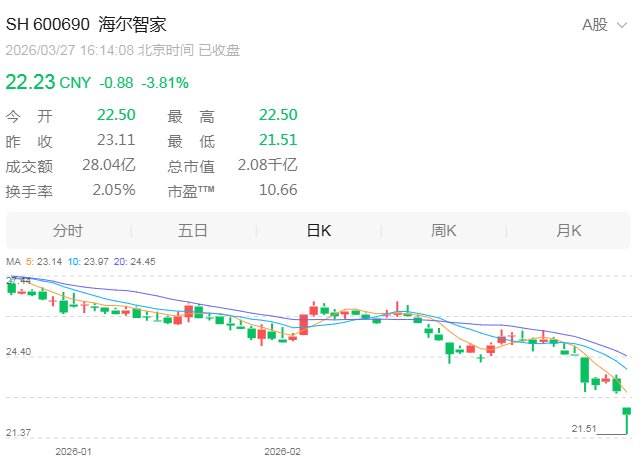
海尔智家股份有限公司关于以集中竞价交易方式首次回购A股股份的公告
Shang Hai Zheng Quan Bao· 2026-03-27 23:18
一、回购股份方案 公司于2026年3月26日召开了第十二届董事会第四次会议,审议通过了《海尔智家股份有限公司关于以 集中竞价交易方式回购A股股份的方案》,同意公司以自有资金和/或自筹资金(含股票回购专项贷款资 金等)以集中竞价交易方式回购公司A股股份,回购资金总额为不超过人民币60亿元(含)且不低于30 亿元(含),回购价格上限为35元/股,本次回购实施期限为自董事会审议通过回购股份方案之日起12 个月内,具体内容详见公司披露于上海证券交易所网站及公司网站的《海尔智家股份有限公司关于以集 中竞价交易方式回购A股股份的方案暨回购报告书》(编号:临2026-014)。 登录新浪财经APP 搜索【信披】查看更多考评等级 证券代码:600690 证券简称:海尔智家 公告编号:临2026-020 海尔智家股份有限公司 关于以集中竞价交易方式首次回购A股股份的公告 本公司董事会及全体董事保证本公告内容不存在任何虚假记载、误导性陈述或者重大遗漏,并对其内容 的真实性、准确性和完整性依法承担法律责任。 重要内容提示: ■ 海尔智家股份有限公司董事会 2026年3月27日 二、回购股份的进展情况 根据《上市公司股份回购规则》《 ...
海尔智家营收首破3000亿,盈利能力下降引发市场担忧
Guo Ji Jin Rong Bao· 2026-03-27 13:24
Core Viewpoint - Haier Smart Home reported its 2025 annual revenue exceeding 300 billion RMB for the first time, but net profit growth has slowed to single digits due to a decline in Q4 performance, rising raw material prices, and overseas tariffs [1][3] Financial Performance - The total revenue for 2025 reached 302.35 billion RMB, a year-on-year increase of 5.71% - The net profit attributable to shareholders was 19.55 billion RMB, up 4.39% year-on-year - The net profit growth rate has significantly decreased compared to previous years, with 2024 showing a 12.86% increase [1][3][4] Quarterly Breakdown - Q4 revenue was 68.29 billion RMB, a decline of 6.72% year-on-year and 11.95% quarter-on-quarter - Q4 net profit attributable to shareholders was 2.18 billion RMB, down 39.15% year-on-year and 59.17% quarter-on-quarter [3][4] Cost and Margin Analysis - The gross margin for 2025 was 26.7%, a decrease of 1.1 percentage points compared to 2024 - Rising prices of raw materials, particularly copper, and intensified domestic competition have negatively impacted profitability [4][5] Strategic Initiatives - The company plans to implement hedging strategies for raw material price fluctuations, with a contract value not exceeding 5.63 billion RMB, valid for 12 months [5] - Management expenses increased by 13.41% year-on-year, attributed to one-time costs for enhancing efficiency in the European market and investments in emerging markets [5] Dividend Policy - Haier Smart Home announced a cash dividend of 8.867 RMB per 10 shares, totaling approximately 8.25 billion RMB, representing 55% of the net profit attributable to shareholders [5][6] - The company plans to steadily increase the dividend payout ratio over the next three years, targeting at least 58% in 2026 and 60% in 2027 and 2028 [6]

华东制造业终端调研报告:需求相对平稳,预期差不大
Dong Zheng Qi Huo· 2026-03-27 09:54
1. Report Industry Investment Rating - The investment rating for rebar and hot-rolled coil is "oscillation" [4] 2. Core Viewpoints of the Report - Terminal manufacturing demand can maintain resilience and a certain degree of growth, but most industries are likely to see a slowdown in growth, especially in domestic demand. Short - term exports to the Middle East may be affected, but the overall pattern of good external demand remains unchanged, which will support future demand growth. Given the current situation of steel products, the probability of a large - scale negative feedback market is not high, and steel prices are expected to fluctuate within a relatively narrow range in the first half of the year [20] - Steel prices are affected by energy and iron ore price fluctuations, and the change in the Middle East situation in April is an important variable. In the second half of the second quarter, the sustainability of the destocking speed needs to be observed, and price correction risks should be watched out for after steel prices enter a high - valuation range [21] 3. Summaries According to Relevant Catalogs 3.1 Research Background - Since 2025, the contradiction between steel supply and demand has significantly decreased. Although the terminal demand for real estate and infrastructure has not improved, the growth and resilience of manufacturing demand have supported steel demand, especially for plates, and led to a continuous shift in the steel product structure. The market's demand expectation for 2026 is relatively vague. With the easing of the decline pressure on building material demand, the situation of manufacturing and external demand has become a more important variable. The domestic demand for automobiles and home appliances has declined to varying degrees, while exports remain strong. The research aims to understand whether manufacturing demand can continue to support the resilience of steel demand and whether there are any expected differences [7] 3.2 Main Findings in the East China Manufacturing Industry Research - Terminal demand is generally neutral, in line with the market's expectation of the manufacturing industry being neither good nor bad. Except for an appliance manufacturing enterprise and a shipbuilding enterprise, most terminal industries reported no significant growth in production and sales in 2026. Shipbuilding orders are basically booked until Q4 2029 - 2030. The demand growth of automobile and home appliance manufacturers mainly comes from overseas, while domestic demand is expected to be stable or slightly decline. The demand of machinery enterprises has slightly increased, mainly through automation substitution and overseas market expansion [1][19] - After the Spring Festival, steel orders and processing volumes were slightly better than expected. Orders were more stable this year compared to last year. Some enterprises reported a shortage of steel resources in the market, which is related to the shift of steel mills to producing special - grade steel and the competition for export quotas in Europe and the United States in the first quarter. However, demand will face pressure in the second half of the second quarter [1][19] - The space for the return of manufacturing to China is limited. Although there is some discussion about it due to geopolitical conflicts, countries like the United States and India still have strict trade policies towards Chinese products, such as the 301 Act affecting Chinese ships and trade barriers on Chinese - made photovoltaic components. Chinese manufacturing enterprises are still exploring overseas建厂 opportunities [2][19] - Terminal manufacturing still faces significant cost - profit pressure, especially for domestic sales. Most manufacturing enterprises are sensitive to cost changes. Since 2025, steel price fluctuations have been low, and downstream terminals are more concerned about the price changes of non - ferrous metals and energy - chemical bulk raw materials. Most enterprises purchase steel as needed and rarely engage in speculative inventory [2][19] - The sign of steel substituting for aluminum based on cost advantages is not obvious. Due to the "involution" in the market, enterprises still have high requirements for product lightweight and aesthetics. Although some industries have tried steel - for - aluminum substitution, there is no clear industry standard yet [2][19] 3.3 Summary and Outlook - Terminal manufacturing demand can maintain resilience and a certain degree of growth, but most industries are likely to experience a slowdown in growth. Domestic demand for automobiles and home appliances is not optimistic. In the short term, exports to the Middle East will be affected, but the overall pattern of good external demand remains unchanged and will support future demand growth [20] - There is no obvious trend - driving contradiction in the steel product fundamentals. The demand resilience and order continuity after the Spring Festival this year slightly exceeded expectations, and the destocking speed of coils after reaching the peak was normal. The probability of a large - scale negative feedback market is not high. However, limited domestic demand restricts the upward space of steel prices. Steel prices are expected to fluctuate within a relatively narrow range in the first half of the year [20] - Steel prices are affected by energy and iron ore price fluctuations, and the Middle East situation in April is an important variable. The market supply of coils is currently tight due to steel mills competing for export quotas. The sustainability of the destocking speed in the second half of the second quarter needs to be observed, and price correction risks should be watched out for after steel prices enter a high - valuation range [21] 3.4 Research Minutes 3.4.1 An elevator and home appliance steel distribution enterprise - The enterprise processes and distributes hot - rolled, cold - rolled, and galvanized sheets for the elevator and home appliance industries. The steel consumption for elevators has not increased. Home appliances mainly rely on exports for growth. This year's orders and processing volumes are better than expected. The enterprise purchases steel from steel mills and processes it for direct supply to terminals. The processing cost of cold - rolled products is about 30 yuan per ton. The enterprise is currently unable to break even in processing. The raw material procurement cycle is about one month, and the downstream payment cycle is about 45 days. Recently, terminal funds have been tight, and some customers have requested to extend the payment cycle [26][27][29] 3.4.2 A forklift enterprise - The enterprise is a leading forklift manufacturer with an annual output of 300,000 - 400,000 units. In the first quarter, steel procurement increased slightly, and the current operating rate is about 70%. The enterprise purchases about 140,000 - 150,000 tons of steel plates annually, with equal proportions of coils and medium - thick plates. The cost of raw material procurement is difficult to transfer to the finished product. The enterprise has been developing intelligent logistics and unmanned forklift projects since 2018, and sales have increased significantly in recent years [30][31][33] 3.4.3 An agricultural machinery enterprise - The enterprise produces tractors, rice transplanters, and harvesters. The annual steel consumption is about 15,000 - 16,000 tons, mainly hot - rolled and cold - rolled sheets. The demand for agricultural machinery in the first quarter is similar to that of last year, and the profit is not high. The export proportion is about 10% and is decreasing. The enterprise is currently in the production peak season, and demand will decline from May [34][35] 3.4.4 An automobile production enterprise - The enterprise has an annual production capacity of 220,000 vehicles, with an actual output of less than 100,000. The sales volume in the first quarter did not increase and decreased significantly compared to the fourth quarter of last year. The annual steel consumption is about 60,000 - 70,000 tons, mainly galvanized sheets. The enterprise purchases steel futures from steel mills and adjusts the purchase volume according to orders. In addition to steel, the enterprise also purchases non - ferrous metals, and there is also a small amount of imported steel [36][37] 3.4.5 A home appliance production enterprise - The enterprise produces refrigerators, washing machines, and freezers. The production volume in April - June is expected to increase by 20% - 30% year - on - year. The domestic demand is expected to be flat or slightly decline, and the growth mainly comes from exports. The enterprise mainly purchases pre - coated plates (PCM plates) and stainless steel. The steel cost of a refrigerator accounts for about 10% - 15%. The enterprise reserves electronic materials about three months in advance and steel about 45 days in advance [38][39] 3.4.6 An automobile parts enterprise - The enterprise mainly produces traditional automobile parts, with overseas markets accounting for 80% - 90%. The auto parts business is expected to be stable in 2026. The steel procurement accounts for about 80% of the total procurement, mainly medium - carbon carbon - structural round steel. The enterprise stocks steel for about two months and may use futures hedging or spot inventory. The price adjustment of bar steel lags behind the threaded steel on the futures market [40][42] 3.4.7 A shipbuilding enterprise - The enterprise has ten shipyards and expects to deliver 20 ships this year. The shipbuilding orders are booked until Q4 2029. The demand for special - grade steel in chemical ships is high. The enterprise purchases about 20,000 tons of stainless steel and 100,000 tons of carbon steel annually. The profit of shipyards is relatively good, with cost advantages in labor and raw materials compared to Japan and South Korea [43][44] 3.4.8 A photovoltaic enterprise - The enterprise focuses on overseas markets, mainly in Thailand and the United States. The domestic photovoltaic market is saturated, and most domestic production lines have been shut down. The overseas market has better profits, but is affected by policies such as tariffs and anti - dumping. The enterprise is concerned about raw material prices and costs, and is trying to reduce costs through technological innovation. It is expected that the domestic photovoltaic installation in 2026 may decline compared to 2025 [45][46][48]
美银证券:海尔智家(06690)加强股东回报 维持“买入”评级
智通财经网· 2026-03-27 09:25
海尔智家去年收入及除税后净利润分别同比增长5.7%及4.4%,单计第四季则分别跌6.7%及39.2%。公司 收入及利润率均低于预期。正面方面,派息比率由2024年的48%,提高至2025年的55%,并计划透过提 高派息比率和回购加强股东回报。 智通财经APP获悉,美银证券发布研报称,维持海尔智家(06690)"买入"评级,看好其在洗衣机及冰箱市 场的主导地位、空调市场份额提升,以及通过产品组合及效率改善进一步扩大利润率的潜力。该行予公 司目标价32.7港元。 ...