
AI算力

Search documents
对科技趋势保持敏锐关注深挖阿尔法机会——访宏利成长混合基金经理孙硕
Shang Hai Zheng Quan Bao· 2026-01-25 14:24
Core Insights - The AI computing sector is expected to continue its steady growth until 2026, while the AI application field is still in the technology trigger phase, exploring core technology and application scenario matching [3][9] - Investment focus will shift towards AI applications post-2026 as technology matures and commercial viability becomes a core development theme, but the demand for AI computing will continue to grow alongside application expansion [3][9] - The technology investment landscape is transitioning from a simple beta market to a more complex alpha discovery phase, with significant differentiation in the drivers of corporate earnings and valuation expansion [4][8] Investment Philosophy - The investment strategy emphasizes dynamic adjustments based on market conditions, focusing on high-growth sectors where corporate earnings can exceed expectations, even if stock prices have risen significantly [5] - The observation that high growth often corresponds with low valuations and vice versa is highlighted, suggesting a need to focus on the growth potential rather than merely matching growth with valuation [5] Risk Management - Two key signals are monitored for risk assessment: changes in industry penetration rates and significant shifts in core technology routes, which could lead to industry restructuring and potential risks for certain companies [6] Sector Performance - The A-share technology sector has shown strong performance since 2026, with a notable divergence in the drivers of stock price increases across different sub-sectors [8] - The core driver for AI computing is substantial corporate earnings growth, while sectors like robotics and commercial aerospace rely more on valuation expansion [8] AI Application Development - The AI application sector is still in the early stages, and the expectation for a significant breakthrough in 2026 should be approached with caution, as true disruptive AI applications will represent a new industrial paradigm [9] - Continuous monitoring of specific sub-scenarios is necessary to validate their commercial value as the industry evolves [9] Other Technology Investment Opportunities - Besides AI, other technology sub-sectors such as robotics, autonomous driving, and commercial aerospace are expected to experience significant growth as they reach critical technological and commercial milestones [10] - Emerging fields like quantum computing and brain-machine interfaces are still in the technology trigger phase, requiring long-term investment strategies and close monitoring for clear signals of commercial viability [10]


【华泰证券】春季行情仍有空间,建议结合基本面预判
Sou Hu Cai Jing· 2026-01-24 16:14
Group 1: Core Logic - The spring market rally is supported by three driving forces: policy, liquidity, and fundamentals [1] - The central economic work conference emphasizes "domestic demand-driven + innovation-driven" policies, with active fiscal measures and a loose monetary policy [1] - A phase of easing in China-US relations, such as the relaxation of chip export restrictions, provides a stable external environment for the market [1] Group 2: Liquidity - Domestic insurance and wealth management funds show significant "opening red" effects, with long-term funds increasing their equity allocation [1] - The overseas Federal Reserve's continued rate-cutting cycle and the appreciation of the RMB attract foreign capital back, with net inflows of northbound funds observed in Q4 [1] Group 3: Fundamentals - The manufacturing PMI has returned to the expansion zone, with PPI's year-on-year decline narrowing and expectations for corporate profit recovery strengthening [1] - The technology sector, particularly AI computing and semiconductors, benefits from the global capital expenditure cycle, while cyclical products like non-ferrous metals and chemicals benefit from improved supply-demand dynamics and price elasticity [1] Group 4: Industry Allocation Recommendations - Balanced allocation between growth and cyclical sectors, focusing on three main lines: - Technology growth line: AI computing (optical modules, servers), semiconductor equipment (accelerated domestic substitution) [4] - Cyclical recovery line: Non-ferrous metals (copper, aluminum) driven by both financial attributes and physical demand, chemicals (MDI, fertilizers) benefiting from price elasticity post-capacity clearance [4] - Chinese manufacturing advantages: Engineering machinery and new energy vehicles benefiting from overseas expansion and global energy transition [4] Group 5: Conclusion - The spring market still has room for development under the triple benefits of policy, liquidity, and fundamentals, but should focus on "fundamental predictions" to avoid blindly chasing hot spots [8] - Investors are advised to dynamically adjust positions based on their risk preferences and seize structural opportunities to share in the investment opportunities of the "14th Five-Year Plan" [8]

怡亚通:资本运作坚持‘请进来’与‘走出去’双轮驱动,聚焦国产替代与科技赛道
2 1 Shi Ji Jing Ji Bao Dao· 2026-01-23 02:40
南财智讯1月23日电,怡亚通在投资者关系活动中表示,公司资本运作主要包括两方面:'请进来'即围 绕国产替代、半导体、存储、芯片及AI算力等领域开展产业链上下游投资并购;'走出去'即推动已孵化 业务或子公司通过融资或被并购方式登陆资本市场,为股东创造投资回报。 ...

A股收评:超3500只个股上涨,三大指数集体收涨
Sou Hu Cai Jing· 2026-01-22 07:41
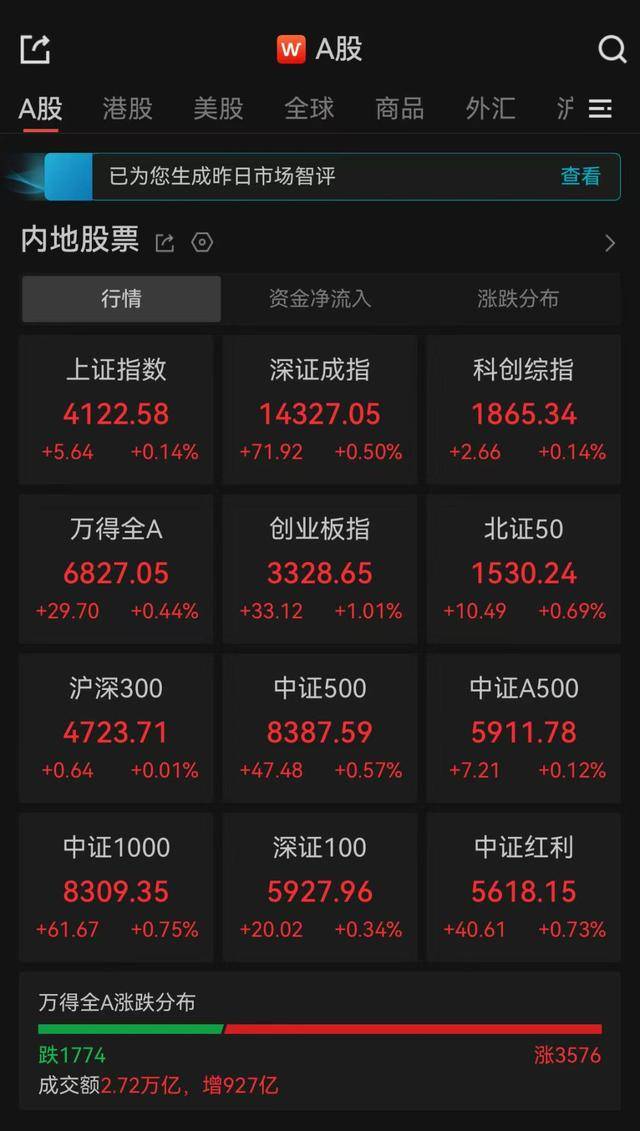
22日,A股三大指数高开,随后震荡下行,午盘一度集体翻绿,午后均有所回升。截至收盘,沪指涨 0.14%,深证成指涨0.50%,创业板指涨1.01%。全市成交额2.72万亿,超3500只个股上涨。 贵金属、保险、半导体、锂电池等板块跌幅居前,创新药概念集体下挫,爱迪药业、回盛生物大跌。 | 14 | | w A股 | | a | | --- | --- | --- | --- | --- | | A股 美股 | 港股 | 全球 商品 | 外汇 | 法 三 | | 已为您生成昨日市场智评 | | | | 查看 | | 内地股票 △ ⊙ | | | | | | 行情 | | 资金净流入 | 涨跌分布 | | | 上证指数 | | 深证成指 | 科创综指 | | | 4122.58 | | 14327.05 | 1865.34 | | | +5.64 +0.14% | | +71.92 +0.50% | +2.66 +0.14% | | | 万得全A | | 创业板指 | 北证50 | | | 6827.05 | | 3328.65 | 1530.24 | | | +29.70 +0.44% | | +33.12 + ...
慢牛下的AI算力与应用
2026-01-21 02:57
Summary of Key Points from Conference Call Records Industry Overview - The AI computing sector is currently experiencing a bottoming phase, with expectations of gradual recovery starting in February and reaching a peak in March and April, with an overall increase potentially exceeding 50% [1][2][6] - AI applications are expected to see short-term adjustments but maintain a positive long-term outlook, with a new wave of growth anticipated during the March earnings release period [1][2][6] Core Insights and Arguments - The decline in annual report forecasts should not be overly concerning, as it reflects strong industry demand rather than a lack of it. For instance, Shenghong Technology's lower forecast was attributed to raw material shortages and capacity constraints [1][4][7] - Current valuations are estimated at 15-20 times for 2026 and 7-10 times for 2027, suggesting that market dips present good buying opportunities [4][15][17] - The domestic computing industry is supported by strong supply and demand dynamics, with significant growth expected this year, particularly in cabinet-level and superpoint solutions [1][5][9] Investment Opportunities - Investors should focus on sectors where AI applications are gaining traction, such as customer service, video, and finance, which have begun to scale up [1][10][19] - Companies with technological barriers and core competitiveness, such as Alibaba and Tencent, are highlighted as potential investment targets due to their strong growth prospects [11][19] - The optical cable industry is experiencing increased demand, with China Telecom planning to procure over 78 million kilometers of new optical cables, indicating a tightening supply-demand relationship [3][22][23] Additional Important Insights - The AI computing sector is expected to see significant growth opportunities in the coming months, particularly in March, with core companies potentially doubling in value [14][18] - The light-asset model of companies like Xuchuang and Xinyi Sheng is expected to outperform heavier asset models due to their ability to increase shipment volumes even during large-scale expansions [16][17] - The optical cable market is projected to continue its upward trend in pricing due to increased demand from AI data center construction, with companies like Hengtong, Zhongtian, and Changfei being well-positioned [3][22][23] Conclusion - The overall sentiment towards the AI computing and application sectors remains optimistic, with significant growth expected in the near future. Investors are encouraged to strategically position themselves in these sectors to capitalize on upcoming opportunities.
转债事件点评:躁动行情换挡,聚焦业绩成色
GUOTAI HAITONG SECURITIES· 2026-01-20 12:33
Report Industry Investment Rating No relevant content provided. Core Viewpoints of the Report - The convertible bond market has positive support overall, but short - term rhythm and structural optimization need attention. It is recommended to optimize positions using market fluctuations and focus on performance and prosperity [2][4]. - The strong start - up of the convertible bond market in early 2026 is due to the resonance of macro - economic improvement and capital return. The regulatory move to cool the market will lead the bullish market into a more stable second half [4][9]. - With the release of annual report pre - announcements, the performance of underlying stocks will be an important basis for the differentiation of convertible bond issues. It is advisable to select convertible bonds of underlying stocks with high - certainty performance growth in Q1 2026 [4][11]. Summary by Relevant Catalogs 1. Convertible Bond Weekly Strategy - In the past week (January 12 - 16, 2026), the A - share market reached a new high and then pulled back. The Shanghai Composite Index had a rare "17 - consecutive - positive" start on January 12, with the trading volume of the Shanghai and Shenzhen stock markets reaching 3.64 trillion yuan, a record high. However, after reaching a peak trading volume of 3.99 trillion yuan on January 14, the market declined, and the Shanghai Composite Index fell 0.45% for the week. Sectors such as electronics, computers, power equipment and new energy, and non - ferrous metals led the gains, while national defense and military industry, coal, real estate, and banking sectors led the losses. Small - and medium - cap stocks outperformed large - cap stocks [6]. - The convertible bond market rose against the trend, and its valuation continued to recover. The CSI Convertible Bond Index rose 1.08% for the week, and the equal - weighted convertible bond index rose 1.45%, slightly less than the 1.88% increase of the equal - weighted index of underlying stocks of convertible bonds. Various convertible bond market indices generally rose, with high - price and low - premium convertible bonds and small - cap convertible bonds performing relatively better, while the large - cap convertible bond index, double - low index, and low - price index performed relatively poorly [6]. 2. Market Analysis and Outlook - The strong start of the convertible bond market in early 2026 is due to the resonance of macro - economic improvement and capital return. The macro - economy shows positive signals, including the manufacturing PMI returning to the expansion range, continuous improvement of price indicators such as CPI and PPI, and a general rise in commodity prices. The RMB exchange rate is strengthening, and the central bank indicates that there is still room for reserve requirement ratio cuts and interest rate cuts. At the beginning of the year, institutional funds such as public funds and insurance funds are in the layout window, and the risk appetite of trading - type funds has increased, with the margin trading balance continuously hitting new highs [4][9]. - To cool the market and prevent leverage risks, the Shanghai, Shenzhen, and Beijing stock exchanges raised the margin ratio for new margin trading contracts from 80% to 100% starting from January 19, 2026. This measure, implemented in a "new - old separation" way, aims to suppress excessive speculation. In the short term, it may cause market fluctuations and investment hotspot differentiation, but in the long term, it helps the capital market to develop steadily [4][9]. - The convertible bond market still has positive support. With the continuous release of policy dividends, moderate recovery of corporate profits, and strong demand for convertible bonds from "fixed - income +" funds in the context of the "asset shortage", the convertible bond market is expected to perform steadily in the volatile market. Since early 2026, the median price of convertible bonds has risen from 134 yuan to 139 yuan, and the median conversion premium rate has increased from 33% to 34%. The new bond market has been booming. However, there are two core risks: the valuation correction caused by the cooling of the equity market and the valuation decline risk of convertible bonds approaching the call - trigger condition [4][10]. - As the Spring Festival approaches, the A - share market may face short - term shocks due to factors such as policy regulation and seasonal capital flow. Given the current high - price and high - valuation situation in the convertible bond market, market fluctuations may increase. It is recommended to re - balance positions and avoid aggressive chasing [4][10][11]. - With the intensive release of annual report pre - announcements, the performance of underlying stocks will be an important basis for the differentiation of convertible bond issues. It is recommended to select convertible bonds of underlying stocks with high - certainty performance growth in Q1 2026, including those in the AI computing power and semiconductor industries, non - ferrous metals and some chemical industries, and the energy storage industry chain [4][11].
帮主郑重:A股换挡震荡期,如何布局“确定性”机会?
Sou Hu Cai Jing· 2026-01-20 07:10
Core Viewpoint - The recent market fluctuations are not indicative of a market downturn but rather a transition towards a healthier and more sustainable market phase [1] Market Adjustment - The current market adjustment is a result of regulatory guidance and market self-regulation, aimed at curbing irrational speculation and preventing a "crazy bull" market [3] - The increase in financing margin requirements by regulators is intended to stabilize the market during the earnings forecast disclosure period, leading to a shift from "emotion-driven" to "value and prosperity-driven" market dynamics [3] Market Support - The three main pillars supporting the market in the medium term remain strong: 1. A loose policy environment with targeted interest rate cuts by the central bank [3] 2. Significant potential for incremental capital from various sources, including insurance, household savings, and recovering public fund issuance [3] 3. Clear industrial prosperity lines in sectors like AI computing power, new energy, and non-ferrous metals, which provide a solid foundation for profit growth [3] Investment Strategy - During the current "gear-shifting" period, it is advised to avoid blind chasing of trends and instead focus on "certainty" with balanced investments [3] - Short-term focus should be on performance as earnings forecasts are disclosed, particularly in sectors with positive earnings outlooks and relatively low valuations, such as the insurance sector and certain cyclical industries like non-ferrous metals and chemicals [4] - For medium-term investments, attention should be directed towards high-prosperity industries, specifically: 1. Technology growth, emphasizing AI computing and semiconductors [4] 2. Energy transition, focusing on energy storage and new grid technologies [4] 3. Cyclical growth, including copper and precious metals, benefiting from both emerging industry demand and supply constraints [4] Thematic Opportunities - Thematic opportunities related to significant events, such as the ByteDance industry chain and domestic computing power, as well as sectors benefiting from holidays and policies, should be monitored but not heavily invested in [4] - The market's short-term adjustments are seen as a preparation for smoother long-term performance, emphasizing the importance of focusing on industry trends and company performance rather than short-term index fluctuations [4]

A股行情换挡 后市如何布局?丨每日研选
Sou Hu Cai Jing· 2026-01-20 01:22
Core Viewpoint - The A-share market has entered a phase of adjustment after reaching a historical high in trading volume, with increased sector rotation and capital competition. Institutions are optimistic about the continuation of the "transformation-driven market" in 2026, driven by economic transformation and industrial upgrades [5][6]. Market Overview - Since January 2026, the total trading volume in the A-share market has repeatedly set new records, indicating signs of overheating in certain areas. Institutions believe that regulatory measures will guide the market towards healthier long-term development [5]. - The market is expected to experience a period of consolidation as annual report forecasts are released in late January, with regulatory adjustments aimed at promoting rational market behavior [5][6]. Investment Strategy - Institutions recommend a balanced investment strategy focusing on "performance certainty + high prosperity sectors," emphasizing three main directions: - Short-term focus on sectors with positive performance forecasts and valuation recovery opportunities, particularly in non-bank financials and cyclical sectors [7]. - Mid-term focus on high-prosperity industries, including AI technology, new energy, and metals, which are expected to benefit from global technological advancements and domestic demand [7]. - Thematic investments that leverage policy and event catalysts, such as the AI collaboration for the Spring Festival and domestic consumption recovery [7]. Supporting Factors - The current market is characterized by policy easing, industrial upgrades, and capital resonance, similar to historical "transformation-driven market" phases. Key supporting factors include: - Accelerated economic transformation and industrial upgrades, driven by AI and energy transitions [6]. - Continuous improvement in the capital market ecosystem, with significant inflows from long-term funds [6]. - Global supply chain restructuring and increased attractiveness of RMB assets, providing dual driving forces for cyclical sectors and technology fields [6].

1月20日每日研选 | A股行情换挡 后市如何布局?
Sou Hu Cai Jing· 2026-01-20 00:06
Core Viewpoint - The A-share market has entered a phase of oscillation and adjustment after reaching a historical high in trading volume, with intensified sector rotation and capital competition. Institutions are optimistic about the continuation of the "transformation-driven market" in 2026, driven by economic transformation and industrial upgrades [1][2]. Group 1: Market Dynamics - Since January 2026, the total trading volume in the A-share market has repeatedly set new highs, indicating signs of overheating in certain areas. Institutions believe that regulatory improvements will lead to healthier long-term market development [1]. - The market is currently experiencing a shift in industry leadership, with previous hot sectors cooling down and capital moving towards areas with fundamental support [1][2]. Group 2: Policy and Economic Environment - The current market is characterized by a cycle of policy easing, industrial upgrades, and capital resonance, similar to the early stages of a "transformation-driven market." Key supportive factors include targeted interest rate cuts by the central bank and ongoing capital market reforms [2]. - The improvement in supply-demand dynamics in sectors such as AI computing power, new energy, and non-ferrous metals is forming a clear prosperity line [2]. Group 3: Investment Strategy - Institutions recommend a balanced investment strategy focusing on "performance certainty + high prosperity tracks," with an emphasis on sectors like non-bank financials, cyclical industries, and high-growth technology areas [3]. - Short-term focus should be on sectors with positive earnings forecasts and valuation recovery opportunities, while mid-term strategies should target high-prosperity industries such as AI, semiconductors, and new energy [3].
中信建投:主动降温下跨年行情的变化
Ge Long Hui· 2026-01-19 00:59
Core Viewpoint - The report from CITIC Securities indicates that the cross-year market trend has intensified since the beginning of the year, and after a recent cooling period, adjustments in hotspots have emerged. The purpose of this cooling is to mitigate potential short-term severe consequences of an overheated market, while maintaining a generally positive long-term outlook. The implementation of this policy is noted to be more mature and forward-looking [1] Industry Configuration - From an industry allocation perspective, sectors such as AI computing power, non-ferrous metals, innovative pharmaceuticals, and automotive are showing significant signs of prosperity [1] - Previous market hotspots like commercial aerospace and AI applications may undergo phase adjustments, suggesting a shift in investment focus [1] Emerging Themes - Other thematic investment opportunities to consider include ultra-high voltage, brain-computer interfaces, and controllable nuclear fusion, indicating a diversification in potential growth areas [1]
