Workflow
畜牧业
icon
Search documents
2800亿!“养猪大王”牧原股份再次冲刺港股IPO
Sou Hu Cai Jing· 2025-11-30 17:53
Core Viewpoint - The company Muyuan Foods has re-submitted its H-share listing application to the Hong Kong Stock Exchange after its initial application failed earlier this year, indicating a strong urgency to go public and enhance its global market credibility [1][3]. Company Strategy - Muyuan Foods aims to expand its international presence, having established a wholly-owned subsidiary in Vietnam and invested 3.2 billion yuan in a high-tech breeding project, which will eventually support a breeding stock of 64,000 sows and produce 1.6 million market pigs annually [5]. - The company has also signed a strategic cooperation agreement with Charoen Pokphand Group to explore global synergies in feed and slaughtering sectors [5]. Financial Performance - For the first three quarters of 2025, Muyuan Foods reported revenue exceeding 100 billion yuan, reaching 111.79 billion yuan, a year-on-year increase of 15.52%, and a net profit of 14.779 billion yuan, up 41.01% [5]. - However, the third quarter saw a decline in performance, with revenue of 35.327 billion yuan, down 11.48% year-on-year, and net profit of 4.249 billion yuan, a decrease of 56%, primarily due to low industry pork prices [6]. Industry Context - The national breeding sow inventory stands at 40.35 million, exceeding the normal holding capacity by 3.5%, with pork consumption expected to decrease by an average of 0.5% annually until 2033 [8]. - The capital market has shown valuation discrepancies, which contributed to the initial IPO failure, with profit forecasts for 2025 varying significantly among analysts [8]. Future Outlook - As the peak pork consumption season approaches in the fourth quarter, there is potential for a moderate recovery in pork prices [8]. - Muyuan Foods aims to leverage its cost advantages and industry chain layout to mitigate cyclical risks in the industry while seeking favorable valuations in the Hong Kong market [8].
金融赋能让畜牧业稳定发展更有底气
Zheng Quan Ri Bao· 2025-11-30 15:28
Core Viewpoint - The sustainable development of the livestock industry, which is crucial for people's livelihoods, requires continuous financial support from banks to address the financing challenges faced by farming entities [1][3]. Group 1: Financial Innovation - Banks need to innovate credit products to address the core financing bottleneck in the livestock industry, breaking the traditional perception that "live animals are not assets" [1]. - The implementation of "Internet of Things + live asset collateral" models is essential, utilizing technologies like electronic ear tags and smart collars to transform live animals into financial assets that can be pledged and circulated [1]. - Optimizing the structure of loan terms and interest rates is necessary, with the design of medium- to long-term loans that align with breeding cycles and repayment schedules, such as no-principal renewal loans and revolving loans [1]. Group 2: Comprehensive Service Construction - Banks should abandon a "one-size-fits-all" credit model and provide customized financial solutions covering the entire livestock industry chain, including seedling cultivation, feed procurement, breeding management, slaughter processing, and production-sales connection [2]. - In the production phase, short-term working capital loans should support feed procurement and disease prevention, while fixed asset loans should assist in upgrading breeding facilities and introducing smart equipment [2]. - In the processing phase, increasing credit investment in slaughter processing enterprises is crucial to support cold chain logistics and deep processing projects, thereby extending the value of the industry chain [2]. Group 3: Risk Prevention and Control - Establishing a specialized risk assessment system is vital, integrating multi-dimensional information such as epidemic prevention records, production and sales data, credit status, and insurance coverage [2]. - Utilizing big data and satellite remote sensing technologies can enhance the precision of risk profiling, improving the scientific nature and efficiency of credit approval processes [2]. Group 4: Policy Guidance and Support - Banks should actively implement the agricultural and rural development department's work deployment and the requirements for high-quality development of the livestock industry during the "14th Five-Year Plan" period [3]. - There should be an increase in credit support for major production areas, large-scale breeding bases, and green low-carbon breeding projects to assist in cost reduction, quality improvement, and industry transformation [3]. - Strengthening the construction of financial service teams that understand both financial operations and livestock production is essential for enhancing service precision and targeting actual needs [3].
农产品研究跟踪系列报告(184):肉牛价格稳步上涨,看好肉奶周期共振反转
Guoxin Securities· 2025-11-30 14:28
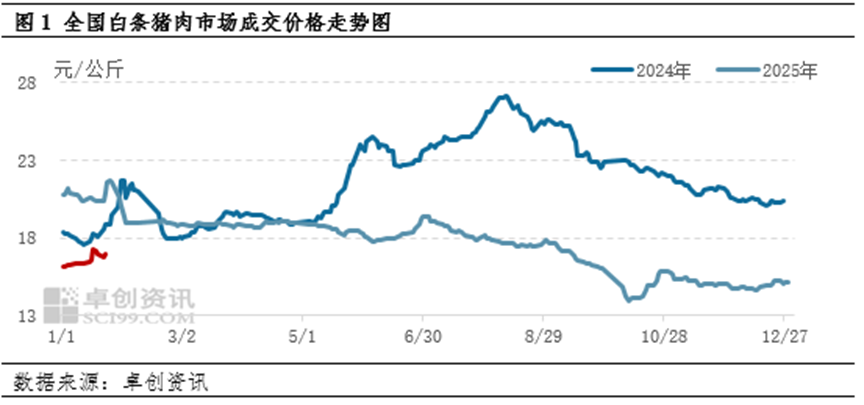
Investment Rating - The report maintains an "Outperform" rating for the agricultural products sector [1][4]. Core Views - The beef price is expected to continue rising, indicating a potential reversal in the beef cycle in 2025 [2][3]. - The pig industry is undergoing a "de-involution," which is likely to support long-term pig prices [1][3]. - The poultry sector is anticipated to benefit from seasonal demand recovery, with limited supply fluctuations [3][4]. Summary by Sections 1. Weekly Overview and Data Summary - The report highlights a steady increase in beef prices, with the average market price at 66.54 yuan/kg as of November 28, 2025, reflecting a week-on-week increase of 0.24% and a year-on-year increase of 8.83% [2][3]. - The average price of live pigs was reported at 11.19 yuan/kg, showing a week-on-week decrease of 4% [1][3]. 2. Fundamental Tracking 2.1 Swine - The report notes that the pig price is supported by industry adjustments, with a current price of 11.19 yuan/kg [1][3]. - The average wholesale price of pork is 17.83 yuan/kg, down 0.45% week-on-week and down 24.13% year-on-year [1][3]. 2.2 Poultry - The price of broiler chickens is 7.19 yuan/kg, up 0.56% week-on-week, while chick prices are slightly down at 3.47 yuan/each [1][3]. - The report indicates that the supply of yellow chickens remains stable, with prices showing slight increases [1][3]. 2.3 Beef - The beef market is experiencing a new round of price increases, with expectations for a bullish cycle in 2025 [2][3]. - The average price of raw milk is 3.03 yuan/kg, with a year-on-year decrease of 3% [2][3]. 2.4 Feed - The report emphasizes that the feed industry is benefiting from deeper industrialization and clearer division of labor, with leading companies expected to gain competitive advantages [3][4]. 2.5 Other Commodities - Soybean meal prices are stable, with a current price of 3100 yuan/ton, reflecting a week-on-week increase of 0.98% [2][3]. - Corn prices are also on a mild upward trend, currently at 2254 yuan/ton, up 1.21% week-on-week [2][3]. 3. Company Profit Forecasts and Investment Ratings - Key companies such as YouRan Agriculture and Modern Agriculture are rated as "Outperform" with respective prices of 4.36 yuan and 1.34 yuan [4]. - Mu Yuan Co. is highlighted with a projected EPS of 3.57 yuan for 2025, maintaining an "Outperform" rating [4].
“肉篮子”购销两旺暖寒冬 “烟火气”升腾映照百姓好生活
Yang Shi Wang· 2025-11-30 09:50
较大的市场需求也带动了价格上涨。据了解,今年每斤羊肉价格提高了2元左右,羊肉已成不少市民冬日餐桌的特色菜。 对海晏的牧民来说,秋冬时节牦牛膘肥体壮,就是一年里最实在的丰收。一家老小围坐在一起,嚼着鲜嫩的牛肉,喝着暖身的奶茶, 这"打冬肉"的民俗藏着对当下的满足,也浸透着对来年的安稳期盼。 四川遂宁:羊肉走俏 消费市场火热 宰好了牦牛,就到了家里的"厨师们"大展身手的时候,新鲜的牦牛肉剁碎混着葱叶一起灌入了清洗干净肠衣当中,灌好的牛肠与大块新鲜 的牦牛肉一起下锅,不一会儿厨房里就飘出了香味儿。 随着天气逐渐变冷,羊肉成为不少市民餐桌上的特色菜。在四川遂宁市,羊肉消费需求持续上涨。 清晨8时,遂宁川中大市场的羊肉铺前已人头攒动。自国庆前后开始,羊肉市场的需求一直保持上涨趋势。 央视网消息:位于青海湖北岸的青海省海晏县,冬季漫长且严寒,当地的牧民便有"打冬肉"的民俗,这也成为高原牧民迎接寒冬的传统之 一。每到此时,经夏秋丰美水草滋养的牦牛膘肥体壮、肉质紧实,正是屠宰储备冬肉的最佳时节。 周末一大早,在海晏县哈勒景蒙古族乡乌兰哈达村,尖木措兄弟俩正在为屠宰牦牛做着准备。"打冬肉"就是要趁着牦牛最壮实的时候,屠 宰、剥 ...
农林牧渔行业周报:年末猪价存在供需双重支撑,牛周期景气持续性或超预期-20251130
KAIYUAN SECURITIES· 2025-11-30 06:46
Investment Rating - The industry investment rating is "Positive" (maintained) [1] Core Views - The report indicates that the pig price is supported by both supply and demand factors as the market enters the winter consumption peak, with expectations for a gradual increase in the price center [11] - The beef cycle is expected to maintain its prosperity, with a decrease in cattle inventory and high calf prices indicating cautious expansion in the breeding sector [20] - The report highlights the acceleration of pig breeding losses and the strengthening logic of domestic pet products, recommending several companies in the pig farming and pet sectors [24] Summary by Sections Weekly Observation - The average price of pigs in China as of November 28, 2025, is 11.20 yuan/kg, with a week-on-week decrease of 0.42 yuan/kg and a year-on-year decrease of 5.27 yuan/kg [11] - The average weight of pigs at market is 129.22 kg, showing a week-on-week increase of 0.41 kg and a year-on-year increase of 2.49 kg [11] - The report notes that winter consumption favors larger pigs, leading to an increase in average weights at market [11] Weekly Views - The report states that pig and piglet prices are in a loss situation, which may accelerate the culling of breeding sows [24] - The feed sector is benefiting from the post-cycle of poultry and livestock, with strong overseas demand supporting prices [24] - The pet sector is experiencing a rise in domestic brands due to consumption upgrades and tariff barriers [24] Market Performance (November 24-28) - The agricultural index outperformed the market by 0.17 percentage points, with the Shanghai Composite Index rising by 1.40% and the agricultural index rising by 1.57% [26] - Key stocks leading the market include Jin Xin Nong (+12.60%), Yuan Fei Pet (+8.39%), and Xi Wang Food (+7.57%) [26] Price Tracking (November 24-28) - The average price of pigs is 11.19 yuan/kg, down 0.45 yuan/kg from the previous week; piglet prices are 19.19 yuan/kg, up 0.04 yuan/kg [33] - The average wholesale price of beef is 66.39 yuan/kg, showing a week-on-week decrease of 0.18 yuan/kg [36] - Corn and soybean meal prices have increased, with corn futures at 2241.00 yuan/ton (up 2.66%) and soybean meal futures at 2459.00 yuan/ton (up 1.32%) [44]
标肥价差走扩31%!大猪能否扛起猪价反弹大旗?
Xin Lang Cai Jing· 2025-11-30 02:15
来源:市场资讯 虽然标肥价差在扩大,但供应端的压力一点没减小。本周价差只扩大了0.01元/公斤,基本没动,说明 市场实际消化大猪的能力并没有明显提升。 (来源:大佑农饲料) 现在的标肥价差已经到了-0.71元/公斤,比去年同期的-0.54元/公斤高出不少。这意味着什么?就像买 车,标准版和加长版的差价拉大了,说明市场上对"加长版"的大猪需求正在升温。 随着天气转冷,西南地区开始做腊肉、香肠了。再加上2026年春节来得晚,腌腊季节比往年长了近两 周。猪肉价格现在不高,老百姓更愿意多买些大肥猪来做腊味。 从往年经验看,冬天和年底这段时间,标肥价差通常都是一年中最大的。原因很简单——快过年了,南 方人需要更多肥猪做腊味,养殖户也乐意多养一段时间让猪长膘。猪在栏里多待一天,就多重一点,市 场上短期供应就少一些,价格自然容易往上走。 供应结构变了,大猪行情有支撑 今年散户手里的猪比去年少了15%,而140公斤以上的大猪在总存栏中的比例却升到了22%。这就好比 市场上卖菜的摊贩少了,但高档蔬菜的比例反而增加了。 有业内行家指出,在散户猪源减少的背景下,大猪作为做腊味的首选原料,价格很可能先涨起来,然后 带动普通猪价跟着回 ...
11月30日猪价 | 稳定为主,局地上涨!
Xin Lang Cai Jing· 2025-11-30 02:15
Core Insights - The national average price for live pigs is stable at 5.65 yuan per kilogram, showing little change from the previous day, with 6 regions experiencing price increases, 4 regions seeing declines, and 18 regions remaining stable [3][4] - The lowest price for live pigs is reported in Guangxi at 5.2 yuan per kilogram, while the highest price is in Hainan at 7.2 yuan per kilogram [3] Price Trends - In the Northeast and North China regions, prices are stable with slight increases, with standard pig prices ranging from 5.5 to 5.8 yuan per kilogram [4] - In Guangdong, prices remain stable, while some low-price areas are experiencing a rebound of about 0.1 yuan [4] - Overall, after a previous decline, pig prices are showing signs of stabilization [4]
10月生猪数据揭秘:出栏量增体重降,母猪去化加速,26年猪价可期
Zhi Tong Cai Jing· 2025-11-30 00:22
Group 1 - The supply of live pigs remains relatively loose, and due to policy guidance from the National Development and Reform Commission, large pig enterprises are reducing the weight of their marketings, which increases short-term supply pressure and leads to a significant decline in pork prices during the month [1][2] - The industry is experiencing expanded losses, with the number of breeding sows in the country entering a de-stocking phase since July, and the de-stocking trend accelerating in October, which may further elevate the price center for pigs in 2026 [1][2] - The cash flow of "low-cost+" pig enterprises is expected to improve significantly, continuously enhancing their intrinsic value [1][2] Group 2 - In October 2025, the total number of live pigs marketed by 15 listed pig enterprises reached 17.52 million heads, representing a year-on-year increase of 30% and a month-on-month increase of 23%, primarily due to the release of capacity by leading pig enterprises [3] - The average marketing weight of pigs from nine listed enterprises decreased to 121 kg, showing a year-on-year decline of 1.9% and a month-on-month decline of 1.5% [3] - The number of piglets marketed in October 2025 was 1.44 million heads, a year-on-year increase of 144%, with the proportion of piglets in total marketings rising by 0.4 percentage points to 20% [3]
宁夏农业现代化步履铿锵:“六特”产业激活乡村共富新引擎
Zhong Guo Xin Wen Wang· 2025-11-30 00:21
Core Viewpoint - Ningxia is witnessing a significant agricultural transformation, with the "Six Special" industries driving rural revitalization and economic growth, as evidenced by the increase in primary industry value added from 33.808 billion yuan in 2020 to 45.124 billion yuan in 2024, reflecting an annual growth rate of 5.8%, surpassing the national average by 1.1 percentage points [1] Group 1: Development of "Six Special" Industries - The "Six Special" industries, including cool-season vegetables, Tan sheep, and milk, have become national advantageous industrial clusters, establishing a complete industrial chain from breeding to processing and sales [2] - The cooperative model involving enterprises and universities has led to the development of specialized feed and a stable annual processing and sales volume of 5,000 Tan sheep in a village previously affected by sandstorms [2] Group 2: Digital Transformation in Agriculture - The transition from traditional farming to smart agriculture is highlighted by the use of a digital agriculture platform that enhances irrigation efficiency and crop management, significantly improving productivity [3] - Technologies such as embryo transfer have increased the good breed rate of beef cattle to 85%, and digital management systems for Tan sheep have achieved a survival rate of 96% [3] Group 3: Shared Economic Benefits - The collective income of villages in Ningxia is projected to reach 2.38 billion yuan by the end of 2024, with 85.6% of villages achieving stable operational income, and over 40% of rural residents' disposable income coming from special industries [4] - Training programs for high-quality farmers have reached 450,000 participants, contributing to the modernization of agriculture and enhancing the skill set of the workforce [4]
2700亿养猪巨头冲刺港股IPO,河南首富身家1870亿
21世纪经济报道· 2025-11-29 14:18
Core Viewpoint - The article discusses the recent actions of Muyuan Foods Co., Ltd., the largest pig farming company in China, as it re-applies for an IPO on the Hong Kong Stock Exchange after a previous application expired. The company aims to achieve dual listing in both A-shares and H-shares, which could enhance its market presence and capital access. Group 1: Company Overview - Muyuan Foods was listed on the A-share market in 2014 and has maintained a strong market position, being the world's largest in terms of pig production and sales since 2021, with a global market share of 5.6% as of 2024 [5][3] - The company's main business includes the entire pig farming industry chain, covering feed processing, breeding, and slaughtering, with the pig farming segment accounting for 98.7% of total revenue in the first half of 2025 [5][3] Group 2: Financial Performance - The company's revenue for 2022, 2023, and 2024 was reported at 1248.26 billion, 1108.61 billion, and 1379.47 billion respectively, with a notable recovery in 2025 as the revenue for the first half reached 764.63 billion [5][3] - The net profit for the first half of 2025 was 107.9 billion, with a significant increase in gross margin from 7.7% in the first half of 2024 to 19.0% in the first half of 2025, attributed to improved profitability in the pig farming business [5][3] Group 3: Shareholding and Management - The direct controlling shareholder of Muyuan Foods is Muyuan Industrial Group Co., Ltd., holding a 15.54% stake. The chairman and president, Qin Yinglin, directly holds 20.86 billion shares and has a reported salary of 3.722 million for 2025 [6][3] - Qin Yinglin and his wife collectively own 54.91% of the company, and they were ranked 16th on the 2025 Hurun Rich List with a wealth of 187 billion [6][8] Group 4: Market Expansion and Strategy - Muyuan Foods plans to use the funds from the IPO to expand into overseas markets and enhance its research and development across the entire industry chain, focusing on breeding, smart farming, nutritional management, and biosecurity [10][3] - The company recognizes the potential for growth in emerging markets, particularly in Southeast Asia, where per capita meat consumption remains low compared to developed countries [10][3] Group 5: Financial Risks - The company has shown a significant increase in net current liabilities, reaching 155.89 billion, 310.76 billion, 241.58 billion, and 166.37 billion from 2022 to mid-2025, primarily due to short-term borrowings and payables, indicating potential liquidity risks [10][3] - Muyuan Foods holds substantial biological assets, with a book value of 81.67 billion for productive biological assets and 302.21 billion for consumable biological assets as of mid-2025, which are susceptible to market price fluctuations and other uncontrollable factors [10][3]