
非银金融

Search documents
光大证券晨会速递-20251222
EBSCN· 2025-12-22 05:24
Group 1: Macroeconomic Insights - The unexpected decline in the US CPI for November is attributed to statistical "distortion" due to government shutdown disruptions, with a shorter data collection period and promotional season affecting price statistics [1] - The market's reaction to this "distorted" data is limited, with a high probability of maintaining interest rate pauses at 72.3% until further data is released in December [1] Group 2: Market Strategy - Historical trends indicate a "spring rally" in the A-share market, driven by monetary policy adjustments and significant economic data releases, suggesting a potential upward market movement [2] - The recent strong market performance may signal the beginning of the 2026 cross-year rally, with a focus on growth and consumer sectors for industry allocation [2] Group 3: Bond Market Observations - The secondary market for publicly listed REITs has seen a continuous decline, with a weighted REITs index return of -2.74% for the week [3] - The issuance of credit bonds has decreased, with industrial bonds accounting for 44.07% of the total issuance, reflecting a 12.44% week-on-week decline [4] Group 4: Industry Research - Computer Sector - The global tech investment enthusiasm remains strong, with a structural differentiation between "strong computing power" and "weak applications," suggesting a focus on AI applications in 2026 [7] - Three main investment lines are recommended: industry empowerment, overseas application, and edge AI, highlighting companies with strong industry know-how and high overseas revenue [7] Group 5: Non-Banking Sector Insights - In a low-interest-rate environment, equity assets have become crucial for insurance companies to enhance investment returns, with a record high of 9.3% equity asset ratio among five listed insurers [8] - The proposed regulatory framework aims to improve asset-liability management in insurance companies, enhancing long-term operational resilience [9] Group 6: Energy Sector Developments - In November, power generation increased by 2.7% year-on-year, with improvements in nuclear, solar, and wind energy growth rates [10] - The storage and hydrogen sectors are expected to see continued investment opportunities, driven by ongoing demand and new project launches [11] Group 7: Metal Industry Analysis - The copper market is expected to see price increases, supported by a tight supply-demand balance and rising commercial net long positions [12] - Investment recommendations include companies like Zijin Mining and Luoyang Molybdenum, with a focus on potential risks from economic conditions and supply releases [12] Group 8: Chemical Industry Insights - The semiconductor materials sector is experiencing accelerated growth due to AI and data center demands, with a focus on high-purity materials [14] - Companies with technological advantages and strong customer ties in high-end materials are recommended for investment [14] Group 9: Medical Sector Developments - Ant Group's AI health assistant has rapidly gained popularity, transforming healthcare management through a digitalized approach [15] - Investment focus includes AI and home medical devices, offline health check-ups, and pharmaceutical retail [15] Group 10: Company-Specific Research - Taihe Co., Ltd. is recognized for its leading technology and capacity in core products, with significant profit growth expected from new product registrations [16] - The company is projected to achieve net profits of 4.55 billion, 5.64 billion, and 6.83 billion yuan from 2025 to 2027, with a target price of 33.67 yuan [16] Group 11: Media Sector Insights - The advertising demand from internet clients remains strong, with potential revenue growth from new business initiatives [17] - Profit forecasts for 2025 and 2026 have been slightly adjusted downwards, reflecting cautious optimism amid macroeconomic conditions [17] Group 12: TMT Sector Developments - Xiaomi's long-term AI strategy emphasizes substantial R&D investments, indicating a commitment to sustainable growth in AI applications [18] - The company is projected to achieve non-IFRS net profits of 426 billion, 438 billion, and 510 billion yuan from 2025 to 2027 [18] Group 13: Medical Device Sector Insights - The company is a leader in the interventional field, with significant revenue growth from overseas and peripheral products [19] - Profit forecasts have been adjusted due to potential policy impacts, with expected net profits of 6.33 billion, 7.05 billion, and 8.48 billion yuan from 2025 to 2027 [19]
上周融资余额增超30亿元,这些行业和个股被显著加仓
Sou Hu Cai Jing· 2025-12-22 04:33
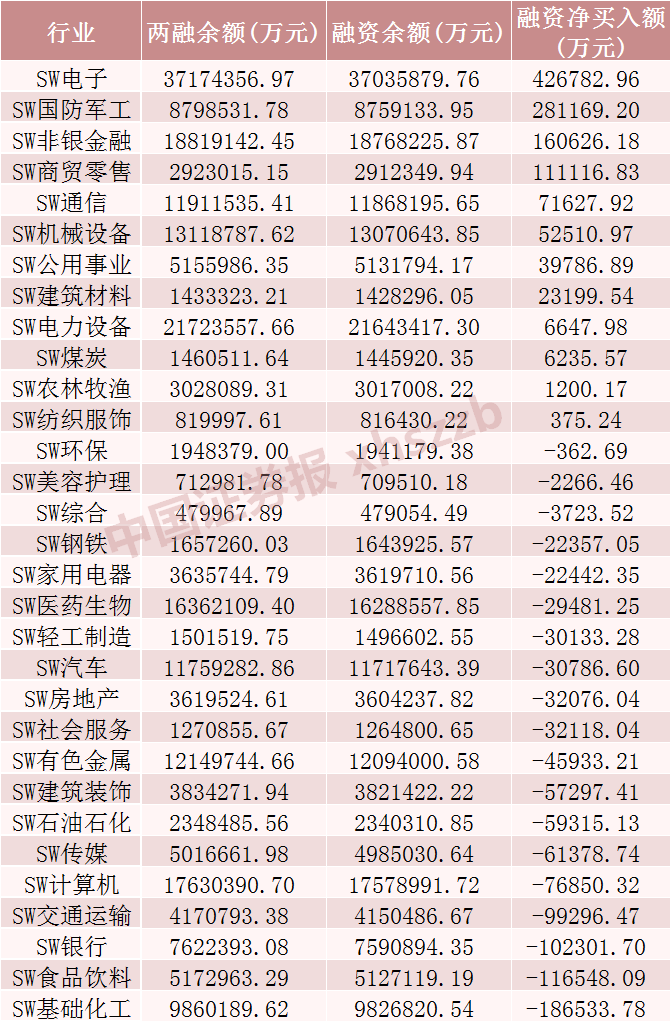
Market Overview - The A-share market experienced fluctuations and adjustments last week, with the margin balance reported at 25,038.28 billion yuan as of December 19, and the financing balance at 24,871.33 billion yuan, reflecting an increase of 3.40 billion yuan over the week [1]. Financing Balance Changes - During the five trading days of last week, the financing balance increased by 4.84 billion yuan on December 15, decreased by 459 million yuan on December 16, decreased by 2.23 billion yuan on December 17, decreased by 3.32 billion yuan on December 18, and increased by 4.58 billion yuan on December 19 [1]. - Among the 31 industries tracked, 12 industries saw an increase in financing balance, with the electronic, defense, and non-bank financial sectors leading in net buying amounts of 4.27 billion yuan, 2.81 billion yuan, and 1.61 billion yuan respectively [1][2]. Industry-Specific Financing Data - The following industries had notable financing net buying amounts: - SW Electronics: 4.27 billion yuan - SW Defense: 2.81 billion yuan - SW Non-bank Financials: 1.61 billion yuan - Conversely, the industries with the highest net selling amounts included: - SW Basic Chemicals: 1.87 billion yuan - SW Food and Beverage: 1.17 billion yuan - SW Banking: 1.02 billion yuan [2]. Individual Stock Performance - Last week, 95 stocks saw net buying amounts exceeding 100 million yuan, with the top ten stocks being: - China Ping An: 2.57 billion yuan - Aerospace Electronics: 988 million yuan - C Muxi-U: 959 million yuan - Yonghui Supermarket: 690 million yuan - Shenghong Technology: 678 million yuan - Ganfeng Lithium: 531 million yuan - C Youxun: 521 million yuan - Moer Thread-U: 517 million yuan - Feilong Co.: 501 million yuan - Zhaoyi Innovation: 501 million yuan [3][4]. Market Performance of Top Stocks - The stocks with the highest net buying amounts generally performed well, with the top performer, Aerospace Electronics, seeing a price increase of over 25% [4].

告别单一叙事!A股跨年行情+春季躁动或将拉开帷幕
Zheng Quan Shi Bao Wang· 2025-12-22 02:46
Group 1 - The core viewpoint is that the factors driving the appreciation of the RMB are increasing, and investors need to adapt their asset allocation in a continuously appreciating RMB environment. Historical data shows that while the exchange rate is not the decisive factor for industry allocation, certain industries may perform better in the early stages of appreciation expectations [2] - Approximately 19% of industries are expected to see profit margin improvements due to RMB appreciation, which will attract investor attention [2] - Industry allocation should focus on three clues: short-term muscle memory-driven sectors (such as aviation, gas, and paper), profit margin change-driven sectors (upstream resources, consumer goods, service-related products, and manufacturing equipment), and policy change-driven sectors (duty-free, real estate developers, brokerages, and insurance) [2] Group 2 - The market is expected to experience a classic "cross-year-spring" rally, with signals indicating that this rally is beginning to unfold. Key factors include accelerated central budget investments and significant institutional investors increasing their holdings in broad-based ETFs [4] - The main focus of the rally is likely to be on blue-chip indices represented by the CSI 300 and SSE 50, with particular attention to cyclical sectors such as industrial metals, non-bank financials, and hotel aviation [4] - The Hong Kong stock market is seen as having high value, with a recommendation to gradually build positions, especially in the Hang Seng Technology index [4] Group 3 - The A-share market is currently in a narrow fluctuation pattern, influenced by external factors such as the Fed's interest rate decisions and the Bank of Japan's policies. The market is expected to resonate upward with global stock markets [6] - Key industry allocation focuses include dividend value, cyclical recovery, and thematic hotspots, with specific attention to sectors like non-ferrous metals, high-dividend Hong Kong stocks, AI, new energy, and innovative pharmaceuticals [6] - The market is anticipated to enter a critical window for cross-year layout, with a focus on structural opportunities driven by policy guidance and industry prosperity [7] Group 4 - The current market structure reflects significant expectation gaps in consumption, non-bank finance, and technology sectors, with potential for structural outperformance in the first half of the year [12] - Key sectors to watch include robotics, nuclear power, commercial aerospace, and non-bank financials, which are expected to be important themes in the spring rally [12] - The market is nearing a phase bottom, making it an optimal time to position for the key rally window before the Spring Festival [12]
22股杠杆资金净买入超亿元,中国平安最受青睐
Zheng Quan Shi Bao Wang· 2025-12-22 02:26
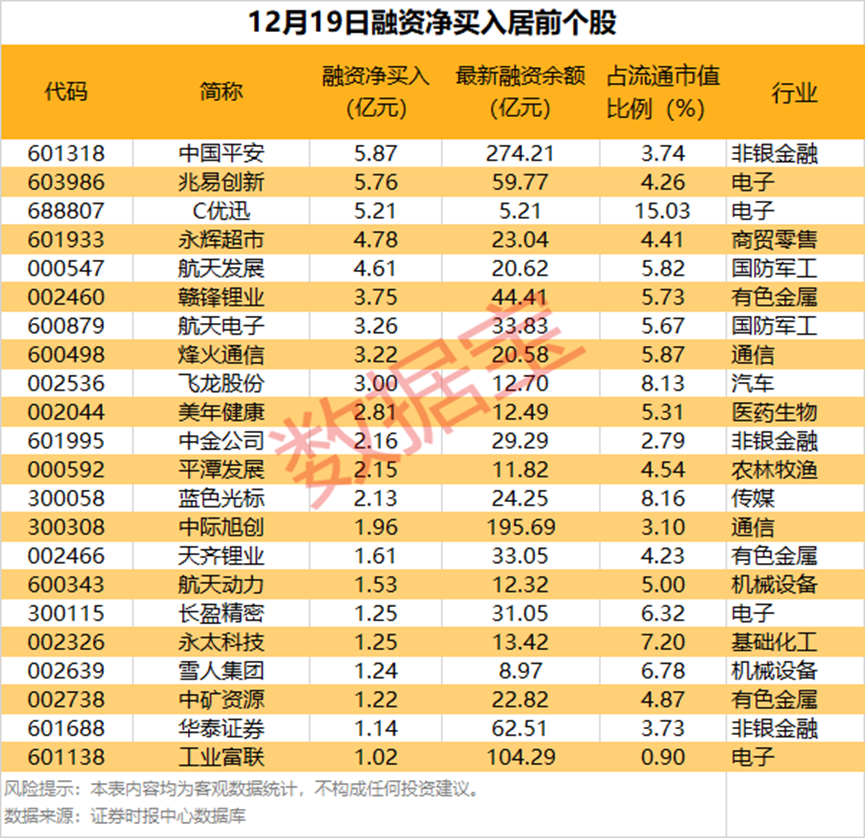
Core Insights - As of December 19, the total market financing balance reached 2.49 trillion yuan, an increase of 4.577 billion yuan compared to the previous trading day [1] Group 1: Financing Activities - A total of 22 stocks had a net financing inflow exceeding 100 million yuan [1] - China Ping An (601318) topped the list with a net financing inflow of 587 million yuan [2] - Other notable stocks with significant net financing inflows include: - Zhaoyi Innovation (603986) with 576 million yuan - C Yujing with 521 million yuan - Yonghui Supermarket (601933) with 478 million yuan - Aerospace Development (000547) with 461 million yuan - Ganfeng Lithium (002460) with 375 million yuan [2] Group 2: Sector Performance - The financing balance for China Ping An (601318) was 27.421 billion yuan, accounting for 3.74% of its market capitalization [2] - Zhaoyi Innovation (603986) had a financing balance of 5.977 billion yuan, representing 4.26% of its market capitalization [2] - C Yujing's financing balance was 521 million yuan, which is 15.03% of its market capitalization [2] - Yonghui Supermarket (601933) had a financing balance of 2.304 billion yuan, making up 4.41% of its market capitalization [2] - Aerospace Development (000547) had a financing balance of 2.062 billion yuan, representing 5.82% of its market capitalization [2] - Ganfeng Lithium (002460) had a financing balance of 4.441 billion yuan, accounting for 5.73% of its market capitalization [2]

12月19日融资余额24793.79亿元,相较上个交易日增加45.38亿元
Sou Hu Cai Jing· 2025-12-22 00:53
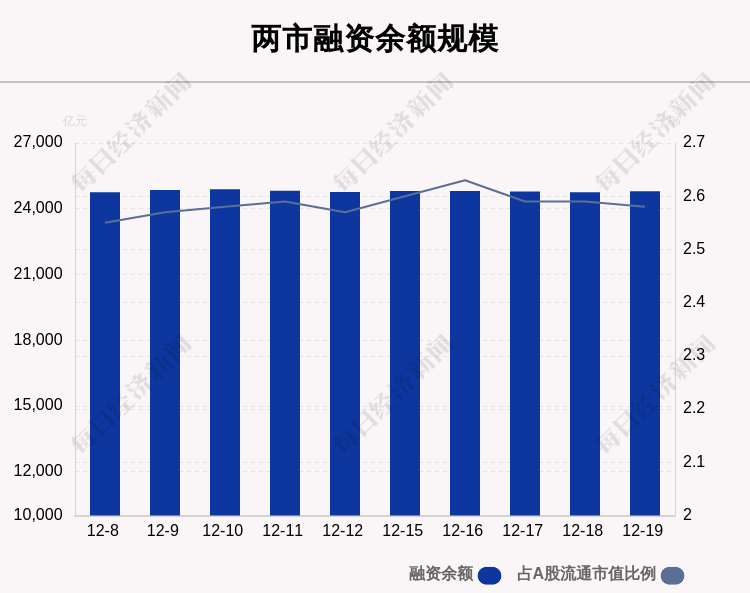
Group 1 - As of December 19, the margin financing and securities lending balance in the Shanghai and Shenzhen markets reached 24,960.73 billion yuan, an increase of 4.423 billion yuan compared to the previous trading day [1] - The financing balance was 24,793.79 billion yuan, which is an increase of 4.538 billion yuan from the previous trading day [1] - The Shanghai market's margin balance was 12,687.4 billion yuan, up by 2.095 billion yuan, while the Shenzhen market's margin balance was 12,273.34 billion yuan, increasing by 2.328 billion yuan [1] Group 2 - On December 19, a total of 1,560 stocks experienced net buying of margin funds, with 45 stocks having net buying amounts exceeding 10% of their total trading volume [3] - The top three stocks with the highest net buying ratios were Jindalai (29.71%), Hangzhou Kelin (23.56%), and Songjing Co. (20.96%) [3][4] Group 3 - The top three stocks by net buying amount were China Ping An (5.87 billion yuan), Zhaoyi Innovation (5.76 billion yuan), and N Youxun (5.21 billion yuan) [8]

十大券商策略:告别单一叙事!人民币升值指引三条配置线索
Zheng Quan Shi Bao Wang· 2025-12-22 00:12
Group 1 - The core viewpoint is that the market is beginning to focus on the potential for a sustained appreciation of the RMB, which could influence asset allocation strategies [1] - Approximately 19% of industries may see profit margin improvements due to RMB appreciation, leading to increased investor interest in these sectors [1] - Key sectors to watch under a strengthening RMB include aviation, gas, and paper industries driven by short-term muscle memory, as well as upstream resources, consumer goods, and services influenced by profit margin changes [1] Group 2 - The 2026 spring market is anticipated to be active, with a focus on non-mainstream sectors such as policy themes and high-dividend stocks, while the mainline structure (AI industry chain, cyclical stocks) may have limited upward potential [2] - A classic "cross-year-spring" market is forming, with significant institutional investors increasing their holdings in broad-based ETFs, indicating stable incremental capital for the market [3] - The A-share market is expected to resonate upward with global markets, driven by clear mid-term policy and liquidity expectations following the Federal Reserve's interest rate decisions [4] Group 3 - The current market is characterized by a narrow range of fluctuations, influenced by external factors such as U.S. AI bubble concerns and Japan's interest rate hikes, with a potential upward trend as investor sentiment improves [4] - The focus for A-share industry allocation includes dividend value, cyclical recovery, and thematic hotspots, particularly in metals, non-bank financials, and AI sectors [4] - The market is entering a critical window for cross-year layout, with attention on potential signals for a small rally around the New Year [5][6] Group 4 - The market is experiencing a structural trend change, with significant discrepancies in expectations for consumption, non-bank finance, and technology sectors as 2026 approaches [10][11] - Key investment themes include AI applications, commercial aerospace, and nuclear power, with a focus on sectors benefiting from domestic demand recovery and structural policy incentives [12] - The upcoming "15th Five-Year Plan" is expected to drive structural opportunities, particularly in AI, renewable energy, and quantum technology sectors [12]

十大券商一周策略:“春季躁动”行情积极因素累积,拥抱更具备确定性的“实物需求拉动”与“内需政策红利”
Sou Hu Cai Jing· 2025-12-21 23:57
Group 1 - The market is entering a critical window for cross-year layout, with expectations for A-shares to resonate upward with global markets by 2026, focusing on "technology + overseas expansion" as a continuing theme [1][2] - Current market conditions are characterized by narrow fluctuations, influenced by external factors such as concerns over the AI bubble in the US and interest rate hikes by the Bank of Japan [2][3] - Investor sentiment has recently dropped below 70, indicating a pessimistic outlook that may lead to a slight recovery in sentiment and upward market fluctuations [2] Group 2 - Industry allocation strategies include focusing on high dividend stocks, cyclical sectors, and thematic hotspots such as Hainan's duty-free shopping and nuclear power [2][4] - The anticipated "cross-year-spring" market rally is supported by early policy implementation and increased institutional investment in broad-based ETFs [4][5] - The potential for a structural outperformance in sectors like brokerage and technology is expected, driven by upcoming monetary policy changes and market liquidity improvements [7][8] Group 3 - The ongoing appreciation of the RMB is expected to influence asset allocation, with approximately 19% of industries likely to see profit margin improvements due to currency appreciation [3] - Key sectors benefiting from policy support include AI, aerospace, and innovative pharmaceuticals, while cyclical sectors like chemicals and energy metals may also see positive impacts [6][9] - The market is expected to experience a "spring rally" driven by favorable valuation levels, liquidity conditions, and catalysts that enhance risk appetite [6][12] Group 4 - The outlook for 2026 suggests a shift from a single narrative to a broader focus on physical demand and domestic policy benefits, with sectors like AI and consumer services poised for recovery [10][13] - Non-bank financials are highlighted as having significant earnings elasticity, while sectors like electric equipment and machinery are expected to benefit from AI investments and export demand [13][14] - The market is currently in a phase of adjustment before the anticipated cross-year rally, with a focus on structural opportunities aligned with policy directions and industry trends [11][14]
华西证券:“春季躁动”行情的启动 需具备哪些必要条件?
智通财经网· 2025-12-21 22:50
智通财经APP获悉,华西证券发布研究报告称,复盘历史,A股"春季躁动"行情启动通常需满足以下条 件:合理的估值水平、宽松的流动性环境以及有效提振风险偏好的催化剂,如国内政策、产业事件催化 或外部风险缓释等。当前来看,海外美联储降息和日本央行加息均已落地,市场对套利交易逆转担忧缓 解,后续人民币汇率升值带动的外资增配、年初保费收入"开门红"带来的增量保险资金入市亦可以期 待。近期股票型ETF再度大规模净申购,多只宽基ETF成交放量,指向增量资金倾向于逢低布局。 华西证券主要观点如下: 市场回顾:本周全球股指多数下跌,韩国综合指数、恒生科技和日经225指领跌。A股成交再度缩量, 万得全A日均成交额回落至1.76万亿元附近,市场情绪趋于谨慎,主要指数中科创50和创业板指领跌, 资金轮动至红利板块。风格上,金融和消费板块上涨,一级行业中,商贸零售、非银金融、美容护理、 社会服务领涨;成长风格下跌,电子和电力设备指数跌超3%。大宗商品方面,COMEX白银大涨8.7%, 铜铝价格震荡上行,双焦底部反弹。外汇方面,日央行加息落地后,日元对美元汇率走贬,人民币对美 元则延续升值态势。 一、复盘历史,除2021和2022年外, ...

短期可布局低位红利板块
Xin Lang Cai Jing· 2025-12-21 18:36
Group 1 - The core viewpoint indicates that most primary industry sectors have shown upward movement, but the growth is generally moderate, with retail, non-bank financials, beauty care, and social services leading the gains due to the increasing importance of domestic demand strategies and related policy expectations [1] - The retail, beauty care, and social service sectors have performed well as a result of the sustained emphasis on domestic demand, while the non-bank financial sector has been boosted by the recovery in brokerage and insurance sectors [1] - Conversely, sectors such as electronics, electrical equipment, and machinery have experienced the largest declines, attributed to profit-taking in the electric equipment sector and a lack of catalysts in the machinery sector [1] Group 2 - In terms of investment direction, defensive low-yield dividend sectors like coal and oil & petrochemicals are recommended for short-term positioning, while non-bank financials should be considered for adjustments to capture market beta opportunities [2] - There is potential for a recovery in cyclical sectors related to domestic demand, such as consumer goods, driven by policy expectations [2] - Growth-oriented sectors, particularly those benefiting from AI and semiconductors, should focus on leading companies with strong earnings certainty, as well as sectors like embodied intelligence and innovative pharmaceuticals that may see progress next year [2]
——信用周报20251221:信用利差多数走阔,优先布局中短端票息资产-20251221
Huachuang Securities· 2025-12-21 14:42
Group 1 - The report indicates that credit spreads have generally widened, with a focus on prioritizing mid-to-short-term coupon assets for investment [1][10] - The current yield for 1-year products is in the range of 1.72%-1.80%, with spreads below the central level since 2024 by 13-19 basis points [2][24] - For 2-3 year products, yields are between 1.83%-2.10%, and spreads are in the range of 19-42 basis points, with a recommendation to prioritize mid-to-short-term coupon assets due to high demand from funds and wealth management [2][25] Group 2 - The report notes that the 4-5 year products have yields ranging from 2.0%-2.35% and spreads between 26-55 basis points, with a marginal recovery in coupon configuration value [3][26] - For products over 5 years, yields are between 2.23%-2.76% with spreads from 24-64 basis points, indicating a need for cautious trading participation due to market volatility [3][26] - The report highlights that the overall sentiment in the bond market remains cautious, with credit spreads showing weak compression momentum [6][24] Group 3 - Key policies include the Shenzhen Municipal Financial Office emphasizing the prevention and resolution of financial risks, and the second meeting of bondholders for "22 Vanke MTN004" [4][28] - The report mentions that nearly 70% of bond-issuing entities in Henan have completed the repayment of hidden debts, indicating significant progress in debt resolution and market transformation [4][28] - The report also notes the first appearance of Guizhou's municipal state-owned enterprise in the capital market, marking a significant event in the current round of debt resolution [4][28]
