
啤酒

Search documents
大行评级丨花旗:降百威亚太目标价至11.4港元 下调销售及利润预测
Ge Long Hui· 2026-01-20 07:19
Group 1 - Citi has lowered Budweiser APAC's (1876.HK) sales forecasts for 2025, 2026, and 2027 by 3%, 4%, and 4% respectively, reflecting a weaker outlook for the second half of 2025 in China [1] - The bank anticipates that sales in the fourth quarter of last year will also be negatively impacted due to the later timing of the Lunar New Year in 2026 [1] - Due to weakened operating leverage, Citi has reduced Budweiser APAC's core net profit forecasts for 2025, 2026, and 2027 by 10%, 10%, and 9% respectively [1] Group 2 - The target price for Budweiser APAC has been adjusted from HKD 12.4 to HKD 11.4, while maintaining a "Buy" rating [1] - Citi's preference order for the Chinese beer industry remains unchanged, ranking China Resources Beer (0291.HK) first, followed by Budweiser APAC and Tsingtao Brewery (0168.HK) [1]
啤酒行业2025年12月跟踪:淡季蓄力,复苏将至
Xiangcai Securities· 2026-01-20 07:05
Investment Rating - The industry investment rating is maintained as "Buy" [2] Core Insights - The macroeconomic and consumption environment shows signs of marginal improvement despite ongoing pressure in the consumer market. The restaurant sector continues to outperform overall retail sales, indicating structural growth opportunities for the beer industry [4][14] - The beer industry is experiencing a seasonal production decline due to the off-peak season, but overall production levels remain stable compared to previous years. The industry is expected to recover, with a focus on high-end and super high-end beer segments [5][36] - Cost pressures in the beer industry are manageable, with stable raw material costs and a neutral overall cost environment. Price stability in the terminal market supports profitability [6][50] Summary by Sections 1. Macroeconomic and Consumption Environment - In December 2025, the retail sales growth rate fell to 0.9% year-on-year, while the restaurant sector showed a 2.2% increase, indicating resilience in selected consumption categories. CPI rose to 0.8%, and PPI showed a narrowing decline at -1.9% [4][14] - Consumer confidence and income indicators are gradually improving, which is expected to enhance consumption potential in 2026 [15][16] 2. Overall Operation of the Beer Industry - December 2025 saw a seasonal decline in beer production, with a total production of 331.81 million hectoliters by the end of November. The industry is expected to maintain production levels close to historical highs despite short-term fluctuations [5][33] - The import and export dynamics show a weak import performance but stable export growth, with expectations for marginal improvement in imports in early 2026 [34][35] 3. Prices and Costs - Raw material costs remain stable, with domestic barley prices at 2205 CNY/ton and imported barley prices at 255 USD/ton. Packaging material costs are in a neutral state due to price fluctuations [6][49] - The terminal prices for canned and bottled beer have shown minimal fluctuations, maintaining a stable pricing structure [50][51] 4. Tracking of Listed Companies - The stock prices of key beer companies in the A-share and Hong Kong markets have shown slight declines, with most companies experiencing negative growth. Market sentiment appears cautious [58][61] 5. Investment Recommendations - Despite ongoing declines in retail sales data, the beer sector is positioned for potential valuation recovery due to low historical valuation levels. The expected improvement in consumer confidence and manageable cost pressures supports a positive outlook for the beer industry in 2026 [9][67]
食品饮料行业:月聚焦:如何布局零食“春季躁动”?
GF SECURITIES· 2026-01-20 06:14
Group 1 - The report highlights the "Spring Excitement" in the snack sector, indicating a historical high relative win rate of 70% for the food and beverage sector in the 40 days leading up to the Spring Festival [7][16] - The report emphasizes that the "Spring Excitement" is not solely dependent on the annual beta of the food and beverage sector, as structural opportunities still exist despite a long-term adjustment period since 2021 [7][16] - Key catalysts for the upcoming Spring Festival include concentrated demand for gifts and gatherings, which leads to more planned channel stocking, creating a positive feedback loop of expectations and validations [7][16][28] Group 2 - In December, the food and beverage sector underperformed the market by 7.5 percentage points, with a decline of 5.2%, ranking last among 31 primary industries [7][61] - The report notes a divergence in performance among sub-sectors, with snacks and soft drinks showing gains while liquor and beer experienced declines [7][61][64] - The absolute and relative valuations of the food and beverage sector are at their lowest since 2010, indicating potential investment opportunities [7][61][64] Group 3 - The report tracks the recovery of consumer confidence, with a 0.9% year-on-year increase in retail sales in December, showing improvement from the previous month [7][63] - It highlights that the liquor sector is facing weak demand and declining prices, with the price adjustments for premium liquor nearing levels seen between 2011 and 2015 [7][63][64] - The report identifies structural differentiation in costs, with some packaging materials and agricultural products experiencing price increases [7][63][64] Group 4 - Investment recommendations include a focus on liquor stocks that have undergone a four-year adjustment period, with potential for a "valuation + performance" double bottom [7][64] - For consumer goods, the report anticipates a moderate increase in industry prices in 2026, with specific recommendations for companies like Anjuke Foods, Qianhe Flavor, and Eastroc Beverage [7][64] - The report suggests that the upcoming Spring Festival will provide a favorable environment for growth narratives, particularly in the restaurant supply chain and certain chain formats [7][64]






扩大内需政策“暖”风频吹!大消费尝试修复
Mei Ri Jing Ji Xin Wen· 2026-01-20 06:13
Group 1 - The National Development and Reform Commission (NDRC) is formulating a strategy for expanding domestic demand from 2026 to 2030, focusing on improving supply structure and enhancing consumer capacity [1] - The consumer sector is experiencing negative performance, exemplified by Shui Jing Fang's (600779) forecast of a 42% year-on-year decline in revenue for 2025, indicating that the industry's pessimism is already reflected in prior adjustments [1] - Leading companies like Kweichow Moutai (600519) are adapting by launching market-oriented initiatives, such as online direct sales, to increase accessibility for consumers [1] Group 2 - The consumer ETF from Huaxia (510630.SH) has seen net inflows for three consecutive days, covering various consumer sub-sectors including liquor and dairy [2] - The food ETF from Huaxia (159151.SZ) focuses on daily consumer goods without including liquor or beer, emphasizing strong demand resilience [2] - The optional consumption ETF (562580.SH) covers sectors like automotive and retail, excluding food and beverage categories [2]
海量财经丨利润两年增长24倍,上市前突击分红:金星啤酒IPO是“逆袭”还是“虚火”?
Sou Hu Cai Jing· 2026-01-20 05:52
Core Viewpoint - The rapid growth of Jin Xing Beer, driven by its innovative product "Jin Xing Mao Jian" tea beer, has led to significant financial improvements, but the company's aggressive dividend policy and family-controlled ownership structure raise concerns about sustainability and governance risks [1][3][6]. Financial Performance - Jin Xing Beer reported a net profit increase from 12.2 million yuan in 2023 to 125 million yuan in 2024, representing a growth of approximately 925%. By the first nine months of 2025, net profit surged to 305 million yuan, marking a 24-fold increase compared to the entire year of 2023 [1]. - Revenue skyrocketed from 356 million yuan in 2023 to 1.11 billion yuan in the first three quarters of 2025, reflecting a growth rate of 191.34%. The gross margin improved from 27.3% to 47.0%, and net margin increased from 3.4% to 27.5% [3][10]. Product Innovation - The core driver of Jin Xing Beer's growth is the launch of its tea beer product "Jin Xing Mao Jian" in August 2024, which combines Xinyang Maojian tea with beer brewing techniques. The product achieved sales of 6 tons on its first day and surpassed 100 million cans within 10 months, contributing nearly 80% of the company's revenue [3][10]. - In the first three quarters of 2025, this product generated 867 million yuan in revenue, accounting for 78.1% of total sales, significantly altering the company's revenue structure [3]. Market Context - Jin Xing Beer's growth is notable against the backdrop of a declining traditional beer market in China, where major players like China Resources and Qingdao are experiencing sales drops. The overall beer industry saw a 5.7% revenue decline [10]. - The craft beer market in China has grown significantly, with a market size exceeding 80 billion yuan in 2024 and a year-on-year growth rate of over 30%. Products incorporating Chinese elements, such as tea beer, have seen a substantial increase in market share [11]. Governance and Risks - The ownership structure of Jin Xing Beer is characterized by a "family fortress," with the Zhang family controlling 100% of the company. This raises concerns about governance and potential conflicts of interest [6][8]. - The company has engaged in aggressive dividend payouts, distributing 2.29 billion yuan before its IPO, which is 182.6% of the projected net profit for 2024. Such practices are rare and may indicate a focus on maximizing family interests [7][8]. - There are compliance issues regarding social insurance and housing fund contributions, with significant amounts owed in these areas, which could lead to legal risks [8]. Competitive Landscape - Despite its current leading position in the niche market of Chinese craft beer, Jin Xing Beer faces increasing competition from established brands like Qingdao and Budweiser, which are also entering the tea beer segment [11]. - The company holds only a 0.3% market share in the overall beer market, while its market share in the craft beer segment is 14.6%, highlighting a disparity in its competitive positioning [11].

情绪价值也是K线:A股沸腾之下,牛市超级啤酒为何被追捧?
Chang Jiang Shang Bao· 2026-01-20 03:26
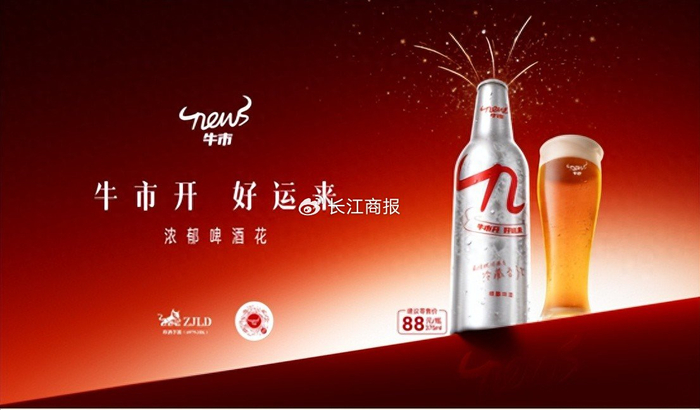
Core Viewpoint - The recent surge in the A-share market and the popularity of the premium craft beer "Bull Market" from Zhenjiu Lidou Group highlight a strong correlation between the capital market and consumer sectors, creating a vibrant consumption atmosphere [1]. Market Performance - On January 19, the Shanghai Composite Index surpassed 4,100 points, closing at 4,114.00 with a gain of 0.29%, while the Shenzhen Component Index rose by 0.09% to 14,294.05, with a total trading volume of 2.71 trillion yuan [1]. - Zhenjiu Lidou (06979.HK) shares increased to 8.36 HKD, reflecting a rise of over 6% in the past month [1]. Product Launch and Popularity - Zhenjiu Lidou Group launched its first premium craft beer, "Bull Market," on August 8, 2025, which has gained significant attention on social media platforms like Douyin and has consistently topped sales charts on e-commerce platforms such as Tmall and JD [1][12]. - The beer is marketed as a "super beer," with its hop content being 20 times that of regular beer, resulting in a cost of approximately 700,000 yuan per ton compared to 35,000 yuan per ton for ordinary hops, making the hop cost 400 times higher [5][4]. Quality and Ingredients - "Bull Market" beer is crafted using high-quality ingredients sourced globally, including hops from Yakima Valley in the USA, barley from Canada and Australia, and premium yeast from Germany and Belgium, along with natural spring water from Moganshan [4]. - The beer's development took three years, emphasizing the importance of taste, which led to a one-year delay in its market launch to ensure an exceptional flavor experience [8]. Health Perspective - The chairman of Zhenjiu Lidou, Wu Xiangdong, challenges the common perception that beer is a high-purine food, suggesting that the purine content is often derived from accompanying foods rather than beer itself [6]. - He advocates for a balanced view of beer consumption, emphasizing that enjoying high-quality beer can be part of a healthy lifestyle [6]. Cultural Integration - "Bull Market" beer incorporates elements of Eastern "good luck" culture into its branding, with its logo symbolizing both the letter "N" for "News" and the mathematical symbol "π," representing endless possibilities and good fortune [10][12]. - This cultural depth enhances the product's appeal, making it not just a beverage but a cultural symbol that resonates with consumers' desires for both material and spiritual satisfaction [12]. Market Impact and Future Outlook - The successful launch of "Bull Market" beer has positively impacted Zhenjiu Lidou's stock performance, increasing investor confidence and demonstrating a beneficial interaction between consumer brands and capital value [13]. - The beer is positioned to continue capturing market share and leading consumer trends towards a lifestyle that values quality and emotional investment [13].
食品饮料行业周报:春节备货启动,肉奶周期共振-20260119
Donghai Securities· 2026-01-19 11:53
Investment Rating - The industry investment rating is "Overweight" indicating a positive outlook for the sector relative to the market index [1]. Core Insights - The food and beverage industry is expected to benefit from the extended Chinese New Year stocking period, which may lead to improved performance in Q1 2026 [5]. - The raw milk price has been stabilizing at a low level, with the average price at 3.02 CNY/kg as of January 8, 2026, indicating a potential turning point in supply and demand dynamics [5]. - The secondary market performance showed a decline of 2.10% in the food and beverage sector, underperforming the CSI 300 index by 1.53 percentage points [10]. - Key companies such as Yuanji Food and Jinxing Beer have submitted applications for listing on the Hong Kong Stock Exchange, indicating growth and expansion in the sector [53]. Summary by Sections 1. Secondary Market Performance - The food and beverage sector experienced a decline of 2.10%, ranking 25th among 31 sectors [10]. - The top five gainers included CITIC Nia, Good Idea, and others, with gains ranging from 5.05% to 8.85% [10]. 2. Major Consumer Goods and Raw Material Prices - As of January 9, 2026, the retail price of fresh milk was 12.18 CNY/liter, and yogurt was 15.88 CNY/kg, showing slight increases [26]. - The price of live pigs was 12.78 CNY/kg, with a week-on-week increase of 1.19% [26]. 3. Industry Dynamics - Yuanji Food reported revenues of 2.026 billion CNY and 2.561 billion CNY for 2023 and 2024, respectively, with a net profit increase of 31% in the first nine months of 2025 [53]. - Jinxing Beer achieved revenues of 3.56 billion CNY and 7.30 billion CNY for 2023 and 2024, respectively, with a significant increase in net profit [53].
2026年食品饮料行业投资策略报告:筑底修复为主线,结构分化藏良机-20260119
Wanlian Securities· 2026-01-19 11:02
Group 1 - The core viewpoint of the report indicates that the food and beverage industry experienced a downturn in performance and stock prices in 2025, with revenue growth slowing and net profit declining for the first time [2][16][23] - The food and beverage sector's revenue for the first three quarters of 2025 was 831.395 billion yuan, a year-on-year increase of only 0.14%, while net profit decreased by 4.57%, ranking 20th and 21st among 31 industries respectively [16][20] - The stock prices of the food and beverage sector fell by 4.72% from January to November 2025, placing it at the bottom of the performance rankings among the 31 industries [23][27] Group 2 - In the liquor industry, the report notes that channel destocking and low valuations combined with high dividend yields provide support for stock prices, despite a challenging environment due to policy impacts [3][36] - The report predicts that the white liquor industry will enter a "volume-price double kill" phase, characterized by intensified competition and market consolidation [3][36] - The report highlights that the beer sector is expected to see marginal improvements in 2026 due to cost advantages and a recovery in on-premise consumption [4][36] Group 3 - The dairy sector is experiencing a recovery in demand, with low-temperature and deep-processed dairy products showing positive growth, while the overall profitability of dairy companies varies significantly [4][9] - The condiment industry is evolving towards customization driven by the rise of chain restaurants and strong retail channels, with a focus on companies that can meet tailored demands [4][9] - The frozen food sector is expected to return to positive growth as price wars ease, with companies like Anji actively exploring new sales channels [4][9] Group 4 - The soft drink market is primarily driven by functional beverages, which are seen as a high-growth segment, while the overall market growth is expected to rely on structural upgrades [4][9] - The snack industry is facing challenges with "revenue without profit," and companies with health-oriented products and strong channel advantages are recommended for attention [4][9]




一周港股IPO:袁记食品、比格餐饮等26家递表;牧原股份等3家通过聆讯
Cai Jing Wang· 2026-01-19 10:35
Group 1: Market Activity - A total of 26 companies submitted applications to the Hong Kong Stock Exchange last week, marking a recent high in submissions [2] - Among the 26 companies, 3 passed the hearing, and 1 company is currently in the process of an IPO [10][12] Group 2: Industry Highlights - The semiconductor and computing sectors are particularly active, with companies like Weizhao Semiconductor and Placo Electronics submitting applications [2] - Weizhao Semiconductor reported a revenue of 615 million yuan and a profit of 40.25 million yuan for the first nine months of 2025 [2] - Placo Electronics achieved a revenue of 751 million yuan and a profit of 76.11 million yuan for the same period [2] Group 3: Robotics Sector - Several robotics companies, including Yifei Intelligent and Estun, are also pursuing listings [3] - Estun is ranked first in the industrial robotics sector by revenue, with a market share of 1.7% globally [3] - TuoStar is recognized as a leader in the domestic industrial robotics market, with a revenue of 1.688 billion yuan and a net profit of 47 million yuan for the first nine months of 2025 [3] Group 4: Biopharmaceutical Sector - Multiple biopharmaceutical companies are applying for listings, including Zeling Bio and Exegenesis Bio Inc. [4][5] - Zeling Bio reported a loss of 1.19 million yuan for the first nine months of 2025, while Exegenesis Bio has not yet received regulatory approval for its products [5][6] - Shanghai Shengsheng achieved a revenue of 538 million yuan and a net profit of 11.3 million yuan for the same period [4] Group 5: Food and Beverage Sector - The food and beverage sector is seeing significant activity, with companies like Yuanji Food and Qian Dama submitting applications [7] - Yuanji Food reported an adjusted net profit of 192 million yuan for the first nine months of 2025, a 31% increase year-on-year [7] - Qian Dama achieved a GMV of 14.8 billion yuan in 2024, maintaining its position as the top player in the community fresh product retail chain industry [7] Group 6: New Listings - Four new stocks were listed last week, with all experiencing price increases on their first trading day [13] - The stock of Howie Group, a global leader in CMOS image sensors, rose by 16.22% on its debut [13] - Zhaoyi Innovation, a storage chip leader, saw its stock price increase by 38.27% on its first day of trading [13]


债务压顶下的泰山啤酒 破产重整能否破局?
Xin Lang Cai Jing· 2026-01-19 10:34
Core Viewpoint - Shandong Tsingtao Beer Co., Ltd. has entered judicial restructuring due to financial difficulties, despite having a strong market presence and innovative product strategies [1][2]. Company Overview - Founded in 1979, the company transitioned to a publicly traded entity in 2000 after being acquired by Hong Kong's Tiger Color Group, focusing on the research, production, and sales of fresh beer [1]. - The company has over 3,000 specialized stores nationwide and was known for its differentiated strategy in a competitive beer market [1]. Business Model and Product Innovation - In 2016, the company adopted a "factory-specialty store-consumer" model, moving away from traditional distribution, which allowed it to build a national network across 28 provinces [2]. - The product lineup includes the core "Red 7" fresh beer and new offerings like the "Oriental Herbal" series and "Golden 7 Premium" aimed at the business banquet market, showcasing a diversified product matrix [2]. Financial Performance - In 2024, the company reported revenues of 502 million yuan, with sales reaching 80,000 tons in 2025, maintaining revenue levels from the previous year [2]. - Despite the financial crisis, the company retains advantages in marketing, technology, and brand recognition, which were crucial for obtaining restructuring eligibility [2]. Debt and Financial Challenges - As of October 31, 2025, the company had total assets of approximately 622 million yuan and total liabilities of 663 million yuan, resulting in a debt-to-asset ratio of 106.63%, indicating severe insolvency [2][3]. - Factors contributing to the financial crisis include significant fixed asset investments, deteriorating performance of the parent company, and failed IPO commitments leading to increased debt pressure [3]. Industry Context - The domestic beer industry showed growth in 2025, with 338 companies producing 30.95 million kiloliters and generating sales revenue of 151.748 billion yuan, but market benefits are concentrated among leading firms [4]. - Increased competition from both established brands and new entrants, including cross-industry players, has intensified the market landscape, posing additional challenges for the company [4]. Future Outlook - The company faces significant challenges in its restructuring process, including the need to shed debt burdens, attract strategic investments, and optimize its capital structure [4]. - Long-term survival will depend on maintaining its differentiated advantages and improving store profitability amid increasing competition [4].