
电子

Search documents
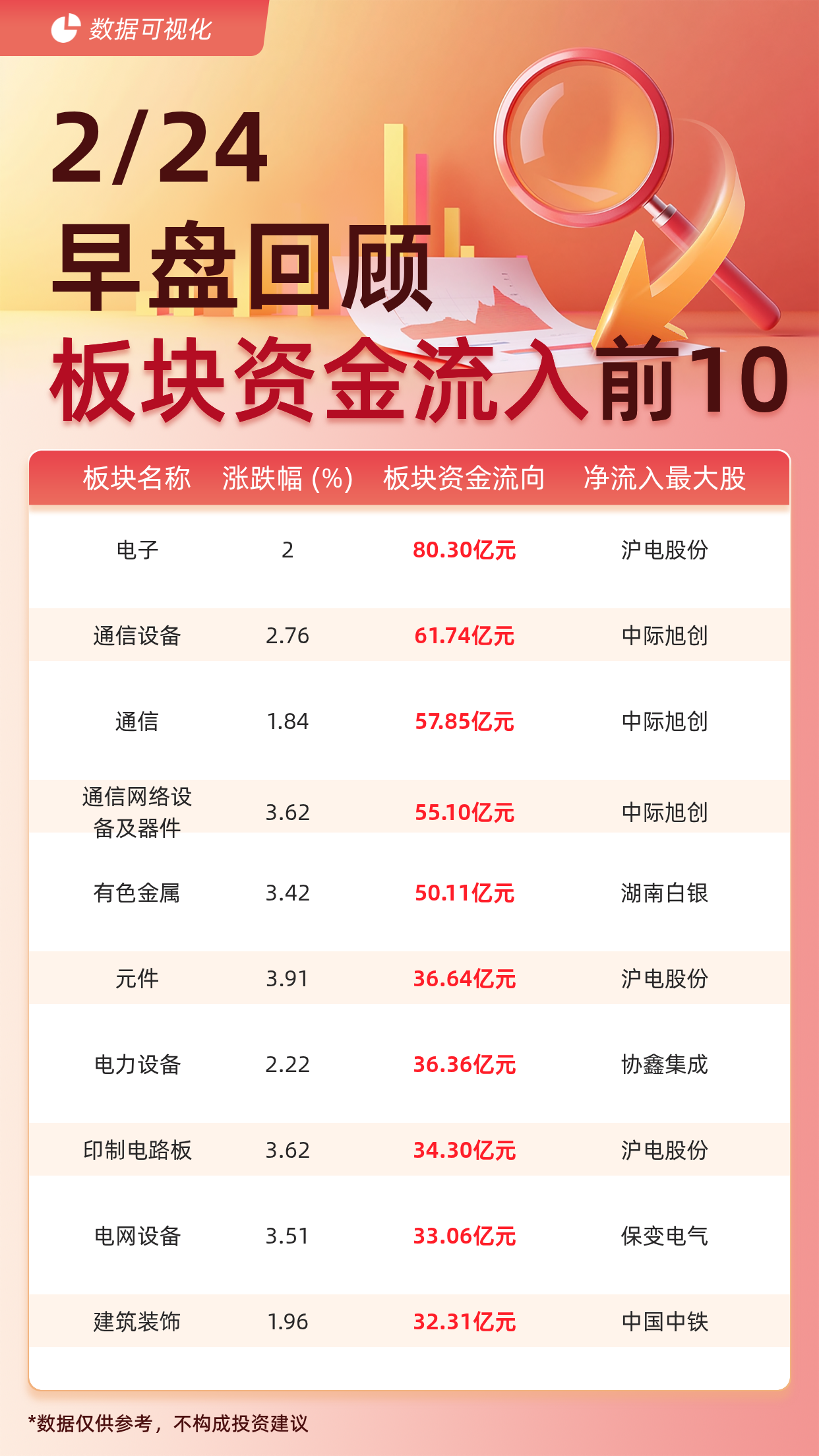
主力板块资金流入前10:电子流入80.30亿元、通信设备流入61.74亿元
Jin Rong Jie· 2026-02-24 03:50
Group 1 - The core point of the news is that as of February 24, the main capital inflow into the market reached 12.298 billion yuan, indicating strong investor interest in various sectors [1] - The top ten sectors with the highest capital inflow include Electronics, Communication Equipment, and Non-ferrous Metals, reflecting a diverse range of investment opportunities [1] Group 2 - The Electronics sector saw a capital inflow of 8.030 billion yuan with a price increase of 2% [2] - The Communication Equipment sector experienced a 2.76% increase with a capital inflow of 6.174 billion yuan [2] - The Communication sector had a capital inflow of 5.785 billion yuan and a price increase of 1.84% [2] - The Communication Network Equipment and Devices sector recorded a 3.62% increase with a capital inflow of 5.510 billion yuan [2] - The Non-ferrous Metals sector had a capital inflow of 5.011 billion yuan and a price increase of 3.42% [2] - The Components sector saw a capital inflow of 3.664 billion yuan with a price increase of 3.91% [2] - The Power Equipment sector experienced a 2.22% increase with a capital inflow of 3.636 billion yuan [3] - The Printed Circuit Board sector had a capital inflow of 3.430 billion yuan and a price increase of 3.62% [3] - The Power Grid Equipment sector recorded a 3.51% increase with a capital inflow of 3.306 billion yuan [3] - The Building Decoration sector saw a capital inflow of 3.231 billion yuan with a price increase of 1.96% [3]

光模块领涨,天孚通信再创历史新高!双创龙头ETF盘中拉升2%,机构:节后A股或开启新一轮上行
Xin Lang Ji Jin· 2026-02-24 03:42
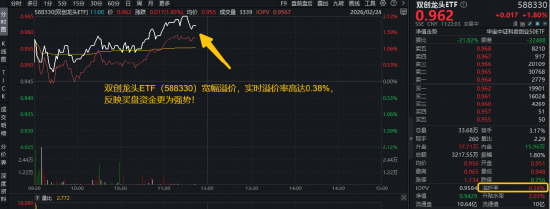
Core Viewpoint - The A-share market experienced a collective rise on the first trading day after the Spring Festival, with the ChiNext Index increasing by 2%, driven by strong performance in hard technology sectors and the Double Innovation Leader ETF (588330) showing significant gains [1][5]. Market Performance - On February 24, the A-share market saw all three major indices rise, with the ChiNext Index's gains reaching 2% and the Double Innovation Leader ETF (588330) peaking at a 2.12% increase during trading [1]. - The ETF's price rose by 1.8% during the session, recovering its 5-day and 20-day moving averages [1]. Sector Highlights - Leading stocks in the optical module sector surged, with Tianfu Communication rising over 14% to reach a historical high, while Zhongji Xuchuang and Xinyi Sheng increased by over 7% and 4%, respectively [1][3]. - Other notable performers included Runze Technology, which rose over 14%, and Sanhuan Group, which increased by over 12% [1][3]. Fund Inflows - The total inflow of new capital from public funds into the market exceeded 90 billion CNY, with a focus on technology growth sectors [3]. - CITIC Securities noted that the overall strong performance of global markets during the Spring Festival period contributed to a positive market sentiment in A-shares, suggesting a potential new upward trend [3]. ETF Performance - The Double Innovation Leader ETF (588330) has achieved a cumulative increase of 60.86% year-to-date, outperforming major indices such as the ChiNext 50 (57.45%) and the ChiNext Index (49.57%) [5]. - The ETF is designed to track a selection of 50 large-cap strategic emerging industry companies from the STAR Market and ChiNext, focusing on sectors like optical modules, semiconductors, and photovoltaic equipment [5]. Historical Trends - Historical data indicates that the probability of the Shanghai Composite Index and ChiNext Index rising on the first trading day after the Spring Festival is around 60% [4]. - Analysis from Zhongyuan Securities suggests that the market's upward trend is likely to continue in the following trading days, aligning with the "14th Five-Year Plan" and global monetary easing trends [4].

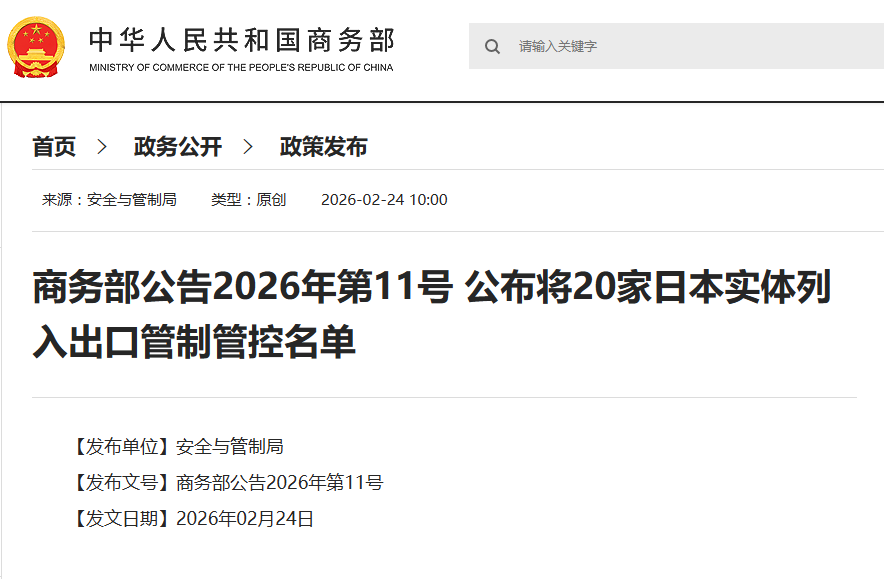
商务部将20家日本实体列入出口管制管控名单,将20家日本实体列入关注名单
Jin Rong Jie· 2026-02-24 03:14
Core Points - The Ministry of Commerce of China has announced export control measures against 20 Japanese entities involved in enhancing Japan's military capabilities, including Mitsubishi Heavy Industries and Subaru Corporation [1][3][10] - The measures include a ban on exporting dual-use items to these entities and a prohibition on foreign organizations and individuals transferring or providing such items to them [1][3][10] Group 1: Export Control Measures - The announcement includes a list of 20 entities, such as Mitsubishi Heavy Industries Shipbuilding Co. and Kawasaki Heavy Industries Aerospace Systems Company, which are now subject to export restrictions [2][3] - Exporters must immediately cease any ongoing activities related to these entities and can only apply for special export permissions under specific circumstances [1][3] Group 2: Focus List - An additional list of 20 Japanese entities, including Subaru Corporation and Fujitsu Defense & National Security, has been created due to the inability to verify the end users and end uses of dual-use items [3][9] - Exporters are prohibited from applying for general licenses or obtaining export certificates through registration for these entities, and must submit risk assessment reports for individual license applications [3][8] Group 3: Regulatory Context - The measures are framed as necessary to prevent Japan's "re-militarization" and nuclear ambitions, emphasizing that they are lawful and targeted at specific entities [10] - The Ministry of Commerce assures that these actions do not affect normal economic and trade relations between China and Japan, and compliant Japanese entities need not worry [10]
新易盛、中际旭创均获融资资金买入约百亿元丨资金流向周报
2 1 Shi Ji Jing Ji Bao Dao· 2026-02-24 03:12
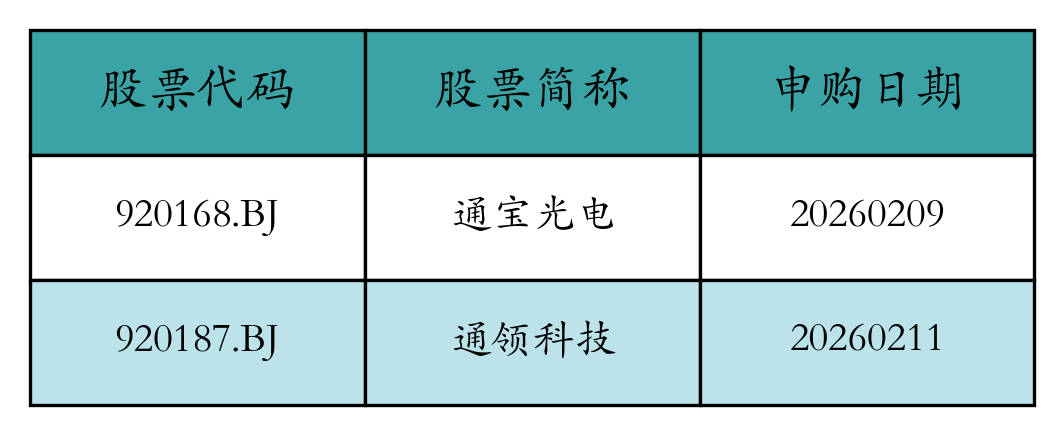
Market Overview - The Shanghai Composite Index increased by 0.41% to close at 4082.07 points, with a weekly high of 4142.56 points [1] - The Shenzhen Component Index rose by 1.39% to 14100.19 points, reaching a peak of 14296.48 points [1] - The ChiNext Index saw a 1.22% increase, closing at 3275.96 points, with a high of 3348.48 points [1] - In the global market, the Nasdaq Composite fell by 2.1%, the Dow Jones Industrial Average decreased by 1.23%, and the S&P 500 dropped by 1.39% [1] - In the Asia-Pacific region, the Hang Seng Index rose by 0.03%, while the Nikkei 225 Index increased by 4.96% [1] New Stock Issuance - Two new stocks were issued during the week: Tongbao Optoelectronics (920168.BJ) on February 9, 2026, and Tongling Technology (920187.BJ) on February 11, 2026 [2] Margin Trading - The total margin trading balance in the Shanghai and Shenzhen markets was 25,797.58 billion yuan, with a financing balance of 25,640.12 billion yuan and a securities lending balance of 157.46 billion yuan [3] - The margin trading balance decreased by 752.4 billion yuan compared to the previous week [3] - The Shanghai market's margin trading balance was 13,113.7 billion yuan, down by 356.66 billion yuan, while the Shenzhen market's balance was 12,683.88 billion yuan, down by 395.74 billion yuan [3] - A total of 3,486 stocks had margin buying, with 184 stocks having over 1 billion yuan in buying amounts, led by Xinyi Technology (103.25 billion yuan), Zhongji Xuchuang (98.63 billion yuan), and Wangsu Science and Technology (74.22 billion yuan) [3] Fund Issuance - Seven new funds were issued during the week, including Guoshou Anbao Enhanced Return Bond E, Huafu Anhua Bond D, Dongfanghong Monetary F, Bank of China Health Life Mixed C, Huitianfu Tiantianle Double Win Bond E, Nuoan Selected Return Mixed C, and Changsheng Electronic Information Theme Mixed C [5] Share Buybacks - Eight companies announced share buybacks, with the highest amounts executed by Luxshare Precision (002475), Hengyi Petrochemical (000703), Linyang Energy (601222), Kaiying Network (002517), and Huitai Medical (688617) [7] - The industries with the highest buyback amounts were electronics, petroleum and petrochemicals, and public utilities [8]





聚焦创新龙头,把握成长主线,中银创业板50指数基金发行
Jing Ji Guan Cha Wang· 2026-02-24 02:56
Core Viewpoint - The Chinese capital market is poised for significant growth driven by reforms and innovations, with a focus on technology independence and industrial upgrades as part of the national strategy, creating a historical opportunity for growth-oriented innovative companies [1] Group 1: Market Trends - Hard technology sectors such as artificial intelligence, high-end chips, and commercial aerospace are gaining unprecedented attention, providing a solid growth foundation for the capital market [2] - As traditional economic risks diminish and new growth drivers emerge, corporate profitability is expected to enter a recovery phase [2] - The "14th Five-Year Plan" emphasizes technology industries, consumer spending, and the construction of a unified national market, continuously catalyzing growth sectors [2] Group 2: Index Fund Advantages - Index investing has become increasingly popular due to its clear rules, transparency, and low costs, serving as an important tool for asset allocation and capturing market beta returns [3] - The components of the ChiNext 50 Index are concentrated in strategic emerging sectors such as power equipment, communications, electronics, and biomedicine, with the top three industries accounting for approximately 72% [3] - Since its base date on May 31, 2010, the ChiNext 50 Index has cumulatively increased by 238.58%, demonstrating strong long-term returns and significant elastic gains [3] - The ChiNext 50 Index components exhibit strong profitability resilience and growth potential due to technological barriers and innovative business models [3] Group 3: Fund Issuance - The issuance of the Bank of China ChiNext 50 Index Fund provides investors with a convenient way to participate in the growth of innovative companies, acting as a bridge to share in China's innovation and growth future [4]

27个行业获融资净卖出,电子行业净卖出金额最多
Sou Hu Cai Jing· 2026-02-24 01:45
Core Viewpoint - As of February 13, the latest market financing balance is 25,723.79 billion yuan, a decrease of 569.58 billion yuan compared to the previous trading day, with 4 industries showing an increase in financing balance [1] Industry Summary - The construction materials industry saw the largest increase in financing balance, rising by 1.22 million yuan to a total of 139.02 billion yuan, reflecting a growth rate of 0.88% [1] - Other industries with increased financing balances include petroleum and petrochemicals (up 707.28 million yuan), environmental protection (up 429.25 million yuan), and comprehensive industries (up 397.13 million yuan) [1] - A total of 27 industries experienced a decrease in financing balance, with the electronics, electric power equipment, and computer industries showing the largest declines of 73.80 billion yuan, 57.32 billion yuan, and 49.84 billion yuan, respectively [1] - The construction materials industry had the highest growth rate, followed by comprehensive, petroleum and petrochemicals, and environmental protection industries with growth rates of 0.80%, 0.32%, and 0.21% respectively [1] - Industries with the most significant declines include media, national defense and military industry, and computer industries, with financing balances of 585.39 billion yuan, 967.68 billion yuan, and 1,812.24 billion yuan, reflecting decreases of 2.89%, 2.70%, and 2.68% respectively [1]
春节假期全市实体店营业额228亿元
Chang Jiang Ri Bao· 2026-02-24 00:38
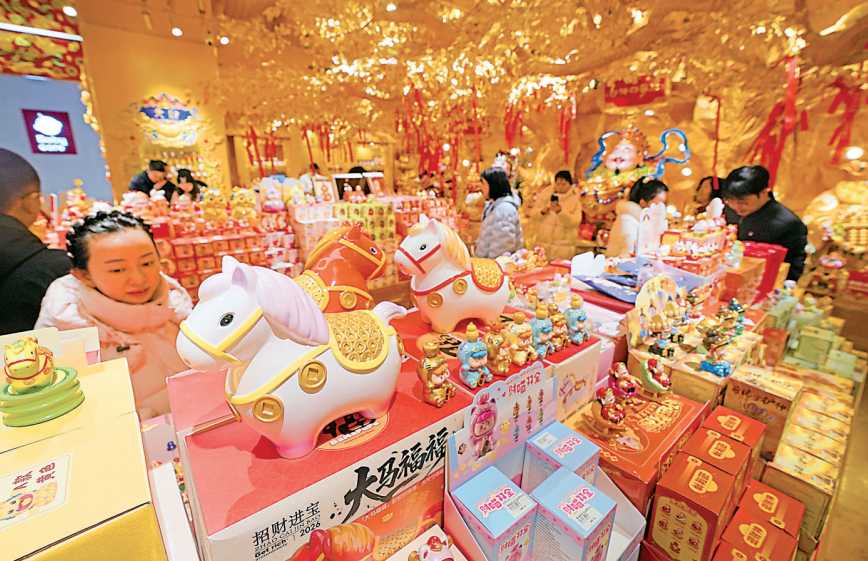
Core Insights - Wuhan's retail sales during the Spring Festival reached 22.811 billion yuan, a year-on-year increase of 26.73% [1] - The number of transactions was 47.6928 million, up 17.93% year-on-year, while the number of consumers reached 42.9656 million, increasing by 17.17% [1] Group 1: Consumption Trends - Key categories such as sports goods, electronic products, gift items, clothing, and home appliances saw significant growth, with sports goods up 196.6%, electronics up 89.18%, gifts up 56.48%, clothing up 36.65%, and home appliances up 31.25% [2] - The consumption structure indicates a clear trend towards quality and upgraded consumption, with steady growth in maternal and infant products, jewelry, and food and beverages [2] Group 2: Consumer Engagement Initiatives - The launch of a prize invoice pilot program integrated with commercial scenarios further stimulated consumer enthusiasm, exemplified by a customer winning 10 yuan after purchasing goods worth 106 yuan [3] - Innovative measures to activate cultural and tourism consumption included landmark renovations and community engagement, attracting a large number of tourists and boosting the restaurant market [2]
电子行业研究存储涨价持续,关注英伟达3月GTC大会亮点
SINOLINK SECURITIES· 2026-02-24 00:35
Investment Rating - The industry is rated positively, with a focus on AI-related sectors, particularly in PCB and core computing hardware, semiconductor equipment, and the Apple supply chain [4][27]. Core Insights - The upcoming GTC 2026 conference is expected to showcase groundbreaking new chips from NVIDIA, which could drive significant advancements in AI infrastructure [1][4]. - The demand for storage solutions is surging due to AI applications, leading to continuous price increases in DRAM and NAND, with limited supply expected to persist throughout the year [1][4]. - Major tech companies like Amazon, Google, and Meta are projected to increase capital expenditures significantly, indicating strong demand for AI-related hardware [1][4]. - The semiconductor industry is experiencing a recovery, with expectations of rising prices and demand driven by cloud computing and consumer electronics [21][23]. Summary by Sections 1. Consumer Electronics - The expansion of AI applications is expected to drive growth in the Apple supply chain and smart glasses, with a focus on enhancing processing power and memory [5]. - AI mobile applications are anticipated to grow, with several manufacturers releasing AI smart glasses and other innovative products [5]. 2. PCB - The demand for copper-clad laminates is increasing, with a high level of industry activity expected to continue due to AI and automotive applications [6]. 3. Components - The AI data center sector is seeing growth in SOFC (Solid Oxide Fuel Cell) projects, with companies like Sanhua Group positioned to benefit from this trend [19][34]. - The demand for passive components, particularly MLCCs, is rising due to increased usage in AI mobile devices [19]. 4. IC Design - The storage sector is expected to see upward trends, with DRAM prices projected to rise due to increased demand from cloud service providers and consumer electronics [21][23]. 5. Semiconductor Equipment - The semiconductor industry is experiencing a shift towards domestic production and self-sufficiency due to export controls, with companies like North Huachuang and Zhongwei Company positioned to benefit [24][26]. - The demand for advanced packaging and HBM (High Bandwidth Memory) is strong, with companies in this space expected to see significant growth [24][25]. 6. Specific Companies - Victory Technology is expected to see substantial profit growth due to its leadership in PCB manufacturing and its alignment with AI infrastructure demands [28]. - North Huachuang is expanding its semiconductor equipment offerings, enhancing its competitive position in the market [29]. - Jiangfeng Electronics is focusing on domestic production of static suction cups to reduce reliance on foreign suppliers, addressing a critical supply chain issue [35].

机构集体期待A股马年“开门红”,给出春季行情两大主线
Di Yi Cai Jing Zi Xun· 2026-02-23 13:24
Group 1 - The core viewpoint of the articles indicates a strong expectation for the A-share market to perform well after the Spring Festival, driven by positive sentiment from the Hong Kong stock market and anticipated policy support [1][5][6] - The Hang Seng Index and the Hang Seng Technology Index both showed significant gains, with the former rising by 2.53% to 27,081.91 points and the latter increasing by 3.34% to 5,385.35 points [1] - Analysts suggest that the investment focus will be on "technology + cyclical" sectors, with a particular emphasis on companies with strong performance certainty in niche markets [1][6] Group 2 - The Spring Festival Gala showcased various technological elements, which are expected to positively influence the stock market, particularly in the robotics and AI sectors [2][3] - The performance of overseas markets during the Spring Festival is likely to have a significant impact on A-shares, with historical data showing that technology growth sectors tend to outperform shortly after the holiday [3][4] - The average increase of the Shanghai Composite Index in the five trading days following the Spring Festival over the past 20 years is 1.2%, indicating a strong seasonal trend [5] Group 3 - Analysts predict that the upcoming policies related to "artificial intelligence +" and digital economy development will accelerate after the holiday, further supporting the technology sector [3][6] - The liquidity environment is expected to remain favorable, with a potential for continued inflow of funds into the market, which could enhance trading activity post-holiday [5][6] - Specific sectors such as industrial metals, chemicals, and technology-related fields like robotics and AI are highlighted as areas of potential investment opportunity [6]
转债事件点评:把握春季行情下半场
GUOTAI HAITONG SECURITIES· 2026-02-23 13:08
Core Insights - The report suggests adopting a "steady first, with growth in mind" approach to maintain gains in the second half of the spring market and to reserve space for future positioning [2][15] - The spring market of 2026 began on December 17, 2025, driven by favorable policies and early capital allocation, leading to a strong performance in the A-share market, with the Shanghai Composite Index achieving 17 consecutive days of gains [9][13] - The convertible bond market experienced rapid growth followed by volatility, with median prices and conversion premiums reaching historical highs, indicating a significant reduction in the safety cushion of bonds [9][10] Market Trends - Historical data from 2017 to 2025 indicates that the market typically experiences a "rise then fall" pattern from the Spring Festival to the National People's Congress (NPC) [13][14] - The report highlights that during the period from the Spring Festival to the NPC, the market is likely to see a "spring surge," with small-cap growth stocks outperforming, particularly in TMT and high-end manufacturing sectors [13][14] - As the NPC approaches, the market may shift towards defensive sectors like pharmaceuticals and utilities, with high valuations in convertible bonds facing potential compression due to stock adjustments [13][14] Investment Strategy - The report recommends a balanced investment strategy, transitioning from aggressive profit-seeking to balancing returns and risks as the market moves into the NPC and Q1 earnings preview phase [15] - It emphasizes the importance of selecting convertible bonds with solid performance and reasonable pricing, while also considering high-quality, high-priced convertible bonds with clear growth prospects [15] - The report identifies sectors such as AI computing, semiconductors, non-ferrous metals, and post-cycle industries like consumption and real estate as favorable for convertible bonds due to improving supply-demand dynamics and favorable policy catalysts [15]