饮料

Search documents
东鹏饮料:2025年净利同比预增30.46%-37.97%
Mei Ri Jing Ji Xin Wen· 2026-01-13 09:43
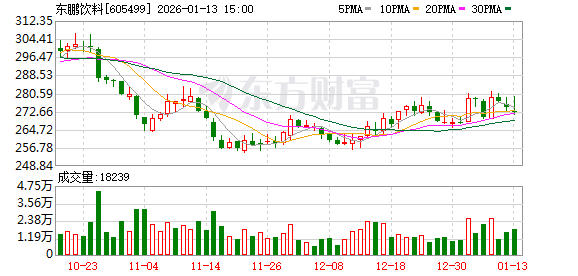
Core Viewpoint - Dongpeng Beverage (605499.SH) announced its 2025 performance forecast, expecting a net profit attributable to shareholders of 4.34 billion to 4.59 billion yuan, representing a growth of 30.46% to 37.97% compared to the previous year [2] Group 1: Financial Performance - The company anticipates a net profit range of 4.34 billion to 4.59 billion yuan for 2025 [2] - This forecast indicates a significant year-on-year growth of 30.46% to 37.97% [2] Group 2: Strategic Initiatives - The company will continue to adhere to the strategy of "sales-driven management" [2] - It aims to advance its national strategy through refined channel management and enhanced channel operation capabilities [2] - The company is focusing on strengthening its two main product categories, Dongpeng Special Drink and Dongpeng Hydration, while actively exploring multi-category development to cultivate new growth points [2]


食品饮料周报(26年第2周):渠道步入春节旺季备货,多重利好催化餐饮供应链-20260112
Guoxin Securities· 2026-01-12 11:14
Investment Rating - The report maintains an "Outperform" rating for the food and beverage sector, indicating expected performance above the market index by over 10% [4][5][70]. Core Views - The food and beverage sector is entering a peak stocking season ahead of the Spring Festival, with multiple favorable catalysts for the restaurant supply chain [1]. - The report highlights a divergence in the fundamentals of different categories, with beverages outperforming food and alcoholic beverages [2]. - Key investment themes for 2026 include cost advantages from low raw material prices, efficiency improvements through supply chain optimization, innovation-driven growth, and opportunities for recovery in distressed sectors [3][10]. Summary by Relevant Sections Alcoholic Beverages - The report emphasizes the strong dividend characteristics of the liquor sector, particularly with Moutai's market reforms gradually taking effect. It suggests that high-quality companies with pricing power and regional influence are likely to achieve greater growth [2][10]. - Recommendations include Moutai, Shanxi Fenjiu, and Luzhou Laojiao, with a focus on their growth potential and market positioning [2][10]. Beer - The beer industry is currently managing inventory well and is poised for demand recovery. The report recommends Yanjing Beer for its rapid growth and strong internal reforms [11]. Dairy Products - The dairy sector is experiencing orderly stocking for the Spring Festival, with a recommendation for leading companies like Yili, which is expected to benefit from improved margins and demand recovery [14]. Snacks - The report suggests focusing on strong alpha stocks in the snack sector, particularly those innovating in konjac products. Leading companies like Weidong and Yanjinpuzi are highlighted for their competitive advantages and growth potential [12][17]. Restaurant Supply Chain - The restaurant supply chain is entering a busy stocking season, with clear recovery trends. Recommendations include leading companies in the compound seasoning sector and those with national capacity and channel layouts [13][14]. Beverage Sector - The beverage sector is primarily focused on destocking during the off-season, with stable stocking for the Spring Festival. Leading companies like Nongfu Spring and Dongpeng Beverage are recommended for their aggressive growth strategies [15].
椰树彻底不装了,“大尺度”新年挂历炸翻全网!
商业洞察· 2026-01-12 09:26
Core Viewpoint - The article discusses the transformation of the marketing strategy of the company "椰树" (Coconut Tree) in response to regulatory pressures and declining growth, shifting from provocative advertising to a focus on brand storytelling and product quality [4][10][32]. Group 1: Marketing Strategy Shift - The 2026 calendar of椰树 marks a significant change in its marketing approach, moving away from previous provocative imagery to a more inspirational narrative featuring the founder's story [4][10][30]. - The company has abandoned its previous "edgy marketing" style, which included the use of attractive models and suggestive advertising, in favor of a more conservative and motivational presentation [15][21]. - Following a fine of 400,000 yuan in 2024 for violating advertising regulations,椰树 has altered its promotional content to avoid further penalties, indicating a serious response to regulatory scrutiny [18][28]. Group 2: Financial Performance and Market Position -椰树's revenue growth has stagnated, with 2024's revenue at 5.006 billion yuan, only a 0.12% increase from 2023, highlighting the challenges faced by the company in a competitive market [28]. - The company experienced a significant drop in market share from 75% in 1999 to 26.3% in 2019, reflecting increased competition and the need for a strategic pivot [23]. - Despite the challenges,椰树's revenue grew from 4.616 billion yuan in 2021 to 5.099 billion yuan in 2023, with a notable sales volume of 700,000 tons in 2023, indicating a temporary success in leveraging new marketing strategies [27]. Group 3: Product Quality and Brand Narrative -椰树's commitment to product quality is emphasized, with a focus on not using artificial flavors or preservatives, and employing proprietary technology to enhance product shelf life [31]. - The brand narrative now centers around the founder's journey of transforming a struggling factory into a leading industry player, which serves to build a resilient brand image [30][32]. - The positive consumer response to the new marketing approach, as evidenced by high demand for the 2026 calendar, suggests that a focus on genuine storytelling and product integrity resonates more with customers than previous sensational tactics [30][32].

达利食品上市前的核心产品矩阵包含哪些品牌?这些品牌是如何逐步培育起来的?
Sou Hu Cai Jing· 2026-01-12 09:14
Group 1 - Dali Foods was listed on the Hong Kong Stock Exchange in 2015, establishing a product matrix centered on snack foods and extending into beverages, with core brands including Daliyuan, Kexi, Haochidian, Heqizheng, and Lehu, covering various categories such as pastries, puffed snacks, biscuits, herbal tea, and functional drinks [1] - The brand Daliyuan was launched in 2002, focusing on the pastry segment with egg yolk pies as the core product, targeting the demand for consumer upgrades, and quickly gaining market traction through celebrity endorsements and effective marketing strategies [1] - In 2003, Dali introduced Kexi potato chips to penetrate the puffed snack market, which was dominated by foreign brands, offering prices one-third lower than imported brands and leveraging celebrity endorsements to attract young consumers [1] Group 2 - The biscuit brand Haochidian was launched in 2004, breaking the dominance of foreign brands in the high-end biscuit market, with a widely recognized advertising slogan endorsed by a popular celebrity [2] - Dali expanded into the beverage sector with the launch of Heqizheng herbal tea in 2007 and Lehu functional drinks in 2013, continuing the strategy of celebrity endorsements while establishing nine production bases nationwide to enhance regional marketing and create an efficient sales network [2] - The company successfully built a multi-brand collaborative product matrix, laying a solid foundation for its listing and achieving nationwide brand coverage [2]
核心投资平台悄然“去娃哈哈化” 宗馥莉独立商业版图渐成型
Sou Hu Cai Jing· 2026-01-12 05:47
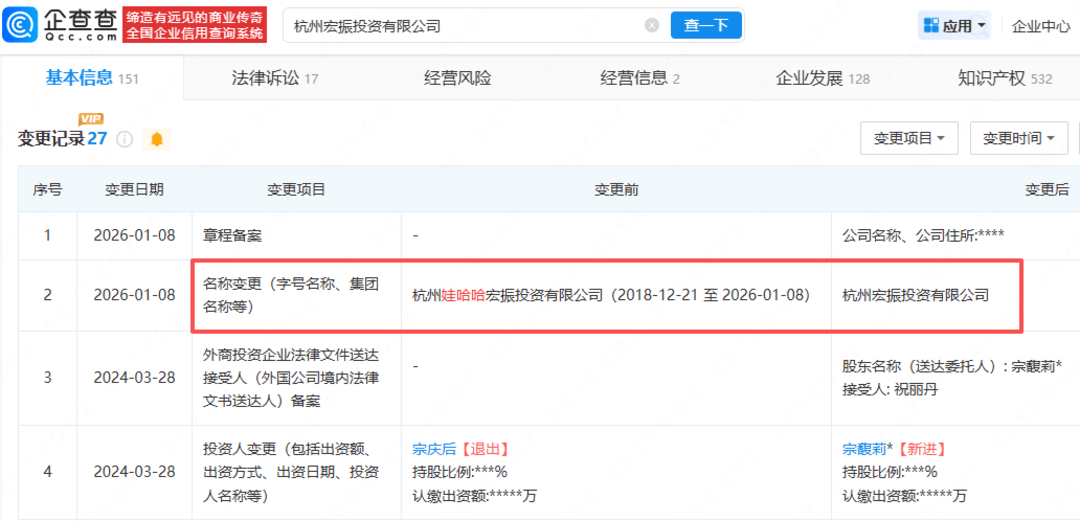
Core Viewpoint - The renaming of Hangzhou Wahaha Hongzhen Investment Co., Ltd. to Hangzhou Hongzhen Investment Co., Ltd. signifies a profound transformation in the operational logic and corporate culture within the Wahaha family, led by Zong Fuli, who is strategically restructuring her business landscape away from the Wahaha brand [1][3]. Group 1: Company Changes - The name change occurred on January 8, 2026, coinciding with Zong Fuli stepping down from key positions at Hangzhou Wahaha Food Co., Ltd. [1][2]. - Zong Fuli has been transitioning to a role that emphasizes capital layout and strategic control, moving away from direct operational involvement [8]. Group 2: Strategic Implications - The restructuring is interpreted as a strategic separation from the complex legacy of the Wahaha brand, allowing Zong Fuli to implement her business vision more freely [7]. - The year 2026 is anticipated to be pivotal for Zong Fuli, with plans for significant business measures to be executed following the completion of her strategic layout [1][7]. Group 3: Historical Context - Zong Fuli's takeover of core assets began after the passing of her father, Zong Qinghou, in February 2024, and she quickly assumed control of key positions within the company [3][5]. - The Hongzhen Investment platform, established in December 2007 with a registered capital of 180 million yuan, controls over 48 enterprises across various sectors, including food and beverage, packaging, and emerging industries like semiconductors and biomedicine [3][4].
2 Top Dividend Stocks I'd Own Over the Next Decade
Yahoo Finance· 2026-01-11 16:07
Group 1: Visa - Visa processed 258 billion transactions and $14 trillion in payment volume in fiscal 2025, connecting approximately 12 billion endpoints globally [2] - The company operates an asset-light model that generates steady cash flow, with value-added services now representing 27% of total revenue, growing at a low-to-mid 20% rate [3] - Visa supports four different stablecoins across multiple blockchains, with settlement volume reaching a $2.5 billion annual run rate, increasing over 100% recently [4] - The Visa Intelligent Commerce platform is being developed to facilitate secure transactions made by AI-powered agents [5] Group 2: Coca-Cola - Coca-Cola owns 30 billion-dollar brands, which is about double its nearest competitor and represents 25% of all billion-dollar brands in the global beverage industry [6] - CEO James Quincey emphasizes the need for continuous evolution to maintain market dominance, referencing past challenges despite previous successes [7] - The company is expanding into premium dairy with Fairlife, which has seen a tenfold growth in Mexico since acquisition, with new capacity expected to increase production by 30% in 2026 [8]


周观点、两湖零食调研反馈:环比走出底部,旺季将至可期-20260111
GOLDEN SUN SECURITIES· 2026-01-11 05:56
Investment Rating - The report suggests a positive outlook for the liquor sector, with a recommendation to invest in specific companies based on supply and demand improvements expected in 2026 [1] Core Insights - The snack industry is showing signs of recovery, with companies entering the critical phase of preparing for the Spring Festival, which is expected to boost performance in Q1 2026 due to low base effects and seasonal demand [2] - Companies are adjusting their channel operations and product priorities in response to evolving market demands, leading to gradual improvements in their performance [2] - Specific companies like 甘源食品 (Ganyuan Food) and 劲仔食品 (Jinzai Food) are highlighted for their strategic adjustments and potential for recovery in 2026 [3][4] Summary by Sections Liquor Sector - The liquor market is expected to see a dual improvement in supply and demand by 2026, with short-term sales showing signs of recovery [1] - Recommended companies for investment include 泸州老窖 (Luzhou Laojiao), 古井贡酒 (Guojingongjiu), and 贵州茅台 (Kweichow Moutai) among others [1] Snack Industry - The snack sector is entering a critical preparation phase for the Spring Festival, with companies like 甘源食品 (Ganyuan Food) and 劲仔食品 (Jinzai Food) making strategic adjustments to improve their market positions [2][3][4] - 甘源食品 is expected to recover from a significant revenue decline by leveraging new product launches and channel improvements [3] - 劲仔食品 is shifting focus to new product categories to drive growth, despite facing some revenue pressures [4] Market Trends - The overall food and beverage sector is projected to experience a rebound, with specific attention on the performance of major brands and their strategic responses to market changes [1][2]
西方营销模式正在失效,中国市场进入“本土规则”时代
Sou Hu Cai Jing· 2026-01-09 15:40
Core Insights - The global floor cleaning robot industry is witnessing a significant shift, with the acquisition of iRobot by its Chinese manufacturing partner, marking the end of an era for the former industry leader [2] - Local brands in China are rapidly gaining market share, forcing international brands like Starbucks, Nike, and Adidas to adapt or face decline [2] - A survey indicates that 85.79% of consumers prefer domestic trendy brands, highlighting the rise of local brands in various consumer sectors [2] Industry Trends - The traditional Western marketing models are becoming ineffective in the Chinese market, as local brands redefine the rules of engagement [4][7] - The previous reliance on mass advertising and standardized marketing strategies is being replaced by personalized and emotionally resonant approaches [9][10] - The emergence of new consumer behaviors emphasizes the importance of emotional connections and personalized experiences over traditional functional marketing [10][11] Brand Strategies - Successful local brands like Qingdao White Beer are leveraging cultural symbols and emotional narratives to resonate with consumers [19][21] - Qingdao White Beer has effectively created immersive experiences that connect with local culture, enhancing brand visibility and consumer engagement [21][22] - The focus has shifted from merely selling products to creating emotional experiences that align with consumers' lifestyles and values [22]





谁在掏空汇源果汁 | 深一度
Sou Hu Cai Jing· 2026-01-09 09:42
Core Viewpoint - The internal conflict within Huiyuan Group, once a leading juice brand, is leading the company towards a crisis, marked by accusations against its controlling shareholder, Shanghai Wensheng, for failing to fulfill financial commitments and jeopardizing brand integrity [1][2]. Group 1: Financial Commitments and Control - Huiyuan Group accused Shanghai Wensheng of breaching their agreement by failing to pay 8.5 billion out of the promised 16 billion, which has resulted in a strained cash flow for the company [2]. - The investment firm has not utilized the 7.5 billion already received for operational management, further exacerbating Huiyuan's financial difficulties [2]. Group 2: Brand Integrity and Safety Concerns - Huiyuan claims that Shanghai Wensheng, lacking juice production experience, has bypassed safety protocols to source raw materials from ordinary factories, leading to the production of counterfeit Huiyuan juice products [2][3]. - This situation not only threatens the brand's reputation but also raises significant food safety concerns [3]. Group 3: Market Position and Competition - The ongoing internal strife has resulted in a loss of market presence, with Huiyuan's e-commerce platforms showing empty product listings, indicating a complete stockout [5]. - Competitors like Nongfu Spring are gaining market share, while retail giants are increasingly pushing their own juice brands, putting additional pressure on Huiyuan [5]. Group 4: Financial Performance and Future Outlook - Huiyuan is projected to see a 10% decline in revenue and a 19% drop in net profit for 2024, reflecting the company's ongoing struggles [6]. - As the peak sales season approaches, Huiyuan's two major e-commerce channels have yet to recover, raising questions about the company's future viability [7].
2025年第53周:食品饮料行业周度市场观察
艾瑞咨询· 2026-01-09 00:05
Group 1: Industry Trends - The condiment industry is seeing a surge in companies going public, focusing on overseas markets to combat rising costs and intense competition, with the industry expected to reach a scale of 498.1 billion yuan by 2024 [2][3] - The popularity of turmeric drinks is rising among young consumers, driven by health trends, with sales strong despite higher prices, and social media engagement showing over 13.2 million views on platforms like Xiaohongshu [4] - The food waste issue is prompting the emergence of the Upcycled Food industry, which is projected to reach a market size of 74.8 billion USD by 2029, utilizing innovative technologies to convert waste into high-value products [6][7] Group 2: Consumer Behavior - A survey indicates that 97.2% of young people have tried "light health" practices, with dietary health and fragmented exercise being the most popular methods, highlighting a shift towards more manageable health solutions [8] - The rise of health-conscious beverages, including sugar-free teas and functional drinks, is attributed to increased consumer awareness and the psychological need for immediate satisfaction in fast-paced lifestyles [10] - The trend of "punk health" in the health liquor sector is attracting younger consumers, with sales of health liquor on e-commerce platforms surging by 75.8% in the first eight months of 2025 [15] Group 3: Market Innovations - The introduction of cooking robots in restaurants is rapidly expanding, with the market expected to exceed 3.7 billion yuan by 2025, driven by AI technology and efficiency improvements [9] - The flavored water market is projected to grow from 22.1 billion USD in 2025 to 57.3 billion USD by 2035, with a compound annual growth rate of 10%, driven by health trends and innovative flavors [16] - The bottled water industry is facing intensified competition, with brands needing to diversify their product offerings and improve supply chain efficiency to maintain market share [17] Group 4: Brand Dynamics - The brand "Guozi Shule" is expanding its product line in the sugar-free tea market and has seen significant growth in its large bottle sales, indicating a strategic shift towards channel expansion [19] - "Tai Er" is undergoing a brand upgrade to focus on fresh ingredients and new dishes, responding to market changes and performance pressures, with a notable decline in revenue [20] - Danone's beverage brand "Pulse" is expected to reach nearly 7 billion yuan in revenue by 2025, with plans to expand into health drinks and face competitive pressures [21]