智能电动汽车

Search documents
李斌:蔚来一直反对打价格战,行业反内卷对蔚来走向盈利是好事
Xin Lang Ke Ji· 2025-06-04 08:28
新浪科技讯 6月4日下午消息,在今日的蔚来沟通会上,蔚来创始人、董事长、CEO李斌,蔚来联合创 始人、总裁秦力洪与媒体对话。 对于近期的价格战话题,李斌表示,最近行业协会、主管部门也在呼吁要坚决反对内卷式竞争,蔚来肯 定是不喜欢价格战。如果只是从价格战去参与做市场竞争的手段,对整个行业的健康发展都是非常不利 的。蔚来一直都是在研发方面坚决进行投入,在充换电网络方面进行坚决投入,在用户体验、用户价值 方面进行投入。这些投入如果简单被价格战就给带进去了,对于蔚来这种做长期投入的公司来说,肯定 是非常辛苦的。 "我们也非常高兴看到现在国家相关部门在治理行业乱象,行业协会也进行了呼吁,我们一直都是反对 打价格战。"他表示,蔚来被迫参与市场促销方面,总的来说都是非常克制的。现在行业反内卷是利好 蔚来,希望整个行业能够把精力放在技术创新、用户服务上。避免简单的用价格战去把行业推到非常难 以持续竞争的境地里去。希望整个行业能够真正拼技术、拼品质、拼服务,这样才能让整个行业能够健 康持续地发展。才能够把中国智能电动汽车产业、新能源产业来之不易的好局面保持下来。 "我们认为现在行业反内卷,对蔚来是好事儿。因为我们本来是被动参与 ...

蔚来汽车
数说新能源· 2025-06-04 03:27
Core Viewpoint - The company has shown a steady increase in electric vehicle deliveries and is focused on cost reduction and product innovation to improve financial performance and market competitiveness [1][2][3][8]. Group 1: Delivery and Sales Performance - In the first quarter, the company delivered 42,094 smart electric vehicles, a year-on-year increase of 4.1%, with expectations for the second quarter to reach between 72,000 and 75,000 vehicles, representing a year-on-year growth of 25.5% to 30.7% [1]. - The company successfully launched new models including ES6, EC6, ET5, and ET5T, which are expected to enhance sales performance [2][12]. - ONVO brand has seen a steady increase in orders since April, with the L60 model ranking among the top three in its segment [18][20]. Group 2: Financial Performance - Total revenue reached RMB 12 billion, a year-on-year increase of 21.5% [8]. - The automotive gross margin improved to 10.2%, up from 9.2% in the previous year, driven by lower material costs [9]. - Operating loss was RMB 6.4 billion, a year-on-year increase of 19%, while net loss was RMB 6.8 billion, a year-on-year increase of 30.2% [10]. Group 3: Cost Management and Efficiency - The company has implemented cost control measures, aiming for a 15% reduction in R&D expenses in the second quarter [14]. - Sales and management expenses increased by 46.8% year-on-year, but the company plans to manage these costs carefully to achieve a target of keeping non-GAAP sales and management expenses below 10% of sales revenue by the fourth quarter [10][14]. - The company is focusing on improving operational efficiency through restructuring and resource allocation [13][14]. Group 4: Product and Technology Innovation - The NX9031 smart driving chip has been deployed in flagship models, enhancing product competitiveness and cost structure [3]. - The NWM model has been launched, providing significant upgrades in active safety and driving experience [16][17]. - The company plans to introduce the L90 model in the third quarter, which is expected to attract strong interest due to its innovative features [20]. Group 5: Charging and Battery Swap Network - The company operates 3,408 battery swap stations globally, providing over 75 million battery swap services [5]. - The charging network has expanded significantly, with over 26,000 charging piles installed across major cities [5]. - The company is working on increasing the coverage of its battery swap network, particularly in lower-tier cities [19]. Group 6: International Expansion - The company has established partnerships in over 15 core markets and plans to expand its global presence with the launch of the Firefly brand in several European countries [7][28]. - The focus remains on long-term growth rather than aggressive short-term sales targets in international markets [28]. Group 7: Production Capacity and Supply Chain Management - The current production capacity is sufficient to meet the expected delivery targets for the fourth quarter, with plans to open a third factory in September [29]. - The company is transitioning to a more inventory-based sales model to better meet consumer demand [30].


蔚来财报信息背后:第一季度耕种 第二季度开始收获
Xin Jing Bao· 2025-06-04 03:02
Core Insights - NIO reported a significant increase in vehicle deliveries, reaching 42,100 units in Q1, a 40.1% year-over-year growth, exceeding market expectations [1] - The company provided a strong delivery guidance for Q2, expecting deliveries to reach between 72,000 and 75,000 units, indicating confidence in its operational performance [1] Technological Advancements - NIO's founder, Li Bin, introduced a "new three major components" technology strategy focusing on smart driving chips, a comprehensive operating system, and intelligent chassis, marking a period of technological development for the company [2] - The launch of the world's first 5nm automotive-grade smart driving chip, "Shenji NX9031," achieved mass production with a computing power exceeding 1000 TOPS, enhancing the performance of key models [2] - The integration of the full operating system and intelligent chassis technology has improved vehicle efficiency and safety, laying a solid foundation for profitability in Q4 [2] Product Strategy - 2025 is projected to be a significant year for NIO, with flagship model ET9 achieving sales that surpassed BMW 7 Series and Audi A8 within its first month of delivery [3] - The company has implemented a "more for less" pricing strategy and an "immediate delivery upon launch" model, enhancing market competitiveness [3] - New sub-brands and models, including the L90 SUV and the L80, are set to expand the product lineup, with significant sales achievements from the Firefly brand [3] Organizational Changes - NIO faced challenges in Q1 due to seasonal sales dips and high R&D costs but implemented a deep organizational restructuring to optimize resource allocation [4] - The introduction of the CBU (Core Business Unit) mechanism divided operations into 12 core units, improving efficiency across the entire value chain [4] - The company reported a 42.8% increase in deliveries for the Lido brand in May, despite a 40% reduction in sales personnel, indicating effective operational improvements [4] Market Outlook - Li Bin emphasized the importance of focusing efforts on key areas to navigate market challenges, with plans for nine new vehicle launches within the year [5] - NIO aims to leverage self-developed technology and refined operations to achieve profitability targets in Q4, amidst a competitive landscape in the smart electric vehicle sector [5]
小米集团-W(01810.HK):1Q25营收、利润创历史新高 智能电动汽车业务亏损收窄
Ge Long Hui· 2025-06-04 01:53
Group 1 - The company achieved record high revenue and profit in Q1 2025, with total revenue of 111.3 billion yuan (YoY +47%) and adjusted net profit of 10.7 billion yuan (YoY +65%), marking a historical high for a single quarter [1] - The gross margin improved to 22.8% (YoY +0.5 percentage points), indicating effective cost management and operational efficiency [1] - The revenue contributions from various business segments in Q1 2025 were 46% from smartphones, 29% from IoT and consumer products, 8% from internet services, and 17% from smart electric vehicles and AI [1] Group 2 - The IoT business generated revenue of 32.3 billion yuan (YoY +59%) with a gross margin of 25.2% (YoY +5.4 percentage points), achieving a historical high in revenue and gross profit [2] - Smart home appliances saw a significant revenue increase of 114%, with air conditioners, refrigerators, and washing machines experiencing shipment growth of 65%, 65%, and 100% respectively [2] - The internet services segment reported revenue of 9.1 billion yuan (YoY +13%) with a gross margin of 76.9% (YoY +2.7 percentage points) [2] Group 3 - The smart electric vehicle and AI business reported revenue of 18.6 billion yuan, with a gross margin of 23.2%, and the loss in this segment narrowed to 500 million yuan [2] - The company delivered 76,000 units of the Xiaomi SU7 series in Q1 2025, with cumulative deliveries exceeding 258,000 units [2] - The company opened 235 automotive sales stores by March 31, 2025, enhancing its sales and service network [2] Group 4 - The company launched its first self-developed SoC, the Xuanjie O1, and introduced the Xiaomi 15S Pro and Xiaomi Pad 7 Ultra, along with a new 4G watch chip [3] - R&D expenses reached 6.7 billion yuan in Q1 2025, reflecting a 30% year-on-year increase, indicating a strong commitment to core technology development [3] - The company raised its profit forecast for 2025-2027, expecting net profits of 36.2 billion, 46.4 billion, and 66 billion yuan respectively, with growth rates of 53%, 28%, and 42% [3]

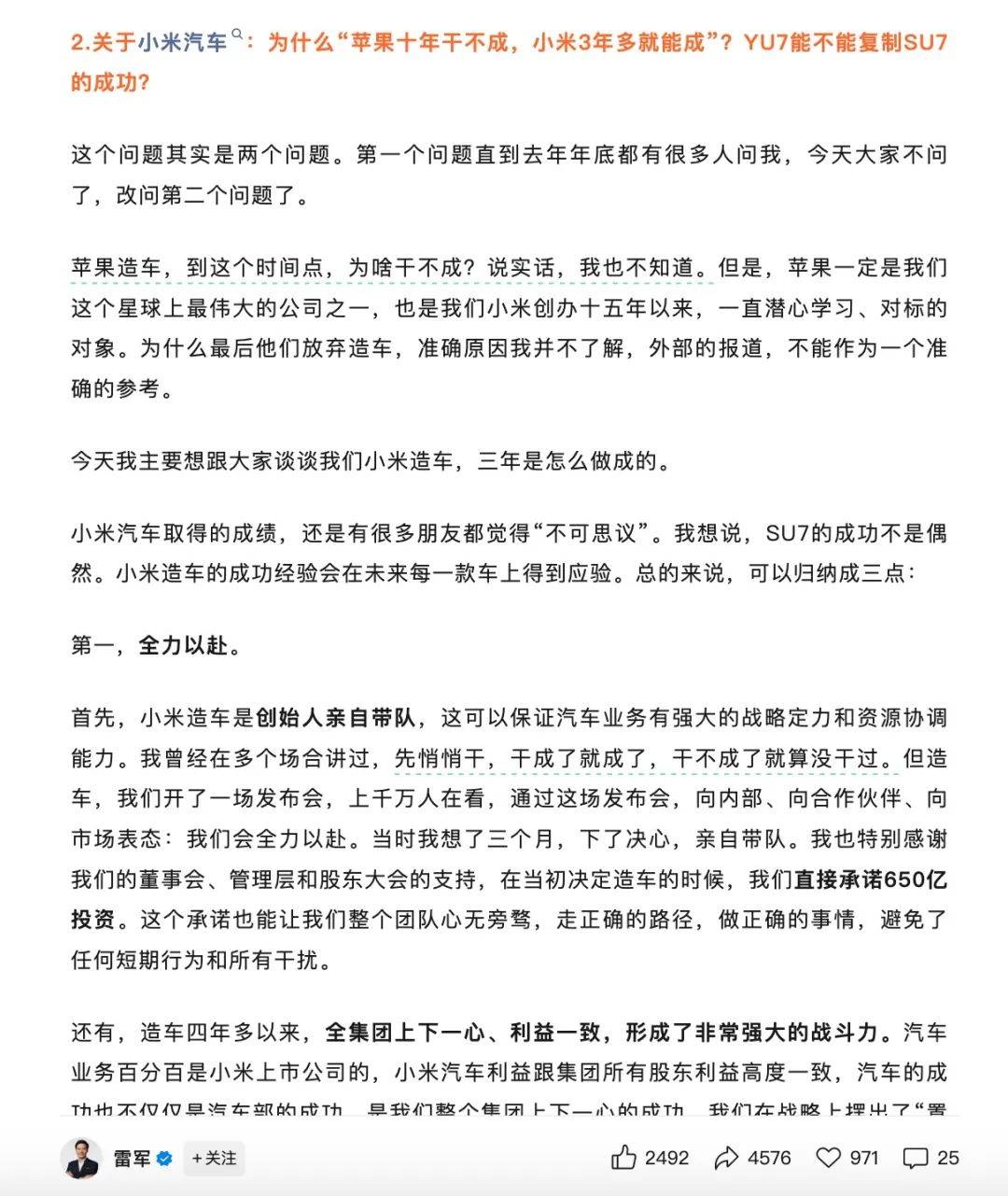
雷军分享造车“成功学”:揶揄有车企一年做几十款,是在“赌”
Sou Hu Cai Jing· 2025-06-04 01:00
Core Insights - Xiaomi's success in the automotive sector, particularly with the SU7 model, is attributed to a focused strategy and significant investment commitment [1][3] - The company aims to learn from industry leaders like Tesla and Porsche, emphasizing the importance of respect for the complexities of the automotive industry [5] - Xiaomi's unique approach, including a focus on a single flagship model, has led to a successful market entry, with the SU7 outperforming competitors in sales [8][10] Investment and Strategy - Xiaomi's board and management committed to an investment of 65 billion yuan, which has allowed the team to focus on long-term goals without distractions [3] - The company emphasizes a "one model at a time" strategy, believing that this approach increases the likelihood of success compared to competitors who produce multiple models [5][10] Market Performance - The SU7 has seen continuous sales growth, surpassing models like the Tesla Model 3 and BYD Han, with over 28,000 units delivered in May, marking a historical high [8][10] - The upcoming YU7 model has generated significant interest, with user registrations three times higher than those for the SU7 during its launch phase [7] Design and Public Perception - The design of the SU7 has faced criticism for its similarities to the Porsche Taycan, while the YU7 has been compared to the Ferrari Purosangue, highlighting the need for originality in design [8] - Despite design controversies, the sales performance of the SU7 has established a strong foundation for Xiaomi's automotive ambitions [8] Financial Outlook - Xiaomi's automotive business is projected to become profitable in the third or fourth quarter of this year, with Q1 revenues from smart electric vehicles reaching 18.6 billion yuan [10] - The gross margin for the smart electric vehicle segment increased by 10.6 percentage points year-on-year to 23.2% [10]
中证智能电动汽车指数上涨0.1%,前十大权重包含立讯精密等
Jin Rong Jie· 2025-06-03 14:14
Core Viewpoint - The China Securities Index for Intelligent Electric Vehicles has shown a slight increase recently, but it has experienced declines over the past month, three months, and year-to-date, indicating a challenging market environment for the sector [2]. Group 1: Index Performance - The China Securities Intelligent Electric Vehicle Index rose by 0.1% to 3119.44 points with a trading volume of 30.695 billion yuan [1]. - Over the past month, the index has decreased by 0.08%, by 9.91% over the last three months, and by 0.34% year-to-date [2]. Group 2: Index Composition - The index includes companies involved in various aspects of the intelligent electric vehicle industry, such as power systems, perception systems, decision systems, execution systems, communication systems, vehicle production, and aftermarket services [2]. - The top ten weighted companies in the index are BYD (18.67%), CATL (14.52%), Luxshare Precision (6.34%), Huichuan Technology (5.06%), Will Semiconductor (4.39%), Great Wall Motors (4.05%), iFlytek (3.21%), Sanhua Intelligent Control (2.78%), EVE Energy (2.67%), and Top Group (2.37%) [2]. Group 3: Market and Sector Breakdown - The index's holdings are primarily listed on the Shenzhen Stock Exchange (72.55%), followed by the Shanghai Stock Exchange (26.72%) and the Beijing Stock Exchange (0.73%) [2]. - In terms of industry composition, consumer discretionary accounts for 36.33%, industrials for 34.99%, information technology for 21.34%, materials for 6.61%, and communication services for 0.73% [2]. Group 4: Index Adjustment and Fund Tracking - The index samples are adjusted biannually, with changes implemented on the next trading day following the second Friday of June and December [3]. - Public funds tracking the intelligent electric vehicle index include several ETFs, such as Hua Bao CSI Intelligent Electric Vehicle ETF and E Fund CSI Intelligent Electric Vehicle ETF [3].





小米汽车一季度亏损收窄至5亿,雷军称预计下半年实现季度盈利
Di Yi Cai Jing· 2025-06-03 13:59
Group 1 - Xiaomi's automotive business is expected to achieve quarterly profitability in Q3 and Q4 of this year as losses continue to narrow [1] - In Q1 2025, Xiaomi's smart electric vehicle and AI innovation segment generated total revenue of 18.6 billion yuan, accounting for 16.71% of the group's total revenue, with smart electric vehicle revenue reaching 18.1 billion yuan, a 10.7% increase quarter-on-quarter [1] - The operating loss for the smart electric vehicle segment has decreased to 500 million yuan, down from a net loss of 700 million yuan in the previous quarter [1] Group 2 - Xiaomi's first SUV model, the YU7, was launched on May 22, 2023, and is positioned as a luxury high-performance SUV, with mass production expected to begin in July [2] - Sales of Xiaomi vehicles in May exceeded 28,000 units, remaining stable compared to April, despite facing a public relations crisis following the SU7 fire incident [2] - Regulatory bodies have intensified scrutiny on issues related to assisted driving and other promotional claims in the automotive industry, following the SU7 incident [2]
告别低谷!蔚来5月交付23,231台,强势反弹信号明确
Zheng Quan Zhi Xing· 2025-06-01 14:07
Core Insights - NIO is redefining its position in the smart electric vehicle market after a challenging first quarter in 2025, with a notable recovery in sales starting from April and a year-on-year growth of 13.1% in May, delivering 23,231 vehicles [1][2] Group 1: Challenges and Strategic Transformation - The first quarter of 2025 was a challenging period for NIO, with a total delivery of 42,100 vehicles, reflecting a year-on-year increase of 40.1%, indicating deep structural changes within the company [2] - NIO faced unprecedented pressures from high R&D investments, brand resource expansion, and seasonal sales declines during the first quarter [2] Group 2: Technological Advancements - NIO has established a comprehensive competitive advantage through its technological layout, moving beyond single-point breakthroughs to a systematic approach [3] - The launch of the new chip, Shenqi NX9031, represents a significant breakthrough in China's smart driving chip technology, offering performance equivalent to the full version of Nvidia Thor-X, thus enhancing supply chain security and cost control [3] - The rollout of the NIO World Model (NWM) has transitioned smart driving from a technical showcase to practical application, covering over 400,000 vehicles, showcasing the depth and breadth of NIO's technological accumulation [3] Group 3: Product Matrix Upgrade - The upgrade of the new 5566 model reflects not only product updates but also the maturity of NIO's product strategy, with significant hardware upgrades and a 45% renewal rate across various models [4] - The "more for less" strategy demonstrates NIO's improved cost control capabilities and confidence in long-term market positioning amidst fierce competition [4] Group 4: Future Challenges and Opportunities - Despite showing strong recovery momentum, NIO faces ongoing challenges from intensified market competition, accelerated electrification by traditional automakers, and the emergence of new brands [5] - NIO's transformation is not just a business adjustment but a value reconstruction, emphasizing quality over scale and enhancing its competitive barriers through technological autonomy [5] - The continuous improvement of the service system, particularly the expansion of the battery swap network, will provide solid support for NIO's long-term development [5] Group 5: Key Turning Point in 2025 - The year 2025 is pivotal for NIO, transitioning from pressure testing in Q1 to signs of recovery in Q2, demonstrating that its decade-long technological accumulation is translating into market competitiveness [6] - NIO's journey from a rebound to value reconstruction is just beginning, with the company possessing foundational conditions for success, relying on execution and continuous innovation [7]
小米集团-W(01810.HK):IOT及EV增长带动季度净利润站上百亿 中国区手机份额重回第一
Ge Long Hui· 2025-05-31 17:48
Core Insights - Xiaomi Group achieved record high revenue and adjusted net profit in Q1 2025, with revenue reaching 111.3 billion yuan, a year-on-year increase of 47%, and adjusted profit of 10.7 billion yuan, a year-on-year increase of 65% [1] Group 1: Financial Performance - Revenue for Q1 2025 was 111.3 billion yuan, marking a 47% year-on-year growth and exceeding 100 billion yuan for two consecutive quarters [1] - Adjusted net profit reached 10.7 billion yuan, surpassing Bloomberg's expectation of 9.1 billion yuan [1] - The performance exceeded expectations primarily due to high growth in IoT business and improved gross margins, particularly in electric vehicles [1] Group 2: Mobile Phone Segment - In Q1, smartphone shipments in China grew by 40%, with revenue from smartphones at 50.6 billion yuan, a year-on-year increase of 9% [2] - The average selling price (ASP) of smartphones reached a historical high of 1,211 yuan, up 6% year-on-year [2] - Xiaomi's global smartphone shipments totaled 41.8 million units, a 2.6% year-on-year increase, maintaining a market share of 14.1% [2] - The company adjusted its strategy to focus more on product structure rather than sheer volume, with a target of 180 million units by 2025 [2] Group 3: IoT Business - IoT revenue reached 32.3 billion yuan, exceeding expectations of 29.4 billion yuan, with a year-on-year growth of 59% [3] - Gross margin for IoT was 25.2%, significantly higher than the expected 21.3%, with a quarter-on-quarter increase of 4.7 percentage points [3] - Major appliances showed exceptional performance, with smart home appliances revenue up 114% year-on-year [3] Group 4: Electric Vehicles and AI - Revenue from the smart electric vehicle segment was 18.6 billion yuan, with deliveries of 76,900 units, and operating losses reduced to 500 million yuan [4] - The gross margin for this segment improved to 23.2% [4] - The company plans to invest significantly in R&D, with a target of 30 billion yuan for 2025, of which 25% will be allocated to AI [1][4] Group 5: Advertising and Services - Service revenue reached 9.1 billion yuan, a year-on-year increase of 13%, with a gross margin of 76.9% [3] - Advertising revenue was 6.6 billion yuan, up 20% year-on-year, contributing to the overall service revenue growth [3]
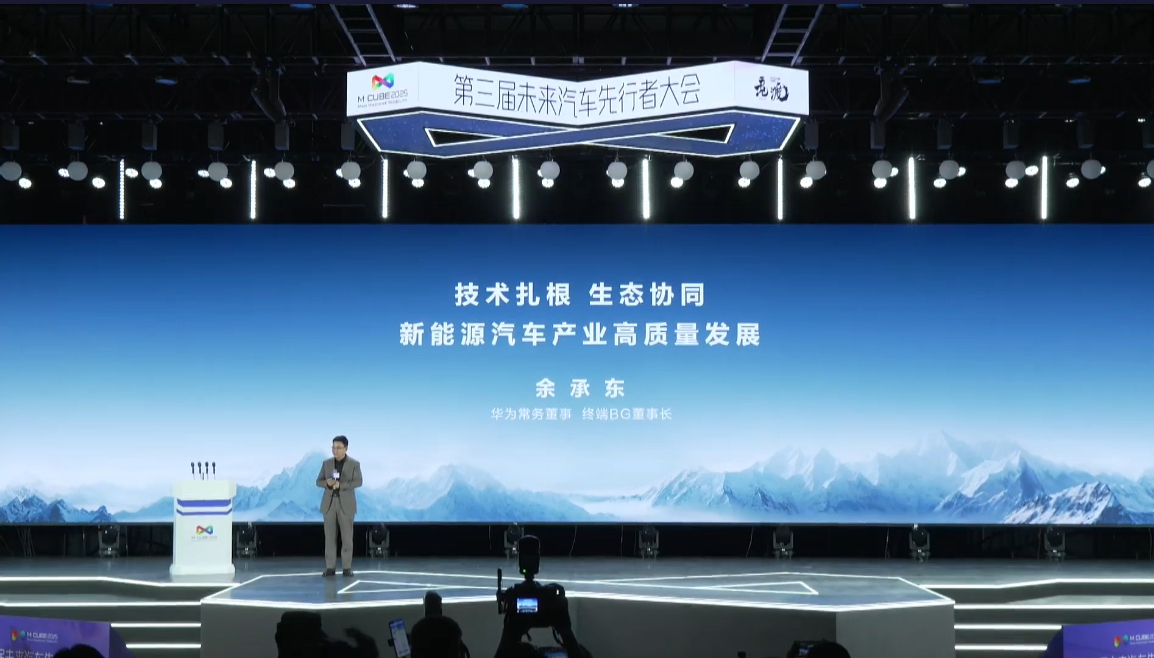
鸿蒙智行“五界”首次齐聚!负责人畅谈与华为合作感受,余承东:“五界”都能崛起但需要时间
Mei Ri Jing Ji Xin Wen· 2025-05-31 11:24
Group 1 - The Future Automotive Pioneer Conference highlighted the collaboration between Huawei and various automotive companies, focusing on the "Five Realms" of Hongmeng Intelligent Driving [1] - Huawei's Executive Director Yu Chengdong emphasized the challenges of developing multiple realms, indicating that achieving scale will take time and effort [1] - The automotive industry is experiencing a new round of price wars, prompting the China Automotive Industry Association to advocate for fair competition and sustainable development [4][5] Group 2 - Companies like Seres and Chery have shared their positive experiences working with Huawei, noting that collaboration can lead to significant changes and advancements in the smart electric vehicle sector [1][4] - The industry leaders stressed the importance of maintaining quality and avoiding low-end competition, which they view as detrimental to long-term growth [5][6] - The trend towards high-end vehicles is evident, with models like the AITO M8 and M9 priced significantly higher, reflecting a shift in consumer preferences [6]