农林牧渔

Search documents
详解千亿级增值税留抵退税政策大调整
第一财经· 2025-08-23 07:38
Core Viewpoint - China has made a significant policy adjustment regarding the value-added tax (VAT) refund system, becoming more cautious about refunds to reduce fiscal pressure and improve management efficiency [3][4]. Summary by Sections VAT Refund Policy Adjustment - The Ministry of Finance and the State Taxation Administration announced a new VAT refund policy effective from September, aimed at enhancing policy precision and reducing compliance costs [3][4]. - The VAT is China's largest tax, generating over 6 trillion yuan annually [3]. Historical Context - Since 2011, China has piloted VAT refunds for specific industries to alleviate financial pressure on enterprises, with significant expansions in 2019 and 2022 [4][5]. - The total amount of VAT refunds surged to 2.46 trillion yuan in 2022, a 3.8-fold increase from 2021, as part of measures to support businesses during the pandemic [5]. Changes in Eligible Industries - The new policy continues to allow full monthly refunds for the manufacturing, scientific research, software, and environmental sectors, while imposing restrictions on previously eligible sectors like wholesale and retail [6][10]. - Industries such as wholesale, retail, agriculture, and hospitality will now receive partial refunds (60% or 30%) instead of full refunds [6][10]. Real Estate Sector Provisions - The real estate sector has a separate VAT refund policy, allowing developers to apply for refunds under specific conditions, maintaining stability in the sector [7][9]. - The policy aims to support the real estate market amidst ongoing challenges, with a focus on maintaining operational stability [8][9]. General Industry Adjustments - Other industries not included in the specified categories will face stricter requirements for VAT refunds, including a minimum threshold of 500,000 yuan for new refundable amounts [10][11]. - The new policy reflects a shift from broad tax cuts to more targeted fiscal measures, addressing the need for fiscal sustainability and risk prevention [10][11]. Implementation and Management - The State Taxation Administration has issued detailed guidelines to ensure the effective implementation of the new VAT refund policy [11]. - Tax revenue data indicates a slight decline in overall tax income, with VAT revenue showing a modest increase of 3% year-on-year [11].

逾200家公司业绩翻倍!A股大额分红频现
Zhong Guo Zheng Quan Bao· 2025-08-23 05:38
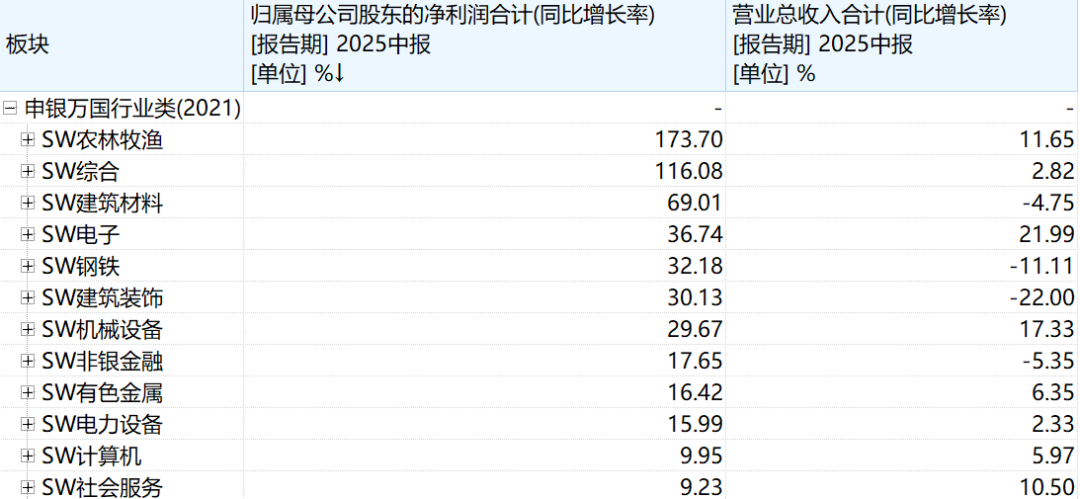
Core Insights - As of August 22, 2025, 1,657 A-share listed companies have disclosed their semi-annual reports, with 959 companies achieving a year-on-year net profit growth, accounting for approximately 57.88% [1] Industry Performance - Industries such as electronics, transportation, agriculture, automotive, machinery, non-ferrous metals, home appliances, and social services have shown strong performance in terms of company earnings [2][8] - In the first half of 2025, the agriculture, electronics, steel, and machinery sectors reported significant year-on-year net profit growth [10] Profit Growth - Among the 1,657 companies, 223 reported a net profit growth exceeding 100%, 382 exceeded 50%, 530 exceeded 30%, and 794 exceeded 10% [4] - Notable companies with high net profit growth include LianDi Information, Digital Video, XianDa Co., ZhiMingDa, RongZhiRiXin, ShiJiaGuangZi, and SuTong Development [4] Profit Scale - In the first half of 2025, 601 companies reported a net profit exceeding 100 million yuan, with 91 companies exceeding 1 billion yuan [5] - Leading companies by net profit include China Mobile, Kweichow Moutai, CATL, China Telecom, Sinopec, Industrial Fulian, Muyuan Foods, Huaneng International, and Luoyang Molybdenum [5] Dividend Proposals - A total of 295 companies have disclosed their mid-term dividend plans, with 111 companies proposing dividends exceeding 100 million yuan, 77 exceeding 200 million yuan, and 37 exceeding 500 million yuan [6][7] - Companies with the highest proposed dividend amounts include China Mobile, China Telecom, and Sinopec [7] Sector-Specific Insights - Within the electronics sector, sub-sectors such as electronic components, consumer electronics, and semiconductors have performed exceptionally well [10] - In the agriculture sector, the breeding and animal health industries have shown notable improvements [11]
逾200家公司,业绩翻倍!A股大额分红频现
Zhong Guo Zheng Quan Bao - Zhong Zheng Wang· 2025-08-23 05:36
Group 1 - As of August 22, 2023, 1657 A-share listed companies disclosed their 2025 semi-annual reports, with 959 companies achieving a year-on-year net profit growth of approximately 57.88% [1] - Among the companies, 223 reported a net profit growth exceeding 100%, while 382 companies saw growth over 50%, and 530 companies reported growth over 30% [2] - Notable companies with significant net profit growth include LianDi Information, Digital Video, XianDa Co., ZhiMingDa, RongZhiRiXin, ShiJiaGuangZi, and SuTong Development [2] Group 2 - In terms of profitability, 601 companies had a net profit exceeding 100 million yuan, and 91 companies surpassed 1 billion yuan [2] - Leading companies by net profit include China Mobile, Kweichow Moutai, CATL, China Telecom, Sinopec, Industrial Fulian, Muyuan Foods, Huaneng International, and Luoyang Molybdenum [2] - A total of 295 companies announced mid-term dividend plans, with 204 companies proposing cash dividends exceeding 1 yuan per 10 shares [2][3] Group 3 - The electronic, mechanical equipment, and agricultural sectors showed strong performance, with significant year-on-year net profit growth [4] - Within the electronic sector, sub-sectors such as electronic components, consumer electronics, and semiconductors performed exceptionally well [5] - In the agricultural sector, particularly in livestock farming, companies like Muyuan Foods reported impressive results, with a revenue of 76.463 billion yuan and a net profit growth of 1169.77% [5]
京基智农2025半年度分配预案:拟10派3.8元
Zheng Quan Shi Bao· 2025-08-22 20:29
Core Viewpoint - 京基智农 announced a cash dividend distribution plan for the first half of 2025, proposing a payout of 3.8 yuan per 10 shares, totaling approximately 197 million yuan, which represents 87.22% of its net profit [1][2]. Company Financial Performance - For the first half of 2025, 京基智农 reported total revenue of 2.387 billion yuan, a year-on-year decrease of 11.61%, and a net profit of 226 million yuan, down 3.97% year-on-year. The basic earnings per share were 0.4292 yuan, with a weighted average return on equity of 5.2% [2]. Dividend History - The company has a history of dividend distributions since its listing, with the latest being the 11th payout. The previous distributions include: - 2024.12.31: 3.5 yuan per 10 shares, total payout of 182 million yuan, dividend yield of 2.12% - 2024.06.30: 3.8 yuan per 10 shares, total payout of 197 million yuan, dividend yield of 2.24% - 2022.12.31: 10 yuan per 10 shares, total payout of 523 million yuan, dividend yield of 5.16% [2][4]. Market Activity - The stock experienced a net inflow of 6.1831 million yuan in main funds today, but over the past five days, there was a net outflow of 11.1622 million yuan [3]. - The latest margin financing balance for the stock is 251 million yuan, with a decrease of 3.6941 million yuan over the past five days, representing a decline of 1.45% [4]. Industry Comparison - In the agricultural, forestry, animal husbandry, and fishery sector, 京基智农 ranks among the top companies in terms of cash dividend distribution, with a payout of 197 million yuan, following 牧原股份, which distributed 5 billion yuan [4][5].

京基智农2025半年度分配预案:拟10派3.8元
Zheng Quan Shi Bao Wang· 2025-08-22 15:52
Core Viewpoint - Jingji Zhino announced a semi-annual distribution plan for 2025, proposing a cash dividend of 3.8 yuan per 10 shares, totaling 197 million yuan, which represents 87.22% of its net profit, with a dividend yield of 2.33% based on the average trading price for the period [1][2]. Company Financial Performance - For the first half of 2025, Jingji Zhino reported operating revenue of 2.387 billion yuan, a year-on-year decrease of 11.61%, and a net profit of 226 million yuan, down 3.97%. The basic earnings per share were 0.4292 yuan, with a weighted average return on equity of 5.2% [2]. Dividend History - The company has a history of dividend distributions since its listing, with the latest being the 11th distribution. The previous distributions include: - 2024.12.31: 3.5 yuan per 10 shares, total cash of 182 million yuan, dividend yield of 2.12% - 2024.06.30: 3.8 yuan per 10 shares, total cash of 197 million yuan, dividend yield of 2.24% - 2022.12.31: 10 yuan per 10 shares, total cash of 523 million yuan, dividend yield of 5.16% [2]. Market Activity - The stock experienced a net inflow of 6.1831 million yuan in principal funds today, but over the past five days, there was a net outflow of 11.1622 million yuan [3]. - The latest margin financing balance for the stock is 251 million yuan, with a decrease of 3.6941 million yuan over the past five days, representing a decline of 1.45% [4]. Industry Comparison - In the agricultural, forestry, animal husbandry, and fishery sector, 11 companies announced their semi-annual distribution plans for 2025. Jingji Zhino ranks third in total cash distribution, following Muyuan Foods with 5 billion yuan and Haida Group with 333 million yuan [4].
2025 年 8 月 22 日沪指站上 3800 点,算力芯片股集体爆发
Guoyuan Securities· 2025-08-22 15:13
Investment Rating - The report indicates a positive investment sentiment towards the computing chip sector, highlighted by a collective surge in stock prices on August 22, 2025, with the Shanghai Composite Index surpassing 3800 points [2][15]. Core Insights - The report emphasizes the significant market performance on August 22, 2025, with the Shanghai Composite Index rising by 1.45%, the Shenzhen Component Index increasing by 2.07%, and the ChiNext Index climbing by 3.36%. The total market turnover reached 25,788.40 billion, an increase of 1,185.04 billion from the previous trading day [2][15]. - It notes that all 30 sectors in the CITIC first-level industry index experienced an upward trend, particularly in electronics (4.91%), telecommunications (3.68%), and computing (3.45%), while banking, oil and petrochemicals, and agriculture sectors lagged behind [20]. Market Performance - On August 22, 2025, the main indices showed strong performance, with the Shanghai Composite Index at 3,825.76, the Shenzhen Component Index at 12,166.06, and the ChiNext Index at 2,682.55, reflecting a robust market environment [7][17]. - The overall market saw 2,802 stocks rise against 2,396 that fell, indicating a bullish sentiment among investors [15]. Sector Analysis - The report categorizes market performance by style, ranking growth stocks above financials, cyclical, stable, and consumer sectors. The overall performance of the CSI All Share Index outperformed the fund-heavy stocks [20]. - In terms of sector performance, the electronics, telecommunications, and computing sectors led the gains, while banking, oil and petrochemicals, and agriculture sectors showed declines [20]. Fund Flow Analysis - On August 22, 2025, the main funds saw a net inflow of 254.19 billion, with large orders contributing significantly to this inflow, while medium and small orders experienced outflows [24]. - Southbound capital also saw a net inflow of 51.65 billion HKD, indicating strong interest from foreign investors in the Chinese market [26]. ETF Fund Flow - The report highlights that most ETFs, including the Shanghai 50 and CSI 300, experienced a decrease in trading volume compared to the previous day, with notable inflows into the ChiNext ETF [28]. - Specific ETFs showed varied performance, with the Huaxia Shanghai 50 ETF and Huatai-PB CSI 300 ETF seeing increases in trading volume, while others like the Jiashi CSI 300 ETF experienced declines [28]. Global Market Performance - The report notes mixed performances in major global indices on August 22, 2025, with the Hang Seng Index rising by 0.93% and the Nikkei 225 Index slightly up by 0.05%, while the Australian S&P 200 Index fell by 0.57% [32][33].





非银金融行业今日涨2.76%,主力资金净流入84.27亿元
Zheng Quan Shi Bao Wang· 2025-08-22 09:01
Market Overview - The Shanghai Composite Index rose by 1.45% on August 22, with 24 out of 28 sectors experiencing gains, led by the electronics and communications sectors, which increased by 4.82% and 3.77% respectively [1] - The non-bank financial sector also saw an increase of 2.76% [1] - Conversely, the banking and textile sectors faced declines of 0.30% and 0.20% respectively [1] Capital Flow - The net inflow of capital in the two markets reached 25.419 billion yuan, with 12 sectors experiencing net inflows [1] - The electronics sector had the highest net inflow of 15.132 billion yuan, corresponding to its 4.82% increase [1] - The computer sector followed with a net inflow of 10.334 billion yuan and a daily increase of 3.50% [1] Non-Bank Financial Sector - The non-bank financial sector saw a net inflow of 8.427 billion yuan, with 75 out of 83 stocks in the sector rising [2] - Among the stocks, Dongfang Caifu led with a net inflow of 1.970 billion yuan, followed by CITIC Securities and Everbright Securities with inflows of 1.135 billion yuan and 0.873 billion yuan respectively [2] - The sector had 13 stocks with net outflows exceeding 10 million yuan, with Zhongyin Securities, Lakala, and China Pacific Insurance leading in outflows [2] Individual Stock Performance - The top performers in the non-bank financial sector included: - Dongfang Caifu: +3.92% with a turnover rate of 6.78% and a net inflow of 1.969 billion yuan [2] - CITIC Securities: +4.27% with a turnover rate of 2.22% and a net inflow of 1.134 billion yuan [2] - Everbright Securities: +10.01% with a turnover rate of 5.54% and a net inflow of 0.873 billion yuan [2]






中观高频景气图谱(2025.8):上游资源行业景气提振
Guoxin Securities· 2025-08-22 08:57
Group 1 - The report indicates that as of mid-August, the upstream resource industry is experiencing an upward trend in prosperity, while the midstream manufacturing sector shows a mixed performance, with sectors like non-ferrous metals, coal, basic chemicals, and oil and petrochemicals improving continuously [4] - In the downstream consumption sector, there is a divergence in performance; the social services and home appliance industries are on the rise, while the commercial retail sector is declining. In essential consumption, the agriculture, forestry, animal husbandry, fishery, food and beverage, and textile and apparel industries are generally experiencing a downturn [4] - Supportive service industries and the financial sector are overall declining, with the environmental protection industry within supportive services also showing a downturn. However, the banking sector is improving, and the non-bank financial sector is on the rise, while the computer sector within the TMT industry is declining [4] Group 2 - The report tracks excess returns in various industries, including basic chemicals, steel, non-ferrous metals, coal, oil and petrochemicals, and construction materials, providing correlation data with high-frequency indicators [5][10][17][31][36][39][46][77] - The basic chemicals industry shows a strong correlation with various commodity prices, indicating potential investment opportunities based on price movements [6][9][17] - The steel industry is closely linked to production and inventory metrics, suggesting that monitoring these indicators can provide insights into future performance [10][12][14] Group 3 - The report highlights the importance of tracking excess returns in the automotive industry, with indicators such as daily sales and production rates being critical for understanding market dynamics [48][50] - The machinery equipment sector's performance is analyzed through various price indices, indicating a need for investors to pay attention to these metrics for better investment decisions [55][58] - The report also emphasizes the significance of high-frequency indicators in the transportation sector, which can provide insights into overall economic activity and sector performance [60][62] Group 4 - The agricultural sector's excess returns are tracked against food product price indices, indicating a strong relationship between agricultural prices and overall sector performance [96][98] - The report discusses the food and beverage industry's performance in relation to various price indices, suggesting that monitoring these can help identify investment opportunities [98][99] - The pharmaceutical and biotechnology sectors are analyzed with respect to traditional Chinese medicine price indices, highlighting the importance of these metrics in understanding market trends [101][106] Group 5 - The public utilities sector's performance is linked to coal consumption metrics, indicating that energy prices and consumption patterns are critical for assessing sector health [111][114] - The real estate sector's excess returns are correlated with metrics such as transaction volumes and land prices, suggesting that these indicators are vital for understanding market conditions [115][121] - The report also examines the computer industry, focusing on the relationship between excess returns and pricing trends in electronic components, which can inform investment strategies [124][127]
粤开市场日报-20250822
Yuekai Securities· 2025-08-22 08:23
Market Overview - The main indices showed positive performance today, with the Shanghai Composite Index increasing by 1.45%, the Shenzhen Component Index rising by 2.07%, and the ChiNext Index gaining 3.36% [1] - Among the Shenwan first-level industries, electronics, communications, and computers performed well, while oil and petrochemicals, steel, and agriculture showed weaker performance [1] - Concept sectors overall saw good performance in continuous boards, stock trading software, and self-controllable concepts, whereas aviation transport, Tibet revitalization, and animal vaccine concepts lagged behind [1]
补涨行情强势启动,谁在引爆大消费?
Sou Hu Cai Jing· 2025-08-22 03:59
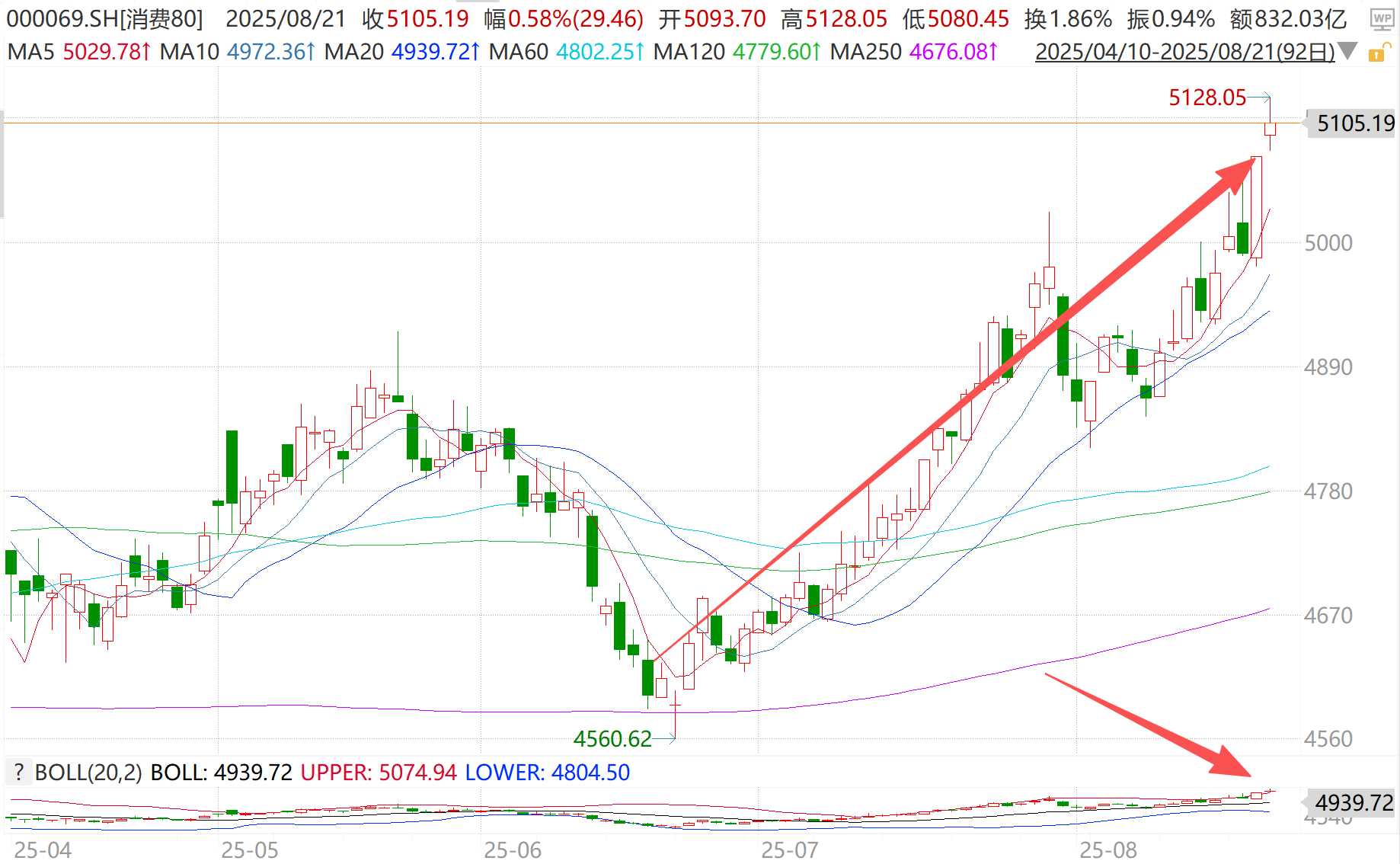
Core Viewpoint - The consumer sector, including retail, liquor, and agriculture, has shown strong performance recently, with the Consumption ETF (510150) experiencing a three-week upward trend and the Consumption 80 index rising over 10% since June 23 [1][3]. Group 1: Market Performance - As of August 21, the Consumption ETF (510150) has seen net inflows for three out of the last five trading days, accumulating over 51 million in investments [3]. - The Consumption 80 index's valuation stands at 25.79 times earnings, which is at the 34.51% percentile of its historical range, indicating significant room for valuation recovery [4][5]. Group 2: Policy Influence - Recent government policies aimed at boosting domestic demand have catalyzed the consumer sector's recovery, with a focus on enhancing consumption potential [4]. - The introduction of personal consumption loan subsidies starting September 1 is expected to further support the consumer sector [4]. Group 3: Sector Dynamics - The liquor sector, particularly notable for its strong performance, has positively influenced the overall consumer market sentiment, with specific stocks like Jinzhongzi Liquor and Shede Liquor seeing significant gains [5][7]. - The upcoming Mid-Autumn and National Day holidays are anticipated to drive further demand in the consumer sector, suggesting continued upward momentum [7].