资产管理

Search documents
美联储主席候选人里德尔发声:支持降息至3%
Jin Shi Shu Ju· 2026-01-13 06:40
在周一播出的CNBC采访中,里德尔表示,数月以来他一直在反复提及希望利率降至3%的观点。他于 周一再次表态支持这一举措,该操作将使借贷成本较当前水平至少下降50个基点(即0.5个百分点)。 美联储官员在去年12月降息25个基点后,当前联邦基金利率目标区间处于3.5%—3.75%。 "我认为美联储确实有一些政策操作空间。"里德尔称,"过去这么多个月,我的态度一直十分明确。美 联储必须下调利率,而且我认为不需要下调太多,最终落到3%即可——这个水平更接近中性利率。"中 性利率是一个理论上的借贷成本水平,既不具有刺激性,也不具有限制性,能够维持美国经济平稳运 行。 AI播客:换个方式听新闻 下载mp3 在周一的交易时段,市场起初充斥着对美联储独立性的担忧情绪。此前鲍威尔于上周末披露,美国司法 部已向美联储送达大陪审团传票,调查事项与其去年就美联储历史性办公大楼多年翻修项目所作的证词 相关。 音频由扣子空间生成 当日美国三大股指开盘均走低,但投资者随后逐渐摆脱忧虑情绪:道指(DJI)与标普500指数(SPX) 最终分别收于49590.20点和6977.27点,双双刷新历史纪录。 贝莱德全球固定收益首席投资官里克・里德 ...
华尔街裁员潮持续蔓延!资管巨头贝莱德(BLK.US)再砍数百岗位
Zhi Tong Cai Jing· 2026-01-13 06:39
值得一提的是,华尔街各大行围绕生成式人工智能(AI)制定的计划乃至日益增多的实际行动,都揭示了 这项技术将如何增强乃至取代人类员工。许多大型银行各自雇佣着超过10万名员工,而受联邦存款保险 公司(FDIC)保护的商业银行体系更广泛地雇佣着近200万人。从银行柜员到年薪数亿美元的交易撮合 者、再到将生成式AI梦想变为现实的庞大软件工程师团队,皆可能在受影响行列。 贝莱德进行最新裁员之际,其首席执行官拉里.芬克正在寻求改造这家全球最大的资产管理公司,并进 一步向另类投资领域进军。自去年7月份完成以120亿美元收购私募信贷专业机构HPS Investment Partners的交易以来,贝莱德一直在整合新的高管团队,并准备为富有的个人投资者推出一系列新基 金。 其他金融公司也一直在寻求削减员工人数和控制成本。花旗集团(C.US)本周将裁员约1000人。此前还有 报道称,瑞银集团(UBS.US)也计划本月进行一轮裁员,之后将在今年晚些时候进行另一轮裁员。 资管巨头贝莱德(BLK.US)正在全球范围内裁员数百人,成为近几周来最新一家削减员工人数的华尔街 金融公司。知情人士称,裁员人数约占贝莱德全球员工总数的1%,即裁员 ...

【UNforex财经事件】政策与制度风险叠加升温 「抛售美国」交易重回视野
Sou Hu Cai Jing· 2026-01-13 04:14
Group 1 - The U.S. financial markets are under pressure due to multiple political and policy disturbances, with a renewed focus on the "sell America" trade as investors adopt a more conservative risk pricing approach [1][2] - The independence of the Federal Reserve is being questioned, with recent judicial investigations into Chairman Powell's actions causing market reactions, leading to a decline in the U.S. dollar, U.S. Treasury bonds, and stock futures [1][3] - The yield curve for U.S. Treasuries is experiencing upward pressure, with the 10-year yield rising to 4.17% and the 30-year yield reaching 4.828%, indicating uncertainty surrounding the Fed's independence [2] Group 2 - Trump's recent statements regarding tariffs have heightened market anxiety, warning of potential liabilities in the hundreds of billions of dollars if the Supreme Court rules against the government [2] - The market is closely watching the Supreme Court's decision on the legality of tariffs imposed under the International Emergency Economic Powers Act, which is expected to impact policy stability and the investment environment [2][3] - The overall market sentiment remains cautious, with a notable divergence in stock performance, particularly supported by the technology sector despite rising political risks [3]
贝莱德据悉裁员250人 约占员工总数1%
Xin Lang Cai Jing· 2026-01-13 01:36
贝莱德正在公司范围内裁减数百个工作岗位,成为近几周来最新一家收缩人力的华尔街公司。 据知情人士透露,此次裁员约占贝莱德全球员工总数的1%。他们表示,公司范围内约250名员工将受到 影响,包括投资和销售团队的成员。 "提升贝莱德始终是我们的首要任务,"一位公司发言人表示。"每年我们都会做出决策,确保资源配置 与我们的目标一致,确保我们能够很好地服务于现在和未来的客户。" 此次裁员正值首席执行官Larry Fink致力于重塑这家全球最大资产管理公司的架构,并深化另类投资布 局之际。自7月完成对私募信贷公司HPS Investment Partners 120亿美元的收购后,贝莱德一直在整合新 管理团队,并准备面向富裕的散户投资者推出一个新基金系列。 据当时报道,贝莱德去年实施了两轮裁员,每次裁减约1%的员工。 其他金融公司也都在寻求裁员控本。花旗本周将裁员约1,000人。据早些时候报道,瑞银也打算本月进 行一轮裁员,并在今年晚些时候再进行一轮,以配合关闭收购瑞信时获得的计算机系统。 贝莱德正在公司范围内裁减数百个工作岗位,成为近几周来最新一家收缩人力的华尔街公司。 据知情人士透露,此次裁员约占贝莱德全球员工总数的 ...
关于邯郸市“元庆亿鑫资产管理有限公司” 非法吸收公众存款案集资参与人登记公告
Xin Lang Cai Jing· 2026-01-13 00:13
三、注意事项:1、携带本人身份证原件以及复印件; 2、携带集资有关资料原件以及复印件,包括合同、协议、收据、银行转账凭证、银行往来流水等相关 证据材料; (来源:邯郸日报) 转自:邯郸日报 邯郸市"元庆亿鑫资产管理有限公司"文新大厦、恒隆广场集资点非法吸收公众存款案,已由邯郸市公安 局丛台区分局立案侦查。请各位集资参与人在公告发布之日起一个月内进行登记(请各位集资参与人相 互转告)。 一、登记范围:在"元庆亿鑫资产管理有限公司"文新大厦、恒隆广场集资点的集资参与人。 二、登记地点:邯郸市公安局丛台区分局经侦大队506办公室(地址:导航地址:邯郸市丛台区滏河北 大街530号苏曹派出所506办公室)。 邯郸市公安局丛台区分局 2026年1月13日 3、联系人:闫警官 张警官 电话:0310-7114016 特此公告 ...
1月13日外盘头条:特朗普施压美联储引发市场担忧 谷歌Gemini将为苹果Siri提供支持 A...
Xin Lang Cai Jing· 2026-01-12 22:09
Group 1 - The White House emphasizes that diplomacy is the "preferred" approach for the U.S. in response to the situation with Iran, although military options remain on the table if necessary [4][6] - President Trump stated that Iran has reached out to U.S. officials to propose negotiations, with meetings being arranged [6] Group 2 - Key Republican figures criticize the investigation into Federal Reserve Chairman Powell, with Treasury Secretary Mnuchin reportedly warning Trump about potential market impacts [8] - Senator Thom Tillis vowed to oppose any Federal Reserve nominees from Trump until the investigation is resolved [8] Group 3 - Google’s Gemini will provide technical support for Apple’s AI features, including Siri, with reports suggesting Apple may pay around $1 billion for this technology [10] - This partnership confirms previous reports of collaboration between Apple and Google [10] Group 4 - Alphabet's market capitalization has officially surpassed $4 trillion, making it the fourth company globally to reach this milestone [12] - The stock price of Alphabet rose by 1% following the announcement of the partnership with Apple [12] Group 5 - Major bond investment firms warn that Trump's pressure on the Federal Reserve could threaten its credibility in combating inflation, potentially leading to higher interest rates [14] - Concerns are raised that the instability caused by the Fed's independence being challenged could increase costs for mortgages and corporate loans [14] Group 6 - JPMorgan no longer expects the Federal Reserve to cut interest rates this year and predicts a rate hike in 2027 based on recent employment data [16] - The employment report for December showed a decrease in the unemployment rate from 4.5% to 4.4%, alleviating concerns about a labor market slowdown [17]





金银双双刷爆历史纪录,“货币贬值交易”已彻底疯狂?
Jin Shi Shu Ju· 2026-01-12 15:39
在美国检察官对美联储主席鲍威尔展开刑事调查后,引发了市场对美联储独立性的担忧,黄金持续刷新历史新高 周一美盘,黄金一度涨超2%,并将历史记录刷新至4620美元上方,白银一度暴涨超7%。截止发稿前,二者均有所回落。 资产管理公司Carmignac的投资委员会成员Kevin Thozet表示,风险在于白宫与美联储之间在未来几个季度可能会"不再手下留情"。鲍威尔上周日表示,美联 储收到了大陪审团的传票以及司法部关于刑事起诉的威胁,这与他在国会就央行总部25亿美元翻新工程的证词有关。 投资者表示,美元和黄金的走势反映出一种风险,即由于政治压力,美国政策利率可能会被压低至低于本应有的水平,从而可能导致长期通胀上升和货币政 策的不确定性。 Fidelity International的基金经理Mike Riddell说:"我们以前经历过这种情况——对美联储的政治压力意味着美元走弱、美国长期国债收益率走高以及通胀预 期上升。" 但市场波动的规模相对较小,许多投资者仍押注利率制定者将保持独立。高盛首席经济学家Jan Hatzius在伦敦的一次会议上表示:"我的预期依然是,委员 会将继续根据其授权和经济数据做出决定。" 黄金和 ...

金银双双刷爆历史纪录!“货币贬值交易”已彻底疯狂?
Sou Hu Cai Jing· 2026-01-12 14:40
Group 1 - The conflict between the White House and the Federal Reserve is intensifying, leading to significant market volatility and record highs in gold and silver prices [2][4] - Following a criminal investigation into Fed Chairman Jerome Powell, concerns about the independence of the Federal Reserve have emerged, with gold prices surpassing $4620 and silver rising over 7% [2][4] - Investors are worried that political pressure may lead to lower policy rates than warranted, potentially causing long-term inflation to rise and increasing uncertainty in monetary policy [4] Group 2 - Despite market fluctuations, many investors still bet on the independence of rate setters, with Goldman Sachs' chief economist expecting decisions to be made based on economic data [5] - Gold and silver are experiencing a surge due to fears of currency devaluation, as investors seek safe-haven assets amid geopolitical risks [5][6] - The gap between 30-year and 2-year U.S. Treasury yields has reached 1.4 percentage points, the largest in four years, raising concerns about government borrowing [6]

“抛售美国”卷土重来!鲍威尔被查引发股汇债“三杀”,金价狂飙破4620美元创历史新高
Hua Er Jie Jian Wen· 2026-01-12 14:34
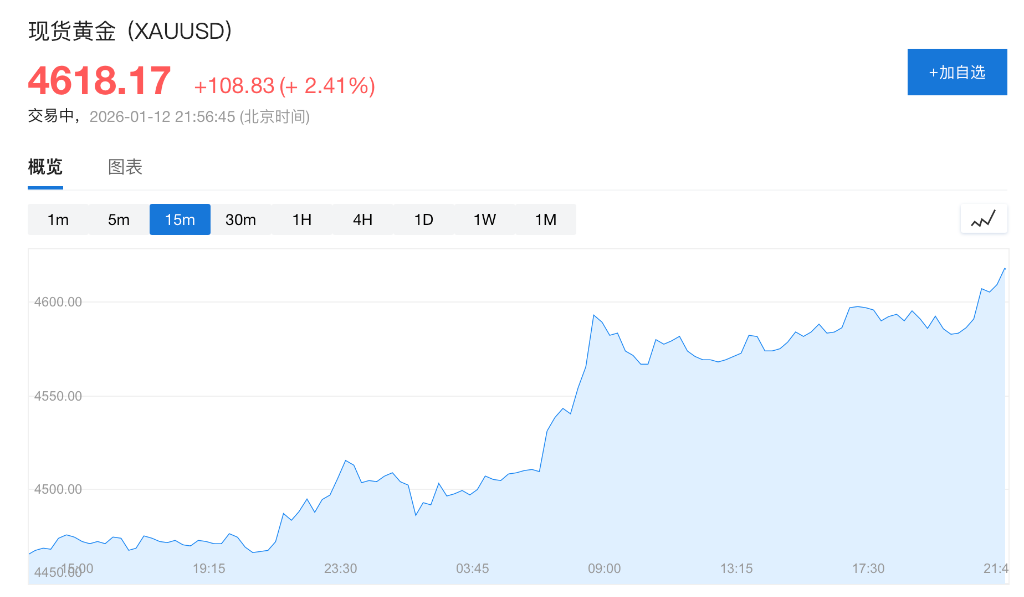
Core Viewpoint - The investigation into Federal Reserve Chairman Jerome Powell by the U.S. Department of Justice has raised concerns about the independence of the central bank, leading to increased risk aversion in the market and a surge in gold prices, which reached a historical high of $4,620 per ounce, with a daily increase of 2.4% [1][3][7]. Group 1: Investigation Details - The investigation is part of a broader effort by the Trump administration against the Federal Reserve, which has included attempts to dismiss board member Lisa Cook and calls for aggressive interest rate cuts [3]. - The focus of the investigation is on a $2.5 billion renovation project at the Federal Reserve headquarters and whether Powell misled Congress regarding the scope of the project [3][10]. - Powell has denied the allegations, stating that the threat of criminal charges is a consequence of the Federal Reserve's commitment to setting interest rates based on public interest rather than presidential preferences [3][10]. Group 2: Market Reactions - Financial markets are exhibiting a typical risk-averse trading pattern, with U.S. stocks, bonds, and the dollar all under pressure, while funds are flowing into precious metals [4]. - U.S. stock index futures have collectively declined, with the S&P 500 futures down 0.5% and the Nasdaq 100 futures down 0.7% [4]. - The 10-year U.S. Treasury yield has risen by 3 basis points to 4.20%, and the dollar index has dropped by 0.4%, marking the largest single-day decline in nearly three weeks [4]. Group 3: Institutional Perspectives - Multiple institutions believe that the market turmoil is driven by a re-evaluation of the political risks associated with the Federal Reserve [8]. - Analysts from Allspring Global Investments and Fidelity International noted that any event questioning the independence of the Federal Reserve increases uncertainty in U.S. monetary policy, potentially leading to a weaker dollar and rising inflation expectations [8]. - Morgan Stanley and Lombard Odier have indicated that the current situation may lead to greater pressure on the dollar and U.S. Treasuries, with expectations of a steeper yield curve due to more aggressive rate cut forecasts [9]. Group 4: Future Implications - The investigation coincides with Powell's term as Federal Reserve Chairman ending in May, with Trump reportedly having selected a successor [11]. - Powell's term as a board member will continue until January 2028, but it remains unclear whether he plans to stay on after this year [11].
ATFX:地缘局势带来新的风险溢价 黄金直接跳涨至4600美元新纪录
Xin Lang Cai Jing· 2026-01-12 11:53
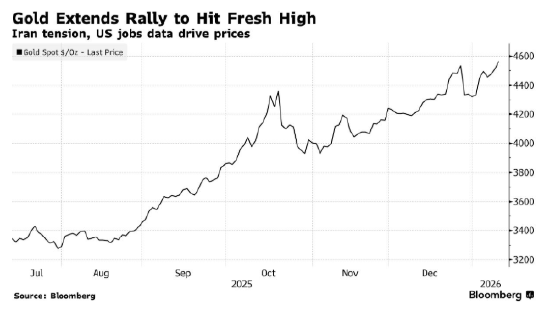
Core Viewpoint - Gold prices have reached a record high of $4600, driven by expectations of interest rate cuts and ongoing geopolitical tensions, particularly in Iran [1][6]. Group 1: Economic Indicators - The U.S. employment data released last week showed mixed results, reinforcing market expectations for the Federal Reserve to lower interest rates at least twice this year [4][9]. - The employment report indicated that job growth in December was below expectations, which supports the notion of continued rate cuts to stimulate the economy [4][9]. Group 2: Market Trends - Gold prices surged by 65% in 2025, marking the largest increase in nearly half a century, with fund managers betting on further price rises due to factors like declining interest rates and geopolitical tensions [4][9]. - UBS Asset Management noted a growing interest from pension and insurance funds in gold, predicting that by 2025, some funds that previously did not hold gold will allocate about 5% of their strategic asset allocation to it [4][9]. Group 3: Investment Dynamics - Despite the record high gold prices, U.S. investors hold a low proportion of gold, with gold ETFs accounting for only 0.17% of U.S. private financial portfolios, down 6 basis points from the peak in 2012 [5][10]. - Central bank purchases are expected to be a significant driver for further gold price increases, with projections of monthly purchases reaching approximately 80 tons by 2026 [10]. - Central banks rarely sell their gold holdings, indicating that institutional demand is viewed as a stable support for gold prices, with rapid inflows from both institutions and retail investors contributing to the price surge [11].