传统制造业

Search documents
十大券商一周策略:需要AI给答案!市场静待转机,慢牛预期不变
Zheng Quan Shi Bao· 2025-11-23 22:55
Group 1 - The volatility of global risk assets is primarily due to liquidity issues and an over-reliance on AI narratives, leading to necessary valuation corrections when industrial development lags behind market expectations [1] - The recent adjustments in the US non-farm employment data and the downshift in interest rate cut expectations from the Federal Reserve have amplified concerns regarding the sustainability of AI infrastructure in North America [1] - The current market environment may lead to a "sharp drop and slow rise" pattern in A-shares and Hong Kong stocks, similar to the US market, as stable return-oriented funds continue to enter the market [1] Group 2 - The Chinese stock market is currently experiencing weakness due to year-end profit-taking and reduced positions by investors, compounded by a lack of internal policy support [2] - Despite the cautious consensus, there is a strong belief in the positive outlook for the Chinese market, with expectations for stabilization and upward momentum in the near future [2] - Key investment themes include AI applications, robotics, domestic consumption, and infrastructure development in Xinjiang [2] Group 3 - The market is in a "three-phase overlap" characterized by a mid-bull market consolidation, critical economic verification, and a policy vacuum, leading to increased volatility [3] - The recent fluctuations in the overseas environment, including the Federal Reserve's interest rate expectations, have affected market liquidity and investor sentiment [3] - Long-term bullish factors remain intact, with a focus on strategic positioning ahead of key meetings in December [3] Group 4 - The current market adjustment has created a preliminary sense of space, with expectations for improved overseas liquidity and reduced domestic funding pressure [4] - Emphasis on safety margins in high volatility environments, focusing on sectors such as seasoning products, leisure foods, and communication services [4] - Recommendations include increasing positions in traditional cyclical sectors and potential growth areas like domestic computing power and innovative pharmaceuticals [4] Group 5 - The recent adjustment in A-shares is attributed to weak domestic economic data, a strong dollar, and year-end performance pressures [6] - The market is expected to remain in a state of fluctuation until mid-December, when significant policy decisions are anticipated to provide direction [6] - The outlook for the first quarter of the following year suggests a potential return to an upward cycle, particularly for large-cap blue-chip and financial cyclical stocks [6] Group 6 - The recent market pullback is influenced by global financial vulnerabilities and concerns over the sustainability of AI capital expenditures [7] - The current state of the AI industry is compared to a critical juncture in the internet sector in 1997, highlighting the uncertainty of future applications [7] - Recommendations focus on sectors benefiting from physical asset consumption, including upstream resources and cyclical industries [7] Group 7 - The recent decline in the A-share index is viewed as a "clear sky turbulence," with expectations for limited future volatility [8] - The current bull market logic based on liquidity is approaching a turning point, necessitating a shift towards fundamental-driven growth [8] - The anticipated transition from a liquidity-driven bull market to a fundamental-driven one will require monitoring political and economic cycles [8] Group 8 - The recent global equity market weakness has led to a rotation in market dynamics, with a focus on three main investment directions: AI technology, economic recovery, and undervalued dividends [9] - The performance of low-valued dividends is closely tied to the progress of the AI industry, which is dependent on breakthroughs in both application and consumption [9] Group 9 - The recent adjustments in the A-share market are expected to stabilize as institutional investors begin to position for 2026 following the central economic work conference in mid-December [10] - The technical analysis suggests that the Shanghai Composite Index may find strong support around the 3700-point level, limiting further downside [10] - The long-term outlook remains positive, with expectations for a renewed buying opportunity in the market [10]
【十大券商一周策略】需要AI给答案!市场静待转机,慢牛预期不变
券商中国· 2025-11-23 15:07
Group 1 - The core viewpoint is that the volatility of global risk assets is primarily due to liquidity issues and an over-reliance on a single narrative surrounding AI, leading to necessary valuation corrections when industrial development lags behind market expectations [2] - The recent adjustments in the US non-farm employment data and the downshift in interest rate cut expectations from the Federal Reserve have amplified concerns regarding the sustainability of AI infrastructure in North America [2] - The current market environment is characterized by a "three-phase overlap," indicating a consolidation phase in the middle of a bull market, a critical period for verifying economic conditions, and a policy vacuum affecting performance [4] Group 2 - The Chinese stock market is currently experiencing weakness due to year-end profit-taking motives, heightened volatility in the US market, and insufficient incremental supply of equity products [3] - Despite the cautious consensus, there is a strong belief in the positive outlook for the Chinese market, with expectations for stabilization and a potential upward movement in the near future [3] - The focus for investment should be on AI applications, robotics, domestic consumption, and infrastructure projects in Xinjiang [3] Group 3 - The recent market adjustments have created a preliminary space for recovery, with expectations for improved overseas liquidity and reduced domestic funding pressures [6] - The current market valuation is approaching a "reasonable" midpoint, suggesting that if there is an overshoot, it may be a good opportunity to increase positions [6] - Key sectors to focus on include traditional manufacturing, food and beverage, and communication services, with an emphasis on safety margins in investments [6] Group 4 - The A-share market has shown significant adjustments due to weak domestic economic data, a strong dollar, and year-end performance pressures [7] - The upcoming central economic work conference in mid-December is expected to provide decisive policy guidance, potentially leading to a market recovery [7] - Investment themes should include cyclical resource products, service industry consumption, and self-sufficiency initiatives [7] Group 5 - The current market volatility is influenced by concerns over the sustainability of AI capital expenditures and the overall fragility of global financial conditions [8] - The adjustment phase is seen as complex and not necessarily indicative of a broader market turning point, with a focus on traditional manufacturing firms that have shown demand growth [8] - Recommended sectors for investment include upstream resources, food and beverage, and capital goods that benefit from China's position in the global supply chain [8] Group 6 - The recent market downturn is viewed as a "clear sky turbulence," with expectations that severe fluctuations will be limited moving forward [9] - The transition from a liquidity-driven bull market to a fundamental-driven bull market is anticipated, requiring close monitoring of political and economic cycles [9] - The focus for investment should shift towards cyclical and low-positioned stocks as the market stabilizes [9] Group 7 - The current market environment is characterized by a decline in trading enthusiasm, with transaction volumes dropping from 12% to around 10% [10] - Investment themes are categorized into three main directions: technology AI, economic recovery, and undervalued dividend stocks [10] - The performance of undervalued dividend stocks is closely tied to the progress of the AI industry and its applications [10] Group 8 - The recent adjustments in the A-share index are attributed to external market influences, with a cautious approach recommended until stabilization signals emerge [11] - Institutional investors are expected to begin positioning for 2026 after mid-December, coinciding with the central economic work conference [11] - The market is anticipated to present new buying opportunities following the adjustments, with a focus on high-dividend blue chips and new consumption trends [11] Group 9 - The current high levels of transaction congestion in popular sectors such as AI and new energy may lead to short-term adjustments [12] - Key areas for potential continued price increases include industrial metals and AI-related sectors, driven by global economic recovery and supply constraints [12] - Optimal buying points are identified when transaction enthusiasm declines to 50%-70% of previous highs, indicating a potential bottoming out [12]


中国制造业“内卷式”现象是如何形成的?
3 6 Ke· 2025-11-19 23:22
中国社会科学院大学经济学院博士研究生 制造业"内卷式"竞争是一种复杂的经济现象。已有的大量研究关注到企业间过度竞争对资源的无效消耗,关注到 供需失衡和产业链重整,关注到中国制造业面临着"创新驱动-效率提升"与"资源错配-内卷加剧"的双重压力,但对 制造业"内卷式"竞争现象的形成机制还缺少一个全面的理论解释框架,特别是缺少将宏观供需失衡、中观产业链 重构与微观企业规模数量变化等各个层面的市场结构变化有机整合的综合理论框架。 黄群慧 中国社会科学院经济研究所研究员、教授 叶其楚 这不仅阻碍了资源的优化配置,还抑制了技术进步和组织效率的提升,使得企业或行业整体无法获得质的突破, 最终陷入"多劳少得"或"多投无果"的困境。更为严重的是,"内卷式"竞争常常伴随着非理性乃至扭曲的企业行 为,催生诸如恶性价格战、排他性协议、滥用市场支配地位、虚假宣传等不正当竞争手段,而这破坏了正常的市 场秩序和资源配置效率。更进一步,行业内的大型企业往往凭借其在技术积累、数据资源、平台控制力、资本运 作等方面的综合优势,形成事实上的市场垄断地位,显著压缩中小企业的生存空间,进而削弱市场的开放性、公 平性和创新活力。 本文基于产业组织理论中 ...
赵伟:向“改革”要红利——2026年宏观形势展望
Sou Hu Cai Jing· 2025-11-17 06:05
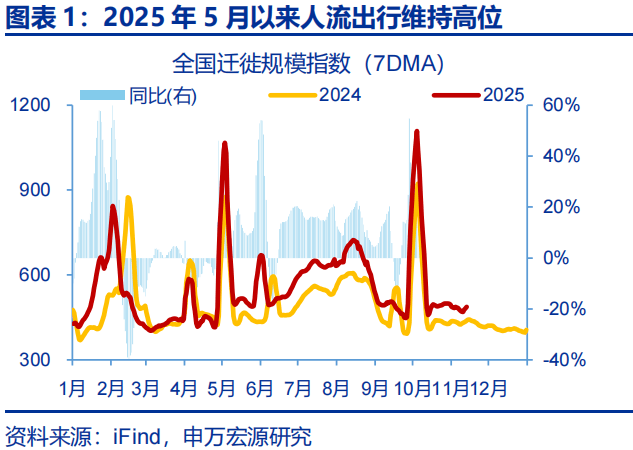
Group 1 - The core viewpoint emphasizes that by 2025, the domestic economic environment will experience significant changes, including the retreat of the "scar effect," the weakening impact of tariff conflicts, and the gradual formation of a new supply-side reform framework [1][8][30] - The "scar effect" is showing signs of retreat, with improvements in consumer behavior and a rapid decline in accounts receivable growth for enterprises, indicating a recovery in economic confidence [15][20] - The trade conflict's impact on the domestic economy is diminishing, with a shift in export structure towards high value-added products and a reduction in the proportion of exports to the US [20][21] Group 2 - The report suggests that the "anti-involution" measures and debt clearance policies are crucial for addressing the stagnation in economic circulation, with a focus on enhancing corporate profitability and revitalizing operations [2][50] - The economic forecast indicates a "non-typical recovery" driven by domestic demand policies, with expectations of improved corporate profitability and investment recovery by 2026 [4][6] - The emphasis on reform in 2026 is seen as a critical period for accelerating economic growth, with a focus on expanding domestic demand and enhancing the efficiency of the economic system [60][79] Group 3 - The report highlights the importance of a unified national market and systemic reforms to enhance economic resilience and competitiveness, particularly in the context of the "14th Five-Year Plan" [63][84] - The focus on service industry development and the acceleration of institutional opening-up are expected to create significant investment opportunities in the coming years [86][87] - The modernization of the industrial system is prioritized, with a clear strategy for upgrading traditional industries and fostering new and future industries [67][73]
向“改革”要红利——2026年宏观形势展望(申万宏观·赵伟团队)
赵伟宏观探索· 2025-11-16 16:03
Group 1 - The article emphasizes the importance of "reform" as a source of dividends for the economy, particularly in the context of the 14th Five-Year Plan, which is expected to accelerate reform processes and enhance domestic demand policies [3][67][83] - The domestic economic environment has undergone three significant changes: the retreat of the "scar effect," the weakening impact of tariff conflicts on the economy, and the gradual formation of a new supply-side reform framework [2][8][21] - The article discusses the "non-typical recovery" of the economy, driven by improved consumer confidence and the effects of ongoing domestic demand policies, which are expected to lead to a recovery in investment growth and corporate profitability [4][5][55] Group 2 - The article highlights the need for a clear industrial adjustment strategy, focusing on advanced manufacturing as a backbone while upgrading traditional sectors and accelerating the opening of the service industry [67][74] - It points out that the structural changes in exports are evident, with a shift towards high value-added products and a decrease in low value-added goods, indicating a robust export resilience [21][22] - The article stresses the importance of addressing the "internal competition" within industries, which has led to a decline in profit margins and necessitates policies aimed at enhancing corporate profitability and operational vitality [15][41][55]

向“改革”要红利——2026年宏观形势展望(申万宏观·赵伟团队)
申万宏源研究· 2025-11-16 12:00
Group 1 - The article highlights three significant changes in the domestic economic environment: the rapid retreat of the "scar effect," the weakening impact of tariff conflicts on the economy, and the gradual formation of a new phase of "supply-side reform" framework [2][8][21] - The "scar effect" is reflected in the improvement of consumer behavior and the rapid decline in accounts receivable growth among enterprises, indicating a recovery in economic confidence [15][16] - The article emphasizes the need for a rational understanding of the "macro-micro temperature difference," which has become a norm since 2022, affecting the economic transformation process in China [8][37] Group 2 - The year 2026 is positioned as a critical year for comprehensive reform and development, with an emphasis on accelerating reform processes to seize significant opportunities [3][67] - The article suggests that economic growth will require maintaining a basic growth rate and emphasizes the importance of advanced manufacturing and service industry development [3][74] - Key areas for investment opportunities include the construction of a unified market, reforms related to social welfare, and accelerating green transformation [3][83][84] Group 3 - The article predicts a non-typical economic recovery driven by internal demand policies, which will help improve consumer confidence and investment growth [4][5] - External demand remains resilient, with a shift in export structure towards high-value-added products, indicating a strong competitive advantage [5][21] - The overall economic recovery is expected to follow a "front low and back high" rhythm, supported by the retreat of the "scar effect" and ongoing internal demand policies [5][55]

向“改革”要红利——2026年宏观形势展望(申万宏观·赵伟团队)
申万宏源宏观· 2025-11-16 11:04
Group 1 - The core viewpoint emphasizes the need to "seek dividends from reform" as a significant opportunity for investment, particularly in the context of the 14th Five-Year Plan and the upcoming 15th Five-Year Plan [7][67] - The domestic economic environment has undergone three significant changes: the retreat of the "scar effect," the weakening impact of tariff conflicts on the economy, and the gradual formation of a new supply-side reform framework [2][8] - The "scar effect" is showing signs of retreat, evidenced by improvements in consumer behavior and a decrease in accounts receivable growth among enterprises [15][21] Group 2 - The economic recovery is characterized as "atypical," with a transition from "confidence building" to recovery, driven by deepening domestic demand policies and a reduction in the "crowding out effect" of debt [4][5] - Export resilience is expected to continue, with a shift in the structure of exports towards high-value-added products, despite a decrease in the share of exports to the US [21][22] - The focus on advanced manufacturing as a backbone and the upgrading of traditional sectors are highlighted as key strategies for economic adjustment [74][77] Group 3 - The 2026 year is anticipated to be a pivotal year for comprehensive reform and development, with significant opportunities arising from accelerated reform processes [3][67] - The emphasis on "self-reliance" and "extraordinary measures to seize high ground" in technology modernization is crucial for supporting China's modernization efforts [77][83] - Key areas for reform include the construction of a unified national market, social security system reforms, and financial and tax reforms, all aimed at enhancing economic resilience and sustainability [83][84]

混沌AI院商业场景实战营:90天让AI为企业创造真实价值
混沌学园· 2025-11-14 10:41
Core Viewpoint - The article emphasizes the transformative potential of AI, urging businesses to move beyond superficial applications and focus on creating real value through AI integration [2][3]. Summary by Sections AI Practical Training Camp - The "Chaos AI Institute" offers a practical training camp that focuses on real business scenarios rather than traditional theoretical courses [6]. - Participants will develop a systematic AI approach, a customized AI solution, and a collaborative team to enhance business operations [7][8][9]. Implementation Path - The program consists of a three-dimensional approach: offline workshops, online support, and one-on-one guidance from AI experts [11]. - The training spans 12 weeks, with clear outputs at each stage, including scenario solutions, application demos, and benchmark cases [11]. Key Scenarios - **AI + Marketing Growth**: Aimed at marketing-driven industries, this scenario focuses on enhancing customer acquisition and conversion efficiency [11][12]. - **AI + Product Innovation**: Targets product-driven sectors, facilitating rapid market innovation and user experience enhancement [14]. - **AI + Operational Efficiency**: Designed for process-driven industries, this scenario aims to reduce costs and improve operational efficiency [16]. Success Stories - Companies like Fujian Minwei Industrial and BF Mall have successfully implemented AI solutions, resulting in significant operational improvements and product development efficiencies [37][38]. Target Audience - The program is suitable for businesses with annual revenues exceeding 10 million, a clear need for AI transformation, and a commitment to innovation [41].

关于社零、投资、物价,国家统计局最新回应!
券商中国· 2025-11-14 09:39
Economic Overview - The national economy is maintaining a stable and progressive development trend, with production supply remaining stable, employment overall stable, and prices showing improvement [1][4] Consumption and Investment - In October, the total retail sales of consumer goods increased by 2.9% year-on-year, exceeding market expectations, with notable sales growth in upgraded products such as communication equipment and cultural office supplies [2][3] - Despite a slowdown in fixed asset investment growth, the physical workload of investments is increasing, and manufacturing investment continues to grow, indicating an ongoing optimization of investment structure [2][5] Price Trends - The Consumer Price Index (CPI) showed positive changes in October, with a month-on-month increase of 0.2% and a year-on-year increase of 0.2%, reversing the previous month's decline [7] - The Producer Price Index (PPI) also exhibited positive changes, with a month-on-month increase for the first time in October, driven by seasonal demand and rising international metal prices [8] Employment and Structural Changes - The employment situation remains generally stable, and there is a continuous trend of transformation and upgrading in various sectors [4][6] - The investment structure is optimizing, with traditional manufacturing undergoing upgrades and new manufacturing sectors expanding, supporting overall investment growth [5][6]
三季度产业景气观察:企业投资阵地往前推了半步
Di Yi Cai Jing· 2025-11-10 12:09
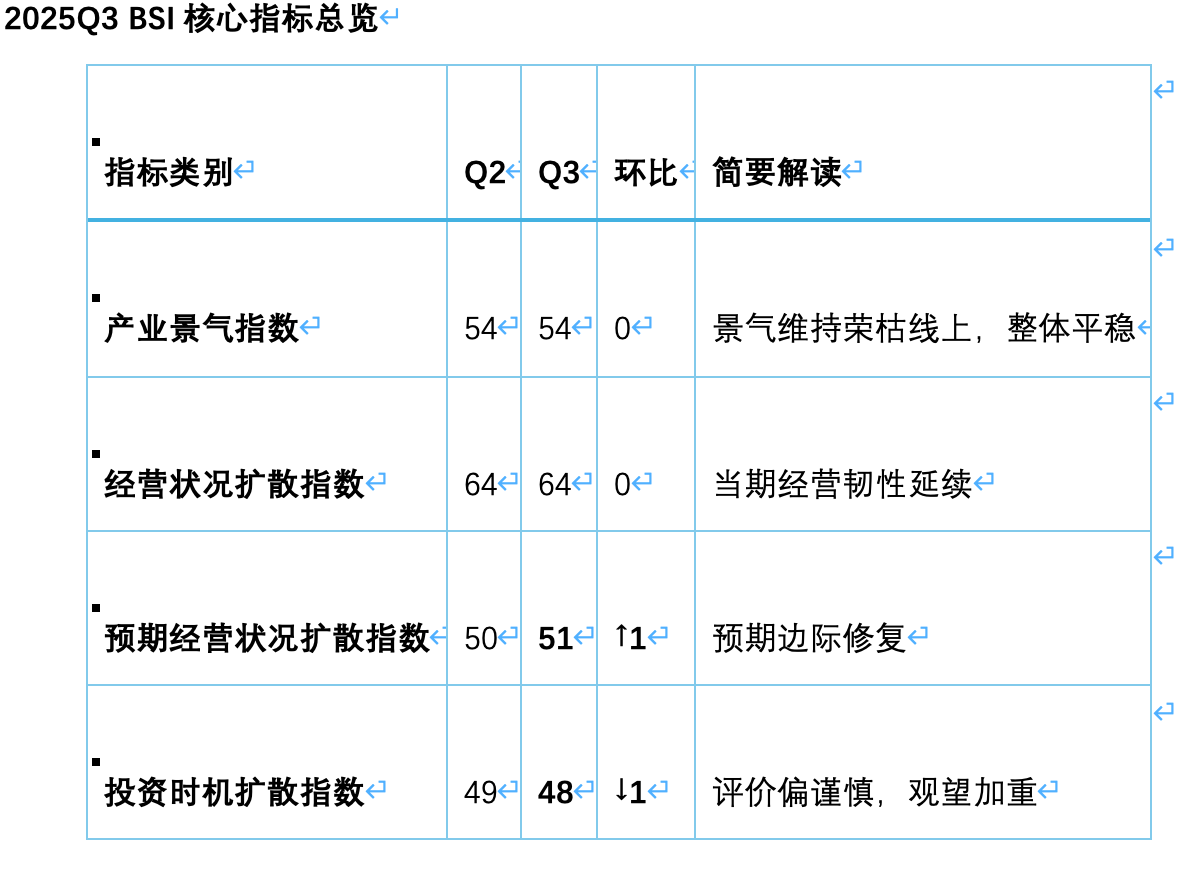
2025年三季度,中国企业在"风声未止"的外部环境与"信号已现"的国内市场之间寻找确定性。对外,关税与贸易摩擦仍高热,外需预期承压;对内,三季度 上证指数上涨12.73%,自3445点升至3882点,创近十年新高区间,情绪与风险偏好明显修复(也是本轮单季最大涨幅之一);9月一揽子服务消费举措强化 稳定预期;美联储议息基调谨慎,全球流动性与预期保持平衡,为国内资产价格与企业融资环境提供侧面支撑。 长江商学院最新发布的BSI(中国产业经济景气指数)显示:三季度产业景气指数54,与上季持平;经营状况扩散指数64,与上季持平;预期经营状况扩散 指数升至51(+1);投资时机扩散指数48(-1)。评价层面趋谨慎,但生产与库存出现"备货式修复",呈现"评价谨慎、行为修复"的张力。 四季度外部与内部的几处"关键齿轮"正在对齐,给"半步"提供继续向前的可能。 三季度画像可概括为:现实可守、预期微升、投资评价趋谨,但生产—库存链条启动"备货式修复"。国内资本市场的显著上行为企业侧情绪与估值锚提供了 支撑,叠加政策托底与节庆信号,共同把谨慎情绪转化为有限可控的实际动作:先提产能与备货,后看订单与价格。 进入10月,外部环境出现" ...