功能饮料

Search documents
行业轮动加快,6月A股机会何在丨南财号联播
2 1 Shi Ji Jing Ji Bao Dao· 2025-05-27 11:01
Group 1: Consumer Sector Performance - The consumer sector in A-shares is actively leading the market, with companies like Pop Mart and Mixue Group reaching historical highs in stock prices, with Pop Mart's stock price at 231.60 HKD and a market cap exceeding 310 billion HKD, while Mixue Group's stock price is at 571 HKD with a market cap surpassing 210 billion HKD [1][1] - The report highlights the strong performance of various segments within the consumer sector, including dairy, cultivated diamonds, beer, liquor, and millet economy [1] Group 2: Banking and Internship Opportunities - A recent initiative by Industrial Bank allows clients with over 10 million CNY in new deposits to secure internship opportunities for their children at prestigious companies like JPMorgan, CICC, Google, and Microsoft, with confirmation from bank staff that the program exists but is currently closed for applications [1][1] Group 3: Salary Trends in Industries - The National Bureau of Statistics reported that the highest average annual salaries in 2024 are in the information transmission, software and IT services, and financial sectors, with the information transmission and IT services sector having a 34.60% increase in average salary over the past five years [1][1] Group 4: A-share Market Dynamics - The A-share market is experiencing increased volatility and accelerated sector rotation, with a focus on technology growth opportunities as the technology sector's crowdedness has decreased, making it more attractive for investment [2][2] - The TMT sector's trading volume has dropped to about 23%, lower than levels seen in 2023 and 2024 during previous adjustments, indicating potential for recovery [2][2] Group 5: Beverage Market Trends - The market for traditional Chinese herbal drinks has seen significant growth, with the market size increasing from 0.1 million CNY in 2018 to 4.5 million CNY in 2023, and projected to exceed 10 billion CNY by 2028, driven by younger consumers [2][2] Group 6: Education and Training Industry - The competitive landscape in the education and training sector for exams like graduate school entrance and civil service has led to a proliferation of training institutions, which are increasingly focusing on marketing their teaching staff as "famous teachers" to attract students [3][3] Group 7: Robotics Market Growth - The domestic market for robotic vacuum cleaners is expected to experience explosive growth by 2025, with online sales increasing by 67.0% and offline sales by 100.5% in the first four months of the year, indicating strong market vitality [3][3] - Major brands like Roborock and Ecovacs have reported significant revenue increases of 86.2% and 11.1% respectively in the first quarter, showcasing robust performance in the sector [3][3]
“低价之王”东鹏特饮:销量狂奔为何换不来利润增长
Sou Hu Cai Jing· 2025-05-20 05:21
Core Insights - The Chinese functional beverage market is highly competitive, with Eastroc Beverage once holding a strong position but now facing challenges due to market shifts and increased competition [1][3] - In 2024, Eastroc Beverage reported a revenue of 15.839 billion RMB, reflecting a year-on-year growth of 40.63%, indicating strong growth momentum [1] - However, the company is struggling with over-reliance on a single product line, declining channel benefits, and a hollow brand value, with over 80% of its revenue coming from its core energy drink business [3][4] Market Dynamics - The competitive landscape has shifted, with Red Bull maintaining its high-end position through brand premium and sports marketing, while new entrants like "Alien" and "Battle Horse" are gaining traction through targeted marketing strategies [3][7] - Eastroc's traditional focus on a 500ml bottle format has limited its ability to innovate and adapt to changing consumer preferences [3] Financial Performance - Eastroc's revenue growth of 9.8% in 2024 masks deeper issues, as its net profit margin plummeted from 15.2% in 2021 to 7.4% in 2024, and gross margin fell from 49.3% to 41.8% [4] - The company's low-price strategy has become a double-edged sword, restricting its attempts to move into higher-end markets [4][11] Innovation and R&D - Eastroc's R&D investment is significantly below industry averages, with a rate of only 1.2% in 2024, compared to over 3% for competitors like Yuanqi Forest and Alien [4][8] - The company's innovation efforts have been criticized as superficial, merely rebranding existing products without substantial improvements [5][11] Distribution and Marketing - Eastroc's reliance on offline channels, which accounted for 87% of revenue in 2021, is declining, with a growth rate of only 4.3% in 2024, while online sales remain low at 13% [5] - The company's digital marketing efforts are lacking, with minimal engagement on platforms like Douyin and Kuaishou, contrasting sharply with competitors who leverage social media effectively [5][10] Strategic Challenges - Eastroc's management structure, dominated by family control, has led to strategic inertia and missed opportunities for innovation and market adaptation [8][12] - The company's marketing strategies have failed to resonate with younger consumers, who perceive its advertising as outdated and disconnected from current trends [10] Future Outlook - The company faces a critical juncture, needing to redefine its strategy to align with evolving consumer demands and market dynamics [11][12] - Eastroc must address key questions regarding its pricing strategy, R&D investment, and organizational governance to avoid becoming obsolete in the competitive landscape [12]



中国功能饮料行业研究报告:场景化消费驱动线下增长
南京掌控网络科技· 2025-04-27 10:05
Investment Rating - The report indicates a positive investment outlook for the functional beverage industry, highlighting its rapid growth and structural changes within the market [1]. Core Insights - The functional beverage sector is leading the growth in China's soft drink market, driven by health-conscious consumer trends and the demand for energy and nutritional products [15][20]. - The market for functional beverages is expected to grow significantly, with a projected compound annual growth rate (CAGR) of approximately 8.3% from 2019 to 2024, increasing from RMB 111.9 billion to RMB 166.5 billion [17][20]. - Energy drinks dominate the functional beverage market, accounting for 66.9% of the total market share in 2024, while sports drinks are the fastest-growing segment [20]. Industry Status - The functional beverage industry is experiencing structural growth, with a notable shift towards healthier options, leading to a decline in traditional sugary beverages [11][12]. - The overall soft drink market in China is projected to reach RMB 1,250.2 billion in 2024, with a CAGR of 4.7% from 2019 to 2024 [12][15]. - The market share of functional beverages within the soft drink category is expected to increase from 11.3% in 2019 to 13.3% in 2024 [16]. Industry Trends - The report emphasizes the importance of offline consumption scenarios, which are crucial for building consumer loyalty in the functional beverage market [30][36]. - The growth of online sales channels is significant, with a projected CAGR of 14.0% from 2019 to 2024, although offline channels still dominate the market [32][35]. - The increasing disposable income of consumers is driving the demand for soft drinks, with per capita consumption in China expected to reach 197.8 liters in 2024, indicating substantial growth potential [39]. Competitive Landscape - The report highlights a low concentration in the competitive landscape, with the top five companies holding a combined market share of 61.6%, leaving ample room for long-tail market opportunities [53]. - Eastroc Beverage leads the market with a 26.3% share, benefiting from its penetration in lower-tier cities and a large packaging strategy [53]. - The energy drink market is characterized by a dual oligopoly, with Eastroc and Red Bull dominating, while new entrants face challenges in establishing brand recognition and distribution networks [57]. Company Case Studies - Eastroc Beverage has shown explosive growth, with revenues increasing from RMB 69.78 billion in 2021 to RMB 158.39 billion in 2024, driven by its flagship product and innovative new offerings [62]. - Huabin Group, despite facing legal challenges, managed to maintain a revenue of RMB 210.9 billion in 2024, although its market share has declined significantly due to competition from local brands [70].
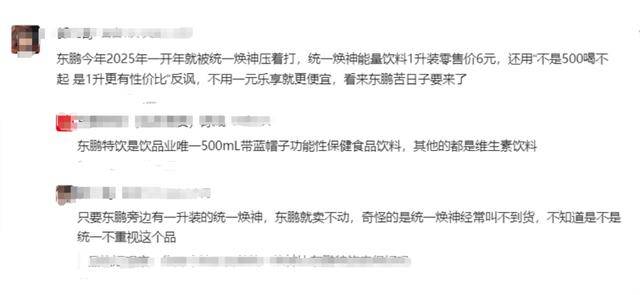
统一焕神“2元乐享”贴脸开大东鹏特饮,能量饮料市场格局生变?
Sou Hu Cai Jing· 2025-04-23 03:08
Core Insights - The energy drink market in China is currently dominated by Red Bull and Dongpeng, creating a significant gap that is difficult for new entrants to bridge. However, a potential reshuffle is anticipated in 2025 due to the rise of Uni-President's "Huan Shen" energy drink [1][3]. - The launch of the 1L "Huan Shen" at a price of 6 yuan has disrupted traditional pricing models, appealing particularly to cost-sensitive consumers such as truck drivers and delivery personnel [3][4]. - The promotional campaign "2 Yuan Enjoy" initiated by Uni-President has further strengthened the market presence of "Huan Shen," drawing comparisons to Dongpeng's successful strategies [4]. Market Dynamics - The energy drink market has seen a clear leader-follower dynamic, with Red Bull and Dongpeng establishing a strong foothold. New products have struggled to gain traction until the recent introduction of "Huan Shen" [1]. - The competitive landscape is shifting as "Huan Shen" demonstrates strong sales performance, reportedly achieving 1.5 times the sales of Dongpeng in similar shelf space [3]. - The aggressive pricing strategy of "Huan Shen" at 6 yuan for 1L, which is 60% of the price of Dongpeng's 500ml, is a key factor in its market penetration [3]. Promotional Strategies - The "2 Yuan Enjoy" campaign has been rolled out across various regions, enhancing brand visibility and consumer engagement [4]. - The messaging strategy directly targets Dongpeng by emphasizing the cost-effectiveness of "Huan Shen," indicating a strategic approach to compete head-to-head with established brands [4].
东鹏特饮IPO:跟跑30年逆袭中国第一,能否反攻东南亚红牛大本营?
Guan Cha Zhe Wang· 2025-04-14 11:48
Core Viewpoint - The Chinese functional beverage market is undergoing structural adjustments, with Dongpeng Beverage leveraging high cost-performance and deep distribution networks to continuously increase its market share. The company has submitted an IPO application to the Hong Kong Stock Exchange, aiming to raise funds for overseas market expansion, particularly in Southeast Asia, mirroring the early market entry of Red Bull into China [1][6]. Group 1: Market Dynamics - Dongpeng Beverage has become the leading brand in China's functional beverage market, achieving a market share of 43.02% in 2023, surpassing Red Bull, although it ranks second in sales revenue [3][5]. - The market landscape has shifted due to Red Bull's legal disputes and brand challenges, creating an opportunity for domestic brands like Dongpeng to gain market share [3][4]. - The consumption growth in lower-tier cities is significant, with a 12% increase in functional beverage consumption in cities below the third tier, compared to 6% in first-tier cities [4]. Group 2: Company Strategy - Dongpeng plans to allocate 30% of its IPO proceeds for brand upgrades and 25% for overseas market expansion, focusing on Southeast Asia, which is Red Bull's traditional stronghold [7]. - The company has established subsidiaries in Vietnam and Indonesia to better understand local market dynamics and consumer preferences, such as launching a 200ml mini-pack targeting the large motorcycle user base in Southeast Asia [7]. Group 3: Competitive Landscape - Dongpeng faces significant challenges in Southeast Asia, where Red Bull has a strong brand presence and consumer loyalty, along with a well-established distribution network [8]. - The competitive environment in the Southeast Asian functional beverage market is intense, with numerous brands vying for market share, some of which may adopt similar strategies to Dongpeng's past approaches [8]. - Dongpeng's reliance on a follow-the-leader strategy has raised concerns about its innovation capabilities, which may hinder its ability to establish a strong brand identity in the Southeast Asian market [8][9].
东鹏饮料赴港IPO:从“红牛挑战者”到行业龙头的崛起密码!
Sou Hu Cai Jing· 2025-04-13 12:30
Core Viewpoint - Dongpeng Beverage, a leading functional beverage company in China, has submitted an H-share listing application to the Hong Kong Stock Exchange, aiming to expand its global market presence through an "A+H" dual listing structure. This marks the company's second attempt to access the capital market after its A-share listing in 2021. Despite impressive financial performance, Dongpeng faces challenges such as reliance on a single product, intensified market competition, and globalization hurdles [1][11]. Financial Performance - Dongpeng Beverage projects a revenue of 15.839 billion yuan and a net profit of 3.326 billion yuan for 2024, maintaining a market capitalization in the trillion yuan range [1]. - The company's stock price surged to 265 yuan per share post its A-share listing in 2021, with revenue increasing over twofold and net profit growing more than threefold in four years [9]. Market Position and Product Dependency - Dongpeng's flagship product, Dongpeng Special Drink, accounted for 84% of the company's revenue in 2024, with energy drinks making up 91.9% of total revenue [9]. - The functional beverage market's growth rate has declined from 38.4% in 2023 to 28.5% in 2024, indicating signs of market saturation [9]. Competitive Landscape - Competitors like Red Bull have resumed aggressive market strategies, regaining a market share of 22%, while other brands like Pulse and Alien are expanding in the sports drink sector [11]. - Dongpeng has introduced new products such as electrolyte drinks and a multi-category strategy, but these new categories contribute less than 10% to overall revenue [11]. Strategic Challenges - The company's financial strategy has raised concerns, as it distributed 1.3 billion yuan in cash dividends while allocating 11 billion yuan of idle funds for investment, which appears misaligned with its stated needs for capacity expansion and supply chain upgrades [11]. - The controlling family, Lin Mulin, holds 50.7% of the company's shares, while the second-largest shareholder has been reducing their stake, reflecting a lack of confidence in Dongpeng's long-term strategy [11]. Future Outlook - Analysts suggest that the dual listing could enhance financing channels and international brand image, potentially paving the way for overseas acquisitions. However, the heavy reliance on a single product may pressure valuations [11]. - Dongpeng aims to adhere to a "platform company" strategy, leveraging existing channel advantages to diversify its product offerings rather than pursuing acquisitions [12].
货拉拉第五次递表港交所,蓝思科技、东鹏饮料开启“A+H”上市
Sou Hu Cai Jing· 2025-04-11 14:15
Summary of Key Points Core Viewpoint The news highlights the recent activities in the IPO market, including new listings, applications for IPOs, and financial data of companies preparing for public offerings. It emphasizes the performance of newly listed companies and their market potential. Group 1: New Listings - Shanghai Stock Exchange had no new listings, while Shenzhen Stock Exchange's ChiNext saw one company, Shihang New Energy, listed on April 2, with a first-day increase of 244.49% and a market value of approximately 12.4 billion yuan [3][4]. - Jiangsu Hongxin was listed on the Hong Kong Stock Exchange on March 31, with a closing price of 2.51 HKD per share, a slight increase from its issue price of 2.50 HKD, resulting in a market value of about 540 million HKD [10][34]. Group 2: IPO Applications - No companies submitted IPO applications on the Shanghai or Shenzhen stock exchanges during the period [6]. - Seven companies submitted IPO applications on the Hong Kong Stock Exchange, including: - Lens Technology, a leading provider of precision manufacturing solutions for smart terminals [16]. - Jiaxin International, focused on tungsten mining in Kazakhstan, with significant resources and production capabilities [20][21]. - Shangdingxin, a fabless power semiconductor supplier [24][25]. - Wenda Technology, providing smart city solutions and property services [26][28]. - Dongpeng Beverage, a leading functional beverage company in China, with a market share increase from 15.0% in 2021 to 26.3% in 2024 [31]. - Lalamove, a logistics platform with a significant market share in China [35][36]. - Xin Hehua, a major supplier of traditional Chinese medicine products [38][39]. Group 3: Financial Data - Shihang New Energy reported a revenue increase of 154.15% from its issue price [3]. - Lens Technology projected revenues of 46.6 billion yuan, 54.3 billion yuan, and 69.8 billion yuan for 2022, 2023, and 2024, respectively, with net profits increasing by 20.72% and 20.88% in 2023 and 2024 [18]. - Jiaxin International has not generated revenue yet, with projected net losses of 94.45 million HKD, 80.13 million HKD, and 177 million HKD for 2022, 2023, and 2024 [22]. - Dongpeng Beverage's revenues are expected to grow from 8.5 billion yuan in 2022 to 15.8 billion yuan in 2024, with net profits increasing significantly [32]. - Lalamove's revenues are projected to rise from 1.036 billion USD in 2022 to 1.593 billion USD in 2024, with adjusted net profits turning positive in 2024 [36].


上市公司密集回应“对等关税”影响
Shang Hai Zheng Quan Bao· 2025-04-06 12:08
据新华社报道,美国总统特朗普4月2日在白宫签署关于所谓"对等关税"的行政令,宣布美国对贸易伙伴 加征10%的"最低基准关税",并对某些贸易伙伴征收更高关税。 东鹏饮料表示,作为国产能量饮料龙头企业,公司依托全产业链本土化优势,持续深化国产替代进程。 据悉,公司目前主要原料采购及生产基地已实现100%国内布局,PET瓶、纸箱等包材供应商国产化率 为100%。通过自建智能化生产基地和数字化供应链体系,关键生产设备国产替代率近100%,有效抵御 外部供应链波动风险。 行业分析显示,功能饮料作为民生消费品类,受关税政策直接影响有限。随着"国货替代"消费趋势深 化,东鹏饮料通过渠道下沉和产品创新,2024年末全国终端网点近400万家,持续巩固本土化竞争优 势。 乐惠国际则表示,公司设备出口份额占到50%左右,超过90%出口到"一带一路"等发展中国家,因此"对 等关税"对公司几乎没有影响。 4月6日晚间,一批上市公司密集回应"对等关税"影响。 食品饮料行业 钢铁行业 在中美关税政策持续激烈博弈的背景下,国内功能饮料行业显现出较强发展韧性。 多家钢铁行业上市公司表示,由于中国对美国钢材出口规模较小,本次加征"对等关税"措施 ...
食品饮料板块投资机会全解析
雪球· 2025-02-28 09:12
Group 1: Baijiu Industry - The current PE-TTM for the baijiu sector is 19.31 times, which is at the 6.18% percentile over the past decade, indicating significant safety margins [1] - High-end baijiu brands like Kweichow Moutai and Wuliangye are expected to maintain market share through "price protection and volume control" strategies, with projected net profit growth rates of 13.3% and 12.7% for 2024 respectively [1] - Regional leaders such as Shanxi Fenjiu and Jinshiyuan are benefiting from channel penetration and the recovery of banquet scenarios, with sales growth expected to exceed 30% during the 2025 Spring Festival [1] Group 2: Consumer Goods - The beer sector continues to see high-end trends, with Qingdao Beer achieving an ASP of 4200 yuan per thousand liters and Yanjing Beer having over 25% revenue contribution from its U8 flagship product [3] - Functional beverages like Dongpeng Beverage, which holds a 31% market share, are rapidly expanding into coffee and energy tea, with a projected revenue growth of 45% year-on-year by Q4 2024 [4] - Health drinks such as Xiangpiaopiao's zero-sugar freeze-dried fruit tea have seen online sales double, with a projected PE of only 20 times in 2025 [5] Group 3: Snacks and Prepared Foods - Online sales for snack brands like Three Squirrels have surged, with a 200% year-on-year increase in GMV through Douyin, while Yanjinpuzi's quail egg product has annual sales of 1 billion [7] - The prepared food sector is benefiting from B-end restaurant recovery and C-end penetration, with companies like Anjifood seeing 30% of their revenue from prepared foods after acquiring Frozen Food Mr. [8] Group 4: Seasoning and Baking Supply Chain - Leading seasoning brands like Haitian Flavoring have reduced channel inventory to 2.5 months, while Qianhe Flavoring has over 50% revenue from zero-additive soy sauce, benefiting from restaurant recovery and household consumption upgrades [10] - Yeast leader Angel Yeast is experiencing over 25% growth in overseas revenue due to capacity release and cost reductions [11] - Innovations in raw materials are seen in companies like Lihai Foods, which has a 60% year-on-year increase in cream revenue, and Huirong Technology, with 30% of its plant-based cream revenue coming from exports [12] Group 5: New Tea Beverage Supply Chain - The IPO of Mixue Ice City has a significant impact, with a frozen capital of 1.77 trillion HKD, benefiting related A-share companies in the supply chain [14] - Companies like Anjifood and Xianle Health are positioned as suppliers of jam and frozen fruits, while Yudong Technology and Hexing Packaging are focusing on eco-friendly solutions and cost advantages in packaging materials [15][16] - The global expansion plan of Mixue, with 46,000 stores, could lead to a 30%+ increase in orders for supply chain companies [17] Group 6: Policies and Industry Trends - The Chinese government's "restore and expand consumption" policy is expected to result in over 300 billion yuan in consumer subsidies by 2025, directly benefiting the food and beverage sector [18] - Retail sales are projected to grow by 3.5% year-on-year in 2024, with health food categories (low-sugar/low-fat) expected to exceed 20% growth [19] - Valuation shifts are evident, with many sub-sectors like seasoning having a PE of 28 times compared to a historical average of 40 times, alongside noticeable foreign capital inflows [19]