
氨纶

Search documents
专家分享:氨纶行业现状与展望
2025-09-26 02:28
Summary of the Spandex Industry Conference Call Industry Overview - The spandex industry is currently facing overcapacity, with an expected addition of approximately 700,000 tons from 2021 to 2025, while demand growth has not kept pace, leading to prices dropping to historical lows below 5,000 yuan compared to pre-supply-side reform levels in 2016 [1][3][20] - Global spandex capacity is projected to grow at an average rate of nearly 10% during the 14th Five-Year Plan, reaching 1.93 million tons by the end of 2025, with China accounting for 80% of global supply [1][4] - The industry concentration has significantly increased to 79%-80%, although competition remains fierce [1][6] Key Insights and Arguments - The spandex industry's cash flow is marginally declining, currently operating below the breakeven line [1] - In 2022, the industry's operating rate was the lowest in recent years at 76%, with a slight recovery to around 81% in the first eight months of 2025 [1][9] - Average inventory levels have decreased from approximately 50 days to about 45 days, but the destocking process is slow [10][22] - The expected spandex production for 2025 is 1.1 million tons, representing a year-on-year growth of about 5% [11] Demand Trends - Demand for spandex is projected to show slight growth during the 14th Five-Year Plan, with a forecasted decline to around 8% in 2025, driven mainly by products like masks, protective clothing, and homewear [12] - The export volume of spandex increased by 10.3% year-on-year to 56,000 tons in the first eight months of 2025, although the average export price has decreased [17] Price Dynamics - Spandex prices have fallen from a peak of 78,500 yuan per ton in August 2021 to approximately 23,000 yuan per ton, which is only one-third of the peak price [2] - The price of spandex is currently at historical lows, with significant fluctuations observed due to market conditions and supply-demand imbalances [20] Capacity Expansion and Competition - Major companies like Huafeng Chemical and Xiaoxin are actively expanding their capacities, with Huafeng adding 30,000 tons in the first half of 2025 and planning further expansions [5][23] - The industry is seeing a trend towards vertical integration, with many spandex manufacturers extending into upstream production areas like BDO [25][26] Challenges and Risks - The industry is experiencing a significant number of companies facing financial difficulties, leading to production halts and potential exits from the market [31][33] - The competition for market share is intense, with companies often resorting to pricing strategies to attract new customers [8] Future Outlook - The spandex industry is expected to face continued challenges with overcapacity and fluctuating demand, leading to a cautious outlook for future growth [27] - The anticipated production capacity growth rate is expected to slow down to around 5% during the 15th Five-Year Plan, with potential for further consolidation in the industry [28] Conclusion - The spandex industry is at a critical juncture, with significant overcapacity, declining prices, and intense competition. Companies must navigate these challenges while seeking opportunities for growth through innovation and strategic expansions.
合盛硅业&华峰化学
2025-09-17 00:50
Summary of Conference Call Records Industry and Companies Involved - **Companies**: 合盛硅业 (Hesheng Silicon Industry) and 华峰化学 (Huafeng Chemical) - **Industry**: Silicon-based new materials and polyurethane industry Key Points and Arguments Hesheng Silicon Industry - Hesheng Silicon Industry is a leading player in China's silicon-based new materials sector, benefiting from low-cost coal and electricity resources in Xinjiang, which allows for coal-electric-silicon integration to reduce production costs [1] - The company has significant production capacity in industrial silicon and organic silicon, with plans for further expansion in polysilicon, which is expected to benefit from improved photovoltaic industry policies [1] - The industrial silicon market is characterized by price volatility, but global demand is steadily increasing due to the needs of photovoltaic components and organic silicon, alongside export growth from overseas economic recovery [1][6] - Hesheng's industrial silicon capacity is projected to reach 1.87 million tons in 2024, with organic silicon production at full capacity, while polysilicon projects are still under construction [4] Organic Silicon Market - Organic silicon has a wide range of applications, particularly in emerging industries like lithium batteries and photovoltaic components, with a compound annual growth rate (CAGR) of over 10% in recent years [5] - The rapid expansion of domestic organic silicon capacity in the past two years has led to price declines, but limited new capacity and shutdowns of overseas production are expected to optimize supply and drive prices up in the next two years [5] Industrial Silicon Market - Industrial silicon prices have historically fluctuated, with peaks reaching 60,000 yuan per ton and lows below 10,000 yuan in 2025 [6] - Global demand for industrial silicon is projected to grow from 2.44 million tons in 2011 to 5.5 million tons in 2024, with a CAGR of 7.7% [6] - Supply-side constraints, including the elimination of small, inefficient furnaces and a slowdown in new capacity additions, are expected to improve the supply structure and potentially drive prices higher [6] Huafeng Chemical - Huafeng Chemical is the largest producer of spandex in China and a leading global player in adipic acid and shoe sole raw materials, with a production capacity of 325,000 tons of spandex and 1.355 million tons of adipic acid [10] - The spandex market is currently at a historical low, but demand is expected to grow due to increased consumption in sportswear, casual wear, and formal attire, as well as new applications [11] - Adipic acid is widely used in nylon and polyurethane, with a projected consumption of nearly 2 million tons in China by 2024, but current oversupply has led to low prices [12] Cost Advantages of Huafeng Chemical - Huafeng Chemical has significant cost advantages in production processes, energy supply, labor costs, and depreciation, allowing it to maintain lower production costs than competitors by 1,000-3,000 yuan per ton [13] - The company’s profitability is supported by its ability to navigate industry cycles, with a current profit of approximately 2,000 yuan per ton for spandex [13] Future Outlook - Hesheng Silicon Industry is expected to benefit from market changes due to anti-involution policies, with potential improvements in cash flow and profitability as prices for organic silicon and industrial silicon rise [8][9] - Huafeng Chemical's performance is projected to reach around 2 billion yuan by 2025, with a price-to-earnings ratio of about 20 times, indicating potential for growth if market conditions improve [14] Other Important Insights - The market is currently divided on Hesheng's ability to recover and the potential risks related to its high debt levels, with a debt-to-asset ratio of 63% and significant short-term liabilities [7] - The anticipated exit of high-cost competitors from the market may further support price recovery for both spandex and adipic acid [11][12]


化工板块狂飙,锂电、氟化工猛涨!政策出手破内卷,行业拐点已现?
Xin Lang Ji Jin· 2025-09-08 02:35
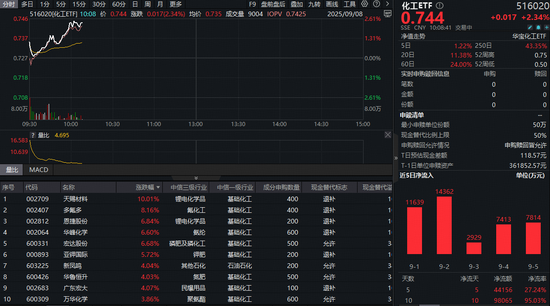
Group 1 - The chemical sector continues to show strong performance, with the chemical ETF (516020) experiencing a price increase of 2.34% as of the latest report, following a brief period of fluctuation [1][3] - Key stocks in the sector, including Tianqi Lithium and Huaneng Chemical, have seen significant gains, with Tianqi reaching the daily limit and others like Enjie and Huafeng Chemical rising over 6% [1][3] - The chemical ETF has attracted substantial investment, with a total inflow of 4.42 billion yuan over the last five trading days and over 9.8 billion yuan in the last ten days [3] Group 2 - The Ministry of Industry and Information Technology and the State Administration for Market Regulation have jointly released a plan aimed at stabilizing growth in the electronic information manufacturing industry, which includes measures to reduce competition in the lithium battery sector [3][4] - The policy shift from "encouragement" to "guidance" indicates potential for mandatory capacity replacement and stricter environmental regulations, suggesting a transition from price competition to policy-driven supply adjustments [3][4] - The valuation of the chemical ETF is currently at a relatively low level, with a price-to-book ratio of 2.23, indicating a favorable long-term investment opportunity [3] Group 3 - Domestic policies frequently emphasize supply-side requirements to combat "involution," while international factors such as rising raw material costs and capacity exits in Europe and the U.S. add uncertainty to chemical supply [4][5] - The "anti-involution" policy is seen as a significant guiding principle for the manufacturing sector, aiming to eliminate unfair competition and improve the overall market environment [5] - The chemical ETF (516020) provides a diversified investment approach, with nearly 50% of its holdings in large-cap stocks and the remainder in leading companies across various chemical sub-sectors [5]





湘财证券晨会纪要-20250905
Xiangcai Securities· 2025-09-04 23:31
Industry Overview - The rare earth magnetic materials industry saw a significant increase of 15.32% last week, outperforming the benchmark (CSI 300) by 12.61 percentage points [3] - The industry valuation (TTM P/E ratio) increased by 5.29 times to 105.19 times, currently at the 98th percentile of its historical range [3] Price Trends - Last week, the prices of rare earth concentrates generally declined, with specific decreases of 2.38%, 5.41%, and 6.25% for various domestic rare earth mines [4] - The average price of praseodymium-neodymium oxide fell by 4.02%, while the metal price decreased by 2.24% [4] - Dysprosium prices experienced a slight decline of 0.62%, and terbium prices remained weak due to insufficient terminal demand [4] - The price of sintered neodymium-iron-boron remained stable, with H35 grade increasing by 1.42% [6] Investment Recommendations - The supply of rare earths is expected to remain tight, with policies strengthening control over the entire industry chain, leading to an increase in the short-term supply gap for praseodymium-neodymium [7] - Demand is anticipated to improve, particularly in emerging sectors such as new energy vehicles and wind power, with major magnetic material manufacturers operating at full capacity [7] - The report maintains an "overweight" rating for the industry, suggesting that upstream rare earth resource companies may benefit from rising prices [8] Mechanical Industry Insights - The company reported a slight revenue increase of 1.7% year-on-year, with total revenue reaching 1.29 billion yuan [10] - The net profit attributable to shareholders decreased by 27.0%, indicating pressure on profitability [10] - The company is focusing on precision reducer business, which is expected to grow due to the demand in intelligent manufacturing and automation [13] Chemical Industry Outlook - The supply-demand dynamics for spandex are expected to improve as outdated production capacities exit the market and new capacities face delays [17] - The demand for spandex is projected to grow with consumption upgrades, leading to a favorable supply-demand balance in the future [19]
“反内卷”专家电话会:氨纶行业拐点何时出现?
2025-08-27 15:19
Summary of the Conference Call on the Spandex Industry Industry Overview - The spandex market is experiencing stable demand expansion, particularly in outdoor, yoga, and sun-protective clothing sectors [1][2] - Domestic spandex production capacity is approximately 1.4 million tons, with China being the largest consumer market, followed by Brazil and Turkey [3][15][17] Key Points and Arguments - **Market Demand**: The demand for spandex is consistently growing, especially in elastic fabric applications. The market is expected to maintain stable growth due to the increasing demand from outdoor and sports brands [3][4] - **Production Capacity**: Limited new production capacity is anticipated in 2025, with only Hengsheng adding 50,000 tons and Xiaoxin releasing 30,000 tons. Other companies are still in the equipment installation phase [10][13] - **Environmental and Cost Pressures**: Coastal spandex manufacturers face significant environmental and cost pressures, leading to potential closures or relocations. More companies are expected to exit the market by the end of this year or early next year [6][7][11] - **Price Adjustments**: Some manufacturers have proposed price increases of 500 to 1,000 yuan due to market conditions, despite overall production challenges [5][10] Additional Important Insights - **Technological Advancements**: Korean companies have a competitive edge in terms of breeding speed, output, and quality. Environmental products are expected to become a crucial competitive factor in the future [3][19] - **Inventory Levels**: The average inventory level in the spandex industry is around 50 days, with leading companies maintaining lower inventory levels compared to smaller manufacturers [25][26] - **Biobased Spandex**: There is a growing interest in biobased spandex, although current demand is low. The market is expected to see increased production and adoption in the next 3 to 5 years [20][23][24] Conclusion - The spandex industry is at a critical juncture, with stable demand but significant challenges related to production capacity, environmental regulations, and cost pressures. The outlook for the second half of 2025 and into 2026 appears cautiously optimistic, with potential improvements in supply-demand dynamics [28]
泰和新材集团股份有限公司2025年半年度报告摘要
Shang Hai Zheng Quan Bao· 2025-08-25 22:34
Core Viewpoint - The company is facing significant challenges in the textile and chemical industries due to a complex global economic environment characterized by low growth, increased differentiation, and intertwined risks, leading to a substantial decline in product prices and profitability compared to the previous year [3][5][16]. Company Overview - The company operates across various sectors including green chemicals, high-end textiles, high-performance fibers, and new energy materials, being the first in China to produce several specialized fibers and the first globally to produce smart fibers [3][4]. Financial Performance - In the first half of 2025, the company reported a significant drop in product prices and profitability due to cyclical downturns and weak demand, with the overall operating load in the industry decreasing compared to previous years [3][5][9]. Industry Trends - The global textile and apparel export from China showed resilience with a total export of $144 billion in the first half of 2025, marking a 0.8% year-on-year increase, although this was accompanied by a decrease in prices [3]. - The spandex industry continued to expand its production capacity, reaching 1.43 million tons by mid-2025, an increase of 76,000 tons from the end of 2024, while demand growth remained limited, exacerbating supply-demand imbalances [5][8]. Product Development - The company has focused on enhancing product quality and reducing production costs through various strategies, including management optimization and marketing efforts, which have led to improved sales rates despite ongoing losses in the spandex business [9][10]. - The company is advancing its green dyeing technology, which aligns with national environmental regulations, and has seen increased orders for its innovative dyeing and digital printing services [10]. Market Outlook - The spandex market is expected to remain under pressure due to an oversupply situation, with approximately 100,000 tons of new capacity expected to come online in the second half of 2025, maintaining a trend of price adjustments [8][9]. - The aramid fiber market is projected to grow significantly, driven by increasing demand in safety, environmental protection, and energy-saving applications, with a compound annual growth rate of 5%-10% anticipated [18][19]. Strategic Initiatives - The company is acquiring 100% of the Yantai Taida Industrial Park Development Co., Ltd. to enhance its production capabilities and streamline its supply chain, which is expected to facilitate the development of downstream applications in special fibers [40][60].

反内卷,化工从“吞金兽”到“摇钱树”
2025-08-25 09:13
Summary of Key Points from the Conference Call Industry Overview - The chemical industry is currently at the bottom of the cycle, but leading Chinese companies have strong cash flow and low debt ratios, which may enhance potential dividend yields as capacity expansion slows down [1][3][5] - Global GDP growth supports chemical demand, and changes on the supply side combined with demand growth are expected to lead to a recovery in industry prosperity [1][4] Key Insights - The "anti-involution" policy aims to control new capacity in sectors like coal chemical, refining, and polyurethane, which may still yield considerable dividend rates even at the cycle's bottom [1][5] - The industrial silicon and soda ash sectors, which are currently in surplus, have greater elasticity due to restrictions on existing and new capacities [1][5] - The oil and gas chemical sector has begun to see positive free cash flow in 2024, indicating a gradual improvement in the industry [8] Financial Metrics - In 2024, the net cash flow for the chemical industry is projected to shrink to nearly 20 billion, while total operating cash flow exceeds 250 billion [7] - Capital expenditures are expected to decrease from 350 billion to below 300 billion [7] - By 2025 or 2026, the industry is anticipated to generate positive net free cash flow, marking a historic shift [7] Company-Specific Insights - Hualu Hengsheng's market value in 2024 is approximately 50.6 billion, with cash flow expected to rise from 5 billion in 2025 to 8.3 billion by 2027, suggesting attractive dividend yields even in a downturn [9] - The European chemical production capacity utilization is at a historical low of around 74%, indicating that high-cost production is unlikely to recover, which benefits Chinese companies with cost advantages [10][11] Future Trends - The chemical industry is expected to see a rebound in prosperity due to low inventory levels and attractive valuations [11] - The exit of high-cost European production will allow Chinese leaders to further consolidate and expand their market positions [11] - The polyurethane sector is currently at a cyclical low, but price recovery is anticipated due to supply constraints and demand growth [18][19] Challenges and Opportunities - The olefin industry faces challenges with low prices, but strict approval processes for new capacities may lead to a recovery if production contracts [16] - The refining sector is grappling with overcapacity and outdated facilities, but the anti-involution policy may help improve market conditions for major players [17] - The organic silicon market is at a historical low, but limited new capacity and potential overseas exits may lead to a recovery in the medium to long term [24][25][26] Sector-Specific Recommendations - Focus on companies in controlled capacity sectors like coal chemicals (e.g., Hualu Hengsheng, Baofeng Energy) and refining (e.g., Sinopec) for potential dividend yields [5][17] - Monitor the industrial silicon market for companies like Hesheng Silicon Industry, which may see profit doubling if prices recover [32] - In the soda ash sector, companies like Boyuan Chemical are worth watching as they navigate a challenging market [33] Conclusion - The chemical industry is poised for a potential recovery driven by policy changes, strong cash flows from leading companies, and a favorable global economic backdrop. Investors should focus on companies with strong fundamentals and those positioned to benefit from supply-side constraints and market shifts.
氨纶:落后产能出清进行时,龙头企业有望受益 | 投研报告
Zhong Guo Neng Yuan Wang· 2025-08-22 01:56
Group 1 - The core viewpoint of the report highlights the increasing demand for spandex driven by its growing penetration in the textile and apparel sector, with 76% of spandex used for clothing production in 2024 and an apparent consumption volume of 102.69 million tons, reflecting a compound annual growth rate of 9.21% from 2020 to 2024, significantly higher than other mainstream fibers like polyester filament and staple [1][2] - The sales revenue of domestic apparel, footwear, and textile categories is expected to grow year-on-year from 2023 to 2024, with a cumulative sales increase of 3.10% in the first half of 2025, indicating a positive trend in clothing consumption that will further boost spandex demand [2] - The emergence of trendy products such as yoga and sun-protective clothing since 2020 has notably driven the overall demand for spandex, alongside a projected export volume of 7.88 million tons in 2024, marking a year-on-year growth of 13.23% [2] Group 2 - The spandex industry is currently facing severe overcapacity, with nominal production capacity consistently exceeding apparent consumption since 2022, leading to prolonged negative profit margins and high inventory levels [3] - As of August 2025, the average gross profit margin for spandex is projected to be -5,217 yuan per ton, indicating over two years of continuous losses, which has resulted in reduced operational willingness among companies and a decline in overall industry operating rates [3] - The exit of outdated production capacities is underway, exemplified by the closure of operations by companies like Taiguang and Xiaoxing, which will contribute to the gradual clearing of excess capacity in the spandex industry [3][4] Group 3 - The supply-demand dynamics of the spandex market may gradually improve as excess capacity is cleared, with leading companies likely to benefit first from this shift [4] - In 2024, leading spandex manufacturers Huafeng Chemical and Xinxiang Chemical Fiber are expected to have unit costs of 22,406 and 25,263 yuan per ton, respectively, which are significantly lower than the industry average of 29,711 yuan per ton, allowing them to maintain positive gross margins of 13.66% and 0.30% despite a challenging market environment [5] - If no substantial anti-involution policies are implemented, the ongoing capacity clearing combined with rising demand could lead to gradual improvements in the spandex industry's overall market conditions, with Huafeng Chemical recommended as a key investment target [5]

行业深度报告:氨纶:落后产能出清进行时,龙头企业有望受益
KAIYUAN SECURITIES· 2025-08-21 09:02
Investment Rating - The industry investment rating is "Positive" (maintained) [1] Core Viewpoints - The demand for spandex is expected to continue growing due to increasing penetration rates in the textile industry and rising consumer preferences for comfort [5][13] - The spandex industry is currently facing severe overcapacity, with outdated production capacity gradually being eliminated [6][22] - The supply-demand dynamics are expected to improve as outdated capacity is cleared, benefiting leading companies in the industry [7][44] Summary by Sections Demand Side - Spandex is primarily used in the textile and apparel sector, with 76% of spandex consumption in 2024 dedicated to clothing production, resulting in an apparent consumption volume of 1.0269 million tons [5][14] - The compound annual growth rate (CAGR) for spandex apparent consumption from 2020 to 2024 is 9.21%, significantly higher than other mainstream fibers [14] - The retail sales of clothing, shoes, and textiles in China increased by 3.10% year-on-year in the first half of 2025, further driving spandex demand [14][19] Supply Side - The spandex industry has been experiencing significant overcapacity, with an average gross profit margin of -5,217 yuan/ton as of August 13, 2025, indicating prolonged losses [6][25] - In 2024, new spandex production capacity is expected to increase by 135,000 tons, with a year-on-year growth rate of 10.88%, continuing a trend of over 10% growth for three consecutive years [25][39] - The industry concentration ratio (CR5) stands at 79.53%, indicating a high level of market concentration among leading companies [33][35] Future Outlook - Leading companies such as Huafeng Chemical and Xinxiang Chemical Fiber are expected to benefit from their cost advantages, with unit costs significantly lower than the industry average [7][39] - The anticipated new production capacity for spandex in 2025 is only 111,000 tons, indicating a slowdown in capacity growth [33][48] - Recommended stocks include Huafeng Chemical, with other beneficiaries being Xinxiang Chemical Fiber and Taihe New Materials [45][48]
【私募调研记录】宁泉资产调研华峰化学
Zheng Quan Zhi Xing· 2025-08-21 00:13
Group 1 - The core viewpoint of the article highlights the recent research conducted by Ningquan Asset on Huafeng Chemical, revealing a decline in revenue and net profit for the first half of 2025 [1] - Huafeng Chemical achieved a revenue of 12.137 billion yuan, a year-on-year decrease of 11.7%, and a net profit decline of 35.23% [1] - The company advocates for "anti-involution" in the spandex industry, focusing on differentiated competition, industry chain collaboration, and technological innovation to enhance competitiveness [1] Group 2 - The industry inventory stands at 50 days, while Huafeng Chemical's inventory is at 20 days, indicating intensified industry reshuffling and increased concentration as small capacities exit the market [1] - Huafeng Chemical maintains strong customer loyalty due to its product quality and technological advantages, with the spandex segment operating at full capacity [1] - The company expects to complete its asset restructuring by December 2026, with sales to the U.S. accounting for only 1% of its revenue [1] Group 3 - Huafeng Chemical is collaborating with Eastman to produce acetic acid, although the current investment scale is small and does not significantly impact the company's performance [1] - There are no new expansion plans, with a differentiated spandex capacity of 150,000 tons per year expected to reach full production by the end of 2026 [1] - The new capacity has a low investment per ton and features more economical, environmentally friendly, and efficient processes [1] Group 4 - The company will continue to improve its dividend distribution system, implementing a reasonable, sustainable, and stable dividend policy [1]