
煤炭等

Search documents
今日沪指涨0.51% 电子行业涨幅最大
Zheng Quan Shi Bao Wang· 2025-08-11 03:55
Core Viewpoint - The Shanghai Composite Index increased by 0.51% today, with the electronic industry showing the largest gain among sectors [2] Industry Performance Summary - The electronic industry rose by 2.00%, with a transaction volume of 154.71 billion yuan, marking a 10.88% increase compared to the previous day. The leading stock in this sector was Lier Technology, which surged by 20.01% [2] - The computer sector experienced a 1.97% increase, with a transaction volume of 99.02 billion yuan, down by 7.89% from the previous day. Huijin Co. was the top performer, rising by 16.87% [2] - The electric equipment sector saw a 1.76% increase, with a transaction volume of 100.48 billion yuan, up by 29.47%. The leading stock was Shuangyi Technology, which increased by 20.00% [2] - Other notable sectors included communication (1.72% increase), building materials (1.72% increase), and machinery equipment (1.44% increase) [2] - Conversely, the oil and petrochemical sector declined by 1.11%, with a transaction volume of 6.25 billion yuan, while coal and public utilities also saw declines of 0.58% and 0.55%, respectively [2]
【盘中播报】沪指跌0.24% 钢铁行业跌幅最大
Zheng Quan Shi Bao Wang· 2025-08-07 03:14
Market Overview - The Shanghai Composite Index decreased by 0.24% as of 10:28 AM, with a trading volume of 58.577 billion shares and a transaction value of 870.759 billion yuan, representing an increase of 8.97% compared to the previous trading day [1]. Industry Performance - The top-performing industries included: - Beauty and Personal Care: Increased by 1.30% with a transaction value of 3.887 billion yuan, led by Lafang Home [1]. - Banking: Increased by 0.59% with a transaction value of 12.943 billion yuan, led by Changshu Bank [1]. - Textile and Apparel: Increased by 0.41% with a transaction value of 9.003 billion yuan, led by Jin Hong Group [1]. - The worst-performing industries included: - Steel: Decreased by 2.08% with a transaction value of 7.254 billion yuan, led by Xining Special Steel [2]. - Non-ferrous Metals: Decreased by 1.25% with a transaction value of 34.583 billion yuan, led by Western Materials [2]. - Coal: Decreased by 1.18% with a transaction value of 3.288 billion yuan, led by Antai Group [2]. Summary of Key Stocks - Lafang Home achieved a significant increase of 9.98% [1]. - Changshu Bank rose by 1.95% [1]. - Jin Hong Group saw a rise of 10.05% [1]. - Xining Special Steel fell by 6.78% [2]. - Western Materials decreased by 7.68% [2]. - Antai Group dropped by 3.40% [2].
行业轮动周报:ETF资金偏谨慎流入消费红利防守,银行提前调整使指数回调空间可控-20250804
China Post Securities· 2025-08-04 07:00
Quantitative Models and Construction Methods 1. Model Name: Diffusion Index Model - **Model Construction Idea**: The model is based on the principle of price momentum, aiming to capture upward trends in industry performance[26][39] - **Model Construction Process**: The diffusion index is calculated for each industry, reflecting the proportion of stocks within the industry that exhibit positive momentum. The index ranges from 0 to 1, where higher values indicate stronger momentum. The model selects industries with the highest diffusion indices for allocation. For example, as of August 1, 2025, the top-ranked industries included Steel (1.0), Comprehensive Finance (1.0), and Non-Banking Finance (0.999)[27][28] - **Model Evaluation**: The model has shown mixed performance over the years. While it achieved significant excess returns in 2021 (up to 25% before September), it experienced notable drawdowns in 2023 (-4.58%) and 2024 (-5.82%) due to its inability to adjust to market reversals[26] 2. Model Name: GRU Factor Model - **Model Construction Idea**: This model leverages GRU (Gated Recurrent Unit) deep learning networks to process high-frequency volume and price data, aiming to identify industry rotation opportunities[40] - **Model Construction Process**: The GRU network is trained on historical minute-level data to predict industry factor rankings. The model then allocates to industries with the highest predicted rankings. As of August 1, 2025, the top-ranked industries included Non-Banking Finance (-1.15), Steel (0.7), and Base Metals (0.5)[34][38] - **Model Evaluation**: The model has demonstrated strong adaptability in short-term scenarios but struggles in long-term or extreme market conditions. Its performance in 2025 has been hindered by concentrated market themes, resulting in difficulty capturing inter-industry excess returns[33][40] --- Backtesting Results of Models 1. Diffusion Index Model - **Weekly Average Return**: -1.67%[30] - **Excess Return (August)**: -0.44%[30] - **Excess Return (2025 YTD)**: -0.40%[25][30] 2. GRU Factor Model - **Weekly Average Return**: 0.00%[38] - **Excess Return (August)**: 0.16%[38] - **Excess Return (2025 YTD)**: -2.35%[33][38] --- Quantitative Factors and Construction Methods 1. Factor Name: Diffusion Index - **Factor Construction Idea**: Measures the breadth of positive momentum within an industry[27] - **Factor Construction Process**: The diffusion index is calculated as the proportion of stocks in an industry with positive momentum. For example, as of August 1, 2025, the diffusion index for Steel was 1.0, while for Coal it was 0.23[27][28] - **Factor Evaluation**: The factor effectively identifies industries with strong upward trends but may underperform during market reversals[26] 2. Factor Name: GRU Industry Factor - **Factor Construction Idea**: Utilizes GRU deep learning to rank industries based on high-frequency trading data[40] - **Factor Construction Process**: The GRU network processes minute-level volume and price data to generate factor rankings. For instance, as of August 1, 2025, the GRU factor for Non-Banking Finance was -1.15, while for Steel it was 0.7[34][38] - **Factor Evaluation**: The factor is effective in capturing short-term trends but struggles in long-term or highly volatile markets[33][40] --- Backtesting Results of Factors 1. Diffusion Index Factor - **Top Industries (August 1, 2025)**: Steel (1.0), Comprehensive Finance (1.0), Non-Banking Finance (0.999)[27][28] - **Weekly Average Return**: -1.67%[30] - **Excess Return (August)**: -0.44%[30] - **Excess Return (2025 YTD)**: -0.40%[25][30] 2. GRU Industry Factor - **Top Industries (August 1, 2025)**: Non-Banking Finance (-1.15), Steel (0.7), Base Metals (0.5)[34][38] - **Weekly Average Return**: 0.00%[38] - **Excess Return (August)**: 0.16%[38] - **Excess Return (2025 YTD)**: -2.35%[33][38]
市场情绪持续上升,模型提示行业间交易活跃度上升——量化择时周报20250725
申万宏源金工· 2025-07-29 08:00
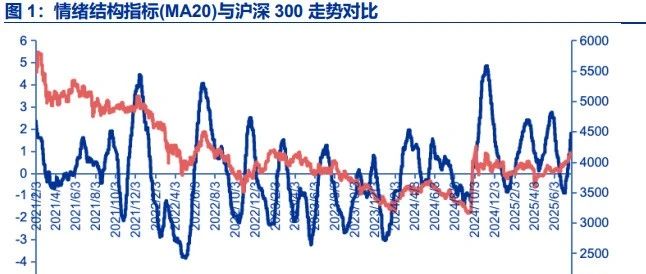
Core Viewpoint - The market sentiment score has increased, indicating a bullish outlook for the market as of July 25, with a score of 1.8, up from 0.65 the previous week [1]. Group 1: Market Sentiment Indicators - The sentiment structure indicator is calculated using a scoring method based on the direction of each sub-indicator and its position within the Bollinger Bands, resulting in a 20-day moving average score [1]. - The trading volatility between industries has shown a positive signal, suggesting increased capital activity and reduced uncertainty in short-term sentiment [4][14]. - The financing ratio has decreased, indicating a decline in the heat of margin trading, which requires further observation [4]. Group 2: Trading Activity and Volume - The overall trading volume in the A-share market has maintained an upward trend, with a peak daily trading volume of 19,286.45 billion RMB on July 25 [9]. - The consistency of price and volume remains high, indicating active participation and capital engagement in the market [6]. Group 3: Industry Performance - Industries such as basic chemicals, non-ferrous metals, and electric equipment have shown strong performance, while sectors like public utilities, media, and banking have lagged behind [16]. - The short-term trend scores for industries like coal, food and beverage, and beauty care have significantly increased, with coal showing a remarkable rise of 109.09% [19][20]. Group 4: Style and Trend Analysis - The small-cap growth style is currently favored, with the relative strength index (RSI) indicating a strong preference for growth stocks over value stocks [21][22]. - The trend scoring model shows that industries like coal, food and beverage, and construction materials have strong short-term trend scores, suggesting potential investment opportunities [19][20].

西部利得基金管浩阳:资源股迎来贝塔时代 供给约束重塑“战略资产”
Zheng Quan Shi Bao· 2025-07-27 17:09
Core Viewpoint - The strategic importance of resource commodities is gaining consensus in the market amid rising de-globalization trends, with a significant commodity market rally since 2020, covering various resources from coal to gold, copper, silver, and rare earths [1] Group 1: Investment Strategy - The new fund manager of Western Lide Fund, Guan Haoyang, emphasizes that supply is more critical than demand at this investment juncture, and beta is more important than individual stocks [1][6] - Guan believes that the ongoing commodity market rally, which has been active for five years, still presents opportunities as resource commodities transition from "cyclical goods" to "strategic assets" [1][6] Group 2: Research Background - Guan has focused on cyclical stock research since entering the industry in 2016, expanding his expertise from steel to various sectors including construction, materials, non-ferrous metals, chemicals, and coal over nine years [2] - He has developed a comprehensive research framework for cyclical commodities, recognizing the high barriers between different sub-industries [2] Group 3: Resource Classification - Guan categorizes resource stocks into four types: 1. **Cyclical Assets**: Assets with explosive performance during uptrends, such as gold and silver, where price tracking is crucial [4] 2. **Thematic Assets**: Assets like rare earths that are rising in price but have not yet shown performance, focusing on price trends and market sentiment [4] 3. **Value Assets**: Stable price assets with low valuations, such as copper, where company growth and valuation matching are key [5] 4. **Dividend Assets**: Stable price assets with high dividend yields, like oil and coal, where finding assets with potential dividend recovery is essential [5] Group 4: Market Outlook - Guan assesses that the current commodity cycle, which began in 2020, still holds potential due to rigid supply constraints [6] - He identifies three main supply constraints: insufficient capital expenditure, a decrease in quality mines, and the elevation of resource commodities to strategic assets through administrative measures by various countries [6][7] - The restructuring of supply chains driven by de-globalization is expected to create long-term benefits for industrial metals like copper [7]
中银量化多策略行业轮动周报-20250727
Bank of China Securities· 2025-07-27 07:40
Core Insights - The current industry allocation of the Bank of China multi-strategy system includes Computer (9.6%), Steel (9.2%), Non-ferrous Metals (7.8%), Consumer Services (7.2%), and Banking (6.8) among others, indicating a diversified investment approach across various sectors [1] - The average weekly return of the CITIC primary industries is 3.5%, with the best-performing sectors being Coal (10.5%), Steel (10.2%), and Non-ferrous Metals (9.6%), while the worst performers are Banking (-2.1%), Communication (-0.6%), and Comprehensive Finance (-0.1%) [3][11] - The composite strategy achieved a cumulative return of 3.4% this week, with an annual cumulative return of 16.4%, outperforming the CITIC primary industry equal-weight benchmark by 1.9% [3] - The highest weight strategy currently is the medium to long-term reversal strategy (S4) at 21.4%, while the lowest is the macro style rotation strategy (S3) at 8.0% [3] - Recent adjustments in positions indicate an increase in upstream cyclical sectors and a decrease in TMT sectors [3] Industry Performance Review - The top three industries in terms of weekly performance are Coal (10.5%), Steel (10.2%), and Non-ferrous Metals (9.6%), while the bottom three are Banking (-2.1%), Communication (-0.6%), and Comprehensive Finance (-0.1%) [11] - The average monthly return over the past month is 7.3%, indicating a positive trend across the industries [11] Valuation Risk Warning - The current PB valuation for the Retail, Automotive, Defense, and Media industries exceeds the 95th percentile of their historical valuations, triggering a high valuation warning [14][15] Strategy Performance - The S1 strategy focusing on high profitability industries shows a weekly excess return of -0.4%, while the S2 strategy tracking unverified sentiment has an excess return of 3.0% [3] - The S4 medium to long-term reversal strategy has the highest weight and has shown significant performance, indicating its effectiveness in the current market environment [3][16] Sector Rankings - The current top three sectors based on profitability expectations are Computer, Non-ferrous Metals, and Steel [17] - The S2 strategy ranks Mechanical, Computer, and Comprehensive as the top sectors based on implied sentiment [20] Macro Style Rotation - The macro style rotation strategy indicates a bullish outlook for Comprehensive Finance, Computer, Media, Defense, Electronics, and Comprehensive sectors based on current macro indicators [24][25]
【盘中播报】51只A股封板 钢铁行业涨幅最大
Zheng Quan Shi Bao Wang· 2025-07-23 03:24
Market Overview - The Shanghai Composite Index increased by 0.25% as of 10:28 AM, with a trading volume of 719.64 million shares and a transaction amount of 851.33 billion yuan, representing a decrease of 4.39% compared to the previous trading day [1]. Industry Performance - The top-performing industries included: - Steel: Increased by 0.86% with a transaction amount of 158.33 billion yuan, up by 85.57% from the previous day, led by Shengde Xintai with a rise of 15.68% [1]. - Pharmaceutical and Biological: Increased by 0.84% with a transaction amount of 709.46 billion yuan, down by 9.15%, led by Hite Bio with a rise of 15.41% [1]. - Comprehensive: Increased by 0.79% with a transaction amount of 12.55 billion yuan, down by 13.25%, led by Nanjing Xinbai with a rise of 10.06% [1]. - The worst-performing industries included: - National Defense and Military Industry: Decreased by 1.16% with a transaction amount of 300.68 billion yuan, down by 29.35%, led by Guolian Aviation with a drop of 13.35% [2]. - Building Materials: Decreased by 0.79% with a transaction amount of 205.27 billion yuan, up by 0.84%, led by Fujian Cement with a drop of 6.63% [2]. - Coal: Decreased by 0.58% with a transaction amount of 162.42 billion yuan, up by 275.67%, led by Yunmei Energy with a drop of 3.68% [2].




粤开市场日报-20250721
Yuekai Securities· 2025-07-21 08:56
Market Overview - The A-share market showed a positive trend today, with major indices mostly rising. The Shanghai Composite Index increased by 0.72% to close at 3559.72 points, while the Shenzhen Component rose by 0.86% to 11007.49 points. The ChiNext Index saw a slight increase of 0.87%, closing at 2296.88 points. Overall, 4002 stocks rose, 1291 fell, and 121 remained unchanged, with a total trading volume of 17000 billion yuan, an increase of 1289.37 billion yuan compared to the previous trading day [1][2]. Industry Performance - Among the Shenwan first-level industries, all sectors except for banking, comprehensive, computer, and home appliances experienced gains today. The leading sectors included construction materials, construction decoration, steel, non-ferrous metals, basic chemicals, and coal [1]. - The top-performing concept sectors included cement manufacturing, water conservancy and hydropower construction, major infrastructure projects in the west, excavators, robotics, rare earths, and various infrastructure-related sectors [2].
“反内卷”刷屏!券商一周“176篇研报+79场路演”,投资机遇来了?
券商中国· 2025-07-13 13:22
Core Viewpoint - The "anti-involution" research trend in the A-share market is gaining momentum due to policy support and rapid responses from various industries [1][5]. Group 1: Research and Market Response - In the past week, financial institutions published 176 research reports on the "anti-involution" theme, covering various sectors including steel, energy, and chemicals [2]. - There were 79 roadshows related to "anti-involution" in the past week, indicating its prominence in analyst discussions [3]. - Analysts believe this round of "anti-involution" has a higher standing, broader coverage, and stronger synergy, potentially becoming the main market theme in the next phase [4][6]. Group 2: Policy Implications - The Central Financial Committee emphasized the need to promote a unified national market and regulate low-price competition, which has led to increased attention on "anti-involution" in the capital market [5]. - Analysts expect further policy deployments related to "anti-involution," with potential measures including industry self-discipline and price monitoring [5]. Group 3: Beneficial Sectors - Key sectors expected to benefit from the "anti-involution" policies include lithium batteries, photovoltaics, coal, steel, chemicals, and construction materials [8]. - The manufacturing sector, particularly in lithium, photovoltaics, and automotive, along with service industries like food processing and logistics, are highlighted as potential beneficiaries [8]. - The steel industry is noted for its potential bottom reversal, with supply-side reforms and improved profitability expected [11][12]. Group 4: Industry-Specific Insights - The photovoltaic sector has seen significant stock performance, with a 5.5% increase in the photovoltaic index over a week, driven by price recovery and regulatory support [13]. - Analysts suggest that the focus on supply-side reforms in the photovoltaic industry will be crucial for long-term competitiveness and market stability [13][14].


今日24.72亿元主力资金潜入通信业
Zheng Quan Shi Bao Wang· 2025-06-26 09:52
Core Insights - The communication industry saw the highest net inflow of funds today, amounting to 2.472 billion, with a price change of 0.77% and a turnover rate of 2.10% [1][2] - The non-banking financial sector experienced the largest net outflow of funds, totaling -5.831 billion, with a price change of -1.20% and a turnover rate of 2.45% [1][2] Industry Summary - **Communication**: - Net inflow: 2.472 billion - Price change: 0.77% - Turnover rate: 2.10% - Volume change: +3.72% [1] - **Non-banking Financial**: - Net outflow: -5.831 billion - Price change: -1.20% - Turnover rate: 2.45% - Volume change: -14.38% [1] - **Real Estate**: - Net outflow: -0.441 billion - Price change: -0.43% - Turnover rate: 1.20% - Volume change: -8.36% [2] - **Machinery Equipment**: - Net outflow: -1.740 billion - Price change: -0.53% - Turnover rate: 2.74% - Volume change: +1.31% [2] - **Pharmaceuticals**: - Net outflow: -2.819 billion - Price change: -1.05% - Turnover rate: 1.72% - Volume change: -4.71% [2] - **Computers**: - Net outflow: -3.272 billion - Price change: -0.23% - Turnover rate: 5.83% - Volume change: +9.33% [2] - **Electric Equipment**: - Net outflow: -4.443 billion - Price change: -0.75% - Turnover rate: 3.40% - Volume change: +3.09% [2]