
啤酒

Search documents
顺义聚焦文旅+工业,拓展燕京啤酒、理想汽车加入工业游
Xin Jing Bao· 2026-01-13 10:08
Group 1 - In 2026, Shunyi District plans to develop an industrial fashion tourism project that combines sightseeing and interaction, encouraging local companies like Yanjing Beer and Li Auto to participate [1] - Shunyi District has been recognized for its industrial tourism, with successful projects like Niulanshan Erguotou Cultural Park and Aimer Fashion Factory being designated as Beijing's industrial tourism demonstration sites by 2025 [1] - The district aims to enhance the visitor experience by integrating exhibition and tourism services, launching "exhibition + tourism" packages to convert exhibition traffic into cultural tourism consumption [1] Group 2 - Shunyi District will expand public cultural spaces by creating new venues such as "quasi-museums" and performance spaces, with plans to introduce at least 45 quality performances and over 3,000 community cultural activities throughout the year [2] - As of Q3 2025, Shunyi District received 11.9 million tourists, generating a tourism revenue of 13.21 billion yuan, reflecting year-on-year growth of 4.4% and 10.3% respectively [3] - Upcoming cultural activities during the Spring Festival will include traditional performances and ice-themed events, with plans for a comprehensive tourism development strategy that connects various cultural hotspots in Shunyi [3]

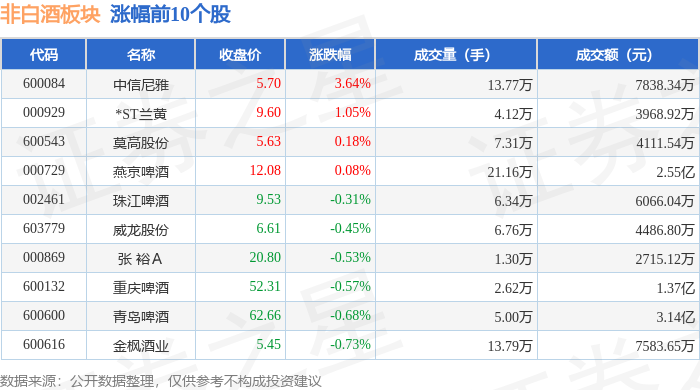
非白酒板块1月13日跌0.54%,会稽山领跌,主力资金净流出1.08亿元
Zheng Xing Xing Ye Ri Bao· 2026-01-13 09:00
| 代码 | 名称 | 收盘价 | 涨跌幅 | 成交量(手) | 成交额(元) | | --- | --- | --- | --- | --- | --- | | 601579 | 会稽山 | 20.74 | -2.35% | 11.49万 | 2.42亿 | | 002568 | 自润股份 | 22.00 | -1.79% | 8.69万 | 1.93亿 | | 600238 | *ST椰岛 | 6.27 | -1.26% | 6.84万 | 4307.04万 | | 000752 | ST西发 | 10.58 | -1.12% | 3.67万 | 3878.56万 | | 600573 | 惠泉啤酒 | 12.03 | -0.91% | 10.40万 | 1.26 Z | | 600059 | 古越龙山 | 9.32 | -0.85% | 12.00万 | 1.12亿 | | 600616 | 全枫酒业 | 5.45 | -0.73% | 13.79万 | 7583.65万 | | 600600 | 顾思明如 | 62.66 | -0.68% | 5.00万 | 3.14亿 | | 600132 | 重庆 ...


小摩:降百威亚太目标价至7.9港元 维持“中性”评级
Zhi Tong Cai Jing· 2026-01-13 07:39
Core Viewpoint - Morgan Stanley forecasts that Budweiser APAC (01876) will see natural sales and EBITDA decline by 6.4% and 8.6% respectively in 2025, followed by average annual growth of 4% and 6% in 2026-2027 [1] Group 1: Financial Projections - The target price for Budweiser APAC has been lowered from HKD 8.5 to HKD 7.9, maintaining a "neutral" rating [1] - The expected dividend yield for the company is projected to reach 5.7%, providing downside support for its stock price [1] Group 2: Recent Performance - The company is anticipated to report a 5.4% year-on-year decline in natural revenue and a 10.5% drop in EBITDA for the fourth quarter of last year, compared to declines of 8.4% and 6.9% in the third quarter [1] - Budweiser APAC's business in China remains weak, while growth in South Korea has slowed due to a high base, and strong growth in India has not significantly improved overall group performance [1] Group 3: Marketing and Sales Strategy - Despite increasing advertising and promotional investments in home channels, sales and profits in China continue to be under pressure [1]

国泰海通:短期啤酒行业景气度承压 建议增持强α区域酒企及行业龙头
Zhi Tong Cai Jing· 2026-01-13 02:25
Core Insights - The beer industry in China is entering a new phase of competition, focusing on structural opportunities arising from category and channel innovations [2] - The demand for beer is gradually declining, with a projected slowdown in average selling price (ASP) growth for leading companies to 0.4% in 2024 due to lower-than-expected demand recovery and inflation [2] - The craft beer segment is emerging as a key trend, with an estimated penetration rate of approximately 3% in China, compared to 5-15% in developed countries [3] Category Innovation - The generational shift among consumers is creating significant opportunities for category innovation in the beer market, particularly in craft beer [3] - The craft beer landscape is expected to see limited concentration in the mid-term, with small brands leading flavor innovation and niche markets [3] - Major breweries are likely to benefit from the craft beer trend, as they are not bound by the same scale and independence requirements as craft breweries in Europe and the U.S. [3] Channel Transformation - The rapid growth of new retail channels is driven by consumer demands for convenience, rationality, and differentiation, with new retail beer sales estimated at around 30 billion yuan and a penetration rate of approximately 6% [4] - New retail is leveling the playing field, allowing regional breweries to gain market share in weaker markets and providing opportunities for small breweries to utilize excess capacity through OEM [4] - Despite the rise of new retail, established brands still hold significant competitive advantages in terms of brand recognition, quality control, and scale, which can help them maintain or increase market share [4]

直航开通后,青岛迎来越南文旅考察团
Qi Lu Wan Bao· 2026-01-12 21:52
Group 1 - The core viewpoint of the news is that the opening of the direct flight route from Qingdao to Ho Chi Minh City marks a new phase in cultural and tourism exchanges between Qingdao and Southeast Asia, with expectations of increased Vietnamese tourist arrivals during the upcoming Spring Festival [1][2] - The direct flight route operates 14 round trips weekly, providing more convenient travel options for travelers between China and Vietnam, which is expected to enhance tourist conversion rates [2][3] - The Vietnamese travel merchants and influencers expressed strong interest in Qingdao's unique winter attractions and cultural offerings, indicating potential for Qingdao to become a popular destination for Vietnamese tourists during the Spring Festival [2][4] Group 2 - The itinerary of the Vietnamese delegation included visits to key cultural and tourism resources in Qingdao, such as historical sites, coastal attractions, and seasonal activities, showcasing the city's diverse offerings [3][4] - The delegation's immersive experience highlighted Qingdao's unique urban planning that integrates natural landscapes with cultural heritage, enhancing their understanding of the city's tourism potential [3][4] - Qingdao's tourism strategy for 2026 focuses on deepening ties with Korea, expanding into Southeast Asia, and enhancing its international brand through targeted marketing and product innovation [4]
河南金星啤酒股份有限公司(H0312) - 整体协调人公告-委任
2026-01-12 16:00
香港聯合交易所有限公司及證券及期貨事務監察委員會對本公告內容概不負責,對其準確性或完整性不發表 任何聲明,並明確表示不會就因本公告全部或任何部分內容而產生或因依賴該等內容而引致的任何損失承擔 任何責任。 河 南 金 星 啤 酒 股 份 有 限 公 司 (「本公司」) ( 於中華人民共和國註冊成立的股份有限公司) 警告 本 公 告 乃 根 據 香 港 聯 合 交 易 所 有 限 公 司(「 聯 交 所 」)與 證 券 及 期 貨 事 務 監 察 委 員 會(「 證 監 會」)的要求而刊發,僅用作提供資訊予香港公眾人士。 閣下閱覽本公告,即代表 閣下知悉、接納並向本公司、其聯席保薦人、保薦人兼整體協 調人、整體協調人、顧問或包銷團成員表示同意: – 1 – HENAN KINGSTAR BREWERY CO., LTD 本公告乃承本公司之命作出。本公司董事會(「董事會」)就本公告的準確性共同及個別承擔責任。 HENAN KINGSTAR BREWERY CO., LTD (a) 在聯交 所網站 登載本 公告,並 不引起 本公司 、其聯 席保薦 人、保薦 人兼整 體協調 人、 整體協 調人、 顧問或 包銷團成 員在 ...
河南金星啤酒股份有限公司(H0312) - 申请版本(第一次呈交)
2026-01-12 16:00
香港聯合交易所有限公司與證券及期貨事務監察委員會對本申請版本的內容概不負責,對其準確 性或完整性亦不發表任何聲明,並明確表示概不就因本申請版本全部或任何部分內容而產生或因 倚賴該等內容而引致的任何損失承擔任何責任。 HENAN KINGSTAR BREWERY CO., LTD 河 南 金 星 啤 酒 股 份 有 限 公 司 ( 於中華人民共和國註冊成立的股份有限公司) 的申請版本 警告 本申請版本乃根據香港聯合交易所有限公司(「聯交所」)及證券及期貨事務監察委員會(「證監會」)的要 求而刊發,僅用作向香港公眾人士提供資料。 本 申 請 版 本 為 草 擬 本 , 其 所 載 資 料 並 不 完 整 , 亦 可 能 會 作 出 重 大 變 動 。 閣 下 閱 覽 本 文 件 , 即 表 示 閣下知悉、接納並向河南金星啤酒股份有限公司(「本公司」,連同其附屬公司,統稱「本集團」)、 其聯席保薦人、整體協調人、顧問或承銷團成員表示同意: 本公司招股章程根據香港法例第32章公司( 清盤及雜項條文)條例與香港公司註冊處處長登記前,本公 司不會向香港公眾人士提出要約或邀請。倘於適當時候向香港公眾人士提出要約或邀請,有意 ...
燕京啤酒:截至2026年1月9日股东总户数为45767户
Zheng Quan Ri Bao Wang· 2026-01-12 12:45
证券日报网讯1月12日,燕京啤酒(000729)在互动平台回答投资者提问时表示,截至2026年1月9日, 公司股东总户数为45767户。 ...
食品饮料周报(26年第2周):渠道步入春节旺季备货,多重利好催化餐饮供应链-20260112
Guoxin Securities· 2026-01-12 11:14
Investment Rating - The report maintains an "Outperform" rating for the food and beverage sector, indicating expected performance above the market index by over 10% [4][5][70]. Core Views - The food and beverage sector is entering a peak stocking season ahead of the Spring Festival, with multiple favorable catalysts for the restaurant supply chain [1]. - The report highlights a divergence in the fundamentals of different categories, with beverages outperforming food and alcoholic beverages [2]. - Key investment themes for 2026 include cost advantages from low raw material prices, efficiency improvements through supply chain optimization, innovation-driven growth, and opportunities for recovery in distressed sectors [3][10]. Summary by Relevant Sections Alcoholic Beverages - The report emphasizes the strong dividend characteristics of the liquor sector, particularly with Moutai's market reforms gradually taking effect. It suggests that high-quality companies with pricing power and regional influence are likely to achieve greater growth [2][10]. - Recommendations include Moutai, Shanxi Fenjiu, and Luzhou Laojiao, with a focus on their growth potential and market positioning [2][10]. Beer - The beer industry is currently managing inventory well and is poised for demand recovery. The report recommends Yanjing Beer for its rapid growth and strong internal reforms [11]. Dairy Products - The dairy sector is experiencing orderly stocking for the Spring Festival, with a recommendation for leading companies like Yili, which is expected to benefit from improved margins and demand recovery [14]. Snacks - The report suggests focusing on strong alpha stocks in the snack sector, particularly those innovating in konjac products. Leading companies like Weidong and Yanjinpuzi are highlighted for their competitive advantages and growth potential [12][17]. Restaurant Supply Chain - The restaurant supply chain is entering a busy stocking season, with clear recovery trends. Recommendations include leading companies in the compound seasoning sector and those with national capacity and channel layouts [13][14]. Beverage Sector - The beverage sector is primarily focused on destocking during the off-season, with stable stocking for the Spring Festival. Leading companies like Nongfu Spring and Dongpeng Beverage are recommended for their aggressive growth strategies [15].
小摩:降百威亚太(01876)目标价至7.9港元 维持“中性”评级
智通财经网· 2026-01-12 09:17
Core Viewpoint - Morgan Stanley forecasts that Budweiser APAC (01876) will experience a decline in natural sales and EBITDA by 6.4% and 8.6% respectively in 2025, followed by annual growth of 4% and 6% from 2026 to 2027 [1] Financial Projections - The target price for Budweiser APAC has been lowered from HKD 8.5 to HKD 7.9, while maintaining a "neutral" rating [1] - The expected dividend yield for the company is projected to reach 5.7%, providing downside support for its stock price [1] Recent Performance - For the fourth quarter of the previous year, Budweiser APAC's natural revenue is expected to decline by 5.4% year-on-year, with EBITDA dropping by 10.5%, compared to declines of 8.4% and 6.9% in the third quarter [1] Regional Business Insights - The company's business in China continues to show weakness, while growth in South Korea has slowed due to a high comparison base; strong growth in India has not been sufficient to boost overall group performance [1] - Despite increased advertising and promotional investments in home channels, sales and profits in China remain under pressure [1]