证券业

Search documents
广东上市公司市值狂飙4万亿,十大龙头领跑
Sou Hu Cai Jing· 2025-11-16 06:20
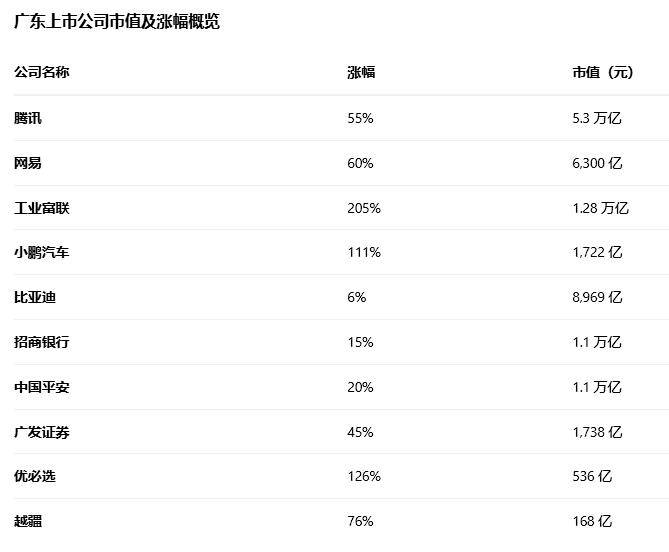
Group 1: Market Overview - As of November 2025, the total market capitalization of A-share listed companies shows Beijing leading with 27.38 trillion yuan, followed by Guangdong at 19.42 trillion yuan, and Shanghai at 9.97 trillion yuan [1] - The data indicates that Jiangsu and Zhejiang still have a gap to catch up with Guangdong, and the full picture of Guangdong's economic strength is not reflected if only A-shares are considered [1] Group 2: Key Companies in Guangdong - Tencent, the highest market cap company in China, has seen a 55% increase in stock price this year, reaching a market cap of approximately 5.3 trillion yuan, contributing 2 trillion yuan to Guangdong's total market value [3] - NetEase's stock has risen by 60% this year, with a market cap of 630 billion yuan as of November 14, 2025 [5] - Industrial Fulian has emerged as a standout performer with a 204% increase in stock price, achieving a market cap of 1.28 trillion yuan, ranking among the top ten A-share companies [7] - Xpeng Motors has shown significant growth with a 111% increase in stock price, driven by AI technology initiatives, reaching a market cap of 207.78 billion yuan [8] - BYD, a leader in the electric vehicle sector, has a market cap of 896.9 billion yuan with a 5% increase in stock price this year [9] Group 3: Financial Sector Performance - China Merchants Bank has a market cap exceeding 1 trillion yuan with a 15% increase in stock price, although its growth rate has slowed [10] - Ping An Insurance has a market cap of 1.1 trillion yuan and a 20% increase in stock price, supported by strong performance in its insurance business [11] - GF Securities has a market cap of 173.8 billion yuan with a 45% increase in stock price, driven by active market conditions and strong brokerage performance [12] Group 4: Robotics Industry Growth - UBTECH, the leading humanoid robot company, has seen a 126% increase in stock price, with a market cap of approximately 536 billion yuan, and plans to mass-produce humanoid robots [13] - Yujin Robotics, a collaborative robot company, has experienced a 76% increase in stock price, with a market cap of about 168 billion yuan, benefiting from strong sales in industrial and commercial applications [13] Group 5: Economic Outlook - Guangdong's leading companies in AI, new energy vehicles, and robotics highlight the province's economic potential and are expected to maintain its competitive edge in the future [14]

上海国际金融中心一周要闻回顾(11月10日—11月16日)
Guo Ji Jin Rong Bao· 2025-11-16 05:14
Group 1 - The 2025 Shanghai Stock Exchange International Investor Conference opened on November 12, focusing on "Value Leading, Open Empowerment - New Opportunities for International Capital Investment and Mergers" with participation from over 100 renowned investment institutions and nearly 400 representatives [1] - The China Securities Index launched the Asia Select 100 Index and the Asia Select 100 Dividend Focus Index at the conference, providing benchmarks for investment in major Asian markets [2] - The Sci-Tech Innovation Board reported a significant 75% year-on-year increase in net profit for Q3, with "hard tech" companies increasing R&D investments in key industries such as integrated circuits, artificial intelligence, and biomedicine [3] Group 2 - The 19th Golden Investment Conference featured a special event focused on the Changxing Marine Equipment Industrial Park, discussing the promotion of inclusive finance and the optimization of the business environment [4] - Hang Seng Bank (China) and China Construction Bank launched a digital RMB merchant payment service in Hong Kong, expanding the application of digital RMB in retail consumption [5] - The Shanghai branch of Bank of Communications facilitated the first mBridge digital currency remittance for Sinochem International, marking a breakthrough in cross-border payment using central bank digital currencies [6] Group 3 - The Export-Import Bank of Shanghai achieved its first credit issuance in the commercial aerospace sector, marking a significant milestone [8] - Cathay Financial Holdings, together with Bank of China and China Pacific Insurance, launched a cross-border financial service plan to support Chinese enterprises' overseas operations [9] - The Shanghai Clearing House signed a strategic cooperation agreement with the Shanghai Commodity Warehouse Receipt Registration Company to enhance collaboration in commodity clearing [10] Group 4 - The China Securities Regulatory Commission chairman visited financial regulatory bodies in France and Brazil to discuss capital market cooperation [11] - The People's Bank of China released the "Interbank Market Brokerage Business Management Measures" to enhance regulation and transparency in the interbank market [13] - The People's Bank of China reported on the implementation of a moderately loose monetary policy, maintaining ample liquidity and supporting economic recovery [14] Group 5 - As of the end of October, the total social financing stock was 437.72 trillion yuan, with a year-on-year growth of 8.5% [15] - The broad money (M2) balance reached 335.13 trillion yuan, growing by 8.2% year-on-year, while the narrow money (M1) balance was 112 trillion yuan, up by 6.2% [15] - The cross-border RMB settlement amount for the current account reached 1.41 trillion yuan in October [17]
居民财富配置转型:解锁消费增长与产业创新路径
Jing Ji Guan Cha Wang· 2025-11-14 16:27
Group 1 - The core viewpoint of the article emphasizes the need to increase household consumption and promote technological and industrial innovation, which requires support from the capital market and a shift in household wealth allocation towards risk financial assets [2][3][16] Group 2 - The decline in household consumption growth is linked to the decrease in property income growth, with retail sales growth falling to 3% in September 2025, indicating ongoing pressure on consumption [3] - From 2021 to 2024, urban residents' property income growth dropped from 10.2% to 2.2%, further declining to 1.7% in the first three quarters of 2025 [3] - The overall decline in household wealth, driven by a 33% drop in the CSI 300 index and a 13.5% decrease in housing prices, has exerted downward pressure on consumption [3][8] Group 3 - The structure of household wealth is heavily skewed towards real estate, with property accounting for approximately 60% of total household assets, significantly higher than in the US and other developed countries [6][12] - The proportion of financial assets held in low-risk investments exceeds 80%, limiting the potential for generating property income [9][11] Group 4 - The article suggests that the current asset allocation structure poses challenges for household wealth and consumption, particularly as property values decline and the demand for real estate decreases [8][24] - It highlights the need for a shift towards risk financial assets to stabilize and increase property income growth, thereby promoting household consumption [16][24] Group 5 - Recommendations for improving the situation include enhancing the profitability of listed companies, increasing household investment in risk financial assets, reducing market volatility, and stabilizing the real estate market [16][20][22] - The article stresses that a transition in household asset allocation will require a concerted effort and may take 10 to 20 years to achieve [24]

——10月金融数据点评:存款搬家延续,债市进入等待期
Shenwan Hongyuan Securities· 2025-11-14 10:53
Core Insights - The report highlights a decline in the year-on-year growth rate of social financing (社融) to 8.5% in October 2025, down from 8.7% in September 2025, indicating weakened credit demand from the real economy [3][4] - New RMB loans in October 2025 amounted to 0.22 trillion yuan, significantly lower than the 0.50 trillion yuan recorded in October 2024, reflecting a decrease in both corporate and household loan demand [3][4] - The report suggests that the current financial data indicates a temporary reduction in fiscal support for the real economy, with improvements in credit demand requiring further policy support [4] Financial Data Analysis - The year-on-year growth rate of social financing has decreased, attributed to weak credit demand from the real sector and a high base effect from last year's government bond net financing [4][5] - Government bond net financing has slowed down, with the Ministry of Finance indicating a reduction in local government bond issuance limits, which may lead to concentrated issuance in November and December [4][8] - Corporate short-term loans and new loans have weakened, with some short-term loans being replaced by bill financing, indicating a shift in corporate financing strategies [4][10] Household Financing Trends - Household short-term and long-term loans have both declined, driven by weak consumer sentiment and housing demand, particularly due to a cooling real estate market [4][16] - The report notes that the overall household financing demand remains subdued, necessitating stronger fiscal and monetary policy support to stimulate growth [4][28] Market Dynamics - The report observes a continued trend of household deposits moving into the equity market, with the balance of margin financing in the A-share market increasing, suggesting a recovery in market sentiment [4][29] - The M1 growth rate has decreased, while the M1-M2 spread has expanded, indicating a weakening correlation between these metrics and economic activity, with a stronger link to equity market performance [4][33][35] - The report emphasizes that the current state of the bond market is characterized by uncertainty, with the 10-year government bond yield fluctuating around 1.8% and limited short-term downward potential [4][36]
【笔记20251114— 今年降息基本没戏】
债券笔记· 2025-11-14 10:40
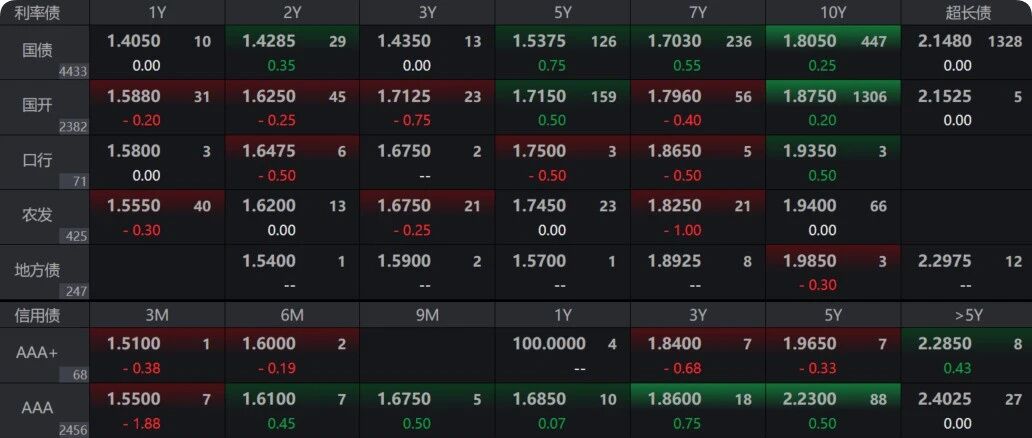
Core Viewpoint - The article discusses the current state of monetary policy, indicating that while there is still some room for adjustment, the marginal efficiency of such policies has significantly declined, suggesting that interest rate cuts are unlikely this year [7]. Monetary Policy and Economic Data - The central bank conducted a 2,128 billion yuan reverse repurchase operation, with a net injection of 711 billion yuan after 1,417 billion yuan matured [3]. - The overnight rates have slightly increased, with DR001 around 1.37% and DR007 at approximately 1.47% [4]. - October economic data appears weak, with the stock market experiencing a pullback, falling below 4,000 points, and the central bank continuing to implement reverse repurchase operations [6]. - The bond market showed stability with the 10-year government bond yield fluctuating around 1.804% [6]. Market Reactions - The article notes that the market quickly understood the implications of the central bank's statements regarding monetary policy, leading to a consensus that interest rate cuts are unlikely this year [7]. - There is a contrast between the experiences of stockholders, who may feel positive about the economy, and those in the labor market, who face different challenges [7]. Bond Market Performance - The weighted rates for various repurchase agreements indicate a slight decrease in transaction volumes, with R001 at 1.43% and R007 at 1.49%, reflecting a decrease in trading activity [5]. - The government bond yields for different maturities show a range of rates, with the 10-year bond at 1.8050% and longer-term bonds yielding higher rates [11].
10月金融数据点评:\存款搬家\再现
Shenwan Hongyuan Securities· 2025-11-14 10:38
Group 1: Financial Data Overview - In October 2025, the credit balance decreased by 0.1 percentage points to 6.5% year-on-year[1] - The total social financing (社融) stock fell by 0.2 percentage points to 8.5% year-on-year[1] - M1 decreased by 1.0 percentage points to 6.2% year-on-year[1] Group 2: Deposit Trends - The phenomenon of "deposit migration" reappeared, with resident deposits decreasing by approximately 770 billion yuan year-on-year[2] - Non-bank institution deposits increased by approximately 770 billion yuan year-on-year, reflecting a "seesaw" relationship with resident deposits[2] - The decline in M1 growth may be linked to the decrease in resident deposits, which is directly related to the contraction in resident credit[2] Group 3: Corporate Lending and Economic Outlook - In October, corporate loans remained primarily short-term, with short-term loans and bill financing increasing by 0.6 percentage points to 10.0% year-on-year[3] - The net financing of government bonds decreased by 560.2 billion yuan year-on-year, significantly impacting the growth rate of social financing[3] - Two fiscal policies, including the issuance of 500 billion yuan in new policy financial instruments, are expected to stabilize credit performance and support social financing[4]
IC Markets:即将公布经济数据对美联储宽松政策是支持还是挑战?
Sou Hu Cai Jing· 2025-11-14 09:59
Market Dynamics - The stock market momentum has weakened, with indices like Nasdaq dropping over 2% and European markets declining approximately 1% [1] - President Trump signed a bill approved by Congress, effectively ending the government shutdown, but the market seems to have already priced in this outcome [1] - The primary concern now is whether upcoming official data will support or oppose the Federal Reserve's further easing policies, particularly the expected rate cut in December [1] - Fed Chair Powell indicated that a third risk management rate cut is not guaranteed, yet the market maintains a high certainty (about 70%) for this outcome [1] Interest Rate Outlook - The probability of a rate cut in December has fallen below 50% for the first time, as indicated by ICMarkets [3] - Minneapolis Fed's Kashkari expressed a wait-and-see attitude towards a December rate cut, opposing the October cut due to strong economic fundamentals and high inflation [3] - Cleveland Fed's Harmack reiterated support for pausing rate cuts next month, emphasizing that inflation concerns outweigh labor market worries [3] - The 30-year Treasury auction saw a tail of $25 billion, with long-end performance being weak, while U.S. Treasury yields generally rose by 2.2 to 5 basis points [3] Currency Movements - The euro to dollar exchange rate rebounded due to interest rate influences but faced resistance near 1.1630 due to U.S. risk aversion [4] - The dollar/yen momentum encountered resistance at the 155 mark, indicating a loss of support for the dollar index [4] - The Chinese yuan appreciated to 7.096 against the dollar, marking its strongest level since October 2024, although weaker-than-expected monthly data limited further appreciation [4] - The euro to pound exchange rate rose to approximately 0.885, the highest since April 2023, amid speculation regarding the UK budget and tax rate adjustments [4] Employment and Economic Reports - The monthly employment report from KPMG and REC indicated the first growth in temporary worker paychecks in 16 months, while permanent job recruitment trends have slowed for the fourth consecutive month [5] - Despite economic weakness and uncertainty surrounding the government budget, employers remain cautious about new hiring [5] - A joint statement from the U.S. government and four Latin American countries announced a reduction in tariffs on various domestically produced goods, including bananas, coffee, and beef, aimed at alleviating the cost of living crisis [5]

2025年10月金融数据点评:债券市场或已对金融数据回落有所预期
KAIYUAN SECURITIES· 2025-11-14 09:12
Report Overview - The report is a commentary on the financial data for October 2025, focusing on the bond market's expectations of the decline in financial data and the internal structural highlights of the data [1][4]. Report's Core View - The bond market may have anticipated the decline in October's financial data. The economic growth rate is not expected to decline significantly in the second half of 2025, and structural issues such as prices are expected to improve. There will be a continued shift in the stock - bond allocation, with bond yields and the stock market expected to rise [4][7]. Summary by Related Catalog Reasons for the Expected Decline in Financial Data - Local government debt resolution will temporarily reduce loan growth. Since 2024, local governments have issued 4 trillion yuan in special refinancing bonds, with about 60 - 70% used to repay bank loans [4]. - The government sector is increasing leverage to offset the de - leveraging of the household sector. As of the end of the third quarter of 2025, the government sector's leverage ratio was 67.5%, up 8.8 pct from the same period in 2024, while the household sector's leverage ratio was 60.4%, down 1.2 pct [4]. - Due to weak demand, household loans declined in October. Household loans decreased by 360.4 billion yuan, with short - term loans down 286.6 billion yuan and long - term loans down 70 billion yuan [4]. - The government bond issuance rhythm in 2025 was advanced compared to 2024, causing a 53.4% year - on - year decline in net government bond financing in October [5]. - The bond market may have anticipated the decline in financial data, as indicated by the significant bill impulse at the end of October and the explanations in the third - quarter monetary policy report [5]. Structural Highlights in the Data - Non - bank institutions' new deposits increased significantly in October, with an 185 billion yuan increase and a 71.3% year - on - year growth, possibly related to the strengthening of the equity market and the increase in residents' willingness to invest in wealth management products [6]. - The credit structure continued to optimize. The balance of inclusive small and micro loans was 35.77 trillion yuan, with an 11.6% year - on - year growth, and the balance of medium - and long - term loans in the manufacturing industry was 14.97 trillion yuan, with a 7.9% year - on - year growth [6]. - 500 billion yuan of new policy - based financial instruments have been fully disbursed, with a total project investment of about 7 trillion yuan, which may support subsequent loans [6]. Bond Market Outlook - Against the backdrop of revised economic expectations, bond yields are expected to rise trend - wise. The report maintains the view that in the second half of 2025, the economic growth rate will not decline significantly, structural issues will improve, and there will be a continued shift in the stock - bond allocation [7].
——10月金融数据点评:社融和存款的变化预示什么?
Huachuang Securities· 2025-11-14 06:46
Group 1: Financial Data Overview - In October 2025, new social financing (社融) amounted to 815 billion, a decrease from the previous value of 3.53 trillion[2] - The year-on-year growth of social financing stock was 8.5%, down from 8.7%[2] - M2 year-on-year growth was 8.2%, a decline from 8.4%[2] - New M1 year-on-year growth was 6.2%, down from 7.2%[2] Group 2: Key Insights - The continuous decrease in corporate medium to long-term loans for four months indicates a potential improvement in supply-demand balance[4] - The decline in household loans over the same period is more closely related to operational loans rather than consumer loans, which still show growth compared to 2024[4] - The significant increase in entrusted loans in October may be linked to the deployment of policy financial tools, although the impact on policy banks' balance sheets appears limited[4] - Direct financing through corporate bonds and domestic stock financing has shown consistent year-on-year growth, indicating a positive trend for high-tech and innovative enterprises[4] Group 3: Deposit Trends - Non-bank financial institution deposits increased by 770 billion year-on-year, suggesting stability in equity market transaction volumes[5] - The new M1's year-on-year decline is attributed to seasonal factors, with a notable drop from September's high growth[5] - The old M1 is expected to show a year-on-year decline, potentially dropping from 6.2% in September to around 3.4% by year-end, still above the -1.4% expected for the end of 2024[5] Group 4: Economic Indicators - Economic cycle indicators have shown a shift from the upward trend observed in the first eight months of the year, with September and October maintaining a fluctuating trend[6] - The change in the enterprise-resident deposit scissors difference indicates a potential slowdown in economic activity, which could impact future corporate profits[6]
四大亮点抢先看!2025深圳国际金融大会即将开幕
Zheng Quan Shi Bao Wang· 2025-11-14 03:37
Core Viewpoint - The 2025 Shenzhen International Financial Conference, hosted by Renmin University of China, will take place from November 19 to 21, aiming to create a high-end dialogue platform to support Shenzhen's financial development and national financial strategy [1] Group 1: Conference Highlights - The conference will feature a forward-looking agenda designed to analyze financial development comprehensively, focusing on the "Financial Power" goal and the financial openness of the Guangdong-Hong Kong-Macao Greater Bay Area with a structured "1+4+8" agenda system [3] - A diverse and representative lineup of guests will participate, including officials from central financial offices, central banks, and international organizations, fostering high-level dialogue and providing international perspectives and professional support for Shenzhen's financial development [4] - The conference emphasizes practical approaches to promote the integration of finance and the real economy, inviting representatives from technology and manufacturing sectors to facilitate precise matching of industry needs and financial services [4] Group 2: Research Contributions - Authoritative institutions will release three high-quality research reports addressing key topics such as financial power construction, financial openness in the Greater Bay Area, and global financial governance, providing theoretical depth and practical insights [5] - The conference aims to summarize experiences from the Greater Bay Area and contribute to China's financial strategies, enhancing Shenzhen's influence in the international financial system [5]