互联网

Search documents
美股三大指数集体低开,中概股普跌,阿里巴巴、百度跌超3%
Feng Huang Wang Cai Jing· 2026-02-13 14:49
Group 1 - US stock indices opened lower, with Nasdaq down 0.16%, Dow Jones down 0.04%, and S&P 500 down 0.01% [1] - Chinese concept stocks fell, with Alibaba and Baidu dropping over 3%. However, Applied Materials rose over 11% due to better-than-expected Q1 earnings. Rivian surged 26% after projecting a 53% increase in delivery volume by 2026 [1] Group 2 - Eli Lilly's acquisition of Ventyx Biosciences has received approval from the US Federal Trade Commission, with a cash purchase price of $14 per share, totaling approximately $1.2 billion. The deal is expected to close in the first half of 2026 [2] Group 3 - Moderna reported Q4 revenue of $678 million, a 30% year-over-year decline, while the market had expected $625.1 million. The company posted a Q4 loss of $2.11 per share, an improvement from a loss of $2.91 per share in the same period last year [3] Group 4 - SoftBank's PayPay has officially submitted an IPO application in the US, reporting a profit of 103.3 billion yen and revenue of 278.5 billion yen for the nine months ending December 31 [4] Group 5 - TrendForce forecasts that HBM4 validation will be completed by Q2 2026, driven by growing GPU demand due to AI infrastructure expansion. Major memory manufacturers are nearing the end of the HBM4 validation process, with Samsung expected to lead, followed by SK Hynix and Micron [5]

阿里巴巴、百度跌超3%
财联社· 2026-02-13 14:38
Market Overview - The three major U.S. stock indices opened lower, with the Nasdaq down 0.16%, the Dow Jones down 0.04%, and the S&P 500 down 0.01% [1] Chinese Stocks - Chinese concept stocks experienced a broad decline, with Alibaba and Baidu both falling over 3% [1] Company Performance - Applied Materials saw a significant increase of over 11% after reporting first-quarter earnings that exceeded expectations [1] - Rivian's stock surged by 26% following the company's forecast of a 53% increase in delivery volume by 2026 [1]


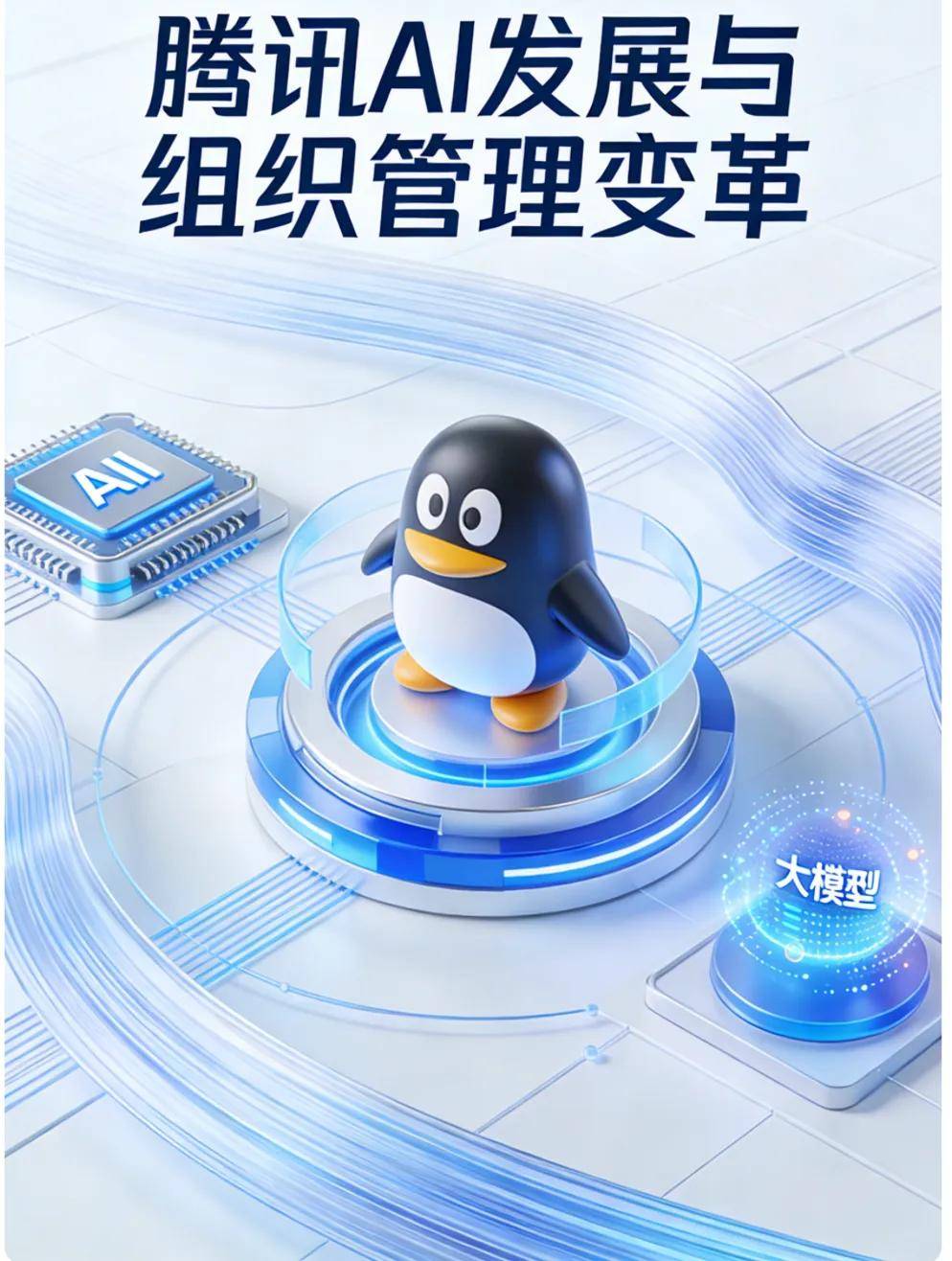
联邦式管理,还适配腾讯的 AI 野心吗?
Sou Hu Cai Jing· 2026-02-13 14:16
2015年Q3以来,腾讯在AI方面有很多令人匪夷所思的行为: 1)当全球主流科技企业都在不遗余力提高资本开支时(买芯片,建算力中心),腾讯的资本开支增速却低于预期; 2)春节AI入口之争刚刚开打,微信就"封杀"了元宝的红包分享链接,理由为"诱导分享违规",一时令舆论十分错愕。 关于上述现象,市场中也多有分析,不过大多集中在"技术","生态"等常规角度,本文我们将从组织管理角度来切入,探讨AI转型周期内企 业究竟需要怎样的组织管理模式。 本文核心观点: 其一,在AI竞争阶段,"联邦式"管理劣势越发明显,"秦制"正在成为主流; 其二,当前腾讯的管理模式是滞后于业务的; 国内互联网厂商亦是如此,阿里开始调整修正原先拆分的"1+6+n"模式,重新回到集约化管理状态,集团CEO亲自负责阿里云,各条产品线无 论是对B端还是C端均调用通义大模型,也就是说,云+通义大模型开始成为阿里集团的"技术中台",短期内其优点也是非常明显的: 1)降低了各业务线盲目赛马造成了"重复建轮子"的资源浪费,且对通义大模型的调用也可以有效提高模型的质量; 2)相较于业务线偏向于短期业绩(KPI考核制约),集团层面有能力也有动力为长期愿景买单,为 ...

这次真的不是“狼来了”:AI主导下,码农职场彻底洗牌了
创业邦· 2026-02-13 14:13
Core Viewpoint - The article discusses the significant impact of AI programming tools on the tech industry, particularly the replacement of mid-level programmers with AI, leading to a transformation in employment dynamics within the sector [5][6][12]. Group 1: AI Impact on Employment - Companies are increasingly adopting AI tools like Cursor, Claude Code, and GPT-5.3-Codex to reduce costs and improve efficiency, resulting in the potential layoff of a significant portion of their programming workforce [5][6]. - The strategy involves replacing experienced mid-level programmers, who demand higher salaries but offer limited skill enhancement, with younger, less expensive talent that AI can support [5][6]. - The emergence of advanced AI tools has raised concerns about the sustainability of this employment strategy, as many programmers may find themselves obsolete [6][8]. Group 2: Technological Advancements - Claude Code and Codex represent a new generation of AI tools capable of automating application development, marking a shift from traditional programming methods [9][11]. - Claude Code excels in deep reasoning and complex program architecture, while Codex focuses on high automation and speed, indicating a divergence in capabilities among AI programming tools [12]. - The introduction of these tools is expected to disrupt the software outsourcing industry, as companies may no longer need large development teams, opting instead for smaller internal AI-focused departments [13]. Group 3: Market Reactions and Future Outlook - The release of new AI models has triggered market reactions, including panic selling among game companies and developers, highlighting the immediate impact of AI advancements on various sectors [14]. - The article suggests that the rapid evolution of AI tools will continue to reshape the tech landscape, with companies needing to adapt quickly to survive and thrive in this changing environment [15].

细数A股爱炒的春节题材
虎嗅APP· 2026-02-13 13:57
Core Viewpoint - The article discusses the structural opportunities in the stock market around the Chinese New Year, emphasizing the importance of macroeconomic factors, liquidity, and event impacts on market trends [5][14]. Group 1: Market Trends Pre and Post Spring Festival - Historical patterns suggest that the stock market does not consistently follow the "digging a pit before the festival and rising afterward" trend, with varying performances over the past ten years [9][11]. - The article presents data showing mixed results for the A-share market before and after the Spring Festival, with some years experiencing significant rebounds while others faced declines [10][12]. - Key factors influencing market movements include macroeconomic expectations, liquidity conditions, and external shocks, which collectively shape the market narrative [14]. Group 2: Factors Influencing 2026 Spring Festival Market - The macroeconomic outlook indicates potential challenges from the U.S. market, particularly concerning technology stocks, which could impact global capital markets [15][19]. - The upcoming Two Sessions are expected to bring positive policy signals, which may enhance macroeconomic expectations and liquidity conditions post-festival [17]. - Historical data shows a 100% probability of leveraged funds returning in the first three trading days after the festival, indicating a potential recovery in market sentiment [18]. Group 3: Investment Opportunities in Consumer and Technology Sectors - The article highlights the K-shaped recovery in consumer spending, with a focus on high-end tourism, luxury goods, and duty-free shopping as key areas of interest for investors [26]. - The Spring Festival is expected to catalyze interest in AI technologies, particularly as major internet companies engage in competitive "red envelope" campaigns, which could drive significant market activity [30][35]. - The performance of technology stocks, especially those related to AI, is anticipated to be a major theme in the post-festival market, with structural opportunities likely to arise [21][33].
亚马逊股价跌入技术性熊市,市场担忧其激进资本支出计划
Jing Ji Guan Cha Wang· 2026-02-13 13:43
股价与资金表现 经济观察网亚马逊股价近期持续下跌,主要受其激进的资本支出计划引发市场担忧,以及科技板块整体 情绪疲软的影响。 股票近期走势 根据财报,亚马逊宣布2026年资本支出计划高达2000亿美元,较2025年的1310亿美元激增逾50%,远超 华尔街预期。这一巨额支出主要投向AI基础设施、自研芯片和低地球轨道卫星项目。市场担忧高投入 会挤压短期利润,导致自由现金流大幅缩水。财报显示,过去12个月自由现金流从382亿美元骤降至112 亿美元,降幅达70.7%。此外,公司对2026年第一季度的营业利润指引中值低于市场预期,加剧了投资 者对短期盈利压力的疑虑。 行业板块情况 美股科技股近期普遍回调,纳斯达克指数在2月初一度跌超2%。市场对AI领域巨额投资的回报周期产生 担忧,亚马逊、微软、Meta和Alphabet四家公司2026年AI相关资本支出预计合计超6300亿美元。投资者 正重新评估高估值科技股的风险,尤其在AMD等芯片公司业绩指引不及预期后,板块情绪进一步恶 化。 尽管亚马逊2025年业绩亮眼,但股价未能得到支撑。截至2026年2月12日,亚马逊股价收于199.60美 元,较近期高点下跌21.4%, ...

盘后,港股突发!恒生指数,重大调整!
券商中国· 2026-02-13 13:42
Core Viewpoint - The Hang Seng Index will undergo changes with the number of constituent stocks increasing from 88 to 90, including the addition of Ningde Times, Luoyang Molybdenum, and Laopu Gold, while Zhongsheng Holdings will be removed. This change will take effect on March 9, 2026 [1][2]. Group 1: Hang Seng Index Changes - The Hang Seng Index Company announced the quarterly review results on February 13, 2026, with changes effective after market close on March 6, 2026 [1]. - The total assets under management for passive products tracking the Hang Seng Index series is approximately $117.7 billion, which is beneficial for newly added constituents as they will attract passive fund inflows [1]. Group 2: Other Index Changes - The Hang Seng China Enterprises Index will maintain 50 constituent stocks, with Beike and Horizon Robotics added, while China Resources Beer and Mengniu Dairy will be removed [2]. - The Hang Seng Composite Index will increase from 507 to 532 constituent stocks, with 53 stocks added and 28 stocks removed, including notable additions like East Asia Bank and JD Industrial [2]. Group 3: Market Outlook - Recent weakness in the Hang Seng Technology Index is attributed to a liquidity shock, but the fundamental outlook remains unchanged, suggesting a "buy the dip" strategy may be effective [3]. - The current support from southbound funds is expected to stabilize valuations in the Hong Kong market, despite ongoing uncertainties regarding U.S. Federal Reserve policies [3][4]. - The market may experience volatility in the short term, with a focus on sectors such as technology, non-bank financials, and dividend-paying stocks [4].

腾讯被错杀了?
Hua Er Jie Jian Wen· 2026-02-13 13:02
一场关于"谁是AI赢家"的辩论,正在让基本面扎实的公司遭遇错杀。 当投资者将目光从稳健的盈利增长转向前沿模型开发和聊天机器人竞争时,腾讯的估值已回落至近年低位。今年以来,腾讯港股已大跌10%,较 去年的高点更是跌去21%。 据追风交易台,伯恩斯坦最新研究显示,腾讯股价下跌,主要受AI模型开发进度落后和游戏行业AI颠覆担忧的双重打击。目前腾讯以14-15倍 2027年预期市盈率交易,接近2022-2023年行业面临游戏审批停滞和疫情封控时的低谷水平。分析师Robin Zhu指出,尽管腾讯在聊天机器人开发 上确实需要迎头赶上,但公司通过广告和游戏业务持续产生稳健的AI投资回报,当前估值已反映过度悲观预期。 与此同时,阿里则因AI模型进展获得市场青睐。阿里巴巴凭借Qwen代理服务的推出和Qwen3-Max-Thinking模型发布,在国内AI竞赛中保持领先 地位。阿里云收入增长30-40%,加上全球前十的AI模型和国内领先的GPU开发项目,为公司提供了长期AI可选性。但分析师也对投资者何时会要 求更多证据证明代理AI能够推动电商GMV份额增长和CMR增长表示疑问。 红包大战难解聊天机器人困局 春节前夕,腾讯、阿里巴 ...
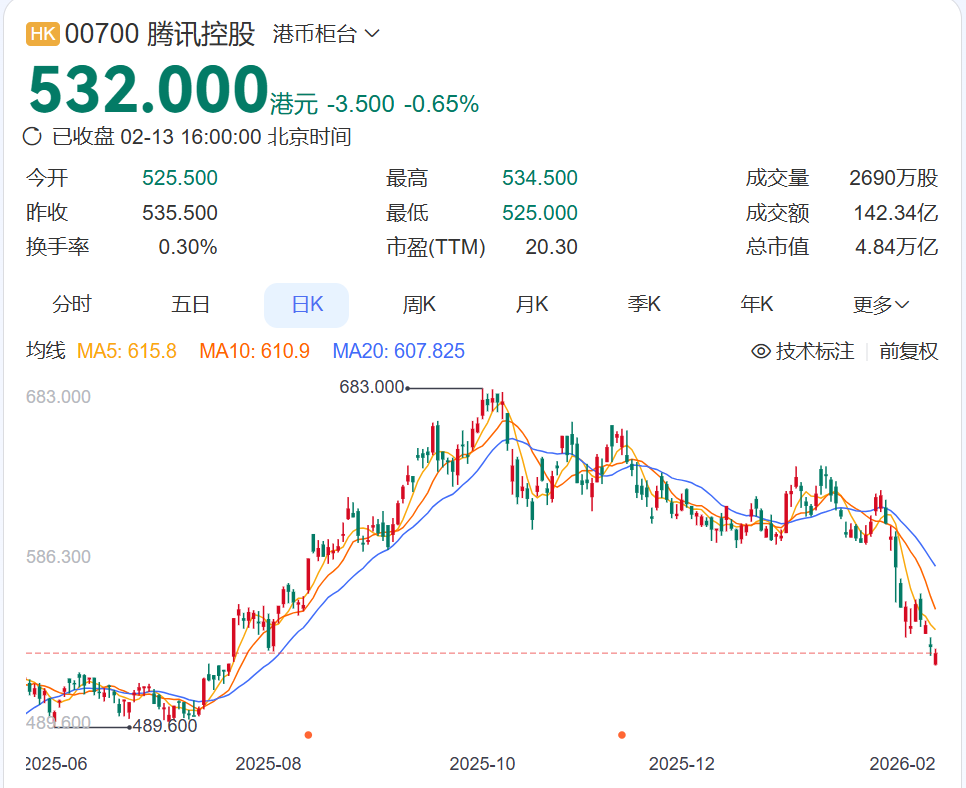
港股13日跌1.72% 收报26567.12点
Xin Hua She· 2026-02-13 12:58
Market Overview - The Hang Seng Index fell by 465.42 points, a decrease of 1.72%, closing at 26,567.12 points [1] - The total turnover on the main board was HKD 257.578 billion [1] - The Hang Seng China Enterprises Index dropped by 142.47 points, closing at 9,032.71 points, a decline of 1.55% [1] - The Hang Seng Tech Index decreased by 48.56 points, closing at 5,360.42 points, down by 0.9% [1] Blue-Chip Stocks - Tencent Holdings fell by 0.65%, closing at HKD 532 [1] - Hong Kong Exchanges and Clearing decreased by 2.13%, closing at HKD 405.2 [1] - China Mobile remained unchanged, closing at HKD 78.2 [1] - HSBC Holdings dropped by 2.72%, closing at HKD 135.7 [1] Local Hong Kong Stocks - Cheung Kong Holdings decreased by 0.59%, closing at HKD 46.9 [1] - Sun Hung Kai Properties increased by 0.15%, closing at HKD 133.7 [1] - Henderson Land Development fell by 1.04%, closing at HKD 32.4 [1] Chinese Financial Stocks - Bank of China decreased by 1.48%, closing at HKD 4.65 [1] - China Construction Bank fell by 1.49%, closing at HKD 7.96 [1] - Industrial and Commercial Bank of China dropped by 1.38%, closing at HKD 6.41 [1] - Ping An Insurance decreased by 2.16%, closing at HKD 70.35 [1] - China Life Insurance fell by 3.67%, closing at HKD 33.08 [1] Oil and Petrochemical Stocks - China Petroleum & Chemical Corporation dropped by 5.12%, closing at HKD 5.37 [1] - China National Petroleum Corporation fell by 4.33%, closing at HKD 9.05 [1] - CNOOC Limited decreased by 3.5%, closing at HKD 24.24 [1]





【财闻联播】正元智慧:实控人被判刑三年!新一轮俄美乌会谈将在瑞士日内瓦举行
券商中国· 2026-02-13 12:11
Macro Dynamics - In January 2026, the social financing scale increased by 7.22 trillion yuan, which is 166.2 billion yuan more than the same period last year [2] - The increase in RMB loans to the real economy was 4.9 trillion yuan, a decrease of 317.8 billion yuan year-on-year [2] - Net financing of corporate bonds was 503.3 billion yuan, an increase of 57.9 billion yuan year-on-year [2] - Government bonds net financing reached 976.4 billion yuan, an increase of 283.1 billion yuan year-on-year [2] Financial Institutions - The People's Bank of China and the National Financial Regulatory Administration have identified 21 systemically important banks in China, including 6 state-owned commercial banks, 10 joint-stock commercial banks, and 5 city commercial banks [3] Market Data - On February 13, A-shares saw all three major indices drop over 1%, with the Shanghai Composite Index falling 1.26% to below 4100 points [10] - The Hong Kong stock market closed with the Hang Seng Index down 1.72% and the Hang Seng Tech Index down 0.9% [11] Company Dynamics - Zhengyuan Wisdom's actual controller, Chen Jian, was sentenced to three years in prison for manipulating the securities market, but the company's operations remain normal [12] - CATL, Luoyang Molybdenum, and Laopu Gold will be included in the Hong Kong Hang Seng Index, increasing the number of constituent stocks from 88 to 90 [13] - Sinopec announced the resignation of Li Yonglin from his positions as executive director and senior vice president [14][15] - Zongshen Power plans to swap its motorcycle engine business with Longxin General's general machinery business, which is expected to constitute a major asset restructuring [16]