建筑

Search documents
香港屋宇署:九月共批出9份建筑图则
智通财经网· 2025-11-17 08:13
香港屋宇署同时发出16份入伙纸,包括港岛四份、九龙四份及新界8份。其中住宅用途的建筑楼面面积 有51721平方米,共1004个单位;而非住宅用途的建筑楼面面积则为100005平方米。九月份新落成楼宇 的报价总值约为41亿港元。此外,该署批准三项拆卸楼宇工程。该署九月接获2485宗有关僭建物的举 报,并发出898张僭建物的清拆令。 智通财经APP获悉,香港屋宇署九月共批出9份建筑图则,其中港岛4份及新界5份。批出的图则包括三 项住宅及商住发展、四项商业发展、一项社区服务发展,以及一项工厂及工业发展。获准动工的建筑工 程项目则有8个,这些工程完成后将提供可作住宅用途的建筑楼面面积共11985平方米,涉及单位216 个,非住宅用途的建筑楼面面积达14785平方米。另外,该署亦接获三个建筑项目的上盖工程动工通 知。 ...
【广发宏观贺骁束】11月经济初窥
郭磊宏观茶座· 2025-11-17 07:15
Group 1: Power Generation and Industrial Activity - Power generation growth rate has declined, with cumulative coal-fired power generation down 2.7% year-on-year as of November 6, compared to a 6.2% increase in October [1][6] - Industrial operating rates show mixed trends, with upstream steel and coking rates declining, while downstream weaving rates in Jiangsu and Zhejiang increased [2][7] - As of the second week of November, the operating rate of 247 blast furnaces increased by 0.9 percentage points year-on-year, while coking enterprises saw a decrease of 0.6 percentage points [7][8] Group 2: Steel Production and Construction Activity - Key steel mills reported a month-on-month decline in crude steel production, with a 1.4% decrease recorded as of November 10 [2][9] - The construction sector is experiencing a seasonal slowdown, with the asphalt operating rate falling by 3.9 percentage points month-on-month as of November 12 [2][11] - Cement dispatch rates decreased to 33.4%, down 4.3 percentage points month-on-month as of November 7 [11][12] Group 3: Consumer Behavior and Sales Trends - Passenger vehicle retail sales saw a significant year-on-year decline of 19% from November 1 to 9, with wholesale sales down 22% [4][18] - Real estate sales are weak, with a 38.4% year-on-year drop in average daily transactions for commercial housing in 30 major cities from November 1 to 16 [3][15] - Home appliance sales continue to decline, with online sales of air conditioners, refrigerators, and washing machines showing significant drops [4][19][20] Group 4: Shipping and Logistics - Port container throughput remained stable year-on-year, with a 6.5% increase from November 3 to 9, similar to October's growth [4][21] - Data on container shipments to the U.S. showed a significant decline, with the number of ships and tonnage down 26.8% and 30.2% respectively as of November 13 [4][21] Group 5: Price Trends and Economic Indicators - The Business Price Index (BPI) has continued to rise, with energy and non-food prices showing upward trends [5][24][25] - The lithium hexafluorophosphate price has significantly increased due to rising energy storage demand, reflecting a broader trend in the new manufacturing sector [5][26] - Consumer price indices for non-food items have shown fluctuations, with some categories experiencing price increases [5][27]


国企招人,提供岗位超2000个 新兴产业成“强磁场”
Si Chuan Ri Bao· 2025-11-17 00:20
Core Points - The "Qihang Tianfu State-owned Enterprises 2025 Campus Recruitment Fair" was held at the University of Electronic Science and Technology of China, organized by the provincial state-owned assets supervision and administration commission, the education department, and the human resources and social security department [1] - A total of 225 state-owned enterprises participated, offering over 2,000 job positions across various sectors including energy, transportation, construction, healthcare, cultural tourism, advanced materials, electronic information, equipment manufacturing, and modern agriculture [1] - The event featured an innovative smart job-seeking area with self-service job application terminals and an AI job matching system, providing students with precise and efficient digital job-seeking services [1] - There was significant interest in booths related to emerging industries such as electronic information, artificial intelligence, and biomedicine, with frequent interactions regarding cutting-edge technologies and innovative application scenarios [1] Additional Information - The online recruitment for this state-owned enterprise job fair will continue until the end of November [2]
华泰证券:港股高低切下短期建议关注消费者服务、建筑、纺织服装、家电等方向
Xin Lang Cai Jing· 2025-11-16 23:56
华泰证券研报表示,上周港股冲高回落,恒生指数上涨1.3%,恒生科技指数下跌0.4%。行业间高低切 演绎较为极致,今年以来相对滞涨的板块上周涨跌幅排名靠前,如农林牧渔、房地产、医药、石油石 化、纺织服饰等。在盈利数据并未明显改善的情况下资金提前切换,或因当前流动性承压、主线不清晰 等交易性因素。若资金高低切持续,短期建议关注今年以来表现排名靠后的消费者服务、建筑、纺织服 装、家电以及具有防御属性的红利方向。此外,12月开始港股流动性压力边际暂缓,切换或难一帆风 顺,依然建议均衡配置。 ...

周期论剑- 跨年行情布局确定性及弹性
2025-11-16 15:36
Summary of Key Points from Conference Call Records Industry Overview - The conference call discusses the Chinese market, focusing on various sectors including technology, manufacturing, aviation, oil shipping, chemicals, and consumer goods [1][4][5][6]. Core Insights and Arguments 1. **Market Outlook**: The index is expected to rise to 4,200-4,300 points from December to February, driven by product structure adjustments and increased capital inflow, alongside supportive policies from the upcoming "15th Five-Year Plan" [1][3]. 2. **Valuation Expansion**: The Chinese market is currently in a valuation expansion phase, with reduced fears of sanctions due to changing perceptions of US-China relations and rationalized economic policies [4][6]. 3. **Sector Recommendations**: - **Technology Sector**: Focus on AI, internet, new energy vehicles, electronic semiconductors, and media communications [5]. - **Manufacturing**: Global expansion in power equipment, machinery, and auto parts [5]. - **Aviation**: Strong fundamentals with record high passenger load factors and low ticket prices, indicating a potential super cycle [10]. - **Oil Shipping**: Record high freight rates expected to lead to the highest profits in a decade due to OPEC production increases and geopolitical factors [11]. - **Chemicals**: Optimism for leading companies benefiting from supply-side optimization and cost advantages [3][16]. - **Consumer Goods**: Opportunities in food, beverages, and retail sectors, particularly for companies with low stock and strong fundamentals [7][30]. Additional Important Insights 1. **Economic Recovery**: The upcoming year is expected to show a high probability of economic recovery, particularly in traditional sectors like cyclical and consumer goods [6]. 2. **Investment Strategies**: Investors are advised to focus on companies with low stock prices and strong fundamentals, especially in the consumer goods sector [7][9]. 3. **Brokerage Role**: Brokerages are anticipated to play a crucial role in market advancement, especially as capital market reforms progress [8]. 4. **Metal Industry Outlook**: Positive expectations for the metal sector, with industrial metals likely to benefit from global liquidity and emerging demands from AI infrastructure and new energy vehicles [18][19]. 5. **Chemical Industry Trends**: The chemical sector has seen significant supply-side optimization, with leading companies expected to benefit from a recovery in demand and pricing [13][14][16]. 6. **Oil Market Dynamics**: Current oil market conditions show a supply surplus, but OPEC's cautious production increases are expected to support prices in the medium term [24]. Conclusion The conference call highlights a generally optimistic outlook for the Chinese market across various sectors, with specific recommendations for investment opportunities in technology, aviation, oil shipping, chemicals, and consumer goods. The anticipated economic recovery and supportive policies are expected to drive market performance in the coming months.
新华财经早报:11月16日
Xin Hua Cai Jing· 2025-11-16 01:06
Group 1 - Multiple airlines in China, including Air China, China Eastern Airlines, and Southern Airlines, announced a special ticket handling policy for flights to Japan, allowing free refunds and changes for tickets with travel dates before December 31, 2025 [2] - Other airlines such as Sichuan Airlines, Xiamen Airlines, and Hainan Airlines also issued similar notifications regarding ticket handling for Japan routes [2] Group 2 - The China Securities Regulatory Commission disclosed that Yuzhu Technology Co., Ltd. has completed its IPO guidance work, with the guidance period lasting less than four months [3] - The IPO guidance was filed on July 18, 2025, and the completion report was issued by CITIC Securities on November 10, 2025, with 24 staff members assigned during the guidance period [3] Group 3 - Berkshire Hathaway built a position in Google-A during the third quarter, purchasing nearly 17.85 million shares, corresponding to a market value of approximately $4.3 billion at the end of the quarter [5] - Berkshire also increased its holdings in several companies, including Chubb, Lennar, Domino's Pizza, Sirius XM, and Lamar Advertising, while reducing its stake in Apple by selling nearly 41.79 million shares, resulting in a 15% decrease in Apple shares held [5]

三季度陕西省级重点项目完成投资4200多亿元
Shan Xi Ri Bao· 2025-11-16 00:07
Core Insights - Shaanxi province has implemented 3,482 key projects at both provincial and municipal levels this year, with 625 provincial key projects and an annual investment reaching 500 billion yuan [1] - The province has publicly promoted over 690 major projects suitable for private enterprises, resulting in intention agreements involving over 29 billion yuan [3] Group 1: Project Implementation and Progress - In the first three quarters, the investment in provincial key projects exceeded 420 billion yuan, with 92% of the 211 planned new projects already commenced, marking a 9 percentage point increase compared to the same period last year [1] - A series of measures have been implemented to enhance project service efficiency, including a leadership mechanism to provide targeted support for key projects [2] - 96% of the 625 provincial key projects have received complete or partial land guarantees, with land approval processes shortened to 12 working days [2] Group 2: Environmental and Archaeological Approvals - 97.6% of the provincial key projects have completed environmental impact assessments, facilitated by a specialized operation and early intervention [2] - The province has streamlined archaeological processes, saving approximately 165 million yuan in exploration costs for project units by reducing the exploration area by about 33.56 million square meters [2] Group 3: Investment and Economic Growth - Innovative measures have been introduced to support new private investment projects and provincial key industrial projects through loan interest subsidies [3] - The province has established a management model focusing on 50 key industrial chains, promoting targeted investment and project planning [3] - Over 1,000 investment projects have been identified in the provincial "four batches" project database, with 400 projects dynamically converted, and a total of 2,224 contracts signed in various investment activities, amounting to nearly 430 billion yuan [3]
罕见大举买入!巴菲特,最新持仓曝光!
Sou Hu Cai Jing· 2025-11-15 14:41
Core Insights - Berkshire Hathaway reported a net sale of stocks for the twelfth consecutive quarter, buying $6.4 billion and selling $12.5 billion in Q3 [1][6] - The company significantly increased its stake in Alphabet, making it its tenth largest holding, which led to a more than 4% increase in Alphabet's stock price after the announcement [1][2] - Berkshire reduced its holdings in Apple by approximately 41.79 million shares, marking the second consecutive quarter of selling Apple stock [1][6] Investment Activities - In Q3, Berkshire purchased 17.9 million shares of Alphabet, valued at about $4.9 billion [2] - The company sold 41.79 million shares of Apple, reducing its stake to 238.2 million shares, with a market value decrease of approximately $10.6 billion [6] - Berkshire also sold 37.2 million shares of Bank of America, lowering its ownership to 7.7% [6] Management Transition - Warren Buffett plans to step down as CEO in January 2024, after holding the position since 1965, with Greg Abel set to take over [7][8] - Concerns have been raised regarding Berkshire's performance post-Buffett, with the stock price declining over 5% since the announcement of his retirement [7] - Buffett expressed confidence in Abel's ability to manage the company effectively [8]



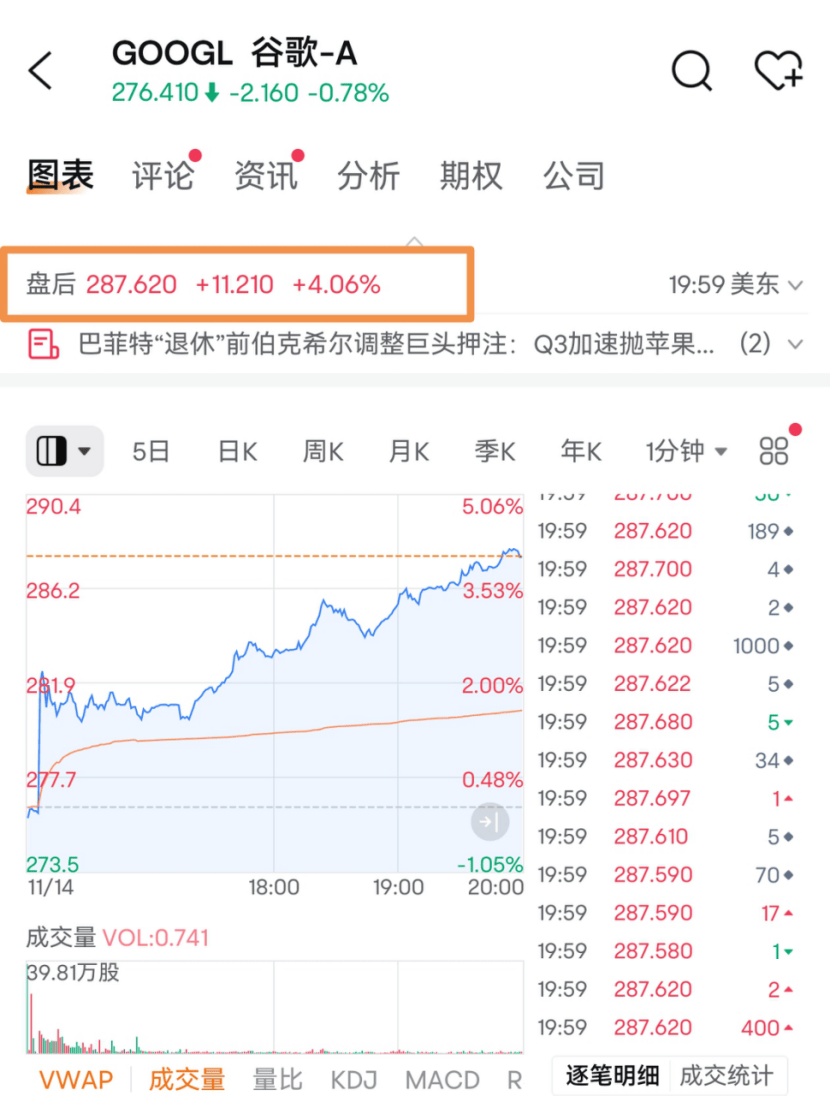
巴菲特“谢幕”前夜,伯克希尔新舵手建仓谷歌
Huan Qiu Wang· 2025-11-15 03:32
Core Insights - Berkshire Hathaway, under Warren Buffett's leadership, has made a significant shift by initiating a position in Google-A, purchasing nearly 17.85 million shares valued at approximately $4.3 billion in Q3, marking a departure from its historically cautious stance on tech stocks [1][3] - The investment in Google is seen as a strong indication of the evolving investment strategy under the new leadership of Greg Abel, who is set to take over as CEO [1][3] Investment Strategy - Historically, Berkshire's portfolio has been characterized by investments in consumer goods, financials, and industrials with stable cash flows and understandable business models, reflecting Buffett's investment philosophy [3] - The recent Q3 report shows a rebalancing strategy, with a reduction of about 41.79 million shares of Apple, decreasing its holdings by approximately 15%, indicating a move to lock in profits and optimize the investment portfolio [3][4] - Other reductions included stakes in American Bank and Verizon, contributing to a net selling position in Q3, with the total portfolio value increasing from $257.5 billion at the end of Q2 to $267.3 billion at the end of Q3, primarily due to market performance rather than new purchases [3][4] Strategic Balance - The Q3 holdings reflect a strategic balance during the leadership transition, with increased investments in traditional sectors like insurance and construction while also venturing into tech with Google, showcasing adaptability to changing market conditions [4] - Buffett expressed strong confidence in Abel's capabilities, stating he exceeded expectations and was the best choice to manage the company's assets, which supports a smooth transition and continuity in future strategies [4] - The initiation of a position in Google signals a potential shift towards a more open approach to technology investments while maintaining the core principles of value investing [4]

中金 | 深度布局“十五五”:基础材料与工程篇
中金点睛· 2025-11-15 00:07
Core Viewpoint - The article emphasizes the importance of optimizing supply and focusing on high-quality development across various industries during the "15th Five-Year Plan" period, highlighting the need for structural adjustments and sustainable growth strategies. Coal Industry - The coal consumption is expected to peak between 4.95 to 5.1 billion tons during the "15th Five-Year Plan" period, with a slight decline to around 4.9 billion tons by 2030 [2] - Coal remains a crucial stabilizer for energy supply during the transition to a new energy system, with a gradual reduction in coal usage expected [3] - The coal sector is projected to maintain investment value due to favorable supply-demand dynamics, with high-quality companies expected to sustain profitability and cash flow [3] Building Materials - Cement demand is forecasted to decline by 30-40% from 2024 to 2030, necessitating capacity reduction to maintain profitability [4] - The industry is expected to focus on overseas expansion, particularly in Africa, as a growth strategy [4] - Glass fiber demand is anticipated to grow at an annual rate of around 5%, driven by wind power installations [4] - The construction materials sector is under pressure, but segments like coatings are expected to recover, with the market size projected to exceed 100 billion yuan by 2030 [5] Steel Industry - The steel industry is transitioning from scale expansion to quality and efficiency improvement, with a focus on high-end product development [6] - Demand for construction steel is expected to decline due to demographic changes, while high-end manufacturing will continue to drive demand for specialized steel products [6] - The industry is undergoing supply-side reforms to eliminate inefficient capacity and improve competitiveness [6] - Green transformation initiatives are being prioritized, with a focus on reducing carbon emissions and enhancing sustainability [7] - The industry aims to increase self-sufficiency in iron ore and expand overseas operations to enhance global competitiveness [8] Paper Industry - The paper industry is experiencing a slowdown in capacity expansion, with demand expected to recover moderately due to supportive consumption policies [9] - The industry is shifting towards self-produced pulp to enhance profit margins amid fluctuating raw material prices [9] Construction Industry - The construction sector is expected to focus on "stock clearance and incremental transformation," with significant government support for infrastructure investment [10] - The sector's financial health is projected to improve as local government debt restructuring progresses, enhancing cash flow and reducing impairment losses [10] - New business models and overseas expansion are seen as key growth drivers for construction companies [12]