电池

Search documents
圣阳股份(002580.SZ):目前尚未开展氢燃料电池领域相关工作
Ge Long Hui· 2026-02-03 09:59
Core Viewpoint - The company has launched an all-immersive liquid cooling solution for data center IDC power and liquid cooling solutions, which features ultra-high power density and intelligent energy efficiency management, and is currently in the market promotion phase [1] Group 1: Product Development - The company has completed third-party authoritative testing for its solid-state and sodium-ion battery products, achieving good performance indicators, and these products are now in the market demonstration application verification phase [1] - The company has not yet engaged in hydrogen fuel cell technology but will continue to monitor industry technological advancements and actively reserve new electrochemical energy storage technologies [1]

圣阳股份:目前尚未开展氢燃料电池领域相关工作
Ge Long Hui· 2026-02-03 09:56
Core Viewpoint - The company has launched an all-immersive liquid cooling solution for data center IDC power and liquid cooling solutions, which features ultra-high power density and intelligent energy efficiency management, and is currently in the market promotion phase [1] Group 1: Product Development - The company has completed third-party authoritative testing for its solid-state and sodium-ion battery products, achieving good performance indicators, and these products are now in the market demonstration application verification phase [1] - The company has not yet engaged in hydrogen fuel cell technology but will continue to monitor industry technological advancements and actively reserve new electrochemical energy storage technologies [1]
瑞浦兰钧实现首次盈利,扭亏约20亿元!
中关村储能产业技术联盟· 2026-02-03 09:12
Group 1 - The core viewpoint of the article is that Ruipu Lanjun is expected to achieve its first profit since establishment, with a projected net profit of approximately RMB 6.30 billion to RMB 7.30 billion for the year ending December 31, 2025, marking a turnaround from a loss of about RMB 20 billion in 2024 [3] - The increase in profit is primarily driven by a continuous rise in the shipment volume of power and energy storage battery products, leading to sustained revenue growth [3] - Improvements in capacity utilization and cost reduction measures have significantly enhanced gross profit margins [3] Group 2 - Ruipu Lanjun has confirmed its participation in the 14th International Energy Storage Summit and Exhibition (ESIE 2026), inviting industry peers to attend the global energy storage industry event [3] - The event is scheduled to take place from March 31 to April 3, 2026, at the Beijing Capital International Exhibition Center [6] - The company reported a nearly fourfold increase in battery gross profit, with energy storage shipments reaching 18.87 GWh in the first half of the year [10]

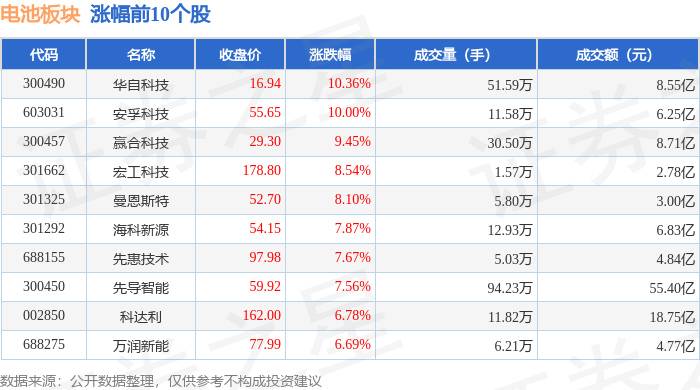
电池板块2月3日涨1.4%,华自科技领涨,主力资金净流入5.08亿元
Zheng Xing Xing Ye Ri Bao· 2026-02-03 09:03
Market Overview - The battery sector increased by 1.4% compared to the previous trading day, with Huazi Technology leading the gains [1] - The Shanghai Composite Index closed at 4067.74, up 1.29%, while the Shenzhen Component Index closed at 14127.1, up 2.19% [1] Individual Stock Performance - Huazi Technology (300490) closed at 16.94, up 10.36% with a trading volume of 515,900 shares and a transaction value of 855 million [1] - Anfu Technology (603031) closed at 55.65, up 10.00% with a trading volume of 115,800 shares [1] - Yinghe Technology (300457) closed at 29.30, up 9.45% with a trading volume of 305,000 shares [1] - Honggong Technology (301662) closed at 178.80, up 8.54% with a trading volume of 15,700 shares [1] - Manns Tech (301325) closed at 52.70, up 8.10% with a trading volume of 58,000 shares [1] - Haike Xina (301292) closed at 54.15, up 7.87% with a trading volume of 129,300 shares [1] - Xianhui Technology (688155) closed at 97.98, up 7.67% with a trading volume of 50,300 shares [1] - Xian Dao Intelligent (300450) closed at 59.92, up 7.56% with a trading volume of 942,300 shares [1] - Keda Li (002850) closed at 4162.00, up 6.78% with a trading volume of 118,200 shares [1] - Wanrun New Energy (688275) closed at 77.99, up 6.69% with a trading volume of 62,100 shares [1] Capital Flow Analysis - The battery sector saw a net inflow of 508 million from institutional investors, while retail investors contributed a net inflow of 594 million [2] - Retail investors experienced a net outflow of 1.1 billion, indicating a mixed sentiment in the market [2] Detailed Capital Flow for Selected Stocks - Xian Dao Intelligent (300450) had a net inflow of 3.80 billion from institutional investors, but a net outflow of 2.50 billion from retail investors [3] - Tianhua New Energy (300390) saw a net inflow of 1.33 billion from institutional investors, with retail investors experiencing a net outflow of 765.46 million [3] - Anfu Technology (603031) had a net inflow of 631.24 million from institutional investors, while retail investors faced a net outflow of 571.16 million [3] - Keda Li (002850) recorded a net inflow of 503.07 million from institutional investors, with retail investors seeing a net outflow of 617.04 million [3]



电池产业"出海"正当时!2026国际电池产业大会4月22日吉隆坡启航
鑫椤锂电· 2026-02-03 08:07
Group 1 - The core viewpoint of the article emphasizes the rapid growth and technological innovation in the battery industry, driven by the global energy transition, with a projected growth rate of 34.6% in 2026, and an even higher growth rate of 70% in the energy storage sector [1][2] - The 2026 International Battery Industry Conference will be held in Kuala Lumpur, Malaysia, from April 22 to 24, 2026, aiming to create a platform for dialogue among industry elites and to explore new paths for industry development [2] - Malaysia has become a significant hub for the global battery industry chain, with over 26 billion yuan invested by Chinese battery companies by 2025, covering all aspects of the battery supply chain [2] Group 2 - The conference will focus on key industry pain points and cutting-edge trends, promoting collaborative innovation within the supply chain and optimizing global resource allocation for sustainable development in the battery industry [2] - The event will include a business networking cocktail on the first day, the main conference on the second day, and site visits on the third day [5]
能源绿色低碳转型”看山东之肥城蔚蓝科技产业园:助力打造千亿级“泰山锂谷
Zhong Guo Fa Zhan Wang· 2026-02-03 08:04
Core Insights - The establishment of the Weilan Technology Industrial Park in Tai'an is a key initiative for building a trillion-level "Taishan Lithium Valley" [1] - The park adopts a "platform + technology + capital" development model, with a total investment of 220 million yuan aimed at creating two listed companies within 3-5 years [1] - The park features a full-chain service platform for new battery electrode materials, including R&D, pilot testing, and industrialization [1] Group 1 - The industrial park has attracted a team of 65 PhD and master's degree holders, including those mentored by Nobel laureate Goodenough, resulting in 25 invention patents and participation in the formulation of 2 national standards [2] - A complete incubation mechanism has led to the incubation of 28 projects with independent intellectual property rights and the implementation of 18 pilot projects [2] - Two projects, Prussian blue sodium-ion batteries and single-walled carbon nanotube conductive slurry, have achieved mass production, leading the industry in both original technology and industrialization processes [2] Group 2 - Shandong Zero One Four Company, which has entered the park, utilizes fully self-developed technology, producing sodium-ion batteries with the most advanced processes, lowest costs, and highest efficiency [3] - The battery production workshop is currently being renovated, with plans to expand production capacity from 1GWh to 10GWh, potentially exceeding 10 billion yuan in annual output value [3] - Carbon Seeking New Materials Company is the only enterprise in the country capable of mass-producing and applying single-walled carbon nanotube materials, breaking international technology monopolies and becoming a designated supplier for leading companies like CATL and BYD [3] - The second phase of the production line, with a capacity of 13,000 tons, is under trial production, with plans to expand to 90,000 tons, also aiming for an annual output value exceeding 10 billion yuan [3] - The integrated project of source-grid-load-storage has a total investment of 24.7 million yuan, expected to generate 3 million kWh annually, reducing CO2 emissions by approximately 2,340 tons each year [3] - The city of Feicheng plans to accelerate the construction of the integrated project to further extend the industrial chain and attract more upstream and downstream enterprises, contributing to the development of a green low-carbon transformation demonstration zone [3]
今日涨跌停股分析:83只涨停股、22只跌停股,BC电池概念走强,罗博特科、奥特维等涨停
Xin Lang Cai Jing· 2026-02-03 07:21
Group 1 - A total of 83 stocks in the A-share market hit the daily limit up, while 22 stocks hit the limit down on February 3 [1] - The perovskite battery concept showed significant activity, with ST Jingji and Jun Da shares hitting the limit up, along with Guosheng Technology [1] - The BC battery concept also strengthened, with Robotech and Aotwei shares reaching the limit up [1] Group 2 - Hunan Gold achieved 6 limit ups in 7 days, while ST Jinglan had 5 limit ups in 7 days [1] - Baichuan shares recorded 4 limit ups in 5 days, and several other stocks like Hengdian Film and Television and Wanfeng shares had 4 consecutive limit ups [1] - On the downside, ST Wanfang faced 16 consecutive limit downs, and ST Jinglun had 6 consecutive limit downs [1]

韩国综合指数收高6.8% 创下历史最高收盘点位 盘中大涨一度触发临停
Xin Lang Cai Jing· 2026-02-03 07:18
Core Viewpoint - The South Korean stock market experienced a significant rebound, closing nearly 7% higher, driven by the tech sector's performance and expectations for domestic market reforms, reaching a historical high closing point [1][4]. Group 1: Market Performance - The KOSPI index closed up 338.41 points, a 6.84% increase, reaching 5,288.08 points, marking the highest closing level in history and the largest single-day percentage gain since March 24, 2020 [1][4]. - The index had previously dropped 5.3%, the largest single-day decline since April 7, 2025 [2][5]. - The index triggered a trading halt for five minutes due to a 5% rise in futures [1][4]. Group 2: Key Stocks - Samsung Electronics surged 11.37% to a historical high, marking the largest single-day gain since October 30, 2008 [2][5]. - SK Hynix rose by 9.28%, while LG Energy Solution increased by 2.89%, and Hyundai Motor and Kia Motors saw gains of 2.82% and 2.60%, respectively [2][5]. Group 3: Foreign Investment and Analyst Predictions - Foreign investors net purchased stocks worth 703.3 billion KRW (approximately 486.11 million USD) [3][6]. - Analysts from JPMorgan predict that the KOSPI index could reach 7,500 points by 2026, with a base scenario target of 6,000 points for this year [3][7]. - The rise in chip prices is expected to continue until the end of 2027, with Samsung Electronics and SK Hynix leading the index's growth, and these stocks are projected to have a 45%-50% upside by 2026 [3][7].
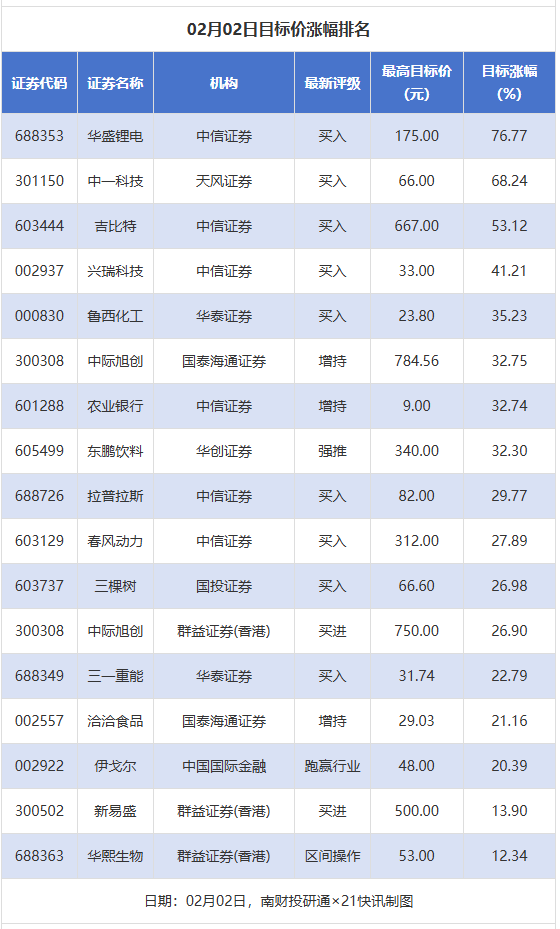
37股获推荐,华盛锂电目标价涨幅超76%
2 1 Shi Ji Jing Ji Bao Dao· 2026-02-03 06:37
Group 1 - The core viewpoint of the article highlights the target price increases for several listed companies, with notable gains in the battery and gaming sectors [1][2]. - The companies with the highest target price increases include Huasheng Lithium Battery with a 76.77% increase, Zhongyi Technology with a 68.24% increase, and Gibit with a 53.12% increase [1][2]. - A total of 37 listed companies received recommendations from brokers on February 2, with Dongpeng Beverage receiving the most recommendations at four [3]. Group 2 - On February 2, brokers provided 12 new coverage ratings, including Aorijins receiving an "Outperform" rating from Guosen Securities, and Zhongyi Technology receiving a "Buy" rating from Tianfeng Securities [3][4]. - Other companies receiving new ratings include China Merchants Shekou and Huayuan Shares, both rated "Buy" by Huayuan Securities, and Xingshui Technology rated "Buy" by CITIC Securities [3][4]. - The sectors represented in the new coverage include packaging printing, real estate development, automotive parts, IT services, and chemical pharmaceuticals [4].

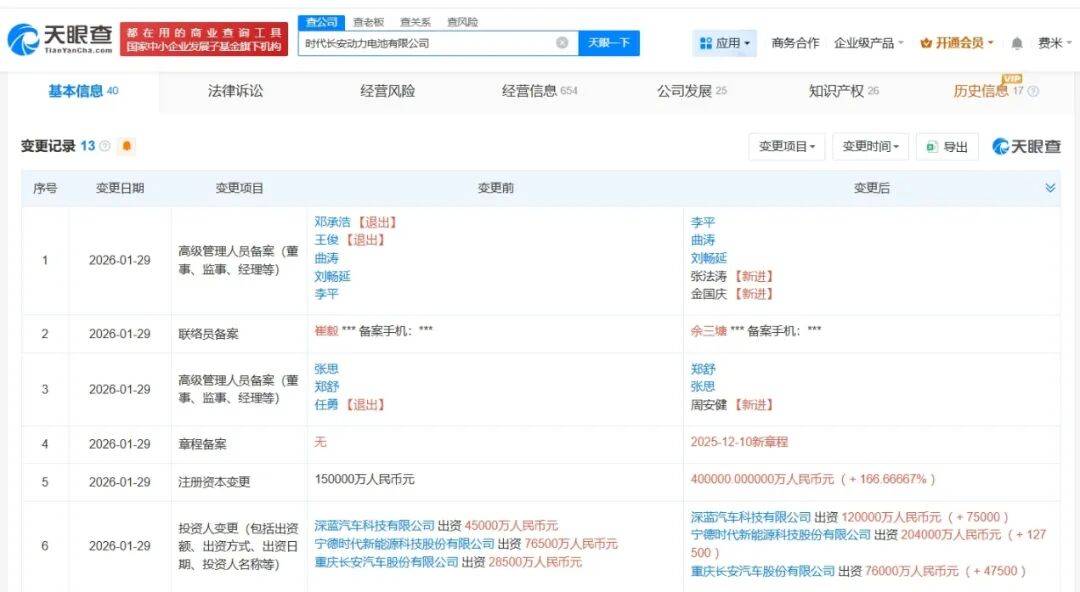
40亿注册资本落地!电池技术迭代前夕,时代长安如何卡位?
Sou Hu Cai Jing· 2026-02-03 06:26
时代长安动力电池有限公司成立于2023年6月,法定代表人为朱云峰,经营范围包括电池制造、电池销售、新兴能源技术研发、新材料技术研发等。股东 信息显示,该公司由宁德时代(300750)、深蓝汽车科技有限公司、长安汽车(000625)共同持股。 | 直关系 | 营风险 | 查公司 直去板 | 都在用的商业查询工具 | 大限宣 | න | 天殿一下 | 器应用 - | 时代长安动力电池有限公司 | 商务合作 企业级产品、 ★开通会员、■ 费米· | 国家中小企业发展了县全旗下机构 | | --- | --- | --- | --- | --- | --- | --- | --- | --- | --- | --- | | 法律诉讼 | 经营风险 | 历史信息 17 3 | 基本信息 40 | 经营信息 654 | 公司发展 26 | 知识产权 26 | | | | | | 变更记录 13 0 | 变更项目, | 变更时间, | 7天眼查 | 电 营品 | | | | | | | | 变更日期 | 变更前 | 变更后 | 序号 | 变量项目 | > | | | | | | | 邓承浩 【退出】 | 李平 | 王俊【唱 ...