芯片制造

Search documents
刚得诺奖的成果被做成芯片了
量子位· 2025-10-13 03:35
Core Viewpoint - The article highlights the recent breakthrough in using Metal-Organic Frameworks (MOFs) to create ultra-miniature fluid chips, which can perform computations and exhibit short-term memory similar to brain neurons, challenging the previous notion that MOFs were "useless" [1][20]. Group 1: MOF Technology and Applications - MOFs, once considered theoretical with limited practical applications, have now been recognized for their potential in advanced computing technologies following their Nobel Prize acknowledgment [1][21]. - The newly developed fluid chip, made from MOF materials, can overcome limitations of traditional electronic chips by enabling advanced functionalities [3][5]. - The h-MOFNT device constructed from layered Zr-MOF-SO₃H crystals demonstrates unique ion transport properties, allowing for precise control over ionic movement [7][12]. Group 2: Device Characteristics and Performance - The h-MOFNT device exhibits non-linear proton transport characteristics, which differ from typical diode behavior, indicating a threshold-controlled transport mechanism [12][13]. - Experimental results show that the device can remember past voltage states, demonstrating fluid memory and learning capabilities, akin to electronic devices [16][18]. - The ability to create a small fluid circuit using multiple h-MOFNTs showcases the potential for complex computations and memory functions in liquid systems [16][19]. Group 3: Historical Context and Future Prospects - Historically, despite extensive research (over 100,000 related papers), the practical industrial application of MOFs has been limited due to issues like structural stability and production costs [25][27]. - The emergence of MOF-based chips suggests that the material may not be "useless," but rather that suitable applications were not previously identified [29]. - Future developments may lead to the realization of liquid-based information storage and brain-like computing systems through innovative design of heterogeneous constraint systems [19].

英伟达对OpenAI千亿美元投资引发“循环交易”质疑
财富FORTUNE· 2025-10-12 13:07
Core Viewpoint - Nvidia's recent $100 billion investment in OpenAI raises concerns about a potential financial bubble in the AI sector, as the valuation of companies in this field may not align with their actual revenue and profit calculations [2][9] Investment Network Complexity - Nvidia has established a complex investment network, notably with OpenAI and Coreweave, where investments lead to mutual benefits, creating a cycle of funding and procurement that obscures the true flow of capital [3][5] - Nvidia's investments allow companies like OpenAI and Coreweave to secure financing at rates comparable to established firms like Microsoft, significantly lower than what startups typically face [5][8] Financial Transactions and Implications - Nvidia has committed to purchasing cloud computing resources from Coreweave, with total expenditures reaching approximately $75 billion for GPUs, indicating a strategy where investments are recouped through sales [6][8] - The company has also engaged in similar agreements with other cloud firms, further entrenching its position in the AI infrastructure market [6][8] Concerns Over Valuation Bubble - Analysts express concerns that Nvidia's financing practices resemble those seen during past tech bubbles, where companies provided loans to customers, leading to inflated valuations and eventual market corrections [9][10] - The rental agreements with OpenAI allow the latter to avoid high depreciation costs, placing the burden on Nvidia, which could lead to inventory issues if demand does not meet expectations [9][10] Historical Parallels - The current situation draws parallels to the dot-com bubble, where excessive financing led to unsustainable growth and significant market corrections, raising alarms about Nvidia's current investment strategies [10][11]


Crypto startups tapping AI hype raise $2bn. Here’s why some are unconvinced
Yahoo Finance· 2025-10-11 04:16
Core Insights - The artificial intelligence-powered crypto sector is projected to grow fivefold to reach a valuation of $1 trillion within the next decade, driven by the entry of legitimate projects [1] - AI is expected to serve as a new interface for blockchains, making it accessible to non-technical users and facilitating on-chain transactions [2] - The sector, currently valued at approximately $20 billion, is anticipated to revolutionize crypto trading [2] Investment Trends - AI-linked crypto startups raised nearly $2 billion across 261 deals in 2025, following over $2.5 billion in 2024, totaling almost $13 billion in funding since 2020 [3] - Startups at the intersection of crypto and AI raised over $550 million in the first nine months of the year, marking a 7% increase from the total raised in 2024 [4] Market Performance - The total value of the AI-linked tokens market surged by 14% over the past 30 days, reaching $35.5 billion, which is about half of the $70 billion record set in December [6] - Companies like Nvidia and Microsoft have significantly contributed to stock market growth, fueled by the hype surrounding AI [5] Future Projections - The market is expected to double in size, potentially reaching $40 billion by 2026, with the emergence of innovative AI applications on-chain [7]
特朗普关税威胁引爆抛售潮,美三大股指暴跌创四个月新低
Sou Hu Cai Jing· 2025-10-11 00:30
Group 1 - The U.S. stock market experienced significant declines on October 11, with the Dow Jones Industrial Average dropping 1.90%, the Nasdaq Composite falling 3.56%, and the S&P 500 decreasing by 2.71%, marking the lowest closing point in four months [1] - The sell-off was triggered by the Trump administration's announcement of new tariffs on Chinese imports, raising concerns about escalating global trade tensions and causing a ripple effect across capital markets [1][2] - Asian markets showed severe volatility, with Japan's Nikkei 225 index experiencing a maximum drop of nearly 9%, and South Korea's composite index triggering a trading halt due to sharp declines [1] Group 2 - The technology sector was particularly hard hit, with Nvidia's market value shrinking by $229 billion, Tesla losing $71 billion, and Amazon and Microsoft shares dropping by 5% and 3.3% respectively [2] - The Nasdaq index has fallen 22% from its historical peak, entering a technical bear market, as chip manufacturers and cloud computing companies faced sell-offs due to supply chain disruption risks [2] - The U.S. government shutdown has exacerbated market uncertainty, delaying the release of non-farm payroll data and increasing information asymmetry in the market [2] Group 3 - The escalating trade tensions have led to new challenges for the global supply chain, with the EU announcing retaliatory tariffs on $28 billion worth of U.S. goods and China implementing a comprehensive 34% tariff on U.S. imports [3] - Key industries such as automotive, semiconductors, and agriculture are facing dual cost pressures, prompting the International Monetary Fund to lower its global economic growth forecast for 2025 from 2.8% to 2.2% [3] - Analysts suggest that the escalation of trade friction may lead to systematic downgrades in corporate earnings expectations, potentially hindering the recovery of global stock market valuations [3]
Stock market jitters are justified given China tariffs: Longview Global's McNeal
Youtube· 2025-10-10 21:56
Group 1 - The current geopolitical climate is more concerning than before, with China seemingly willing to provoke the US and leverage its position [1][2] - China has announced enhanced export controls, indicating a long-term strategy that has been in place for about five years, which could significantly impact sectors reliant on chip production [2][3] - There is a pressing need to address China's dominance in the critical mineral space, which is essential for various industries [4] Group 2 - China's recent military maneuvers, such as naval vessels cruising near Japan, suggest a more aggressive stance in the region [5] - The movement in gold prices reflects China's diversification away from the US, as it holds a significant amount of gold, which supports its currency [6] - China is frustrated with the ongoing 20% tariffs on fentanyl and is seeking to negotiate the removal of export controls on advanced chips, indicating a desire for short-term access to technology [7] Group 3 - Long-term, China aims to assert its role on the global stage and demonstrate that it can compete with the US, which has diplomatic implications [8]
今日要闻
Ge Long Hui· 2025-10-10 20:51
Group 1 - Israel and Hamas have reached a preliminary agreement allowing humanitarian aid into Gaza, releasing 20 hostages, and adjusting the Israeli military withdrawal roadmap. This agreement is seen as progress but not a complete resolution, influenced by the upcoming Nobel Peace Prize announcement [1] - HSBC plans to privatize Hang Seng Bank at a price of 155 HKD, leading to a 30% increase in the bank's stock price. High interest rates have significantly benefited foreign banks, prompting major shareholders to take action [2] - JPMorgan anticipates that Macau's October gaming revenue will increase by approximately 12% year-on-year, reaching a six-year high, yet most casino stocks are valued at less than half of their 2019 levels, indicating a potential expectation gap [3] Group 2 - International flight schedules increased by 11.8% year-on-year during the first seven days of the National Day holiday, while the number of travelers opting for camping has also risen, suggesting a K-shaped trend in tourism consumption, with some upgrading and others downgrading [4] - The semiconductor sector continues to experience explosive growth, supported by strong fundamentals, although the rapid pace of increase raises concerns about potential adjustments in the future [5]


特朗普「国有化」后,英特尔=美版中芯国际
36氪· 2025-10-10 09:29
Core Viewpoint - The article discusses Intel's financial struggles and its recent investments from major players like Nvidia, SoftBank, and the U.S. government, highlighting the need for Intel to secure external orders to improve its wafer foundry business and overall financial health [4][12][26]. Investment and Financial Situation - Nvidia's $5 billion investment in Intel has led to a significant stock price increase for both companies, with Intel's stock rising approximately 50% since the announcement [4]. - Intel's financial situation is dire, with a cash reserve of about $212 billion, which is only 75% of the total cash reserves expected by mid-2025, primarily due to over $200 billion invested in wafer foundry operations without adequate returns [8][11]. - The investments from SoftBank and the U.S. government, totaling $15.9 billion, have not significantly boosted Intel's stock price, indicating a lack of confidence from the market [5][8]. Comparison with Competitors - Intel's fixed assets and capital expenditures are comparable to TSMC, but its wafer foundry revenue is significantly lower, with projected revenues of $17.5 billion and $9.1 billion for 2024 and the first half of 2025, respectively, compared to TSMC's much higher figures [9][16]. - Intel's fixed asset turnover ratio has declined to 0.52, indicating low capacity utilization, while TSMC maintains a much higher utilization rate, which is critical for profitability in capital-intensive businesses [19]. Strategic Partnerships and Future Outlook - Intel is actively seeking partnerships with major clients like Apple and TSMC to secure wafer foundry orders, which is essential for improving its financial situation [21][26]. - The U.S. government's support for Intel's wafer foundry business is seen as a strategic move to bolster domestic semiconductor manufacturing, similar to the role of SMIC in China [25][26]. - If Intel can successfully attract orders from Nvidia and Apple, it could lead to a significant turnaround in its wafer foundry business and stock performance, with potential for further price increases in the future [26].

AI算力热浪点火3nm与先进封装 富国银行力挺半导体设备牛市
Zhi Tong Cai Jing· 2025-10-10 07:21
Group 1: Semiconductor Equipment Industry Outlook - Wells Fargo has released a bullish report on the semiconductor equipment industry, highlighting the acceleration of advanced process chip production and packaging capacity expansion driven by major tech companies like Microsoft, Google, and Meta [1] - The long-term bullish narrative for the semiconductor equipment sector remains strong, with a focus on companies like ASML, Applied Materials, and KLA, all receiving "buy" ratings and target price increases [1][4] - The demand for 3nm and below high-performance AI chips is expected to remain robust at least until 2027, prompting major manufacturers like TSMC, Samsung, and Intel to expand their production capacities [5] Group 2: Key Collaborations and Investments - Nvidia and Intel have announced a collaboration, alongside Nvidia's significant investment of up to $100 billion in OpenAI, aiming to build a super AI data center with at least 10 GW of computing power [2] - AMD has also partnered with OpenAI to deploy a total of 6 GW of AI GPU computing power, indicating a substantial scale of collaboration within the semiconductor and AI sectors [2] Group 3: Performance of Key Companies - Applied Materials' target price has been raised from $240 to $250, with a year-to-date stock price increase of over 36%, outperforming major indices [8] - ASML's target price has been significantly increased from $890 to $1,105, with a stock price increase of 40% year-to-date, driven by strong demand for High-NA EUV lithography machines [9] - KLA's target price has been raised from $920 to $1,115, with a year-to-date stock price increase of over 70%, focusing on defect detection and yield management in semiconductor manufacturing [10]


科技股强势助推美股年终上涨预期再升温
Xin Lang Cai Jing· 2025-10-10 01:16
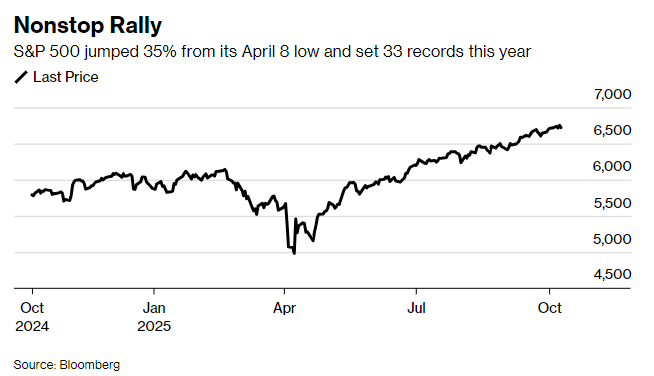
在企业盈利表现方面,市场对第三季度的财报表现预期乐观。标普500指数成分股的利润预计增长约 7.4%,这与前两个季度相比增幅有所减缓,但仍显示出积极的迹象。科技股上涨的主要驱动因素被认 为是实际的盈利增长而非纯粹的估值提升。 值得关注的是,AI领域的芯片制造商和数据中心企业可能成为投资的热点,原因是科技板块中少数盈 利稳定的大企业仍在推动市场增长。与此同时,还有潜在风险,包括美国政府停摆可能导致经济数据发 布中断,以及就业市场状况不确定带来的经济压力。 来源:市场资讯 (来源:美股情报站) 近期,美国股市有望在年终继续上涨。Nuveen Asset Management的首席投资官认为,尤其是大型科技 公司强劲的业绩可能为股市提供支撑。当前第四季度往往是股市表现强劲的时期,这种趋势似乎在今年 再次出现。 自四月份以来,随着贸易摩擦的缓解和人工智能领域的热度上升,标普500指数已经增长了35%。科技 巨头如英伟达、谷歌和博通领涨,标普500指数达到了历史新高。尽管这轮涨势推高了市场估值,引发 了股市泡沫风险的担忧,但企业的稳健盈利仍显示出支撑作用。 历史数据显示,情况似乎支持对当前行情的乐观预测。以标普500指 ...


美股年底涨势稳了?Nuveen:巨头盈利将成“定海神针” AI仍是核心引擎!
智通财经网· 2025-10-10 00:12
智通财经APP获悉,Nuveen Asset Management LLC首席投资官表示,美国股市很可能在年底前延续升 势,稳健的企业盈利——尤其是超大规模科技巨头的业绩——将持续推动股价上涨。 Saira Malik周四在接受采访时指出,对于股市而言,第四季度"通常是表现强劲的季度,尤其是在年初 至今已实现大幅上涨的情况下。因此,当前这波涨势延续的概率较高"。 自4月8日触及低点以来,随着贸易紧张局势缓解、人工智能(AI)热潮涌动以及市场对美联储进一步降息 的预期升温,标普500指数已累计飙升35%,英伟达(NVDA.US)、谷歌(GOOGL.US)、博通(AVGO.US) 等AI领域的科技巨头成为领涨主力。该指数年内已33次刷新纪录,目前仍徘徊在历史高位附近。 尽管这一轮涨势使得股市估值较历史水平偏高,并引发了市场对股市泡沫的担忧,但在Malik看来,强 劲的企业业绩足以支撑当前估值。她预计,随着下周即将开启的第三季度财报季,企业盈利将再次超出 市场预期。分析师数据显示,标普500指数成分股第三季度利润预计增长7.4%,这将是两年来的最小增 幅。 Malik表示:"若探究科技股上涨的核心驱动力,会发现主要 ...