软饮料

Search documents
大众品Q2业绩前瞻及中期策略报告:新消费重构投资范式,传统消费循势待时-20250715
ZHESHANG SECURITIES· 2025-07-15 11:48
Group 1 - The report emphasizes the reconstruction of investment paradigms in the food and beverage sector, driven by new consumption trends that focus on emotional value, health, and technological innovation [1][14][30] - The new consumption paradigm is characterized by a shift from traditional consumption frameworks to a model that prioritizes innovative supply and new demand creation through quality offerings [1][14][35] - The report identifies three main consumption trends: rational quality consumption, emotional value self-consumption, and technological iteration innovation [1][14][30] Group 2 - The analysis of sub-sectors indicates that traditional leaders in beer, dairy, and condiments should be evaluated through traditional consumption frameworks, while new consumption-driven sectors like snacks, tea drinks, and health products require a bottom-up approach to identify explosive changes [2][35] - In the snack sector, companies with category dividends and new channel expansions are expected to perform well, with projected revenue growth rates for various companies in Q2 2025 [4][36] - The soft drink sector shows differentiated performance across segments, with energy drinks and ready-to-drink tea expected to grow, while traditional segments face challenges [4][37] Group 3 - The dairy sector is anticipated to have stable revenue in Q2 2025, with a focus on profit elasticity once raw milk prices stabilize [4][38] - The tea drink market is experiencing high growth driven by the delivery battle, with key players like Mixue Group and Cha Bai Dao expected to thrive in the mid-price segment [4][41] - The health product sector is seeing a concentration in the B-end market, while the C-end market requires attention to high-growth single products [4][39] Group 4 - Investment recommendations include companies that align with new consumption trends, such as Wei Long, Yili, Wanchen Group, and others, indicating a focus on long-term growth opportunities despite short-term adjustments [6][35] - The report highlights the importance of supply chain optimization and product innovation for brands to remain competitive in the evolving retail landscape [30][33]
高温烧烤季电解质水“爆单”,外星人“科学补水”领跑行业
Di Yi Cai Jing· 2025-07-15 01:35
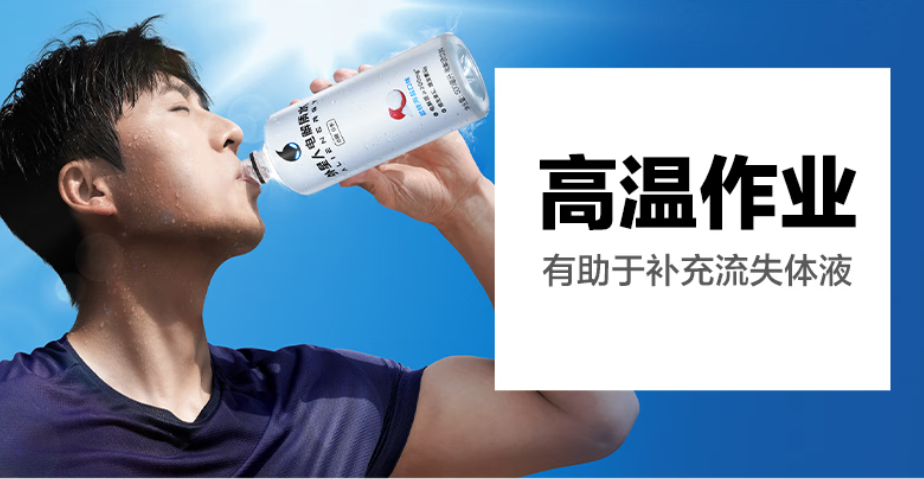
Core Viewpoint - The rising temperatures across China have significantly increased the demand for electrolyte water, making it a hot commodity in the beverage market [1][4]. Group 1: Market Trends - From January to May 2023, the leading brand in the electrolyte water segment, Yuanqi Forest, achieved over 20% growth, capturing nearly 50% of the domestic market share [3][5]. - The sales of electrolyte drinks have consistently shown a year-on-year growth rate exceeding 40% since April 2024, with some months surpassing 60% [4][5]. - The weighted market penetration rate for electrolyte drinks has approached 95%, with numerical penetration rates exceeding 70%, a significant increase from 18.5% two years ago [4]. Group 2: Consumer Behavior - High temperatures have led to increased consumer awareness regarding hydration and health, driving sales of electrolyte drinks, particularly in convenience stores and supermarkets [4][5]. - The demand for electrolyte water is not only driven by heat but also by a growing consumer preference for scientifically formulated hydration solutions [3][6]. Group 3: Product Innovation - Yuanqi Forest's Alien Electrolyte Water features a clean formula with zero sugar and zero calories, developed in collaboration with Beijing Sport University [7][8]. - The product utilizes a scientifically calibrated isotonic formula to enhance absorption speed by 50%, addressing consumer needs for effective hydration [7][8]. - The company has created a four-tier product matrix to cater to diverse hydration scenarios, including options for light exercise and high-intensity activities [9]. Group 4: Scientific Validation - A recent study from Beijing Sport University confirmed the superior hydration efficacy of Alien Electrolyte Water compared to regular water, showing a lesser reduction in plasma volume after exercise [10]. - The study also indicated that even in air-conditioned environments, individuals can experience mild dehydration, highlighting the importance of electrolyte water for maintaining hydration [10]. Group 5: Competitive Landscape - The electrolyte water market has seen over 200 new SKUs launched this year, indicating intensified competition, although leading players like Yuanqi Forest maintain a strong market position [5][6]. - The industry is characterized by a shift towards scientifically-backed formulations, with companies focusing on functional benefits to differentiate their products [11].

冰杯单价是瓶装水的3倍,你的消暑“凉”方被谁赚走了溢价?
3 6 Ke· 2025-07-14 11:21
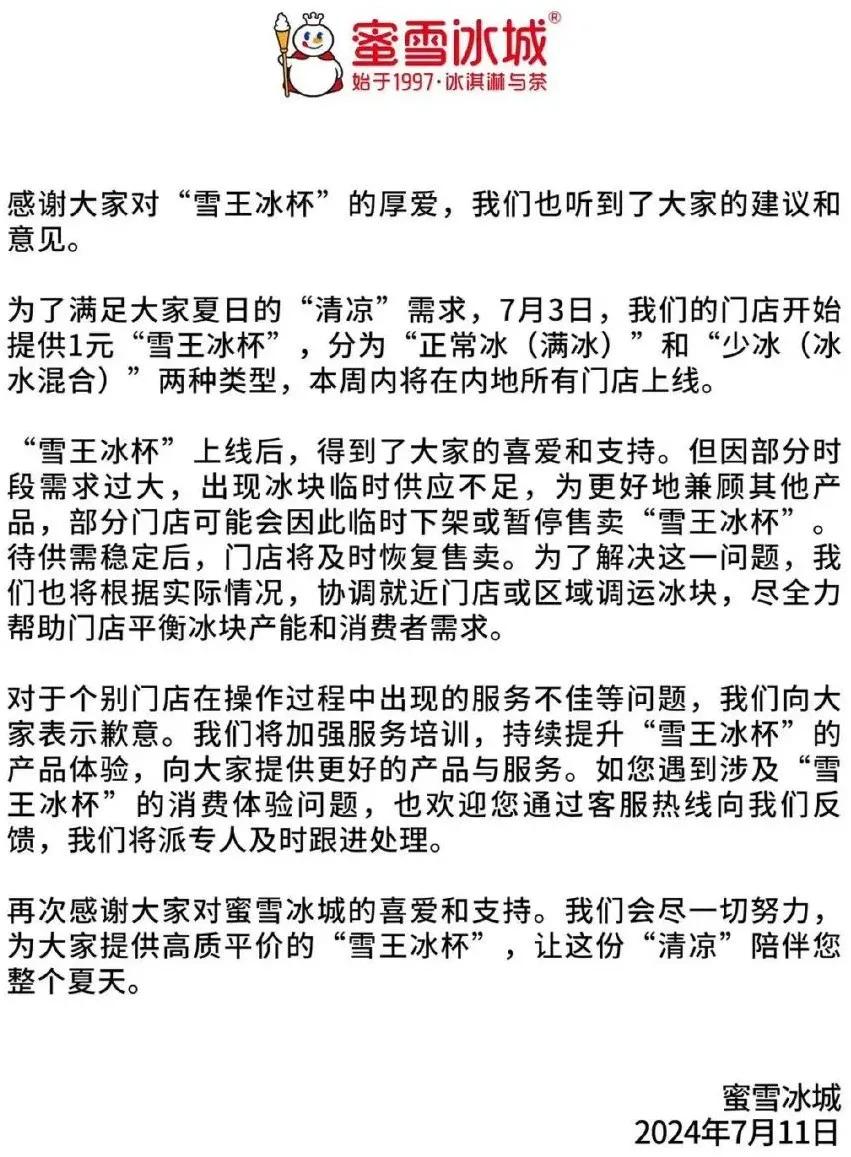
Core Insights - The emergence of the "ice cup" as a phenomenon in 2024, driven by consumer demand for instant cooling solutions during hot weather, has disrupted traditional pricing structures in the beverage market [3][18][26] - The rapid popularity of the "Xue Wang Ice Cup" from Mixue Ice City, priced at 1 yuan, led to supply shortages and negative consumer experiences, prompting the company to issue an apology and implement supply chain improvements [3][4][10] - The ice cup market is characterized by high growth potential, with projections indicating a market size of 6 billion yuan by 2025 and a compound annual growth rate of 7.5% [8][21] Company Insights - Mixue Ice City and other beverage brands are entering the ice cup market, with Mixue's ice cup costing approximately 0.7 yuan to produce, raising questions about profitability at the 1 yuan retail price [18][21] - Companies like Nongfu Spring are leveraging their existing water supply chains to enter the ice market, offering products that highlight superior quality and production methods [11][21] - The ice cup phenomenon has attracted various players, including convenience stores and new tea brands, all aiming to capitalize on the growing consumer interest in ice products [9][23] Industry Trends - The ice cup market is experiencing a shift in consumer behavior, with increasing demand for DIY beverage combinations and instant ice solutions, reflecting a broader trend towards convenience and experiential consumption [6][17][24] - The competitive landscape is intensifying, with brands engaging in price wars and promotional strategies to attract consumers, potentially leading to market saturation and reduced margins [18][22] - The production and supply chain for ice cups involve complex logistics, including specialized ice-making technology and distribution networks, which are critical for maintaining product quality and meeting consumer demand [20][21]


香飘飘: 国浩律师(杭州)事务所关于香飘飘食品股份有限公司注销2023年股票期权激励计划首次授予及预留授予部分股票期权相关事项之法律意见书
Zheng Quan Zhi Xing· 2025-07-14 09:18
国浩律师(杭州)事务所 之法律意见书 浙江省杭州市老复兴路白塔公园 B 区 2 号、15 号国浩律师 楼 邮编:310008 Grandall Building, No.2& No.15, Block B, Baita Park, Old Fuxing Road, Hangzhou, Zhejiang, China 电话/Tel: (+86)(571) 8577 5888 传真/Fax: (+86)(571) 8577 5643 网址/Website: http://www.grandall.com.cn 关 于 香飘飘食品股份有限公司 注销 2023 年股票期权激励计划首次授予及预 留授予部分股票期权相关事项 二〇二五年七月 国浩律师(杭州)事务所 法律意见书 国浩律师(杭州)事务所 关 于 香飘飘食品股份有限公司 注销 2023 年股票期权激励计划首次授予及预留授予部分 股票期权相关事项 之法律意见书 《中华人民共和国证券法》 (以 下简称" 《证券法》" )、《上市公司股权激励管理办法》(以下简称"《管理办法》 ")等有 关法律、法规和规范性文件的规定,按照律师行业公认的业务标准、道德规范和勤勉尽 责精 ...

香飘飘2025半年报看点:即饮稳健增长,冲泡焕新前行
Cai Fu Zai Xian· 2025-07-14 01:51
Core Viewpoint - The company anticipates a revenue of approximately 1.035 billion yuan for the first half of 2025, indicating a slight increase in Q2 revenue but an overall decline in H1 due to Q1 performance [1] Group 1: Business Strategy and Performance - The company focuses on "steady recovery of brewing business" and "accelerated expansion of ready-to-drink business" in 2025, actively promoting various operational measures [1] - The ready-to-drink segment is seen as a second growth curve, with continuous product innovation, including new flavors like "Orange Jasmine" and "Mulberry Jasmine" [1] - The company launched several new products, such as "Meco Grapefruit Kale Juice" and "Meco Cup Fruit Tea," targeting health-conscious young consumers and expanding product application scenarios [1] Group 2: Marketing and Brand Development - The company appointed the "Times Youth League" as the new brand ambassador for Meco Cup Fruit Tea, enhancing its youth-oriented strategy through content marketing [1] - The Meco brand saw a 361% year-on-year increase in sales during the 618 shopping festival, with overall e-commerce sales for the company's products rising by 165% [1] Group 3: Sales and Inventory Management - Despite being in a sales off-season, the company maintained a focus on "sales-driven principles," actively reducing channel inventory to ensure healthy stock levels for the upcoming brewing peak season [2] - The company introduced new products like "Original Leaf Fresh Brew Light Milk Tea," leveraging technology to retain freshness and attract health-conscious young consumers [2] - The brand's 618 sales increased by 111% due to the launch of the co-branded product "New Hui Chen Peel Moonlight White Light Milk Tea," which combines traditional and modern elements [2] Group 4: Future Outlook - Analysts suggest that the company's Q3 performance is expected to improve compared to Q2, driven by the deepening execution of health-oriented and youth-focused strategies, along with the upcoming summer consumption peak [2]
食品饮料业绩反馈&观点更新
2025-07-14 00:36
Summary of Key Points from the Conference Call Industry Overview: Baijiu Market - The baijiu market is currently in a low season, with sales accounting for less than 5% of the annual total, primarily driven by events like graduation banquets [1][3] - There is a slight increase in demand for liquor priced below 300 yuan, with expectations for improved sales in the second half of the year, particularly around the Mid-Autumn Festival and National Day [1][4] - Inventory pressure is evident, but it is expected to ease after October, reducing the risk of stockpiling or unsold goods before the 2026 Spring Festival [1][5] Company Performance: Moutai and Other Leading Brands - Moutai maintains profitability for distributors through a tiered pricing strategy, with wholesale prices for its flagship products ranging from 1,900 to 2,000 yuan, and actual prices exceeding 2,000 yuan [1][6][7] - The overall performance expectation for the baijiu market in Q2 is low, with many companies struggling to sustain growth; however, leading brands like Moutai are still expected to show growth [1][8] - Current valuations for baijiu companies are between 13 to 16 times earnings, which is considered normal; valuations could rise to 15 to 20 times if external risks are mitigated [1][9] Market Dynamics and Future Expectations - The baijiu market is expected to see improved sales in the second half of the year, with a potential recovery in gifting demand during the festive season [1][4] - The overall sentiment in the market is improving, with cash flow pressures on distributors easing, which may lead to better sales performance [1][10] Other Notable Insights - The beer sector is performing well, with Yanjing Beer and Zhujiang Beer reporting net profit growth of 25% to 35% and 15% to 25%, respectively [3][11] - The seasoning industry is stabilizing, with companies like Haitian Flavor Industry expected to achieve mid-single-digit revenue growth and double-digit profit growth [3][24] - The snack food sector is also showing strong growth, with companies like Yanjin and Weilong performing well despite some cost pressures [3][15] Conclusion - The baijiu market is currently facing challenges due to seasonal factors but is expected to recover in the latter half of the year, particularly if gifting demand returns to normal levels. Leading brands like Moutai are positioned to maintain profitability through strategic pricing and product offerings. The overall sentiment in the food and beverage industry remains cautiously optimistic, with several sectors, including beer and snacks, showing robust performance.

东鹏饮料(605499):新品势能充沛,持续兑现高成长
SINOLINK SECURITIES· 2025-07-13 03:22
Investment Rating - The report maintains a "Buy" rating for the company, with expected profits for 2025, 2026, and 2027 projected at 46.1 billion, 58.5 billion, and 73.3 billion RMB respectively, reflecting year-on-year growth rates of 39%, 27%, and 25% [4]. Core Insights - The company is expected to achieve revenue of 106.3-108.4 billion RMB in the first half of 2025, representing a year-on-year increase of 35.0% to 37.7%. The net profit attributable to shareholders is projected to be 23.1-24.5 billion RMB, with a year-on-year growth of 33.5% to 41.6% [2]. - The second quarter of 2025 is anticipated to see revenue of 57.8-59.9 billion RMB, a year-on-year increase of 31.7% to 36.5%, and a net profit of 13.3-14.7 billion RMB, reflecting a year-on-year growth of 24.6% to 37.8% [2]. - The company is focusing on diversifying its product offerings and expanding its market presence, with strong growth expected from its core beverage categories and new product lines [3]. Summary by Sections Revenue and Profit Forecast - The company is projected to achieve significant revenue growth, with estimates of 11.263 billion RMB in 2023, 15.839 billion RMB in 2024, and 21.132 billion RMB in 2025, reflecting growth rates of 32.42%, 40.63%, and 33.42% respectively [7]. - The net profit attributable to shareholders is expected to grow from 2.040 billion RMB in 2023 to 4.612 billion RMB in 2025, with growth rates of 41.60% and 38.62% for the respective years [7]. Profitability Metrics - The report indicates that the net profit margin for the second quarter of 2025 is expected to be 23.8%, a slight decrease of 0.50 percentage points year-on-year, while the non-deductible net profit margin is projected at 22.6%, down 2.04 percentage points year-on-year [3]. - The company is expected to maintain strong profitability due to cost advantages and effective channel management, with a focus on enhancing product visibility and driving sales at the retail level [3]. Market Position and Strategy - The company is actively pursuing a national expansion strategy, leveraging refined channel management to enhance operational capabilities and increase product exposure [3]. - The report highlights the company's commitment to innovation and product diversification, which is expected to unlock new revenue streams and enhance overall market competitiveness [3].

东鹏饮料(605499):25Q2保持高增长 全国化持续推进
Xin Lang Cai Jing· 2025-07-12 10:28
Core Viewpoint - The company expects significant revenue and profit growth for the first half of 2025, driven by national expansion and multi-category product offerings [1][2] Group 1: Financial Performance - For the first half of 2025, the company anticipates revenue between 10.63 billion to 10.84 billion yuan, representing a year-on-year increase of 35.01% to 37.68% [1] - The expected net profit attributable to shareholders is projected to be between 2.31 billion to 2.45 billion yuan, reflecting a year-on-year growth of 33.48% to 41.57% [1] - The forecasted net profit excluding non-recurring items is estimated to be between 2.22 billion to 2.36 billion yuan, indicating a year-on-year increase of 30.06% to 38.26% [1] - For Q2 2025, the company expects revenue between 5.78 billion to 5.99 billion yuan, a year-on-year growth of 31.7% to 36.5% [1] Group 2: Strategic Initiatives - The company is focusing on "sales-driven operational activities" as a core strategy, enhancing channel management and operational capabilities to support national expansion [2] - The company is strengthening its product base with steady growth in its core product, while also developing new growth points through a multi-category approach [2] - A new production base in Hainan is under construction, expected to be completed by 2027, which will support the company's expansion into the Southeast Asian market [2] Group 3: Revenue and Profit Forecast - The company projects revenues of 20.78 billion, 25.38 billion, and 30.07 billion yuan for 2025-2027, with year-on-year growth rates of 31.2%, 22.1%, and 18.5% respectively [2] - The expected net profits attributable to shareholders for the same period are forecasted to be 4.43 billion, 5.42 billion, and 6.49 billion yuan, with year-on-year growth rates of 33.3%, 22.3%, and 19.8% respectively [2]
冲泡业务失势,果汁茶难扛大旗,香飘飘上半年预亏近亿元!
Nan Fang Du Shi Bao· 2025-07-11 13:31
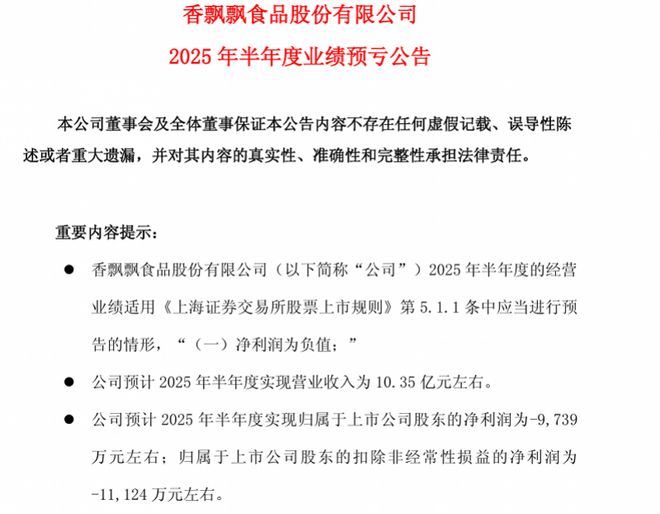
Core Viewpoint - The company Xiangpiaopiao has announced a significant loss in its performance for the first half of 2025, with revenue declining and net profit expected to worsen compared to the previous year [1][3]. Financial Performance - In the first half of 2025, Xiangpiaopiao's revenue is approximately 1.035 billion yuan, a year-on-year decrease of 12.21% [1]. - The expected net loss for the company is around 97.39 million yuan, which represents an increase in loss of approximately 678.9 million yuan compared to the same period last year [1]. - The company's net profit loss has expanded by 230% compared to the same period in 2024, with a further increase in non-recurring net profit loss to 111 million yuan, marking a record high in recent years [1][3]. Reasons for Performance Decline - The decline in performance is attributed to changes in the external consumption environment, consumer habits, and demand, which have pressured traditional brewing products during peak sales seasons [3]. - The timing of the Spring Festival has shifted compared to the previous year, resulting in a shorter peak season and an early transition into the off-peak period for brewing business [3]. - The company has actively reduced channel inventory levels to maintain the interests of distributors and ensure healthy inventory for the upcoming peak season [3]. Strategic Transition - Xiangpiaopiao has initiated a strategic transition, focusing more on the ready-to-drink segment, particularly the Meco juice tea [6]. - The ready-to-drink business saw an 8% revenue increase in 2024, reaching 973 million yuan, with Meco juice tea growing by 20.69% [8]. - However, the growth rate of the ready-to-drink segment has significantly slowed in 2025, failing to offset the decline in brewing products, which has contributed to the company's performance pressure [8]. Market Challenges - The ready-to-drink business has a much lower gross margin compared to brewing products, and the company has not yet established a breakout product in the highly competitive ready-to-drink tea market dominated by major players [8]. - Xiangpiaopiao faces challenges with its channel transformation, as its supermarket and distribution system shows weak growth, with online channels accounting for less than 15% in 2024 [8]. Future Outlook - To alleviate performance pressure, the company has invested 100 million yuan to acquire a 13.29% stake in the Changsha Quanzhong Venture Capital Fund, which focuses on the consumer sector [8]. - However, industry insiders believe that the investment will take a long time to yield results, and the company's expanded losses are fundamentally due to weak growth in its main product category and a lack of new growth engines [8]. - The performance in the second half of 2025 will be crucial, as the recovery of sales during the brewing peak season will determine the company's annual performance baseline [8].
中金研究 | 本周精选:宏观、策略、量化及ESG、食品饮料
中金点睛· 2025-07-11 11:59
Group 1: Macroeconomy - The core of the "Great Beautiful Act" signed by Trump includes significant tax cuts for corporations and individuals, reductions in clean energy subsidies, and cuts to Medicaid and SNAP, which will increase the fiscal deficit in the future [3] - The act is projected to boost the actual GDP by less than 0.5 percentage points and has an inflationary impact of no more than 0.15 percentage points by 2026 [3] - Over the next decade, the combination of tariffs and tax cuts is expected to increase the net deficit by approximately $1.3 trillion, maintaining a deficit rate around 6% [3] - Current economic conditions, including low unemployment and moderate inflation, suggest that the U.S. government debt does not face immediate risks [3] Group 2: Strategy - The passage of the "Great Beautiful Act" is anticipated to increase bond supply, which may lead to higher U.S. Treasury yields, potentially affecting market sentiment and stock prices in the short term [7] - Despite short-term liquidity disturbances, the overall credit cycle recovery and the Federal Reserve's interest rate reduction trajectory remain unchanged, providing better buying opportunities for both U.S. stocks and bonds [7] Group 3: Quantitative & ESG - A real-time forecasting model driven by large language models (LLMs) is proposed to address the lag in macroeconomic indicators, allowing for timely adjustments in investment strategies based on economic changes [11] Group 4: Strategy - A forecast for the mid-year report indicates that A-share earnings growth may slow compared to the first quarter, but the second half of the year could see improved performance, particularly in the non-bank financial sector due to high market activity [14] - In the non-financial sector, midstream and upstream companies may face performance pressures due to price impacts, while sectors like gold, consumer upgrades, and tech hardware are expected to show structural strengths [14] Group 5: Food and Beverage Industry - The food and beverage sector is expected to stabilize in demand in the second half of 2025, driven by government policies aimed at boosting consumption and encouraging births [17] - The mass food segment has shown signs of improvement since March, with new consumption trends in snacks and health drinks likely to drive valuation increases in the sector [17] - The liquor sector is currently in a valuation correction phase, but the basic valuation has reflected pessimistic expectations, indicating emerging investment value [17]