
数字经济

Search documents
新华视点丨逐浪数字经济 激活发展新动能
Xin Hua She· 2025-06-23 08:30
Group 1 - In May, the added value of the digital product manufacturing industry grew by 9.1%, significantly higher than the overall industrial growth rate [2] - The Guizhou Gui'an New Area has transformed from a "blank slate" to a "new engine" for the digital economy, reshaping China's digital economic landscape [2][3] - Gui'an New Area has shifted from "data center economy" to an integrated model of computing power, enhancing productivity and economic growth [2] Group 2 - Gui'an New Area is developing a comprehensive network architecture that supports digital transformation across over 20 industries nationwide [3] - The area focuses on data storage, processing, application services, and supporting industries, leading to a rapid increase in data centers [3] Group 3 - Beijing's robot industry is projected to exceed 30 billion yuan in revenue in 2024, marking a nearly 50% year-on-year growth [6] - The city is becoming a hub for robot technology innovation and high-end industry aggregation, with over 400 core robot enterprises [9] Group 4 - Tianjin is leveraging AI to enhance cultural tourism consumption, exemplified by the "Smart Technology Experience Exhibition" at the Tianjin Library [8][11] - The city plans to develop smart scenic spots and museums, integrating VR and AR applications for immersive experiences [11] Group 5 - The Tianjin Library has introduced AI services to enhance the cultural experience, showcasing the integration of technology, culture, and entertainment [12]

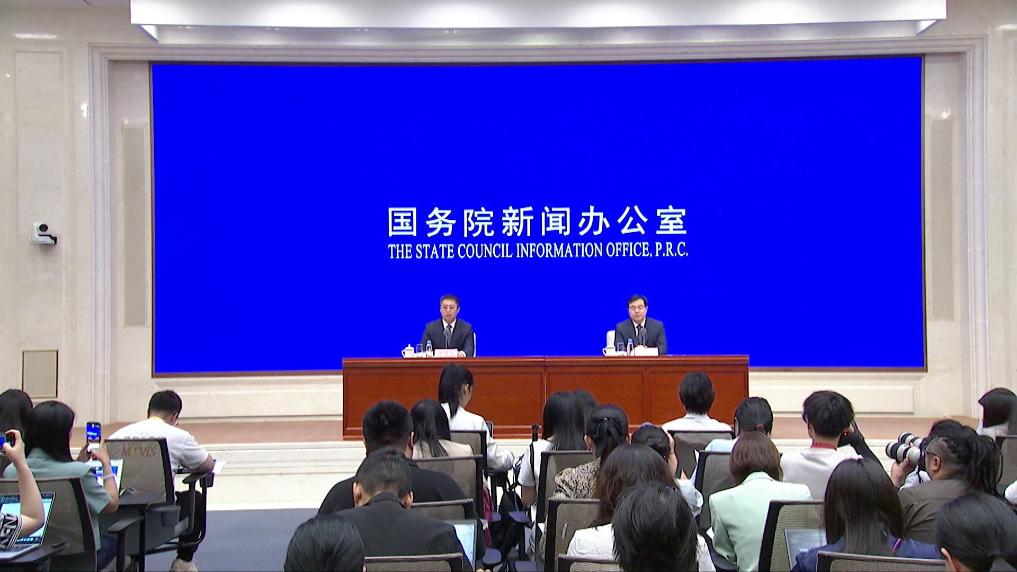
爱高集团对准“数字中国”再落子——政策窗口已开
Jin Tou Wang· 2025-06-23 02:15
Group 1 - The core idea of the news is the strategic direction set by two significant documents: the "Digital China Construction 2025 Action Plan" and the "Opinions on Deepening the Comprehensive Reform Pilot in Shenzhen," which aim to enhance the digital economy and facilitate capital market access for enterprises in the Guangdong-Hong Kong-Macao Greater Bay Area [1][2][9] - The "Digital China Construction 2025 Action Plan" targets that by the end of 2025, the core industries of the digital economy will account for over 10% of GDP, with "Artificial Intelligence+" included in eight major projects [1][5] - The Shenzhen reform document allows companies listed on the Hong Kong Stock Exchange to also list on the Shenzhen Stock Exchange, creating a dual-channel for financing and market access for new economy enterprises [1][9] Group 2 - Aigo Group announced a joint venture with Shenzhen Zhongcheng Digital Technology Group to enter three key sectors: digital equipment leasing, SaaS and cloud services, and digital content and media [2][3] - The digital equipment leasing sector aligns with national policies encouraging equipment recycling and leasing services, which are highly compatible with "dual carbon" assessments [5] - SaaS is identified as the fastest commercial form for the large-scale implementation of AI, as per the action plan [6] Group 3 - The joint venture's announcement led to a significant stock price increase for Aigo, with a 139% rise on the day of the announcement, reflecting market expectations and business upgrades [4] - If Aigo successfully lists on the Shenzhen Stock Exchange, it could achieve a valuation comparison of over 30 times in A-shares, while the current PE in Hong Kong is only 8 times [10] - The intersection of the digital economy and capital markets is opening up for technology transformation enterprises with manufacturing backgrounds, and Aigo's joint venture is seen as a diversification of business leveraging national policies and regional reform benefits [10]
持续激发中国民间投资活力 发改委推介项目超3万亿元
Chang Jiang Shang Bao· 2025-06-23 00:44
Core Viewpoint - The National Development and Reform Commission (NDRC) is actively promoting over 3,200 projects to stimulate private investment, with a total investment exceeding 3 trillion yuan, aiming to enhance the participation of private enterprises in major national projects [1][2]. Group 1: Project Promotion and Investment - The NDRC has introduced a platform to promote projects focusing on key sectors such as transportation, energy, water conservancy, and new infrastructure, facilitating the attraction of private capital [2][3]. - As of June 20, 2023, a total of 11,745 projects have been promoted to private capital, with a total investment amounting to 10.14 trillion yuan [3]. Group 2: Private Investment Growth - From January to May 2023, private investment remained stable, with a year-on-year growth of 5.8% in non-real estate private investment [4]. - The hospitality and catering sector saw a significant increase in private investment by 25.3%, while the cultural, sports, and entertainment sectors grew by 10.0% [4]. Group 3: Regional Initiatives - Various provinces have released investment project lists aimed at attracting private capital, with Hubei planning to introduce 916.7 million yuan across 229 projects, and Shanxi planning 622 million yuan across 60 projects [5]. - Yunnan has established a project database with 382 projects totaling 345.66 billion yuan, covering diverse sectors such as energy, agriculture, and digital economy [5].
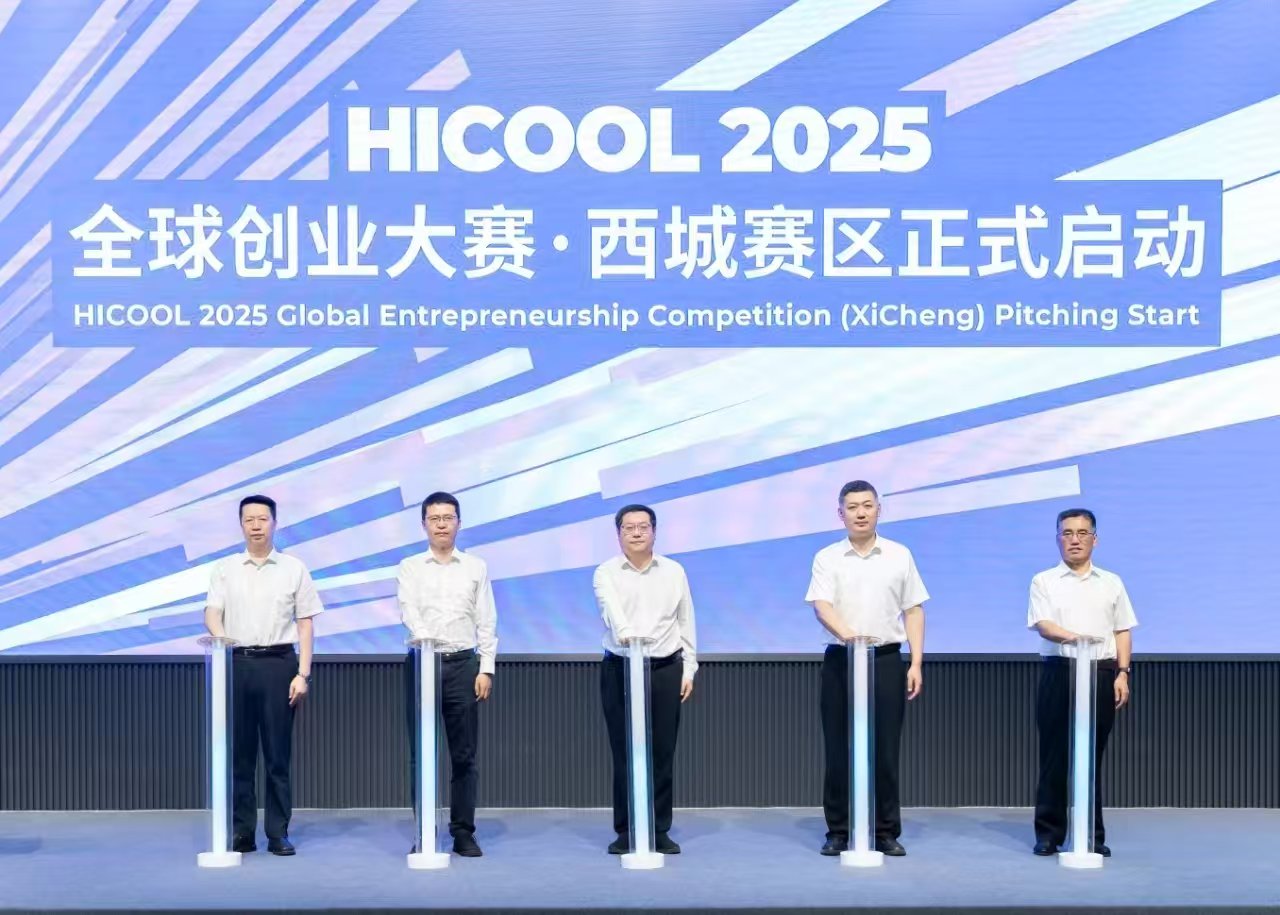
建设国际一流金融科技示范区,HICOOL 2025全球创业大赛西城赛区启幕
Bei Jing Wan Bao· 2025-06-21 02:19
Core Insights - The HICOOL 2025 Global Entrepreneurship Competition aims to establish Beijing's Xicheng District as a globally influential hub for fintech and digital economy innovation [1][3][4] Group 1: Event Overview - The HICOOL 2025 competition was launched on June 20, with participation from various government officials and industry representatives [1] - The event marks a milestone with over 10,000 projects and participants, highlighting increased international engagement and a broader network of young entrepreneurs [4] Group 2: Xicheng District's Strategic Position - Xicheng District serves as a key area for national political, cultural, and technological innovation, leveraging its status as a national financial management center and fintech demonstration zone [3][4] - The district has developed a "4+N" industrial open system focusing on finance, fintech, asset management, and digital economy, facilitating the transformation of technological achievements [3] Group 3: Talent Development Initiatives - The "Xirong Plan" is a core initiative under the district's talent policy framework, aimed at attracting high-level talent in finance, technology, culture, and digital economy [7] - The plan includes an "incentive for talent introduction" mechanism, providing rapid recognition for project leaders who win at national competitions and choose to settle in Xicheng [7] Group 4: Financial Technology Ecosystem - The Zhongguancun Xicheng Park is identified as the core of technological innovation, with a focus on fintech and digital economy, supported by comprehensive industry policies [6] - The Jin Ke New Area, recognized as a national fintech demonstration zone, has attracted 266 key fintech and professional service institutions with a registered capital exceeding 1.4 billion [6] Group 5: International Collaboration - A partnership was established for international certification of fintech professionals, aiming to enhance the standardization and professionalization of talent in the sector [8] - The competition will feature around 150 projects from 41 countries, covering advanced topics such as financial modeling, quantitative trading, and blockchain applications [8]

汉仪股份:拟出资160万元设立控股子公司
news flash· 2025-06-20 12:10
Core Viewpoint - The company, Han Yi Co., Ltd. (301270), plans to establish a new subsidiary, Hangzhou Hanmi Network Technology Co., Ltd., in collaboration with Xianmi Technology, aiming to enhance the recognition of Chinese characters among younger audiences and promote traditional culture through digital economy gaming [1] Investment Details - The board meeting is scheduled for June 20, 2025, to approve the investment proposal [1] - Han Yi Co., Ltd. will contribute 1.6 million yuan in cash, representing 80% of the registered capital, while Xianmi Technology will invest 400,000 yuan, accounting for 20% [1] - The funding for this investment will come from the company's own funds [1] Strategic Objectives - The investment aims to leverage Han Yi Co., Ltd.'s intellectual property (IP) in the digital economy gaming sector [1] - The initiative is focused on increasing the awareness of Chinese character culture among the youth [1]
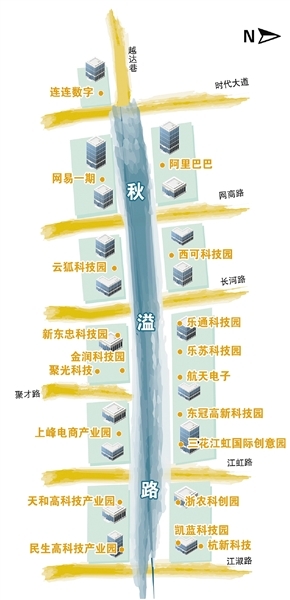
秋溢路, “溢”出场景智变
Hang Zhou Ri Bao· 2025-06-20 02:49
Group 1 - The core idea of the news is the transformative impact of AI technology on various industries, particularly in retail and health sectors, exemplified by the innovations from Shifang Technology [2][6][7] - Shifang Technology's AI electronic scale simplifies the checkout process in supermarkets, saving customers time and the company approximately 60 million yuan annually [2] - The development of AI applications in Hangzhou, particularly on Qiuyi Road, reflects a broader trend of integrating AI into everyday life and business operations, with numerous companies embracing this technology [2][4][5] Group 2 - Qiuyi Road has evolved from a lesser-known route to a hub for digital industry development, housing significant companies like Alibaba and NetEase, and fostering a rich ecosystem for tech innovation [4][5] - Shifang Technology has established the world's first food intelligent computing joint laboratory in collaboration with Beihang University, showcasing its commitment to advancing AI in the food industry [6] - Other companies, such as Baiyi Technology, are also leveraging AI to enhance their operations, particularly in automated sequencing technology, indicating a widespread trend of industries adopting AI solutions [8][9] Group 3 - The AI-driven innovations are not limited to retail; they extend to various sectors, including gaming and public health, with companies like NetEase and Baiyi Technology leading the charge [7][8] - The rapid growth of Shifang Technology, with an annual growth rate exceeding 30% over the past five years, highlights the increasing demand for AI solutions in the food sector [6] - The shift towards AI is driven by market demands, with companies aiming to lower barriers for users and enhance operational efficiency through intelligent solutions [9]
2024年全球外国直接投资下降11%!亚洲仍是全球外资流入主要目的地
第一财经· 2025-06-19 12:18
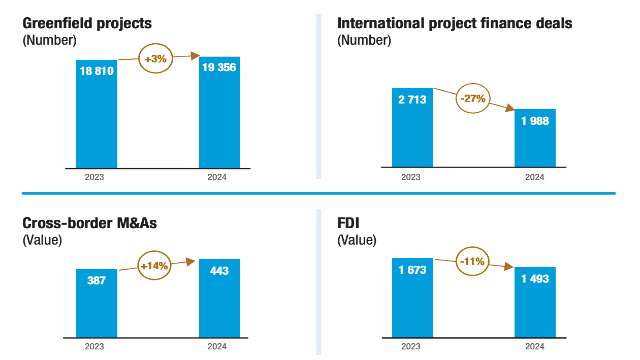
Core Viewpoint - The UNCTAD report indicates a slight increase in global foreign direct investment (FDI) by 4% in 2024, reaching $1.5 trillion, but a significant actual decline of 11% when excluding large financial transactions from certain European economies, marking two consecutive years of double-digit declines [1] Group 1: Global Investment Trends - The report highlights that the global economy is facing complex challenges, including rising debt, sluggish GDP growth, geopolitical tensions, and structural changes in trade and investment flows [1] - Early data for Q1 2025 shows that transaction and project activities have hit historical lows, indicating a pessimistic outlook for international investment [1] Group 2: Regional FDI Insights - Developed economies saw a 22% drop in FDI inflows in 2024, with European FDI plummeting by 58% when excluding financial transaction fluctuations, while North America experienced a 23% increase [5] - Developing economies in Asia remain the primary destination for global FDI, accounting for 40% of total FDI, although the region's FDI inflows decreased by 3% to $605 billion in 2024 [5] - ASEAN countries saw a significant FDI increase of 10%, reaching a record high of $225 billion, while Africa's FDI surged by 75% to $97 billion, driven by a major project in Egypt [5] Group 3: Sectoral Investment Dynamics - Greenfield investment projects in the industrial sector rose by 3% but saw a 5% decline in total value, maintaining a high level of $1.3 trillion [3] - International project financing (IPF) continued to decline, dropping by 26%, influenced by uncertainties in exchange rates and interest rates [3] - Cross-border M&A transactions increased by 14% to $443 billion, yet remained below the average levels of the past decade, indicating a shift towards domestic and nearshore investments due to rising policy risks and regulatory scrutiny [3] Group 4: Digital Economy and Investment - The digital economy is identified as a growth and transformation engine, with investments in this sector growing at an annual rate of 10% to 12%, outpacing global GDP growth [10] - Developing countries attracted $531 billion in greenfield projects in the digital economy from 2020 to 2024, with a concentration of investments in ten economies that accounted for nearly 80% of total investments [8] - Data centers emerged as the primary investment target in developing countries, followed by digital services and ICT infrastructure [8] Group 5: Policy and Regulatory Environment - The global investment policy landscape remains heavily influenced by geopolitical tensions and industrial policy objectives, with 174 new investment policy measures introduced in 2024, 78% of which favor investors [10] - As of the end of 2024, the total number of investor-state dispute settlement (ISDS) cases exceeded 1,400, with a significant portion occurring in the extractive and energy sectors [10]

2024年全球FDI下降11%,联合国机构报告:亚洲仍是全球外资流入主要目的地
Di Yi Cai Jing· 2025-06-19 11:46
Group 1 - In 2024, global Foreign Direct Investment (FDI) is projected to reach $1.5 trillion, reflecting an 11% decline when adjusted for significant financial transaction fluctuations in major European economies [1] - The report indicates that the international investment outlook for 2025 is pessimistic, with trade tensions leading to downward adjustments in most FDI outlook indicators [1][2] - Developed economies saw a 22% drop in FDI inflows in 2024, while North America experienced a 23% increase [4] Group 2 - Asia remains the primary destination for global foreign investment, accounting for 40% of total FDI, although it saw a 3% decline to $605 billion in 2024 [4] - ASEAN countries experienced a significant FDI increase of 10%, reaching a record high of $225 billion [4] - Africa's FDI grew by 75% to $97 billion, driven by a large project in Egypt [4] Group 3 - Greenfield investment projects in the industrial sector increased by 3%, but their total value decreased by 5%, maintaining a high level of $1.3 trillion [2] - International project financing (IPF) declined by 26%, influenced by uncertainties in exchange rates and interest rates [2] - The number of infrastructure projects decreased by 9%, while digital infrastructure projects increased by 4% [4] Group 4 - Renewable energy and critical minerals sectors saw a decline in greenfield project announcements by 12% and nearly 50%, respectively [5] - The semiconductor sector experienced a resurgence with four of the ten largest announced projects, totaling $70 billion in capital expenditure [5] - Investment in health and education sectors grew by approximately 25%, although total investment remained low at under $15 billion [5] Group 5 - Digital economy investments are identified as a key growth and transformation engine, growing at an annual rate of 10% to 12%, outpacing global GDP growth [8] - Over the past decade, major tech companies have increased their share of sales and assets among the largest multinational corporations [6] - From 2020 to 2024, developing countries attracted $531 billion in greenfield projects, with a concentration in ten economies that accounted for nearly 80% of total investments [6]
5月份国民经济运行总体平稳、稳中有进 稳增长政策发力下消费表现亮眼
Qi Huo Ri Bao Wang· 2025-06-16 22:15
Economic Performance Overview - In May, the national economy demonstrated stable growth with industrial added value increasing by 5.8% year-on-year and 0.61% month-on-month, while the cumulative growth from January to May reached 6.3% [1] - Retail sales of consumer goods totaled 41,326 billion yuan in May, marking a 6.4% year-on-year increase, which is 1.3 percentage points higher than the previous month [1] - Fixed asset investment (excluding rural households) amounted to 191,947 billion yuan from January to May, reflecting a 3.7% year-on-year growth, with a notable 7.7% increase when excluding real estate development investment [1] Economic Characteristics - The economy exhibited five key characteristics: stable growth supported by policy measures, steady operation with a decreasing unemployment rate, continuous improvement in domestic demand and production supply, accumulation of new growth drivers in high-end manufacturing and digital economy, and resilience in the face of external challenges [2][3] - The overall economic performance in May was characterized by strong resilience and vitality, with macro policies working in coordination to support stability [3] Price and Real Estate Market - In May, the Consumer Price Index (CPI) showed a slight decline year-on-year, influenced by international factors and falling food prices, while the core CPI's growth rate steadily expanded [4] - The real estate market remained stable, with a narrowing year-on-year decline in housing prices across 70 major cities and a continuous reduction in inventory [4] Consumption and Investment Trends - Consumption growth in May exceeded expectations, driven by policies such as trade-in programs and national subsidies, with retail sales reaching their highest level of the year [6] - Key categories such as home appliances, furniture, and communication equipment saw significant sales increases, indicating the effectiveness of consumption stimulus policies [6] Future Outlook - The economic fundamentals remain strong, with expectations for continued monetary easing and fiscal support for consumption and real estate markets [5][6] - The focus will be on enhancing domestic demand and structural reforms to ensure stable economic growth amid external uncertainties [3]
“十四五”高质量收官在即,如何规划下一个五年|“十四五”规划收官
Di Yi Cai Jing· 2025-06-16 11:51
Core Viewpoint - The "15th Five-Year Plan" will focus on expanding domestic demand and the overall leap in new quality productivity as the main line of development [1][2]. Economic Growth and Development - During the "14th Five-Year Plan" period, China's GDP growth rates were 8.6%, 3.1%, 5.4%, and 5.0%, with a total economic volume reaching 134.9 trillion yuan in 2024, marking a significant scale advantage [3]. - The economic increment during the "14th Five-Year Plan" is expected to exceed 30 trillion yuan, equivalent to recreating an economic entity the size of the Yangtze River Delta [3]. New Quality Productivity - The concept of "new quality productivity" has gained prominence, with significant advancements in high-end equipment and artificial intelligence sectors, contributing to a steady development of new quality productivity [6][7]. - In 2024, the added value of high-tech manufacturing industries is projected to grow by 8.9%, with intelligent consumer equipment manufacturing increasing by 10.9% [6][7]. Reform and Policy Initiatives - The "15th Five-Year Plan" will emphasize comprehensive deepening of reforms, with over 300 important reform measures proposed to enhance the socialist market economy system [8][9]. - The "Private Economy Promotion Law," effective from May 20, marks a significant legal framework for the development of the private sector, reinforcing the commitment to promote sustainable and high-quality growth [9]. Future Planning and Challenges - The planning for the "15th Five-Year Plan" is underway, with a focus on maintaining an average annual economic growth rate of around 5% to achieve long-term strategic goals [12][13]. - The challenges for the "15th Five-Year Plan" include addressing insufficient effective demand and managing risks in sectors like real estate and finance [11][12].