服务业

Search documents
美元地位越来越弱?全球结算占比不足50%,人民币强势抢夺市场
Sou Hu Cai Jing· 2025-09-29 16:17
Group 1 - The recent discussions around Hong Kong brokers checking Chinese accounts and the removal of mandatory foreign exchange settlement are seen as part of a natural economic evolution rather than confrontational actions against the dollar [2][5] - The account checks in Hong Kong are aligned with global capital regulation trends, aiming to distinguish between legitimate investors and those engaging in illegal activities [5][6] - The removal of mandatory foreign exchange settlement reflects a long-term policy shift that allows businesses to manage currency risks based on their needs, rather than a sudden rejection of the dollar [8][24] Group 2 - The value of currency is fundamentally tied to its ability to be exchanged for real productive capacity, rather than being anchored to commodities like gold or oil [10][11] - Historical examples illustrate that an increase in currency supply without a corresponding increase in production leads to inflation and currency devaluation [11][13] - The current global reliance on the dollar is diminishing as other economies, such as Russia, are willing to accept currencies like the yuan for trade, reflecting a shift in production capabilities [15][18] Group 3 - The long-term trend indicates that the yuan is likely to appreciate gradually due to China's significant manufacturing capacity, which surpasses that of the US, Japan, and Germany combined [20][22] - The gradual appreciation of the yuan is intended to protect export-oriented businesses from sudden cost increases, allowing them to transition towards higher quality and brand-focused strategies [22][24] - Despite the yuan's current small share in global trade settlements, its usage is steadily increasing, particularly in trade with ASEAN and Russia, indicating a gradual expansion rather than a complete replacement of the dollar [24][26]


"昂贵"就是新标准?华尔街开始接受股市估值"新常态"
Hua Er Jie Jian Wen· 2025-09-29 13:29
Core Viewpoint - The article discusses the shifting perception of stock market valuations, suggesting that high valuations should be viewed as a "new normal" rather than a temporary anomaly, driven by structural changes in the economy and market dynamics [1][2]. Group 1: Structural Changes in Valuation - The S&P 500 index's rolling average price-to-earnings (P/E) ratio has increased from approximately 14 times in the early 1990s to about 19.5 times today, indicating a significant upward shift in valuation norms [2]. - The frequency of economic recessions in the U.S. has decreased from about 42% historically to around 10% in the past 30 years, contributing to a more stable economic environment that supports higher valuations [2]. - The U.S. economy has transitioned from an industrial base to one dominated by technology and services, which tends to favor growth stocks that can sustain higher valuations [2]. Group 2: Support for High Valuations - Analysts from Bank of America argue that the intrinsic characteristics of current S&P 500 constituents, such as lower financial leverage and more stable profit margins, justify the elevated valuation multiples [3]. - The current index composition shows significant changes compared to the 1980s, 1990s, and early 2000s, suggesting that today's valuation multiples should be considered as a new benchmark rather than reverting to historical averages [3]. Group 3: Diverging Opinions on Valuation Trends - Some analysts, like Jonathan Golub from Seaport Research Partners, propose a more cautious view, suggesting that the market is not in a state of continuous upward valuation drift but rather "re-anchoring" at a higher level [4]. - Golub notes that high interest rates in the 1970s and 1980s contributed to lower valuations, and if borrowing costs were to rise significantly again, valuations could revert to historical averages, although he currently sees no such risk [4].
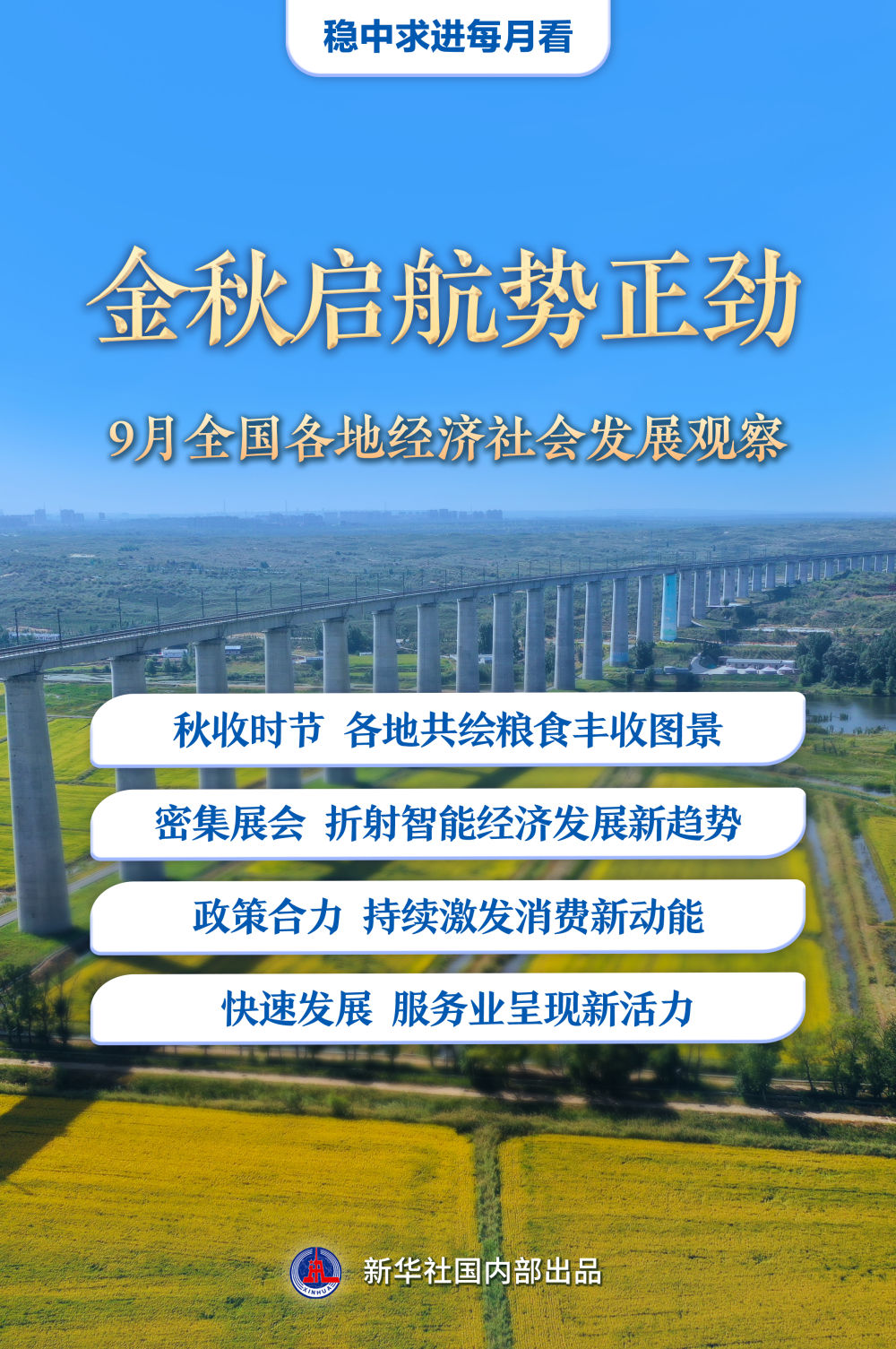
稳中求进每月看|金秋启航势正劲——9月全国各地经济社会发展观察
Xin Hua She· 2025-09-29 13:19
Group 1: Agricultural Production - The autumn harvest season is crucial, with various regions working together to ensure a bountiful grain harvest, supported by advanced agricultural technologies like IoT and AI [6][10] - National summer grain production reached 2,994.8 million jin, indicating stable yields, while autumn grain acreage is increasing, laying a solid foundation for a good harvest [10][11] - Local governments are implementing measures to enhance grain quality and yield, such as introducing good seeds and improving agricultural practices [10] Group 2: Intelligent Economy Development - Recent exhibitions, including the World Intelligent Industry Expo, showcase the rapid development of China's AI industry, with over 5,000 AI companies now operating [15][16] - The integration of AI technologies into various sectors is accelerating, with applications in smart vehicles, healthcare, and digital trade [15][16] - The AI industry is transitioning into a new phase characterized by technological breakthroughs and ecosystem development, driving significant industrial changes [16] Group 3: Consumer Policy Initiatives - New fiscal policies, such as personal consumption loan interest subsidies, are being implemented to stimulate consumer spending and support businesses [17][20] - Various local governments are launching initiatives to promote consumption, including subsidies for vehicle trade-ins and restaurant vouchers [20] - These policies aim to enhance consumer confidence and drive economic growth, highlighting the importance of consumption as a key economic engine [20] Group 4: Service Industry Growth - The service industry in China is entering a new phase of high-quality development, with the 2025 China Service Industry Enterprises Top 500 report indicating a total revenue of 51.1 trillion yuan [22][24] - New business models and service sectors are emerging, contributing to the transformation and upgrading of the economy [24][25] - Local governments are actively supporting the development of the service industry through various policies, enhancing service quality and expanding service offerings [24][25]
新政策工具,定了!规模5000亿元
21世纪经济报道· 2025-09-29 12:35
Core Viewpoint - The recent economic indicators show a marginal weakening in China's economic performance, with industrial value-added growth at 5.2%, service production index growth at 5.6%, retail sales growth at 3.4%, and export growth at 4.8% in August, indicating certain downward pressure on the economy [1][3][4]. Group 1: Economic Performance - In August, the value-added of major industrial enterprises turned from a decline of 1.7% in the first seven months to a growth of 0.9% in the first eight months, with a significant monthly increase of 20.4% in August compared to a decline of 1.5% in July [3][4]. - The manufacturing and service sectors showed stable growth, with the value-added of equipment manufacturing and high-tech manufacturing increasing by 8.1% and 9.3% respectively, outpacing the overall industrial growth rate [3][4]. - The retail sales of new energy vehicles increased by over 20% year-on-year in the first eight months, reflecting strong consumer demand [4]. Group 2: Investment and Policy Measures - A new policy financial tool worth 500 billion yuan is set to support project capital requirements, focusing on emerging industries and infrastructure, including digital economy, artificial intelligence, and green low-carbon projects [5][6]. - The new financial tool is designed to enhance effective investment and is expected to play a crucial role in stabilizing investment by providing capital for key projects [6]. - The National Development and Reform Commission (NDRC) is actively promoting the implementation of these financial tools to ensure timely project initiation and increase physical workload [5][6].

万业企业:9月29日召开董事会会议
Mei Ri Jing Ji Xin Wen· 2025-09-29 09:22
每经头条(nbdtoutiao)——农夫大战怡宝,抢到更多蛋糕的却是宗馥莉!农夫绿瓶上市后,怡宝上 演"滑铁卢":市占率大跌近5个百分点 每经AI快讯,万业企业(SH 600641,收盘价:20元)9月29日晚间发布公告称,公司第十二届董事会 临时会议于2025年9月29日以通讯方式召开。会议审议了《关于调整公司第十二届董事会专门委员会委 员的议案》等文件。 2024年1至12月份,万业企业的营业收入构成为:房地产业占比48.34%,制造业占比41.44%,服务业占 比8.72%,其他业务占比1.49%。 截至发稿,万业企业市值为186亿元。 (记者 王晓波) ...

5000亿元!国家发改委:全部用于补充项目资本金
Zheng Quan Shi Bao· 2025-09-29 09:04
Core Viewpoint - The National Development and Reform Commission (NDRC) emphasizes the need for macroeconomic policy adjustments to address ongoing challenges in economic operations, while highlighting the resilience and growth in key sectors like manufacturing and services [2]. Group 1: Economic Performance - In August, China's economic operation remained generally stable, supported by continuous macro policy efforts [2] - Manufacturing and service sectors showed positive growth trends, with retail sales related to trade-in programs maintaining rapid growth [2] - Despite these positive indicators, the economy still faces significant risks and challenges, particularly from a complex external environment [2] Group 2: Policy Implementation - The NDRC plans to strengthen economic monitoring, forecasting, and early warning systems, and will prepare policies for timely implementation based on changing circumstances [2] - The NDRC will work with relevant departments to create a conducive policy environment for the application and popularization of new-generation smart terminals and intelligent systems [3] Group 3: Support for Private Enterprises - Private enterprises are identified as key players in the "Artificial Intelligence +" initiative, with 254,000 new AI software development firms established in Q1 of this year [4] - The NDRC aims to support various enterprises, including private ones, in deepening their participation in the AI sector through policy and financial measures [4] Group 4: Financial Tools - The NDRC is advancing new policy financial tools totaling 500 billion yuan, all designated for supplementing project capital [5] - Efforts are being made to ensure that these financial tools are quickly allocated to specific projects to promote stable and healthy economic development [5]
赚钱越来越难?
Hu Xiu· 2025-09-29 06:58
Core Insights - The article discusses the transition from an "incremental market" to a "stock market," highlighting the challenges faced by individuals in earning money as traditional wealth-generating sectors slow down [1][4][64] - It emphasizes the need for a paradigm shift in thinking and strategies to adapt to the new economic landscape driven by information and connectivity rather than physical assets [6][68] Group 1: Economic Transition - The past two decades favored bold individuals who could capitalize on booming sectors like real estate, internet, and foreign trade, but these opportunities are diminishing [1][4] - The shift from an "incremental market" to a "stock market" has led to structural unemployment and a realization that effort alone may not yield success in a changing environment [4][6] Group 2: New Economic Paradigm - The article contrasts the "arrangement of atoms" economy, which relies on physical assets and linear growth, with the emerging "arrangement of bits" economy, which is driven by information and exponential growth [18][20][41] - In the new economy, value is derived from sharing and connectivity rather than scarcity, fundamentally altering traditional business models [21][22][44] Group 3: Challenges and Opportunities - The conflict between old and new paradigms creates a sense of anxiety, as many individuals struggle to adapt their skills and strategies to the new economic realities [29][39] - The rise of AI is expected to further disrupt traditional roles, automating tasks previously performed by knowledge workers and intensifying competition [48][50] Group 4: Strategic Shifts - Companies and individuals are encouraged to abandon outdated metrics like GDP and focus on new value systems that reflect the realities of the information economy [56][58] - Emphasizing the importance of network capital, the article suggests that creating value within networks is crucial for success in the new landscape [59][60]
2025四季度宏观策略报告-20250929
Guang Da Qi Huo· 2025-09-29 06:06
1. Report Industry Investment Rating No relevant content provided. 2. Core Viewpoints of the Report - The stabilization and recovery of fixed - asset investment growth require the central government to increase fiscal leverage, as real - estate storage and infrastructure funds face challenges [2][8]. - China is undergoing an economic re - balance from investment to consumption. The government's assessment method may shift from GDP to increasing the proportion of consumption in GDP. Future policies may reform the social security system to release consumption potential [2][25]. - A moderate recovery of inflation is a prerequisite for releasing consumption potential. Inflation recovery will drive corporate profit improvement, increase residents' income, and then achieve consumption recovery. Future inflation is expected to stabilize and rebound [2][52]. 3. Summary According to the Table of Contents 3.1 Investment: Central Fiscal Leverage Expected to Increase - **Real - estate**: The downward inertia is large, policy support is gradually increasing, but demand - side stimulus policies have under - performed expectations. The progress of real - estate storage is accelerating, and central fiscal funds are crucial for breaking the "impossible triangle" among storage parties, sellers, and commercial banks [9][10][11]. - **Infrastructure**: The growth rate of infrastructure investment is declining. As of September 14, the proportion of new special bonds invested in land reserves is 14.3%. If the scale of land - reserve special bonds continues to increase this year, the funds for traditional infrastructure may be less than in 2024. The infrastructure investment structure will continue to be divided, with central - government - led projects stronger and local - government - led projects weaker. The estimated overall infrastructure growth rate in 2025 is about 2.6% [14][18][20]. - **Manufacturing**: "Anti - involution" in emerging industries mainly restricts capital expenditure and capacity expansion, leading to a slowdown in manufacturing investment growth [22]. 3.2 Consumption: Structural Reform of Economic Re - balance - **Policy Support**: A series of consumption - related policies have been introduced, including measures to expand service consumption, financial support for consumption, and special action plans to boost consumption. These policies address both the supply and demand sides of consumption [25]. - **Problems in Consumption**: China's consumption rate is relatively low, mainly due to low household consumption rates. Factors include income polarization, large urban - rural income gaps, an imperfect social security system, and a low proportion of service consumption [28][33][37]. - **Solutions**: The "Boosting Consumption Special Action" addresses key consumption issues from multiple aspects such as income increase, consumption capacity support, service supply improvement, and policy support. Future consumption policies may focus more on service consumption [41][42][50]. 3.3 Inflation: An Important Tool to Stabilize Expectations and Promote Consumption - **Relationship with Consumption**: A moderate recovery of inflation is necessary for releasing consumption potential. Inflation recovery drives corporate profit improvement, increases residents' income, and promotes consumption recovery [52]. - **CPI Differentiation**: There are two significant differentiations in CPI. The core CPI and CPI are diverging, and service consumption and commodity consumption within the core CPI are also diverging. Future consumption policies may shift towards service consumption [55]. - **Inflation Outlook**: Considering the central bank's stance and the expected increase in "anti - involution" policies, future inflation will stabilize and rebound. Although inflation is in a state of "weak reality and strong expectation" in the second half of the year, the data recovery may occur in the first half of next year [58].
海外宏观周报:美国政府关门风险上升-20250929
Ping An Securities· 2025-09-29 02:36
Group 1: U.S. Economic Policy - The risk of a U.S. government shutdown is increasing, with Trump canceling a meeting with Democratic leaders and the House planning to reconvene only on October 1[1] - The U.S. has confirmed a 15% tariff on EU cars and parts starting August 1, and new tariffs on various imports, including 50% on kitchen cabinets and 100% on patented drugs, effective October 1[1] - The U.S. second-quarter GDP growth was revised up to an annualized rate of 3.8%, significantly higher than the previous estimate of 3.3%[1] - Initial jobless claims fell by 14,000 to 218,000, the lowest level since mid-July, and well below the market expectation of 235,000[1] Group 2: Global Economic Indicators - Eurozone's September manufacturing PMI fell to 49.5, below the neutral mark, while services PMI rose to 51.4, exceeding expectations[1] - Japan's Tokyo core CPI rose by 2.5% year-on-year in September, indicating stable inflation pressure[5] - The CME FedWatch data shows an 87.7% probability of a 25 basis point rate cut in October, with an average expected policy rate of 3.59% by the end of 2025[1] Group 3: Market Reactions - Global stock market optimism has decreased, with precious metal prices rising due to the increased risk of a U.S. government shutdown[10] - The S&P 500 index fell by 0.3%, while the Dow Jones and Nasdaq dropped by 0.1% and 0.7%, respectively[12] - The dollar index rose by 0.55%, closing at 98.19, while major non-U.S. currencies declined against the dollar[19]
广东不必学江苏经济模式,也难以复制|微观视界
Jing Ji Guan Cha Wang· 2025-09-28 01:13
Economic Overview - In 2024, Guangdong's GDP reached 14.16 trillion yuan, while Jiangsu's GDP was 13.7 trillion yuan, narrowing the gap to 462.6 billion yuan. Jiangsu's real growth rate of 5.8% significantly outpaced Guangdong's 3.5% [2] - By the first half of 2025, Jiangsu's GDP was 669.68 billion yuan, and Guangdong's was 687.25 billion yuan, further reducing the economic gap to 175.76 billion yuan, the smallest in nearly six years [2] Infrastructure Investment - Since 2019, Jiangsu has shown a clear upward trend in infrastructure investment growth, while Guangdong's investment has been declining. In 2024, Jiangsu's infrastructure investment growth was 13.3%, compared to Guangdong's mere 0.2% [2][3] - Jiangsu's county-level state-owned enterprises (SOEs) have significantly larger financing scales compared to Guangdong, with Jiangsu's county SOEs financing 8.54 trillion yuan through 481 enterprises, while Guangdong's 49 enterprises financed only 1.54 trillion yuan [3] Development Models - Jiangsu's development model is characterized by "government-led, park-driven, and debt-supported," while Guangdong's model emphasizes "market-led, private enterprise-driven, and global layout" [5] - Jiangsu's unique fiscal system allows county-level governments significant financial autonomy, enabling them to mobilize resources effectively, unlike Guangdong, where only a few cities have similar fiscal arrangements [5][8] Financing Mechanisms - Jiangsu has a special financial support mechanism for county-level investment companies, allowing them to obtain funds at costs below 3%, creating a sustainable funding loop for infrastructure projects [6] - In contrast, Guangdong's financing relies heavily on government special bonds, raising concerns about its future economic sustainability [3][6] Cultural and Risk Factors - The cultural differences between Jiangsu and Guangdong affect their economic governance, with Jiangsu's model being more reliant on government intervention, while Guangdong's market-oriented approach fosters greater entrepreneurial spirit [9][10] - Guangdong's historical financial issues have led to a more cautious approach to debt, limiting its ability to replicate Jiangsu's high-leverage investment strategies [10][19] Consumer Market Potential - Guangdong's large domestic market, with a retail sales total of 4.79 trillion yuan in 2024, provides significant opportunities for industrial development, emphasizing the importance of building a consumer market [11][12] - The province's manufacturing sector is diverse, with a complete industrial chain, making it well-positioned to transition from "Made in Guangdong" to "Brand from Guangdong" [11][14] Internationalization and Reform - Guangdong needs to enhance its internationalization efforts, drawing lessons from Japan's overseas investment strategies to support its manufacturing sector [15][17] - The province should explore institutional reforms to enhance its role as a "co-legislator" in national policy-making, particularly in areas like cross-border finance and professional services [18][19]