
饮料

Search documents
7707亿元!上市公司也爱买理财
Shen Zhen Shang Bao· 2025-12-16 16:48
Core Insights - A total of 1,094 A-share listed companies have subscribed to financial products this year, with a cumulative investment amount of 770.72 billion yuan [1][2] - In December alone, 138 companies announced the use of idle funds for financial product purchases, totaling 15.61 billion yuan [1] Group 1: Company Actions - Dongpeng Beverage announced an investment of 1.252 billion yuan in financial products through six institutions, aiming to enhance fund efficiency and ensure safety [1] - Hisense Home Appliances reported a total investment of 1.76 billion yuan in financial products through its subsidiaries [2] - Wangfujing disclosed an investment of 850 million yuan in structured deposits and large-denomination certificates of deposit [2] Group 2: Investment Preferences - Companies primarily invest in structured deposits, large-denomination certificates of deposit, bank wealth management, and securities company products, focusing on low-risk and high-liquidity options [2] - Structured deposits are the most favored investment product among listed companies [2] Group 3: Analyst Recommendations - Analysts suggest that investors should rationally assess the nature and scale of the funds used by companies for financial management, particularly distinguishing between short-term idle funds and long-term investments [2]


晨会聚焦:食饮、农业、传媒年度策略-20251216
ZHONGTAI SECURITIES· 2025-12-16 15:37
Group 1: Media and Internet Industry Strategy - The core viewpoint emphasizes the dual driving forces of AI and IP in the media sector, suggesting a focus on AI applications in various fields such as AI comics, games, marketing, education, and publishing [4][5] - AI comics are expected to enhance production efficiency by over 300% while reducing costs by more than 90%, supported by favorable platform policies [4] - The investment value of the IP industry is highlighted, with a shift from functional satisfaction to emotional resonance in consumer markets, indicating strong demand for domestic cultural products [5] Group 2: Beverage Industry Strategy - The energy drink market in China is projected to reach 62.785 billion yuan in 2025, with a year-on-year growth of 4.3%, driven by stable demand and competitive pricing strategies [14] - The industry is experiencing a shift towards health-oriented products, with 67.87% of consumers expressing a need for reduced sugar intake, prompting companies to innovate with sugar-free options [16] - The main raw materials, taurine and white sugar, are expected to maintain low prices due to oversupply and changing consumption patterns [15][16] Group 3: Agriculture and Fisheries Industry Strategy - The agricultural sector is facing challenges due to declining demand and efficiency improvements, with a lack of price imagination leading to a prolonged period of low prices [17] - The report suggests that the demand for agricultural products will gradually increase due to rising disposable incomes and government initiatives aimed at boosting consumption [18] - The pet industry is transitioning from high-speed growth to high-quality development, with increased competition and a focus on companies that excel in R&D and supply chain management [18]
达能中国饮料全国销售总监或将变更
Xi Niu Cai Jing· 2025-12-16 14:28
Group 1 - The core point of the article highlights recent personnel changes within Danone China, specifically the promotion of Zhou Zhigang to head the specialized nutrition business and the potential appointment of Huang Jin from Mars as the new national sales director for the beverage business [1][2] - During Yu Fuyang's tenure as the sales director for Danone's beverage division, the business experienced stable growth, with sales figures indicating a revenue of €764 million (approximately 5.82 billion yuan) in 2024, reflecting a year-on-year increase of 12.2% [1] - For the first three quarters of 2025, Danone's beverage business in China, North Asia, and Oceania reported sales of €696 million (approximately 5.76 billion yuan), marking a year-on-year growth of 6.9%, with the third quarter alone generating €251 million (approximately 2.08 billion yuan), up by 5.6% [1]


康师傅饮品:从“读懂”到“共创”,以多维创新持续领跑年轻市场
Sou Hu Wang· 2025-12-16 10:28
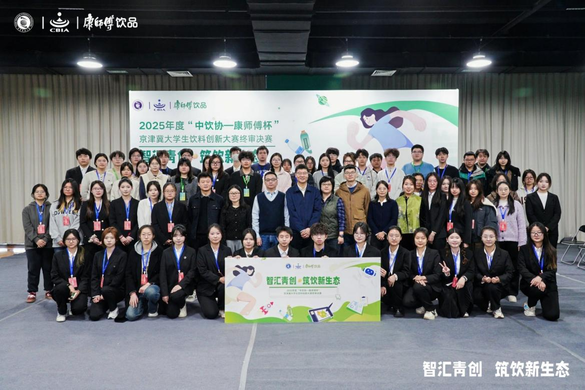
Core Viewpoint - The "2025 China Beverage Industry Association-Kangshifu Cup" college student beverage innovation competition serves as a platform for deep collaboration between Kangshifu and young people, reflecting the company's commitment to empowering the younger generation and aligning with their growth aspirations [1][3][8]. Group 1: Event Overview - The competition was officially launched on June 23, 2025, at Tianjin University of Science and Technology and concluded with the final round on December 11, 2025, focusing on the theme "Intelligent Innovation for a New Beverage Ecosystem" [5]. - The event targets three major trends in the beverage industry: green supply chain, health upgrades, and digital integration, bringing together multidisciplinary youth from the Beijing-Tianjin-Hebei region [5][6]. - The competition has evolved since its inception in 2013, now featuring a comprehensive innovation model that includes research, design, and marketing, thus enhancing the connection between young innovators and industry practices [8]. Group 2: Brand Engagement with Youth - Kangshifu emphasizes not just understanding but also empowering young people, creating a collaborative environment that allows their innovative ideas to flourish [3][6]. - The brand captures the emotional landscape of the younger generation, aligning its marketing strategies with their lifestyle and aspirations, as seen in campaigns like the "Painful Taste, Irreplaceable" for its iced tea products [9][15]. - The company has successfully integrated its products into popular culture, leveraging collaborations with media and events to resonate with the youth demographic [15][17]. Group 3: Product Innovation and Market Strategy - Kangshifu is advancing its product offerings by focusing on health and sustainability, introducing items like "Jasmine Longjing" and "Fresh Green Tea" that cater to the health-conscious consumer [19][21]. - The brand is also enhancing its premium product line, such as the "Tea Inheritor" series, which combines high-quality ingredients with sustainable practices, appealing to the younger generation's desire for responsible consumption [21][23]. - The company has implemented sustainable practices in its production and packaging processes, such as using lightweight bottles and automated factories, which align with the environmental values of young consumers [23][24]. Group 4: Future Outlook - Kangshifu's ongoing commitment to understanding and meeting the evolving needs of young consumers positions it as a leading brand in the beverage industry, capable of defining future trends [24].

巴西ETF逆势上涨,跨境ETF迎来快速发展期,规模已逼近万亿元大关
Ge Long Hui· 2025-12-16 04:46
Group 1: Brazilian ETF Performance - Brazilian ETFs are rising against the market trend, tracking the IBOVESPA ETF index, which includes around 80 representative companies from Brazil's mining, agriculture, finance, and energy sectors [1] - The current price-to-earnings ratio of the IBOVESPA index is 10.51, positioned at the 43.46th percentile over the past decade, while the dividend yield stands at 7%, at the 73.31st percentile [1] Group 2: Cross-Border ETF Growth - The cross-border ETF market is experiencing rapid growth, with the total number of ETFs reaching 200 and a combined scale of 927.857 billion, indicating strong expansion momentum [2] - Global liquidity easing expectations have led to robust performance in risk assets, attracting more investors to participate in global markets through cross-border ETFs [2] Group 3: Investment Considerations for Cross-Border ETFs - Key factors for investing in cross-border ETFs include the tracking index, liquidity, and premium rate, which significantly influence long-term investment returns [3] - The largest cross-border ETF, the Hong Kong Internet ETF, has a concentrated holding structure, which increases its elasticity [3] - Liquidity is crucial, as insufficient liquidity can lead to price distortions and significant price impacts when large funds enter or exit [3]
食品饮料2026年度策略:大年起点,持旧迎新
2025-12-16 03:26
Summary of the Food and Beverage Industry Conference Call Industry Overview - The food and beverage industry is entering a pivotal year in 2026, characterized as a "starting point for a big year" with expectations for absolute returns across the sector [2][3] - The industry has seen a decline in valuations to reasonable levels, with performance being the core issue [3] Key Insights and Arguments - **Consumer Demand Trends**: Anticipated L-shaped recovery in consumer demand driven by the repair of household balance sheets and economic structural transformation [3] - **Traditional vs. New Consumption**: Both traditional and new consumption are expected to coexist, with traditional consumption showing signs of bottoming out and potential recovery [2][8] - **Investment Recommendations**: - Prioritize investments in frozen food companies, followed by the liquor sector [5] - Companies like Anjuke, Qianqianwei, and Sanquan in the frozen food sector are expected to optimize competition through B-end transformations [5] - High market share beer companies such as Yanjing and Zhujiang are seen as having good growth potential [5] New Consumption Opportunities - The new consumption sector is expected to benefit from structural dividends, with significant growth potential for companies like New Dairy and Yanjing Zhujiang [4][10] - New channels and product categories are anticipated to drive performance growth in beverages and snacks, even in the current economic environment [6][12] Liquor Industry Insights - The liquor sector, characterized by strong commercial barriers and high inventory accumulation, is expected to see improvements in Q1 2026 as inventory levels decrease [7] - The stability of liquor prices or an L-shaped trend is viewed as an attractive investment opportunity, with companies like Wuliangye, Yanghe, and Moutai being highlighted as good choices [7][9] Market Characteristics and Future Outlook - The future consumer market in China is expected to exhibit three main characteristics: large market size, high innovation in channels and categories, and a trend towards international expansion to address supply-demand imbalances [11] - Structural dividends are anticipated to arise from new channels, new product categories, and new markets [11] Specific Investment Targets - In the snack sector, companies with strong channel adjustment and category expansion capabilities, such as Weilong and Yanjin, are recommended [12] - In the beverage sector, functional drinks and sugar-free tea segments are highlighted, with companies like Dongpeng and Nongfu Spring expected to maintain leading growth [12] Strategic Recommendations - The investment strategy for 2026 emphasizes that the food and beverage sector is likely to rise, with a focus on performance recovery, particularly in the liquor sector [13] - The strategy includes holding traditional consumption while embracing new consumption, indicating a balanced approach to investment [14]
中泰证券:健康化与场景细分引领能量饮料新增长 重点推荐东鹏饮料
Zhi Tong Cai Jing· 2025-12-16 01:51
Core Insights - The energy drink industry is shifting from a rigid demand for energy replenishment to a focus on health and scenario segmentation, with Dongpeng Beverage positioning itself as a leading brand by launching sugar-free products to meet core consumer needs [1] Group 1: Industry Development - By 2025, the Chinese energy drink market is expected to reach a scale of 62.785 billion yuan, with a year-on-year growth of 4.3%, and a sales volume of 4.1899 million kiloliters, reflecting a stable growth trend [1] - Dongpeng Beverage holds a market share of 39.87% in the first half of 2025, leading the industry amid intensified competition and ongoing low-price promotions [1] - The average price in the industry is projected to decrease by 1.89% year-on-year to 14.98 yuan per liter, with Dongpeng's strategy focusing on low pricing and large packaging [1] Group 2: Underlying Logic of Industry Development - Domestic demand for energy drinks is driven by social competition and the need for energy replenishment, with significant consumption among "new blue-collar" workers, white-collar professionals, and students [2] - In the overseas market, the energy drink industry is transitioning from a focus on basic functionality to health-oriented, differentiated functions, and diverse flavors, as evidenced by the rise of Celsius in the U.S. market [2] Group 3: Main Raw Materials - Taurine prices are expected to remain low due to oversupply, with the beverage industry being the largest application market, accounting for 45% of global taurine consumption [3] - Sugar prices are also projected to stay relatively low, with a total sugar production of 11.7 million tons in China for the 2025/26 season, indicating a shift from inventory reduction to accumulation [3] Group 4: Development Trends - Health has become a core product trend, with 67.87% of consumers expressing a need to control sugar intake, prompting Dongpeng to launch a sugar-free energy drink by 2025 [4] - Consumption scenarios are evolving from high-intensity physical exertion to more frequent, lighter cognitive demands, with Dongpeng's sugar-free version targeting brain fatigue relief [4]

《椰子水》团体标准发布,非复原椰子水可标示“NFC”
Bei Jing Shang Bao· 2025-12-15 14:07
Core Viewpoint - The newly released group standard for coconut water aims to establish clear, scientific, and unified regulations for the coconut water category, guiding companies in production and helping consumers make informed choices, thereby promoting healthy and sustainable industry development [1] Group 1: Definition and Standards - The new standard defines "coconut water" as a product made solely from coconut fruit through physical processing or reconstituted from concentrated juice, distinguishing it from coconut-flavored beverages that contain added sugars, flavors, or colorings [1] - The standard mandates that pre-packaged product labels must comply with relevant national standards, requiring reconstituted coconut water to be labeled as "reconstituted" and non-reconstituted coconut water to be marked as "NFC" (Not From Concentrate) [1] - Products that meet the standard can claim to be "100%," emphasizing the legal obligation of producers to accurately label their products, which respects consumers' right to know [1]
保障消费者知情权 《椰子水》团体标准发布
Bei Jing Shang Bao· 2025-12-15 09:54
Group 1 - The core viewpoint of the news is the establishment of a unified standard for coconut water to promote healthy and sustainable industry development [1] - The new standard clearly defines "coconut water" as a product made solely from coconut fruit through physical processing or reconstituted from concentrated juice, distinguishing it from flavored drinks with added sugars and additives [1] - The standard mandates that all products claiming compliance must adhere to this definition to ensure product purity [1] Group 2 - The labeling regulations require pre-packaged products to comply with existing food labeling standards, with specific indications for reconstituted coconut water and non-reconstituted coconut water [1] - The introduction of advanced stable isotope fingerprint technology allows for the verification of coconut water authenticity, tracing its origin and ensuring it is not diluted with water [2] - The coconut water market is experiencing a trust crisis as low-priced products raise questions about their authenticity, amidst a growing trend for natural, low-sugar beverages [2]
香飘飘(603711.SH):目前公司新品“古方五红”暖乳茶正在线上进行试销探测 产品尚处于初期阶段
Ge Long Hui· 2025-12-15 08:12
Core Viewpoint - The company is currently conducting an online trial sale of its new product "Gu Fang Wu Hong" warm milk tea, which is still in the early stages of development [1] Group 1 - The new product is in the initial phase of market testing [1] - The company will continue to monitor the performance of the new product [1] - The company plans to actively advance its channel construction based on the product's suitable distribution channels [1]
